Generate More B2B Leads With Webinars
Get proven strategies, templates, and tactics to generate qualified B2B leads through high-converting webinars.
 Lead-Gen now on Auto-Pilot with
Build My Campaign
Lead-Gen now on Auto-Pilot with
Build My Campaign

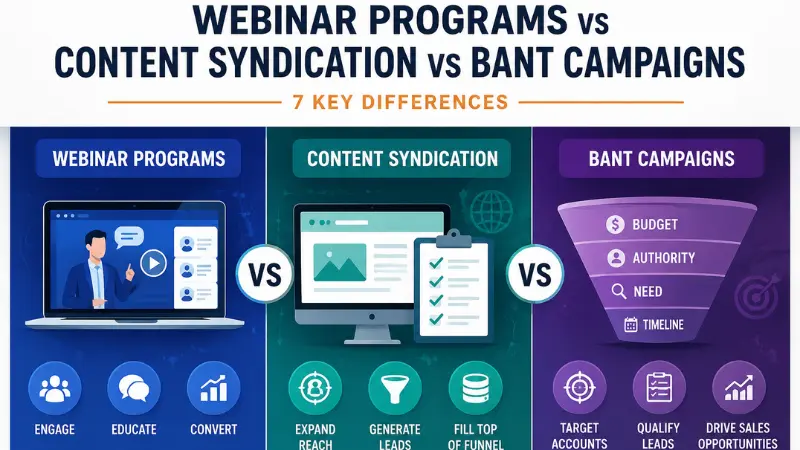
Compare webinar programs, content syndication, and BANT campaigns 7 key differences to improve lead generation and demand generation strategy


Generate More B2B Leads With Webinars
Get proven strategies, templates, and tactics to generate qualified B2B leads through high-converting webinars.
B2B marketers love a good lead generation channel.
Give us a form, a landing page, and a dashboard, and suddenly everyone is talking about the pipeline as if it is a magic spell that can solve every revenue problem.
The challenge is that not all lead generation tactics are designed to do the same job.
Webinar programs, content syndication, and BANT campaigns are often discussed in the same conversations because they all contribute to demand generation. But they serve very different purposes, attract buyers at different stages, and create completely different signals for marketing and sales teams.
Treating them as interchangeable is one of the fastest ways to create unrealistic expectations and misleading performance metrics.
Think of them this way:
Each has a role. The best demand generation programs know when to use each one and how to connect them together.
Generate More B2B Leads With Webinars
Get proven strategies, templates, and tactics to generate qualified B2B leads through high-converting webinars.
Webinar programs are designed to educate buyers, generate engagement, and create first-party intent signals. Content syndication helps marketers scale reach and generate leads from new audiences. BANT campaigns focus on qualifying prospects based on budget, authority, need, and timeline. The right approach depends on your campaign goals, buyer intent, lead quality requirements, and pipeline objectives.
| Category | Webinar Programs | Content Syndication | BANT Campaigns |
| Primary Goal | Education and engagement | Reach and lead generation | Qualification |
| Buyer Intent | Medium to high | Early to mid-stage | High |
| Lead Quality | Based on engagement | Based on targeting | Based on qualification |
| Sales Readiness | Varies depending on goals | Usually requires nurture | Often sales-ready |
| Scalability | Moderate | High | Moderate |
| Best For | Building trust | Expanding audience | Prioritizing opportunities |
| Key Metric | Engagement | Lead volume and quality | SQL creation |
| Data Ownership | First-party behavioral data | Often third-party sourced leads | Qualification data |
| Speed to Pipeline | Medium | Fast lead volume | Fastest qualification |
| Best Funnel Stage | Mid-funnel | Top-funnel | Bottom-funnel |
The biggest mistake marketers make is expecting webinars, content syndication, and BANT campaigns to deliver the same outcome.
They are built for different jobs.
Webinar programs: Buyers attend because they want to learn something, hear expert perspectives, understand a market trend, or evaluate possible solutions. The value comes from interaction and attention.
Content syndication: The goal is to place valuable content in front of audiences who may never discover it through your owned channels alone. If your objective is expanding awareness and generating a predictable flow of leads, content syndication can help accelerate that process.
BANT campaigns: Their purpose is qualification. They help determine whether a lead has a genuine business need, the ability to influence a decision, a realistic timeline, and the organizational support needed to move forward.
In simple terms:
Understanding that distinction makes it much easier to choose the right tactic and set realistic expectations.
One of the most common mistakes in demand generation is treating every lead as if it has the same level of intent.
It does not.
A webinar registration tells you someone is interested in a topic. A live attendee demonstrates a stronger level of commitment because they invested time to participate. Someone who stays through most of the session, responds to polls, asks questions, and engages with follow-up content is sending even stronger signals.
The difference between a registration and an engaged attendee is significant.
Content syndication typically produces a different type of intent signal. A prospect may download a report because the topic is relevant, because they are researching a challenge, or because they want industry benchmarks. That does not automatically mean they are ready to buy.
Many content syndication leads are still gathering information and exploring options.
BANT campaigns operate much closer to buying readiness. By the time qualification conversations happen, the focus shifts from interest to action. The conversation becomes less about curiosity and more about business priorities, timelines, stakeholders, and decision-making processes.
The key takeaway is simple: intent exists on a spectrum. The strongest demand generation programs recognize the difference between interest, engagement, and qualification.
Lead quality is one of the most debated topics in B2B marketing.
Sales teams often want fewer leads with higher intent. Marketing teams often need scalable programs that generate enough volume to support pipeline goals.
The reality is that quality cannot be measured by volume alone.
For webinar programs, engagement is often the strongest indicator of quality. Two contacts may complete the same registration form, but their value can be dramatically different depending on how they interact with the event.
A useful framework is the Webinar Signal Ladder:
The higher someone moves on the ladder, the stronger the buying signal becomes.
Content syndication quality depends heavily on targeting, publisher quality, audience fit, and data accuracy. A highly targeted campaign reaching the right audience can generate meaningful opportunities. Poor targeting can generate large volumes of contacts with little pipeline impact.
BANT campaigns generally generate fewer leads, but they often arrive with more context and stronger qualification signals. Because qualification is built into the process, sales teams usually spend less time sorting through low-priority contacts.
Lead quality is not about quantity versus quality. It is about understanding what type of signal each channel is designed to produce.
A lead is not sales-ready simply because it filled out a form. That assumption creates friction between marketing and sales in organizations of every size.
Webinar leads illustrate this perfectly.
Someone who registered but never attended may not be ready for sales outreach. Someone who attended for five minutes may need additional nurturing. On the other hand, a participant who stayed through the session, engaged with polls, asked a question, and clicked a demo link is signaling a much stronger level of intent.
Content syndication leads often require additional nurturing before sales involvement makes sense. Their actions indicate interest, but not necessarily buying readiness.
That does not make these leads less valuable. It simply means they belong in a different stage of the buyer journey.
BANT campaigns sit much closer to sales readiness because qualification is the goal. By the time a prospect meets qualification criteria, sales teams have a clearer understanding of needs, priorities, timelines, and stakeholders.
The best organizations align outreach intensity with demonstrated intent. Not every lead deserves immediate sales engagement. But high-intent signals should never wait weeks for follow-up.
Every marketing team eventually faces the same challenge:
How do we generate more pipeline without increasing costs at the same rate?
This is where scalability becomes important.
Content syndication is often the easiest channel to scale because it operates through established distribution networks and predictable cost-per-lead models. Marketers can expand reach relatively quickly without building a new audience from scratch.
Webinar programs require more coordination. Speakers need to be secured. Content needs to be developed. Promotion needs to happen before the event. Follow-up processes need to be executed afterward. The investment is greater, but so is the depth of engagement.
BANT campaigns typically involve additional qualification effort. Whether that qualification happens through SDR conversations, surveys, or structured assessments, more effort is required to validate buyer readiness.
The important question is not which tactic is cheapest. The better question is: Which tactic creates the right next step at the right cost?
Capturing a lead is only the beginning. The real challenge is moving those leads closer to a buying decision. Each campaign type requires a different nurturing approach.
Webinar follow-up should be behavior-based.
A registrant who never attended should not receive the same follow-up as someone who actively participated throughout the event.
A simple segmentation model looks like this:

Content syndication nurture should be progressive.
Start with the topic the prospect originally engaged with. Then gradually introduce related pain points, industry insights, buying considerations, customer stories, and conversion-focused offers.
The objective is to transform research activity into meaningful engagement over time.
BANT campaigns require speed.
Once qualification criteria are confirmed, delays reduce momentum. Sales teams should receive clear context about the prospect’s needs, timeline, role, and engagement history so conversations can continue without unnecessary friction.
Effective nurturing is not about sending more emails. It is about delivering the right next interaction.
One of the fastest ways to create confusion is measuring every campaign using the same metrics. Different channels serve different purposes, so they should be evaluated differently.
Webinar programs are excellent at generating engagement signals and influencing opportunities. They help educate buyers, accelerate trust, and provide valuable first-party behavioral data.
Content syndication excels at audience expansion and demand creation. Its value often comes from introducing new prospects into the funnel.
BANT campaigns are designed to strengthen qualification and improve sales efficiency. They often have a more direct connection to sales-accepted pipeline and opportunity creation.
A useful rule is to measure each channel according to its job.
The goal is not collecting more leads. The goal is generating more meaningful opportunities.
The answer depends entirely on your objective.
If your priority is reaching new audiences and generating awareness, content syndication is usually the strongest option.
Your goal is education, trust-building, and gathering first-party engagement signals, webinar programs are often the better fit.
If your sales team needs help prioritizing opportunities and identifying serious buyers, BANT campaigns provide valuable qualification.
Most high-performing demand generation teams do not choose one approach over the others. They combine all three:
Content syndication expands reach.
Webinars deepen engagement.
BANT validates readiness.
Together, they create a more complete demand generation engine.
Imagine a cybersecurity company targeting mid-market IT leaders.
The company syndicates a cloud security report through industry publishers to generate awareness and attract new prospects.
The most engaged contacts are invited to a live executive webinar focused on emerging security threats and response strategies.
During the webinar, attendees participate in polls, ask questions, and engage with supporting resources. Their activity is scored to identify stronger buying signals.
The highest-intent accounts are then moved into a BANT qualification process to determine organizational priorities, timelines, and decision-making structure.
Sales receives qualified opportunities with full context rather than isolated form submissions.
The result is a connected buyer journey that moves from awareness to engagement to qualification.
Webinar programs, content syndication, and BANT campaigns are not competing tactics.
They are different stages of the same demand generation process.
Content syndication creates reach.
Webinar programs create engagement.
BANT campaigns create qualification.
The strongest marketing teams understand the role each one plays and connect them into a coordinated system rather than treating them as isolated campaigns.
Because success is not measured by how many leads you collect. It is measured by how many buying conversations you create.
Are webinars better than content syndication for B2B lead generation?
Webinars are better for engagement, education, and behavioral intent signals. Content syndication is better for scalable lead generation and reaching new audiences. The better option depends on whether your goal is depth or volume.
Are content syndication leads sales-ready?
Usually, no. Most content syndication leads are research-stage or mid-funnel leads. They should typically enter nurture first, then move to sales when they show stronger engagement or qualification signals.
Is BANT still relevant in modern B2B marketing?
Yes, but only when used flexibly. BANT is still useful for understanding budget, authority, need, and timeline, but modern B2B buying involves committees, digital research, and non-linear decision journeys. Use BANT as a guide, not a rigid script.
Which campaign type has the lowest cost per lead?
Content syndication often provides the most predictable CPL because it is commonly purchased on a lead delivery model. However, the lowest CPL does not always mean the best pipeline impact. Measure downstream conversion, not just acquisition cost.
Which campaign type creates the highest-quality leads?
BANT campaigns typically produce the most sales-ready leads because they include qualification. Webinar programs can also create high-quality leads when marketers score live attendance, Q&A, and engagement. Content syndication quality depends heavily on targeting and data standards.
Can webinar programs, content syndication, and BANT campaigns work together?
Yes. In fact, they often work best together. Use content syndication to generate reach, webinars to create engagement, and BANT campaigns to identify which engaged prospects are ready for sales.
What metrics should B2B marketers track for these campaigns?
Track CPL, lead-to-MQL conversion, MQL-to-SQL conversion, sales acceptance rate, opportunity creation, pipeline sourced, pipeline influenced, and closed-won revenue. For webinars, also track attendance duration, poll engagement, and Q&A activity.
Generate More B2B Leads With Webinars
Get proven strategies, templates, and tactics to generate qualified B2B leads through high-converting webinars.