Generate More B2B Leads With Webinars
Get proven strategies, templates, and tactics to generate qualified B2B leads through high-converting webinars.
 Lead-Gen now on Auto-Pilot with
Build My Campaign
Lead-Gen now on Auto-Pilot with
Build My Campaign

Learn how on-demand webinars drive pipeline growth by turning webinar content into powerful syndication assets for lead generation.

Generate More B2B Leads With Webinars
Get proven strategies, templates, and tactics to generate qualified B2B leads through high-converting webinars.
An author spends a year writing a book. The launch event is a success. Readers attend the book launch, reviews are positive, and the excitement is at its zenith.
But then the book never reaches bookstores. It isn’t stocked in libraries, listed by online retailers, or recommended to new readers.
The book may be excellent, but without the right distribution, very few people will ever read it.
Many webinar programs follow the same pattern. Teams invest significant time and budget creating valuable content, celebrate the live audience, and then leave the recording sitting on a replay page.
The webinar isn’t where the story ends. In many ways, it’s where the opportunity begins.
The recording, the transcript, audience questions, and engagement data can continue educating buyers and influencing decisions long after the live event is over. The webinar is the content asset. Distribution is what determines how much value it ultimately creates.
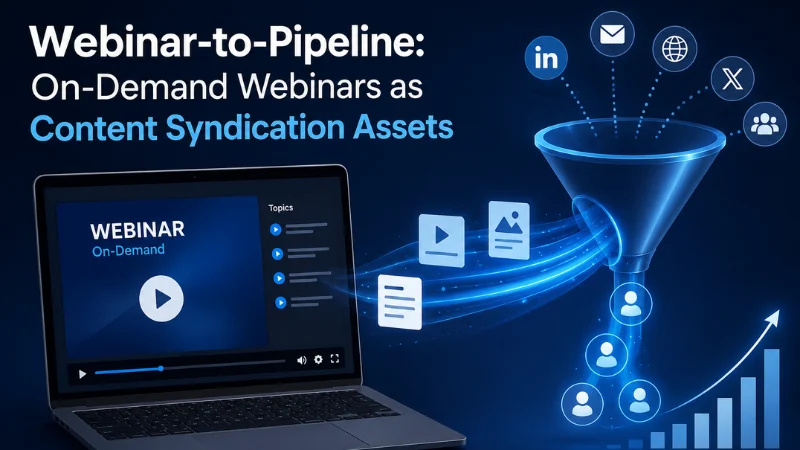
On-demand webinars as content syndication assets are recorded sessions that are actively distributed across owned, partner, and search-visible channels to educate buying groups, capture intent signals, and influence pipeline.
Generate More B2B Leads With Webinars
Get proven strategies, templates, and tactics to generate qualified B2B leads through high-converting webinars.
Unlike passive replay pages, they are treated as always-on distribution engines: repurposed into clips, transcripts, blog recaps, and email nurture, and measured at the account level for commercial impact.
Understanding this definition requires drawing a clear line between three concepts that teams often conflate:
| Channel | Primary Goal |
| Partner newsletters | Reach new audiences |
| Publisher networks | Demand generation |
| SDR sequences | Account engagement |
| AI-search-visible landing pages | Organic discovery |
| ABM platforms | Target-account penetration |
Registration count is a proxy metric. It tells you how many people were interested enough to fill out a form. It tells you almost nothing about whether any of those people are in active buying cycles or whether the webinar content moved anyone closer to a decision.
Attendance rate adds marginal context. But attending a live session and converting into a qualified pipeline opportunity are separated by a chain of behaviors, follow-up sequences, CRM routing decisions, and sales conversations that a raw attendance figure cannot capture.
The deeper problem is structural. When webinar ROI is measured at the Top Of The Funnel (TOFU) in terms of impressions, registrations, attendance, teams optimize for activities that produce those numbers, not activities that produce revenue. They invest in promotion that inflates registrations rather than targeting that increases account penetration.
Research found that marketing and sales teams collaborate on only three out of 15 commercial activities, which means webinar engagement data often fails to flow into the sales process at all. Organizations that do share buyer journey insights across functions are measurably more likely to improve conversion and revenue outcomes.
Turning a single live session into an always-on content syndication asset requires a repeatable process. The framework is simple:
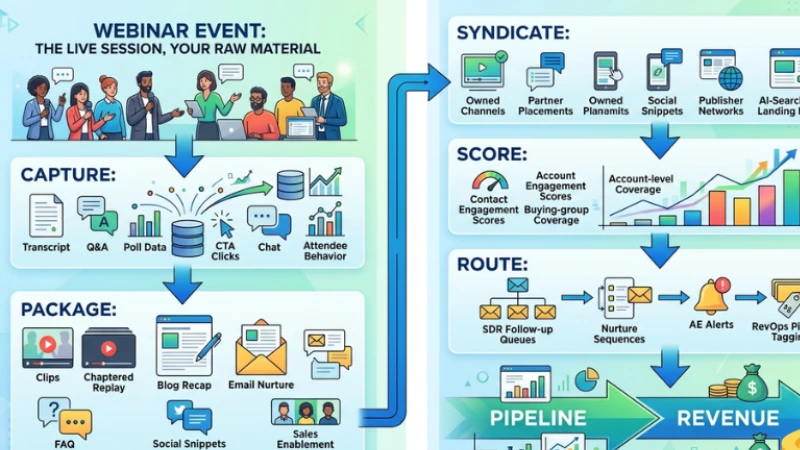
Start by collecting everything the webinar produces: the recording, transcript, poll responses, Q&A, CTA clicks, and engagement data. These assets become the foundation for future distribution and measurement.
Convert the webinar into multiple content formats. The transcript can become a blog recap, key insights can become short clips, and the replay can be optimized with chapters and summaries for easier consumption. High-performing teams treat packaging as a workflow, not an afterthought.
Publishing the replay on your website is only the starting point. Distribute webinar content through email, partner newsletters, publisher networks, SDR outreach, and ABM programs to reach buyers where they are already researching solutions.
Track engagement at both the contact and account level. A single replay view is useful, but multiple stakeholders from the same account engaging with webinar content is a far stronger buying signal.
Turn engagement into action. High-intent accounts should trigger personalized SDR follow-up, while mid-intent engagement can enter nurture programs. Routing webinar signals into the CRM ensures pipeline influence can be measured accurately.
Measurement is where most webinar programs fall short. The fix is not more metrics, it is the right metrics at the right level of the funnel.

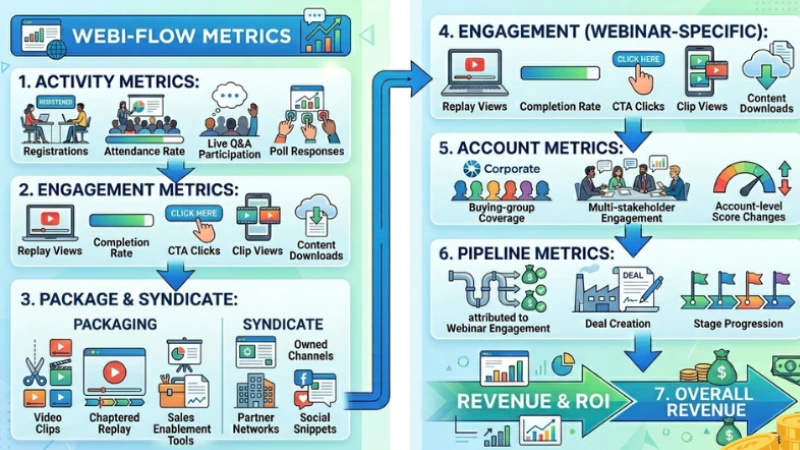
Webinar-to-pipeline measurement works across five levels: activity metrics (registrations, attendance), engagement metrics (replay views, completion, CTA clicks), account metrics (buying-group coverage, account-level score changes), pipeline metrics (opportunities influenced, deal progression), and revenue metrics (closed-won revenue attributed to webinar-engaged contacts). Connecting these levels requires CRM integration, marketing event tracking, and campaign attribution reporting.
The most important shift is from lead-level to account-level analysis. A webinar that generated 12 registrations from three target accounts, resulting in two discovery calls and one active opportunity, is more valuable than a webinar with 400 registrations from 390 different companies and no pipeline movement. Account penetration and engagement depth are the metrics that actually correlate with revenue outcomes.
The gating debate is one of the most consistently mishandled conversations in B2B demand generation. The answer is almost never binary.
Gate when your primary goal is lead qualification or when the content is designed to capture net-new contact data. Gating is also reasonable when the webinar covers proprietary research or positions your organization as an exclusive source of insight. The tradeoff is reduced distribution reach and limited AI/search discoverability.
Make the first chapter or a curated clip available openly, then gate the full recording. This approach balances discoverability with lead capture, allows buying-group members who were not on the original registration list to sample the content, and tends to improve the quality of gated form completions because viewers have already self-selected based on content relevance.
Ungate when your goal is buying-group coverage, broad account engagement, or AI and search visibility. An ungated replay with a clean transcript and clear chapter structure can rank for relevant queries, surface in AI Overviews, and be shared internally within a buying organization without requiring every stakeholder to submit their email address.
The decision framework is straightforward: gate when you need qualification signals, ungate when you need reach, and partially gate when you need both.
The strongest B2B webinar programs in 2026 are not the ones with the best live attendance. They are the ones that have rethought what a webinar actually is.
A webinar is not an event. It is a content production session that yields a recording, a transcript, a set of behavioral signals, and a repository of buyer questions. In the end all of which can be packaged, distributed, scored, and measured for commercial impact over weeks and months. The live session is the raw material. The distribution lifecycle is where the pipeline is actually influenced.
This shift in mindset changes how teams plan webinars, how they measure them, and how they connect the post-event workflow to the revenue process. It also changes what counts as a successful outcome: not “how many people registered” but “how many qualified buying groups engaged, and what moved forward as a result.”
The Capture → Package → Syndicate → Score → Route framework gives teams a repeatable way to operationalize that shift. The measurement model above gives teams the vocabulary to explain it to leadership and to prove it in attribution reporting.
The opportunity is clear, the benchmark data supports it, and the competitive gap is real. Most teams are still treating webinar recordings like leftovers. The ones that don’t are building an on demand engine that compounds in value every time a new buying group discovers the content.
They serve different purposes. Live webinars excel at real-time engagement, Q&A interaction, and capturing immediate intent signals from a captive audience. On-demand webinars are better for long-tail discovery, buying-group education across multiple stakeholders, AI and search discoverability, and syndication into third-party channels. The strongest programs use both: a live session to create the asset and generate initial engagement, followed by a structured on-demand distribution strategy to extend reach and compound value.
It depends on your goal. Gate for qualification: when you need net-new lead capture or form-fill data, a gate makes sense. Ungate for reach: when your goal is buying-group coverage, AI discoverability, or account-level engagement across contacts who weren’t on the original registration list, ungating typically produces more pipeline influence. A partially gated approach like open clip or first chapter, gated full replay often balances both objectives effectively.
On-demand webinars generate multiple syndication-ready assets from a single production session: the recording itself, a transcript, short clips, a blog recap, Q&A-derived FAQ content, and email nurture materials. These assets can be distributed across owned channels, partner networks, publisher placements, and ABM-targeted platforms. Because webinar consumption correlates with stronger mid-funnel purchase intent than many other content formats, webinar-derived assets are particularly effective as evaluation-stage syndication content.
Measure webinar ROI across five levels: activity (registrations, attendance), engagement (replay completion, CTA clicks, clip views), account (buying-group coverage, multi-stakeholder engagement, account-level score changes), pipeline (influenced opportunities, deal stage progression), and revenue (closed-won attribution for webinar-engaged contacts). The most commercially meaningful measurement happens at the account and pipeline levels, not the activity level.
High-value signals include full replay completion (indicating substantive evaluation behavior), multiple content interactions from the same contact (suggesting active research), engagement from multiple contacts at the same account (indicating buying-group activity), CTA clicks during or after the webinar (signaling decision-stage intent), and replay views within 30 days of the live session (often the highest-intent on-demand window). Account-level signal aggregation where you sum engagement across all known contacts at a target account is more reliable for pipeline prioritization than any single contact-level action.
Yes, and they are particularly well-suited to ABM. On-demand webinars can be syndicated through ABM platforms to reach specific target accounts, distributed internally within an account by a single engaged contact, used by SDRs as contextual follow-up assets for named accounts, and measured at the account level to track buying-group coverage. The combination of high completion rates, strong mid-funnel intent signals, and multi-format repurposing potential makes on-demand webinars one of the more effective content types for account-based pipeline programs.
Generate More B2B Leads With Webinars
Get proven strategies, templates, and tactics to generate qualified B2B leads through high-converting webinars.