Webinar Lead Conversion Optimization Playbook
Convert webinar attendees into sales pipeline opportunities faster
 Lead-Gen now on Auto-Pilot with
Build My Campaign
Lead-Gen now on Auto-Pilot with
Build My Campaign

Your webinar generated interest. Your nurture flow determines revenue. Learn how email nurture flows for webinar leads turn engagement into qualified pipeline.

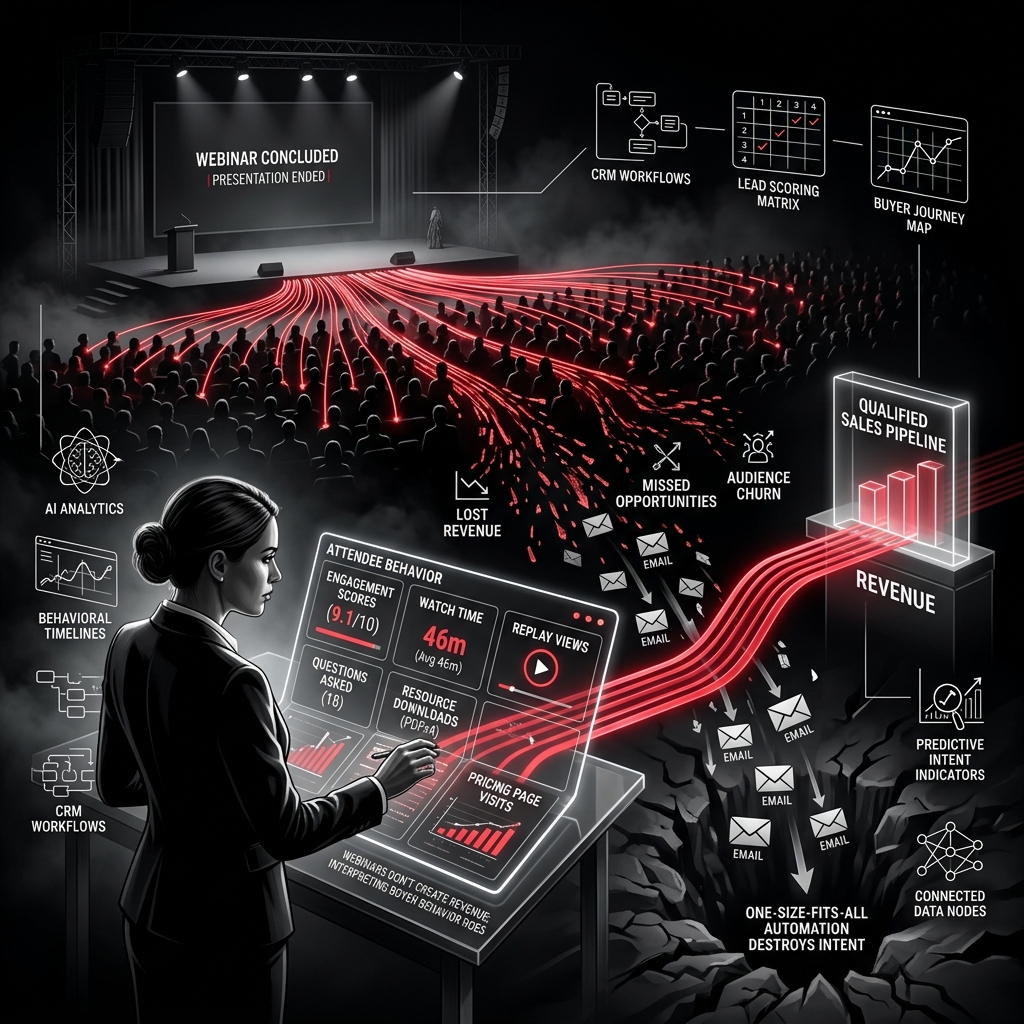
Webinar Lead Conversion Optimization Playbook
Convert webinar attendees into sales pipeline opportunities faster
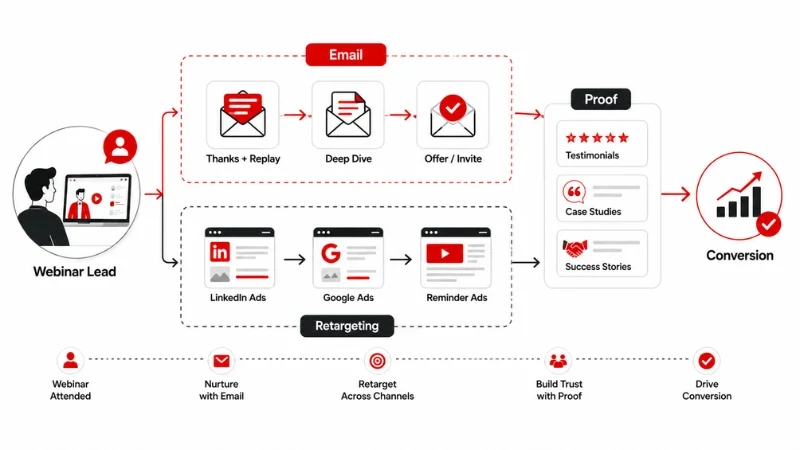
You just ended your webinar.
247 people registered. 132 attended. 115 never showed up.
Most teams think the problem is attendance. It is not.
The real problem begins after the webinar ends.
This is where many webinar campaigns quietly lose pipeline. A replay email goes out. Everyone gets added to the same nurture list. Sales receives a few names with almost no context. Then, two weeks later, the team wonders why the webinar created engagement but not revenue.
The issue is not the webinar. The issue is what happens to the signals the webinar created.
A webinar does not create pipeline by itself. It creates behavioral evidence. Pipeline comes from the system that interprets that evidence and acts before intent fades.
Webinar Lead Conversion Optimization Playbook
Convert webinar attendees into sales pipeline opportunities faster
That is the real job of webinar nurture. Not sending emails. Preserving intent.
Most webinar follow-up is built around content delivery.
Send the replay.
Send the slides.
Send a case study.
Ask for a demo.
That sequence is not wrong, but it is incomplete.
It assumes every lead is in roughly the same place. Attendees, no-shows, replay viewers, late joiners, question askers, resource clickers, and pricing-page visitors all get treated as if their behavior means the same thing.
It does not.
A person who watched 50 minutes and asked an implementation question is in a different mental state altogether from someone who registered and missed the session. A no-show who later watches the full replay may be more engaged than a live attendee who left after seven minutes.
Attendance matters, but attendance is not a qualification.
The more useful question is not, “Did they attend?”
The better question is, “What does their behavior suggest they are trying to understand, solve, or decide?”
That is where webinar nurture becomes more strategic.
Interest can last for weeks.
Buying intent often disappears in days.
Someone may still care about the topic later, but the urgency they felt when they registered is fragile. Another meeting happens. A competing project takes over. A budget conversation gets delayed. The problem remains, but the moment fades.
That is why timing matters so much after a webinar.
ON24’s webinar benchmark data shows that webinar attendees stayed engaged for an average of 51 minutes, while on-demand viewing accounted for 50% of all webinar attendees. That means the strongest signals may happen live, after the event, or across both moments. The nurture system needs to catch those signals while they are still fresh.
The replay email is not the strategy. It’s a bare minimum. It is the first chance to stop intent from cooling.
Most lead sources tell you who someone is. A webinar tells you what someone did.
They chose a topic, invested their time, and revealed whether they stayed engaged, asked questions, clicked resources, watched the replay, or returned later. Every action becomes another piece of behavioral evidence.
This makes webinar leads different from passive content downloads. The same principle applies to content syndication nurture, where behavioral signals transform downloaded leads into meaningful buying conversations instead of just another email list.
An ebook download may show interest in a topic. A webinar can reveal intensity, urgency, the buyer’s role in the decision-making process, potential objections, and readiness to continue the conversation.
That is why webinar nurture should not simply move people through a fixed email sequence. It should interpret behavior by following a pipeline that moves from Behavior → Interpretation → Confidence → Conversation → Pipeline.

This is the mental model most teams miss. They think the nurture flow is there to send more content. It is really there to understand what the buyer is telling you.
Understanding buyer intent is only half the job.
The other half is acting on it.
This is where many webinar programs break down. Teams collect valuable behavioral signals but then push every registrant into the same generic sequence. The result is a nurture flow that treats very different buyers as if they are at the same stage.

A stronger approach starts with one simple distinction:
Attendees and no-shows should not receive the same follow-up.
An attendee has already experienced your idea. They need continuation.
A no-show expressed interest but never consumed the content. They need recovery.
Both groups matter. They simply require different nurture paths.
Attendees are warm, but warm does not mean sales-ready.
The objective is to move them from attention to understanding, from understanding to confidence, and from confidence to action.
Email 1: The Instant Replay (Within 2 Hours)
The first email should preserve momentum while the webinar is still fresh.
Share the replay, slides, and any promised resources along with a short recap of the key ideas. The goal is not to push for a demo immediately. The goal is to reinforce that their time was well spent.
A soft CTA works best here, such as:
Email 2: The Deep Dive (Day 2)
Instead of repeating the webinar, expand one important idea.
Take a framework, insight, or challenge discussed during the session and explain it in greater depth through a practical example or short analysis.
This teaches the buyer something new while proving that your follow-up emails are worth opening.
Possible CTAs include:
Email 3: Build Confidence Through Proof (Day 4)
At this stage, buyers rarely need more information.
They need confidence.
Share a customer story, case study, benchmark, or before-and-after example that demonstrates how the approach works in a real business environment.
Proof reduces uncertainty far better than another sales pitch.
Possible CTAs:
Email 4: Remove Buying Friction (Day 6)
Every buyer has unanswered questions.
Address the most common objections with FAQs, examples, or expert guidance. The objective is not pressure. It is reassurance.
Possible CTAs:
Email 5: Present the Next Best Action (Day 8 or 9)
By now, the lead has received education, proof, and reassurance.
This is the appropriate moment for a stronger conversion action such as:
Urgency should only be used when it is genuine. Artificial scarcity weakens credibility.
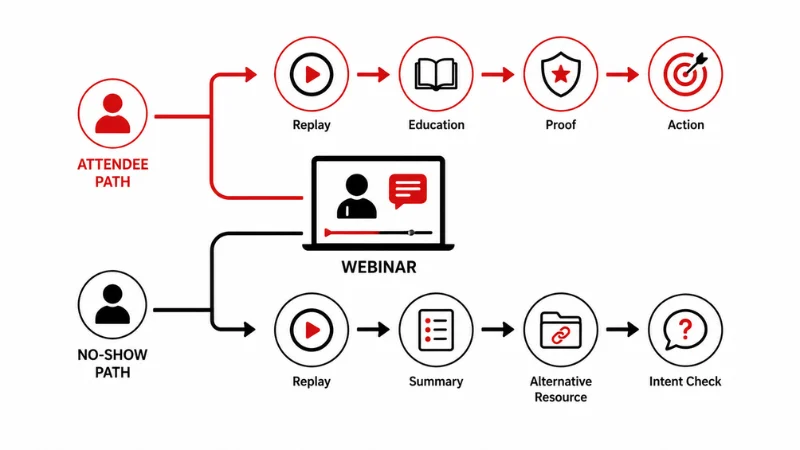
No-shows are not dead leads. They are interrupted leads.
They cared enough to register, but something prevented them from attending. The objective is not to remind them what they missed. It is to help them recover the value they expected when they signed up.
If you’re building a broader system to warm cold contacts back to active pipeline, the playbook on how to nurture and reactivate B2B leads is a strong companion read.
Email 1: Replay Recovery (Within 4 Hours)
Send the replay as quickly as possible along with a brief summary of the session.
Keep the message simple and easy to act on.
Primary CTA:
Email 2: The 3-Minute Version (Day 2)
Many people will never watch a full recording.
Respect their time by summarizing the key takeaways in a few bullet points while linking back to the complete webinar for those who want more detail.
Possible CTAs:
Email 3: Offer an Alternative Format (Day 4)
Different buyers consume information differently.
Instead of relying only on the webinar recording, offer another format such as:
The goal is to remove friction, not create more work for the buyer.
Email 4: The Intent Check (Day 7)
The final follow-up should not rely on fake urgency.
Instead, simply ask whether the topic is still a priority and provide one last opportunity to engage.
If the lead remains inactive after multiple attempts, move them into a broader re-engagement program rather than continuing the webinar sequence.
Once you accept that webinar nurture is about interpreting behavior, the structure becomes clearer.
Use the SIGNAL Framework:
S – Separate audiences
I – Interpret engagement
G – Give value before selling
N – Nurture according to intent
A – Accelerate high-intent buyers
L – Loop learning back into revenue
This is not a naming trick. It is a way to prevent webinar follow-up from becoming generic automation.
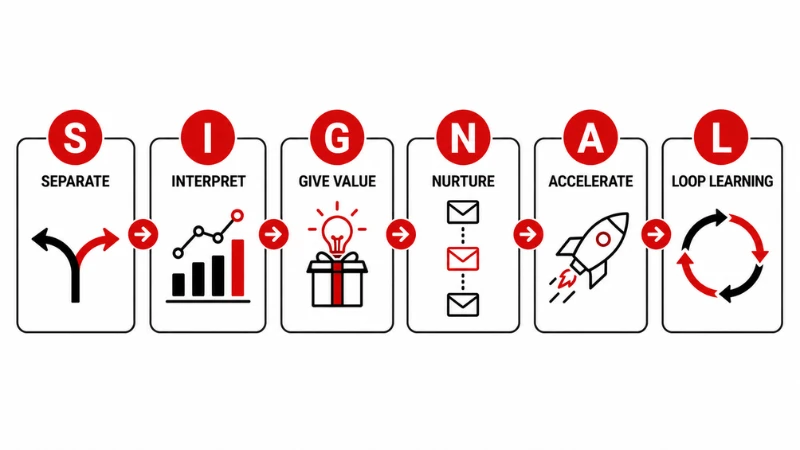
Each part of the framework answers one question:
That is the difference between email follow-up and intent management.
The first split is attendees and no-shows.
But the reason matters.
An attendee has already experienced your idea. A no-show has only expressed interest in it. If they receive the same sequence, the attendee may get follow-up that feels too basic, while the no-show may get sales pressure before they have consumed the core message.
Attendees need continuation. No-shows need recovery.
That is the simplest way to think about it.
For attendees, the nurture should build from what they already heard. For no-shows, the nurture should help them access the value they intended to get when they registered.
No-shows are not failed leads. They are interrupted leads.

That difference changes the tone of every email.
Segmentation is useful, but segmentation is not the same as understanding.
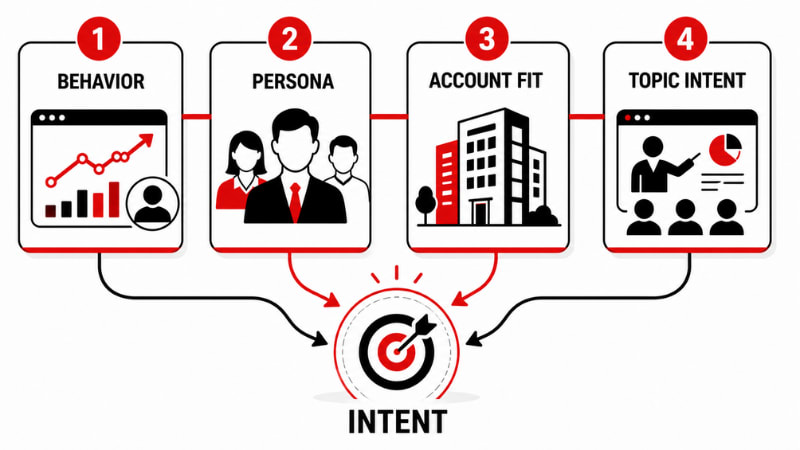
A strong webinar nurture program looks at four layers together.
High engagement can signal urgency, but only when interpreted correctly. A lead who stays for most of the webinar, asks a question, downloads a case study, and visits a pricing page is showing a different level of intent than someone who only clicked the replay link.
The point is not to assign random points to every action.
The point is to understand what the pattern means.
Different people attend the same webinar for different reasons.
A practitioner may want workflow details. A manager may want performance improvement. An executive may want risk reduction, ROI, and strategic fit. A champion may need assets they can forward internally.
The webinar attendee is often not the final buyer.
They may become the internal translator, the person who shares the replay, summarizes the idea, and brings the problem into the buying committee. Good nurture equips that person with content that can travel.
That means slides, short summaries, business cases, comparison guides, and proof points matter.
Not because they fill the sequence. Because they help the idea move inside the account.
For a deeper look at how to build sequences that speak to each stakeholder’s role, the guide on personalizing nurture emails by buying committee walks through exactly this.
High engagement can be misleading.
A perfect-fit account with moderate engagement may deserve faster action than a poor-fit account with high engagement because pipeline value depends on both intent and fit.
This is where CRM context matters. Company size, industry, revenue potential, geography, and ICP match should influence how aggressively the lead is routed.
The best webinar nurture systems do not treat engagement and fit as separate decisions.
They combine them.
The topic itself tells you something.
A broad educational webinar may signal early research. A comparison webinar may signal vendor evaluation. A webinar on implementation, pricing, ROI, or migration may suggest a buyer is closer to decision.
The follow-up should match the implied stage.
Do not rush early-stage leads into sales. Do not trap late-stage buyers in basic education.
The attendee journey should not feel like a five-email campaign.
It should feel like a natural progression in the buyer’s mind, moving from Attention → Meaning → Belief → Confidence → Action.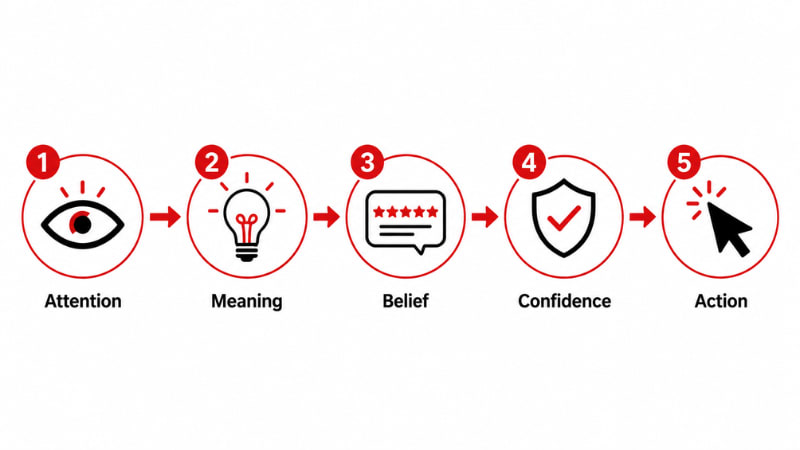
First, keep the moment alive. Send the replay, resources, and a clear recap while the session is still fresh.
Then give the webinar meaning. Expand one strong idea instead of repeating the full session. Help the reader understand why the topic matters and what they should think differently about.
After that, build belief. This is where proof belongs. Buyers rarely stall because they lack another explanation. They stall because they are not confident the idea will work in their world.
A customer story, use case, benchmark, or before-and-after example helps reduce that uncertainty.
Only then should the flow move toward risk reduction and action. Answer the questions that slow buyers down: implementation, cost, time, internal buy-in, integrations, adoption, and expected impact.
The CTA should feel earned.
A demo request on email one can feel premature. A demo request after relevance, proof, and confidence feels like a logical next step.
This is also why webinars remain valuable in B2B content strategy. Content Marketing Institute’s 2025 B2B research found that marketers rated webinars as one of the most effective distribution channels at 51%, just behind in-person events at 52% and ahead of email at 42%. The channel works because it creates deeper engagement. The follow-up has to respect that depth.

No-shows need a different path because they never experienced the main idea.
The wrong approach is guilt.
“We missed you” is fine.
“You missed out” is not.
The no-show sequence should be built around value recovery.
Give them the replay quickly. Then give them the short version. Then offer an alternative format for people who will never watch a full recording.
A useful no-show flow might look like this: Replay→3-minute summary→Alternative resource→Intent check
The final email should not sound like a fake last chance unless the replay is genuinely expiring. A better angle is simple:
“Is this still a priority?”
That question respects the buyer’s reality. They may still care. They may not be ready. They may need a shorter asset. They may need to forward the idea to someone else.
The role of nurture is to find out.
For a broader playbook on how to reactivate cold B2B leads who go dark after initial engagement, that guide extends this logic well beyond the webinar window.
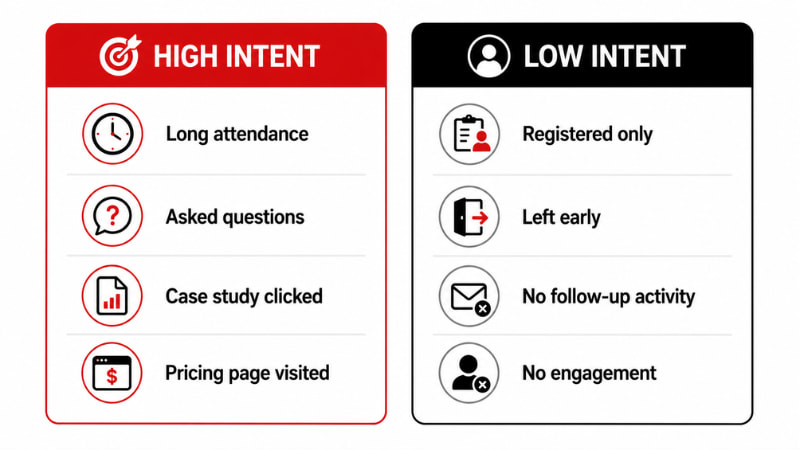
Not every webinar lead should complete the full nurture flow.
Some should move faster.
But acceleration should happen only when behavior and fit overlap.
A high-fit account that attends the full session, clicks a case study, asks a buying-related question, or visits a pricing page should not wait through a generic sequence. That lead has already told you something.
Sales should act while the context is still recent.
But the handoff matters.
A weak handoff says:
“Here is a webinar lead.”
A strong handoff says:
“This person attended the webinar on lead conversion, stayed 47 minutes, asked about CRM handoff, clicked the case study, and visited the pricing page the next morning.”
Those are different conversations.
Modern buyers also expect more control over the process. Gartner reported in March 2026 that 67% of B2B buyers prefer a rep-free experience. That does not mean sales is irrelevant. It means sales must enter with context, not interruption.
The better the behavioral context, the less the follow-up feels like a cold pitch.
This is also where the broader MQL-to-SQL nurture framework becomes relevant. Webinar acceleration is really a faster lane of the same MQL-to-SQL journey, and having that system in place is what makes the handoff work.
Webinar nurture should not be judged by email activity alone.
Registrations are not pipeline. Attendance is not pipeline. Clicks are not pipeline.
They are signals.
The question is whether those signals move the right accounts toward revenue.
Open rates can still be useful, but they are not enough. Apple’s Mail Privacy Protection can affect open-rate accuracy, which makes it risky to treat opens as the main performance measure.
Better metrics include:
The goal is not to prove that emails were sent. The goal is to prove that intent was recognized and advanced.

Most webinar nurture does not fail because the emails are badly written.
It fails because the system is blind.
It does not know the difference between attendance and readiness. It does not know whether the attendee is a decision-maker, champion, researcher, or practitioner. It does not know whether the account fits the ICP. It does not know whether the lead came back later and viewed high-intent pages.
So the system defaults to sameness.
Sameness is the enemy of webinar nurture.
The buyer already gave you behavioral information.
The mistake is not using it.
This is also the core argument in the piece on moving leads from MQL to revenue that the gap between qualified interest and actual pipeline is almost always a system failure, not a lead quality problem.
Companies think webinars create pipelines.
They do not.
Webinars create information.
A nurture system creates understanding.
Revenue happens when your organization acts on that understanding before the buyer moves on.
That is the real purpose of email nurture flows for webinar leads. Not to send more messages. Not to force every registrant toward a demo. Not to celebrate attendance as success.
The purpose is to preserve intent while it is still alive, interpret what the behavior means, and move the right buyers toward the right next step.
A webinar captures attention.
Your nurture system decides whether that attention becomes a pipeline.
Yes, webinar attendance is a buying signal, but it is not qualification by itself. Attendance shows interest. Stronger intent appears when attendance is combined with behavior such as questions, replay views, resource clicks, pricing visits, case study downloads, or direct replies.
Sales should not automatically contact every no-show. Most no-shows should first receive the replay, a short summary, and an alternative resource. If they engage afterward or belong to a high-fit account, sales follow-up becomes more relevant.
Webinar intent is usually strongest in the first few days after the event. Interest in the topic may last longer, but urgency fades quickly. That is why the first follow-up should happen within hours, not days.
Yes. A replay viewer who watches deeply, clicks resources, and visits bottom-funnel pages may show stronger intent than a live attendee who left early and never engaged again. Live attendance is useful, but replay behavior should also influence scoring and follow-up.
Yes. Ebook nurture usually starts from passive content consumption. Webinar nurture starts from a richer behavioral event. You know the topic they selected, whether they attended, how long they engaged, and what they did afterward. That context should change the sequence.
Webinar nurture should include assets that are easy to share internally, such as slide summaries, business cases, ROI points, comparison guides, implementation notes, and customer stories. The attendee may not be the final buyer, so the content should help them carry the idea into the organization.
The best CTA depends on intent. Early follow-up can use replay, summary, or resource CTAs. Mid-stage follow-up can use case studies, guides, or comparison content. High-intent leads can receive demo, audit, assessment, or consultation CTAs.
Most flows work well with 4 to 5 emails for attendees and 3 to 4 emails for no-shows. The number matters less than the progression. Each email should help move the lead from attention to meaning, belief, confidence, or action.
The most useful metrics are replay completion, reply rate, engagement by segment, sales acceptance rate, time to SQL, lead-to-opportunity conversion, pipeline influenced, and revenue influenced. Opens and clicks are helpful indicators, but they do not prove pipeline impact.
The biggest mistake is treating webinar nurture like a standard email sequence. Webinar nurture should preserve, interpret, and act on buying intent before it fades. The emails are only the mechanism. The real strategy is understanding the signals.
Webinar Lead Conversion Optimization Playbook
Convert webinar attendees into sales pipeline opportunities faster