Generate More B2B Leads With Webinars
Get proven strategies, templates, and tactics to generate qualified B2B leads through high-converting webinars.
 Lead-Gen now on Auto-Pilot with
Build My Campaign
Lead-Gen now on Auto-Pilot with
Build My Campaign

Learn why sales teams should follow up after webinars to convert leads faster, improve engagement, and turn into qualified opportunities.

Generate More B2B Leads With Webinars
Get proven strategies, templates, and tactics to generate qualified B2B leads through high-converting webinars.
What if ChatGPT ignored every prompt users typed?
Whether someone asked a casual question or requested a detailed business proposal, the response was always identical:
“Thanks for your interest. Here’s a generic help article.” Users would leave immediately. Yet many webinar programmes operate this way.
A prospect who asks detailed implementation questions during a webinar often receives the same follow-up as a registrant who never attended. The strongest buying signals get buried under generic automation.
This is the most common way webinar follow-up fails, and it costs revenue teams more than they realise.
Most webinar follow-up advice centres on email sequences and subject-line variations. That is a reasonable starting point for low-intent leads. It is not a revenue strategy.
Several structural problems explain why the standard approach leaks pipeline:
Generate More B2B Leads With Webinars
Get proven strategies, templates, and tactics to generate qualified B2B leads through high-converting webinars.
TRACE is a five-stage operating model for turning webinar engagement into a pipeline. It replaces the ad hoc replay-and-hope approach with a repeatable, signal-driven workflow that sales, marketing, and RevOps can align on.
Each stage has a clear owner, clear inputs, and a clear handoff condition. The goal is not to automate every interaction, it is to make sure high-intent signals reach the right person fast, and lower-intent contacts receive relevant follow-up without burning rep time.
| T | TRIAGE
Score by ICP fit + engagement depth (polls, Q&A, watch %, CTA clicks) |
| ↓ | |
| R | ROUTE
Assign to SDR, AE, marketing nurture, or self-serve path based on score + account fit |
| ↓ | |
| A | ACTIVATE
Same-day outreach for high-intent accounts; personalise to their specific signal |
| ↓ | |
| C | CONTINUE
Run a short 3 to 5 touch behavior-matched sequence; retire contacts that disengage |
| ↓ | |
| E | EVALUATE
Measure follow-up rate, MQL conversion, pipeline created, buying-group expansion |
We built the operating system for webinar-to-pipeline so that next time you can maximize your MQL to SQL conversion ratio.
Segment-by-Segment Follow-Up Playbook
Not every webinar attendee deserves the same follow-up. The most effective sales teams adjust outreach based on engagement and intent.
These attendees stayed for most of the session, engaged through Q&A or polls, and clicked high-value CTAs such as demos or pricing pages.
Priority Action: Route them to an SDR the same day. Reference the specific signal that drove engagement and provide a relevant next step, such as a discovery call, case study, or product walkthrough. Personalized outreach consistently outperforms generic follow-up.
These contacts attended but showed limited engagement, with little interaction beyond viewing the session.
Recommended Next Step: Keep them in a marketing-led nurture track unless account-level activity suggests stronger intent. Send the replay, supporting content, and a low-pressure next step.
Registrants who missed the webinar showed interest but have not yet demonstrated active buying intent.
Re-Engagement Plan: Send the replay with a compelling reason to watch. If the account fits your ICP, a brief personalized note can help re-engage them.
On-demand engagement remains part of the active buying journey, especially when viewers consume significant portions of the recording.
When to Route to Sales: Score on-demand engagement the same way you score live attendance. A viewer who watches most of the recording and clicks a CTA should be routed for sales follow-up immediately.
Clear ownership prevents webinar leads from falling through the cracks. Each team should have defined responsibilities and measurable outcomes.

| Function | Primary Responsibility | Key KPI |
| SDR / BDR | Follow up with high-intent attendees, personalize outreach, and book discovery calls. | Time-to-first-contact, meeting booked rate, follow-up SLA compliance |
| Account Executive (AE) | Engage existing opportunities and strategic accounts showing webinar intent. Expand conversations across the buying group. | Opportunity progression rate, pipeline influenced, buying-group expansion |
| Marketing | Manage nurture programs for standard attendees and no-shows. Deliver replay content and update lead scoring. | Email engagement rate, MQL conversion rate, nurture-to-opportunity rate |
| RevOps | Manage routing rules, lead scoring, CRM workflows, attribution, and SLA reporting. | Routing accuracy, follow-up completion rate, webinar-attributed pipeline |
Not every engagement warrants a phone call. The following signals, individually or in combination, are strong enough to justify same-day human outreach:
Measuring webinar-to-pipeline performance requires tracking across three stages: follow-up activity, conversion behaviour, and revenue impact.
Forrester’s 2025 Buying Networks research argues that modern B2B buying involves broader decision networks, including external influencers and increasingly AI agents. Pipeline influenced at the account level, not just the contact level is therefore a more complete measure of webinar ROI than individual MQL counts.
Post-Webinar Sales Follow-Up Checklist
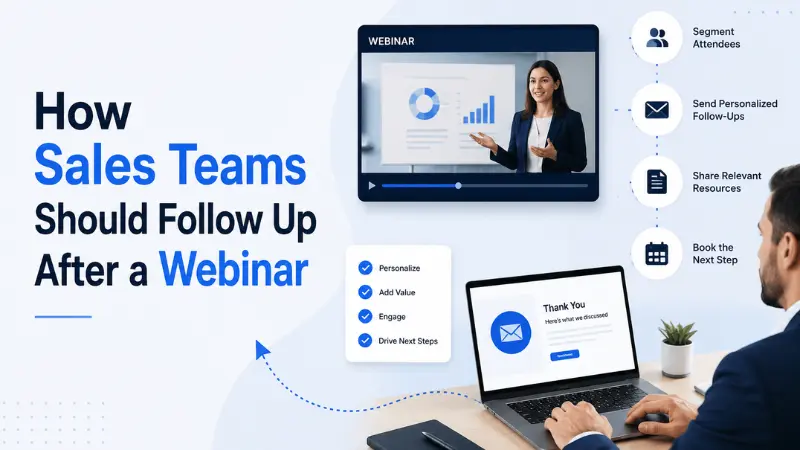
The webinar is not over when the presenter stops talking. It is over when sales either captures or wastes the intent it created. Most teams waste it not because they do not care, but because the handoff from event activity to sales action has no structure.
The TRACE framework gives revenue teams a repeatable model: triage by signal, route to the right owner, activate fast on high intent, continue with behaviour-matched sequences, and measure what actually moved the pipeline. Applied consistently, it turns a content event into a conversion machine.
The fundamentals are well-evidenced. Fast follow-up outperforms slow follow-up. Adaptive, customer-oriented, empathetic outreach outperforms generic templates. Account-level engagement matters more than individual contact scoring. And on-demand consumption is an active buying signal, not an archive.
The teams winning with webinar follow-up are not doing anything exotic. They are moving fast, matching the message to the moment, and building the infrastructure to measure what works.
What should sales teams do immediately after a webinar ends?
Within four hours, pull engagement data from the webinar platform, score and segment attendees by intent level, and route high-intent contacts to an SDR or AE for personalised outreach. Marketing can handle the replay distribution for standard attendees and no-shows in parallel.
How quickly should sales follow up after a webinar?
For high-intent contacts those who clicked CTAs, asked questions, or attended the full session sending a same-day follow-up is significantly more effective than next-day outreach.
Which webinar attendees should sales prioritise first?
Prioritise in this order: (1) contacts who clicked a demo, pricing, or trial CTA; (2) contacts who asked Q&A questions referencing specific pain points; (3) contacts who attended 75% or more of the session; (4) accounts with multiple registrants or attendees. On-demand viewers who complete the full recording are a fifth category that warrants the same urgency as live high-intent attendees.
How should sales follow up with webinar no-shows?
Do not send a generic ‘Sorry you missed it’ email. Send the replay with a short, specific reason to watch tied to their role or industry. If the account fits your ICP, a brief personalised note from an SDR referencing the registration topic is worth testing. Do not invest significant rep time here until the contact re-engages with the replay or subsequent content.
How do you measure whether webinar follow-up is generating pipeline?
Track three categories: follow-up activity (completion rate, time-to-first-contact), conversion behaviour (MQL rate, meeting booked rate), and revenue impact (pipeline created, pipeline influenced, buying-group expansion). The most important leading indicator is follow-up completion rate within SLA, if that number is low, pipeline impact will follow.
Should on-demand webinar viewers be treated differently from live attendees?
The follow-up motion should be the same; the key difference is timing. On-demand signals fire after the live event, sometimes weeks later. Route them with the same urgency as live high-intent signals when watch time and engagement depth justify it. Do not let on-demand engagement sit in a reporting dashboard; treat it as a live intent signal.
How do you prevent webinar leads from sitting unworked in the CRM?
Define explicit routing rules and SLAs before the webinar runs, not after. RevOps should set the scoring thresholds, assignment logic, and follow-up SLA as part of the webinar programme setup. Post-event, track follow-up completion rate as a lead indicator and flag overdue contacts in a daily RevOps review.
What is the biggest mistake sales teams make when following up after webinars?
Treating all attendees identically. Sending the same replay email to someone who asked three Q&A questions and someone who registered but never logged on is not a follow-up strategy, it is template noise. The teams that convert webinar engagement in to pipeline do so by segmenting on actual behaviour and matching their outreach intensity and message to the signal.
Generate More B2B Leads With Webinars
Get proven strategies, templates, and tactics to generate qualified B2B leads through high-converting webinars.