Best AI Sales Intelligence Platforms With Buyer Intent and Predictive Lead Scoring in 2026
Compare six AI sales intelligence platforms for buyer intent, predictive lead scoring, account intelligence, contact data, CRM integration, and sales prioritization.

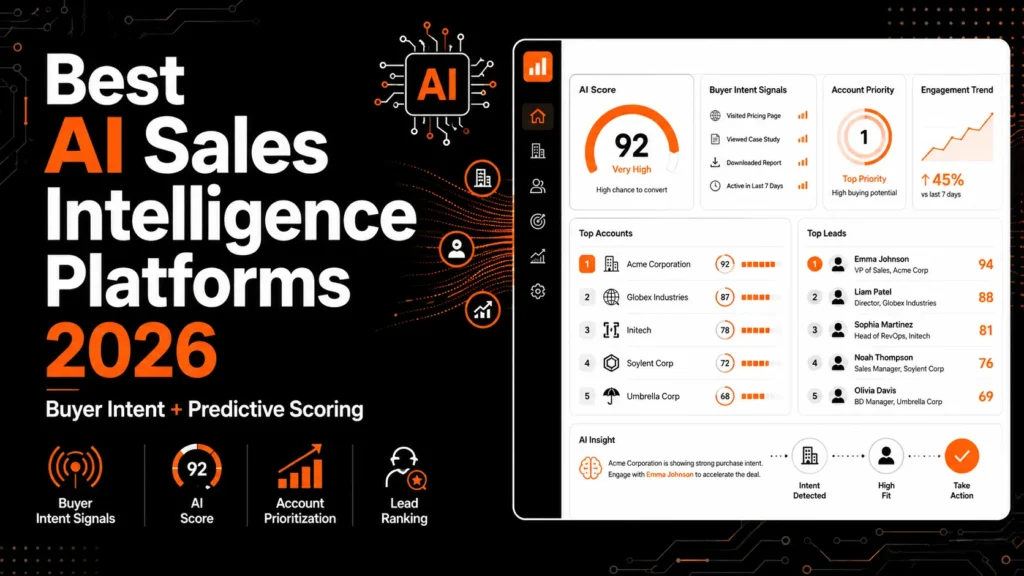
Your sales team probably doesn’t need another dashboard telling them that 387 accounts did “something interesting.”
They need to know which accounts deserve attention first.
The best AI sales intelligence platforms in 2026 include 6sense and Demandbase for predictive ABM, Apollo for AI scoring plus outbound execution, ZoomInfo for predictive account-fit scoring and data-led prioritization, Cognism for contact intelligence with intent, and VAIS for fit-plus-intent prioritization. The right choice depends on whether you need native predictive models, buyer-intent signals, contact data, or activation workflows.
Buyer intent vs predictive scoring: they are not the same thing
Buyer intent identifies behavioral signals suggesting a company may be researching a problem, category, competitor, or solution.
Predictive scoring uses models and data to estimate which leads or accounts are more likely to fit, engage, create pipeline, convert, or otherwise deserve prioritization.
Three concepts often get tossed into the same AI-shaped bucket:
| Scoring type | What it does |
| Traditional lead scoring | Adds predefined points for attributes or actions, such as job title, form fills, or webinar attendance. |
| Intent scoring | Measures the strength, frequency, recency, or trend of research activity. |
| Predictive scoring | Uses historical data and statistical or machine-learning models to estimate a future outcome or propensity. |
An AI recommendation is not automatically a predictive score. And a high-intent account is not automatically a good prospect.
A hot intent spike from a terrible-fit account is still a terrible-fit account with excellent timing.
For a deeper explanation of that distinction, see our guide to account intelligence. For the buyer-intent side specifically, compare the Best B2B Intent Data Providers.
Best AI Sales Intelligence Platforms in 2026: Quick Comparison
The right platform depends on what your team needs to prioritize. Some products lean into predictive account modeling; others are stronger at contact intelligence, prospecting, or activation.
Methodology and disclosure: Valasys Media publishes this article and offers VAIS. Product facts below are based on publicly available vendor documentation reviewed in September 2026. The providers are compared, not ranked. “Best for” is editorial; scoring labels follow vendor documentation.
| Platform | Best for | Buyer intent | Predictive scoring status | Core features | Integrations |
| VAIS (Valasys) | Fit + intent + account prioritization with campaign activation | Yes. Bombora | Predictive AI scoring; 55–95 product-account alignment | Account scoring, Account Intelligence, prospect discovery, enrichment, segmentation, campaign workflows | HubSpot, Salesforce |
| 6sense | Enterprise predictive ABM and account-based sales | Yes. First- and third-party sources | Native predictive account model | 0–100 predictive intent, buying stages, account/contact intelligence, orchestration | Salesforce, HubSpot, Microsoft Dynamics, broader revenue-tech stack |
| Demandbase | Enterprise account prioritization and GTM orchestration | Yes | Native predictive account models | Qualification Scores, Pipeline Predict, account/contact intelligence, enrichment, advertising | Salesforce, HubSpot, Microsoft Dynamics, MAS and sales-engagement integrations |
| ZoomInfo | Data-heavy prospecting and account prioritization | Yes | Predictive AI account-fit scoring | Company/contact data, Account Fit Score, intent and buying signals, Copilot guidance, enrichment | Salesforce, HubSpot, Microsoft Dynamics, Outreach, Salesloft, Marketo |
| Apollo | Prospecting + scoring + outbound execution in one workflow | Yes. Bombora | AI scoring/prioritization; not described as a native predictive model | People/company data, AI auto-scores, intent filters, enrichment, sequences, calling | Salesforce, HubSpot, email, calendars, workflow integrations |
| Cognism | Contact-data-heavy and international prospecting | Yes. Bombora | Not verified as native predictive scoring | Contact/company intelligence, intent, technographics, hiring/funding signals, enrichment | Salesforce, HubSpot, Microsoft Dynamics, Outreach, Salesloft, Zapier |
Not every platform in this table should automatically be described as offering predictive lead scoring.
6sense and Demandbase explicitly document predictive account models. VAIS documents predictive analytics within its product-account alignment scoring. Apollo documents AI-generated lead and company scores.
ZoomInfo documents AI-supported account-fit scoring and prioritization, but buyers should verify whether their specific package provides the predictive-scoring functionality they need. Cognism documents intent-driven prioritization and data that can support predictive models, but we would not classify it as a verified native predictive lead-scoring platform based on the documentation reviewed.
That distinction matters.
Intent tells you who may be researching. Predictive scoring helps estimate who deserves priority. The strongest workflow uses both without pretending they are the same signal.

1. Valasys VAIS
Verified capabilities
VAIS combines AI-based scoring, Bombora buyer intent, account intelligence, prospect discovery, segmentation, enrichment, and campaign workflows.
Valasys documents VAIS as a 55–95 product-to-account alignment score using predictive analytics and weighted market, demand, firmographic, and product-fit factors. Intent is layered separately, which is useful because fit and timing answer different questions.
Its newer Account Intelligence capability analyzes Bombora topic activity, momentum, and historical signals before creating AI-generated account briefs. Valasys explicitly notes that Account Intelligence confidence reflects interpretation strength, not purchase probability, an unusually useful distinction in a market that sometimes labels everything “likelihood to buy.”
Our assessment
VAIS is most relevant for teams that want to move from fit → intent → interpretation → campaign action without treating one intent spike as divine intervention.
Read more about AI-powered account intelligence and company-level intent signals inside VAIS.
If your team already has an ICP but still argues about who should get called first, book a VAIS walkthrough and test the scoring against real target accounts.
2. 6sense
Verified capabilities
6sense documents predictive intent scores from 0–100 that estimate the likelihood of an account opening an opportunity within the next 90 days. Inputs can include CRM, marketing automation, website activity, keyword activity, and third-party intent. Its predictive buying stages also help prioritize accounts and opportunities.
6sense also provides contact data and CRM integrations, including Salesforce, HubSpot, and Microsoft Dynamics configurations.
Our assessment
Consider 6sense when enterprise ABM requires mature predictive modeling, buying-stage intelligence, account prioritization, and coordinated revenue workflows.
3. Demandbase
Verified capabilities
Demandbase documents both Qualification Scores and Pipeline Predict Scores.
Qualification uses machine learning to identify accounts resembling previous customers using firmographics, technographics, and intent. Pipeline Predict learns from previous opportunities to estimate which accounts are likely to enter the pipeline.

Demandbase also combines intent, account intelligence, contact data, enrichment, CRM connectivity, and a large integration marketplace.
Our assessment
Demandbase is particularly relevant to mature account-based organizations that want scoring tightly connected to marketing, advertising, sales, and orchestration.
4. ZoomInfo
Verified capabilities
ZoomInfo combines large-scale company/contact intelligence, buyer signals, account research, CRM data, buying groups, recommendations, and Copilot-based account prioritization.
Its published sales material describes Account Fit Scoring that uses win-loss data, account patterns, and deal context to rank accounts resembling successful customers. Copilot also surfaces real-time signals and recommended actions.
Our assessment
ZoomInfo makes sense for organizations where contact coverage and company intelligence are central to outbound sales.
We would verify the exact predictive-scoring functionality included in your proposed ZoomInfo package before buying, rather than assuming account-fit scoring equals a full predictive lead model.
5. Apollo
Verified capabilities
Apollo provides company-level buying intent and documents intent scores based on frequency, trend, and recency. Its current documentation says Apollo partners with Bombora for more than 15,000 intent topics.
Apollo also documents AI-generated lead scores for people and companies using prospecting activity, company context, filters, and signals to help identify prospects more likely to convert. Salesforce and HubSpot integrations support CRM syncing and enrichment.
Our assessment
Apollo is attractive when sellers want intelligence and prioritization inside the same system they use to find contacts and execute outbound sequences.
6. Cognism
Verified capabilities
Cognism combines company and contact intelligence with Bombora Company Surge intent. Its platform supports company search, technographics, hiring and funding signals, CRM integrations, enrichment, and international prospecting workflows.
Cognism also offers data that customers can use in their own predictive models through Data-as-a-Service. That does not make native predictive lead scoring a verified Cognism platform feature.
Our assessment
Cognism is most relevant where high-quality contact intelligence, European prospecting, compliance workflows, and intent-based account filtering matter more than a native predictive model.
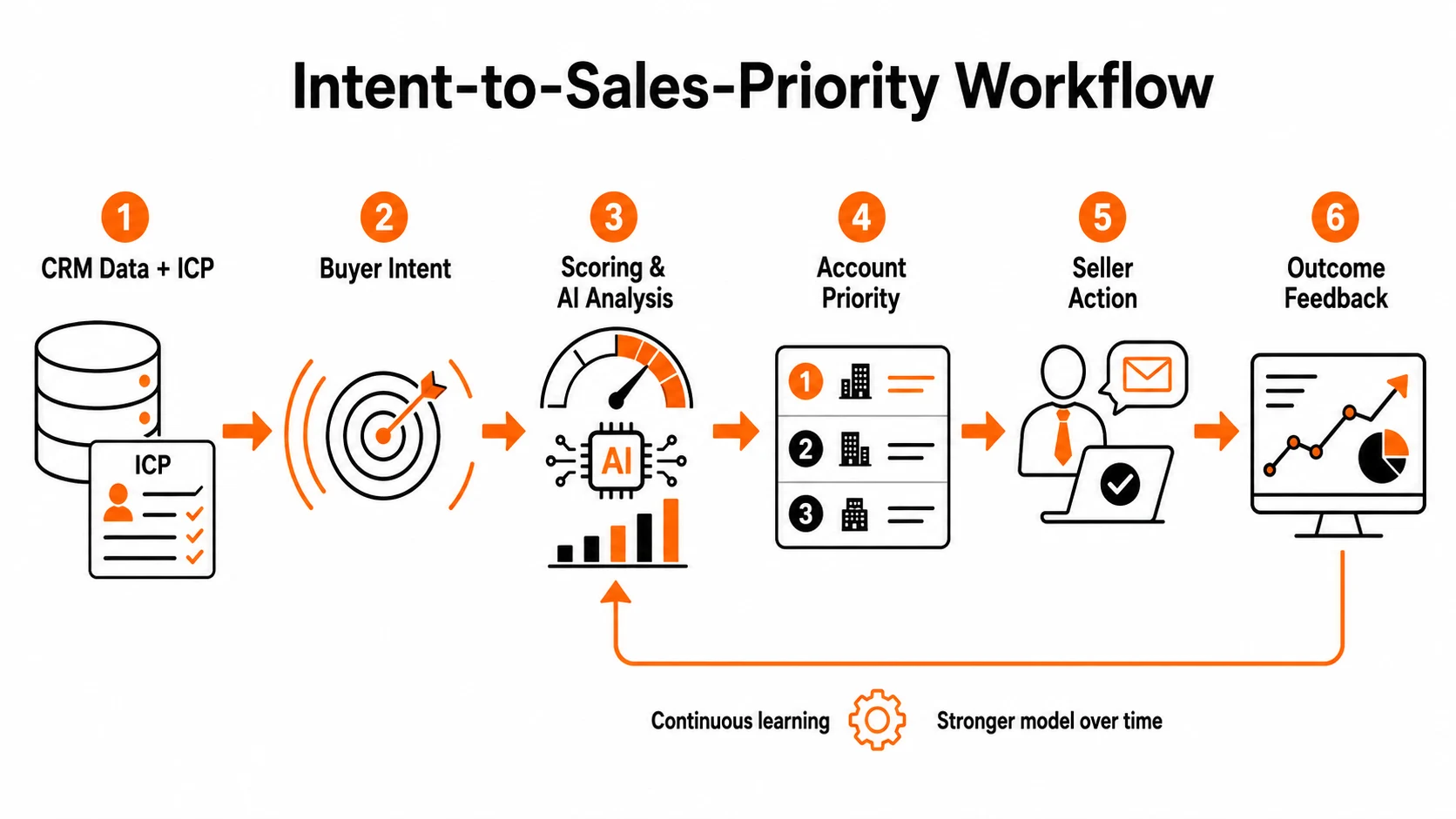
A six-step framework for implementing intent + predictive scoring
- Clean the CRM. Duplicate accounts and missing stages poison scoring models. Measure field completeness, duplication, and enrichment coverage.
- Define the ICP. Document industries, employee bands, technologies, geography, revenue, buying roles, and disqualifiers.
- Separate fit from intent. Fit asks “should they buy?” Intent asks “are they researching now?”
- Choose narrow intent topics. “Cybersecurity” may create noise. “Cloud workload protection” may tell you considerably more.
- Set action thresholds. Define exactly what happens when an account crosses a score or stage.
- Measure outcomes. Review score bands every 30–60 days against meetings, opportunities, pipeline created, conversion rate, and sales cycle length.
The goal is not prettier scoring. It is better sales allocation.
Building this architecture now? A VAIS walkthrough can show how product fit, Bombora intent, account intelligence, and prioritization can be evaluated together before you redesign your sales workflow.
Implementation checklist
Before signing anything, confirm:
- CRM data is clean enough to train or consume scores.
- Sales and marketing agree on the ICP.
- Intent topics map to actual purchase problems.
- Reps understand why an account is prioritized.
- Scores can enter existing CRM and sales workflows.
- Thresholds trigger a specific action.
- Performance can be measured by score band.
- Models and topics are reviewed at least every 30–60 days initially.
For adoption problems, see how to fix ABM software adoption and how to evaluate ABM software.
Common mistakes
- Treating intent as qualification: Research activity does not guarantee fit. Combine intent with ICP and account context.
- Scoring everything into one mystery number: Keep fit, intent, engagement, and predictive probability distinguishable where possible.
- Ignoring explainability: Reps stop trusting scores they cannot interpret.
- Buying before fixing CRM data: Machine learning is sophisticated. Garbage in, garbage out remains annoyingly undefeated.
Conclusion
The best sales intelligence platform is not the one with the most signals. It is the one that helps your team turn signals into defensible priorities.
6sense and Demandbase bring mature predictive account models. Apollo connects AI scoring with prospecting and execution. ZoomInfo combines deep GTM data with AI-driven account prioritization. Cognism emphasizes contact intelligence and intent. VAIS combines predictive product-account scoring, Bombora intent, account intelligence, prospect discovery, and campaign action.
That distinction matters because sales prioritization is ultimately a resource-allocation problem.
Your reps have limited hours. Your target market does not.
Want to see how your own target accounts score when product fit and buyer intent are analyzed together? Book a VAIS walkthrough.
Frequently Asked Questions:
1. What is predictive lead scoring?
Predictive lead scoring uses historical and current data to estimate which leads or accounts are more likely to reach a desired outcome such as engagement, pipeline creation, or conversion.
2. Can buyer intent improve predictive scoring?
Yes. Intent can add timing and behavioral context when the scoring model supports it.
3. Should sales prioritize accounts or leads?
Complex B2B purchases usually benefit from account-level prioritization first, followed by identifying the relevant people within the buying group.
4. Which platform is best for enterprise ABM?
6sense and Demandbase deserve consideration because both document extensive predictive account and orchestration capabilities.
5. Which platform combines intent with outbound execution?
Apollo and VAIS are relevant candidates where prioritization needs to connect quickly to prospecting or campaign execution.
6. Which platform is strongest for contact-data-heavy workflows?
ZoomInfo and Cognism are worth evaluating where contact and company intelligence are central requirements.