

Best B2B Intent Data Providers for Identifying In-Market Accounts (2026)
Compare VAIS, Bombora, 6sense, Demandbase, G2 Buyer Intent, and ZoomInfo to see which B2B intent data provider fits your accounts, signals, sales motion, and tech stack.

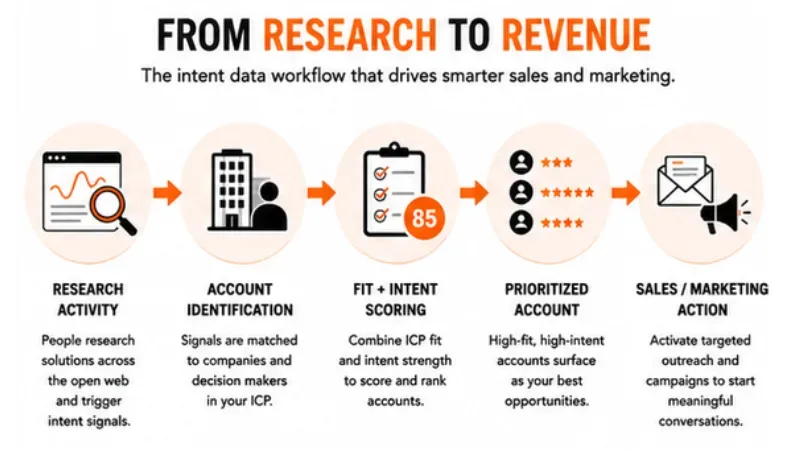
Choosing among the best B2B intent data providers is less about finding one universal winner and more about matching the signal source and workflow to your GTM motion.
There is no single best B2B intent data provider. The right choice depends on where the signal comes from, coverage across your target accounts, account or person-level resolution, integrations, activation options, and your sales motion. Compare providers by how reliably they identify in-market accounts and how quickly your team can act on the signal.
B2B buyer intent data can help revenue teams distinguish accounts that simply match their ideal customer profile from accounts showing signs of active research. But providers differ in the signals they capture, how they resolve that activity to companies or people, and how easily marketing and sales teams can turn the insight into action.
The useful question is not simply, Which platform has the most intent data?
It is:
What kind of buying signal does your team need, and what should happen when that signal appears?
Because an intent signal sitting untouched in another dashboard is not intelligence. It is expensive wallpaper.
Which B2B intent data provider is best for in-market accounts?
There is no single best provider for every B2B team.
6sense is best suited to mature revenue organizations that want predictive account prioritization and buying-stage intelligence. Bombora is a strong fit when third-party topic intent needs to plug into an existing GTM stack. Demandbase suits account-based organizations that want intent embedded in broader account intelligence and orchestration. G2 Buyer Intent is particularly relevant to software vendors whose buyers actively research products and categories across software marketplaces. Valasys VAIS is designed for teams that want to combine ICP or product fit with intent and campaign prioritization. ZoomInfo is relevant when sales teams want intent close to company, contact, and prospecting intelligence.
The right choice depends on signal source, signal resolution, platform scope, activation model, existing technology, and what your team can realistically do with the information.
6sense, for example, uses account activity and predictive models to help prioritize accounts and assign buying stages, while G2 captures specific software-research behaviors.
B2B intent data providers compared
Methodology and disclosure: Valasys offers VAIS. This comparison uses publicly available product documentation and does not represent a hands-on or independently scored ranking. Providers are evaluated across signal source, signal resolution, platform scope, activation model, and best-fit use case. “Best fit” descriptions are editorial assessments rather than claims that one provider universally outperforms another.
Providers are listed alphabetically. Their order does not indicate ranking.
Sources last reviewed: August 18, 2026.
| Provider | Platform category | Primary signal source | Signal resolution | Activation model | Best fit |
| 6sense | Predictive revenue/account intelligence | CRM, MAP and web activity plus 6sense network and supported third-party intent | Primarily account-level intent and buying-stage intelligence | Predictive scoring, prioritization and revenue workflows | Mature revenue teams that need predictive account prioritization and buying-stage intelligence (6sense Support) |
| Bombora | Third-party B2B intent data | Company Surge research activity around B2B topics | Account-level Company Surge; buying-group/persona insight available. | Data feeds, APIs and GTM-platform integrations | Teams with an existing GTM stack that need a third-party topic-intent layer (Bombora Customer Resource Center) |
| Demandbase | Account intelligence and ABM | Proprietary intent combined with account and engagement intelligence | Primarily account level | Native ABM workflows plus integrations and APIs | Account-based GTM teams that want intent embedded in broader account intelligence (Demandbase Support) |
| G2 Buyer Intent | Software-marketplace intent | Product, category, comparison and related research occurring on G2 | Company level | CRM integrations, reporting and workflow activation | B2B software vendors whose buyers actively research on G2 (G2 Documentation) |
| Valasys VAIS | Account scoring and campaign management | Product/ICP fit, firmographic data and Bombora-powered intent | Account level | Scoring, prioritization and campaign execution | Teams that want fit plus intent connected to campaign prioritization (Valasys) |
| ZoomInfo | GTM and sales intelligence | Topic-research intent combined with company and contact intelligence | Account level, with person-level resolution available for some intent signals | Search, prioritization and seller workflows | Sales teams that want prospecting intelligence and intent in the same environment (ZoomInfo) |
6sense documents CRM, MAP, web, B2B-network and supported third-party inputs in its predictive intent model. Bombora describes Company Surge as account-specific intent derived from research activity over time and supports activation through a broad integration ecosystem.
Demandbase combines intent with broader account intelligence, while G2’s current Buyer Intent documentation identifies buyer organizations and specific software-research actions.
What is an in-market account?
An in-market account is a company showing behavior that suggests it may be researching a business problem, solution, category, product, or competitor.
The word suggests matters.
Intent is evidence of possible buying activity. It is not confirmation that a buyer has approved a budget, selected a vendor, established a purchase date, or wants immediate sales outreach.
If a company suddenly increases its research into cloud-security topics, something has changed. That change may deserve investigation, but the research signal alone does not tell you the complete commercial story.
A useful distinction is:
Fit tells you who should care. Intent helps you spot who might care now.
Strong programs add more context:
Fit + Intent + Engagement + CRM context
That combination is more useful than treating every intent surge as a sales-ready lead.
How do B2B intent data providers differ?
Intent providers do not all sell the same type of product.
Some specialize in third-party topic research. Others capture buyer activity within software marketplaces. Revenue-intelligence platforms may combine intent with predictive analytics and buying stages. Account-intelligence and AI ABM software platforms may combine intent with first-party engagement, account identification, advertising, sales workflows, and orchestration.
This is why comparing all six providers as feature-for-feature equivalents can be misleading.
A better comparison asks five questions:
- Where does the signal come from?
- Can the activity be resolved to companies or people you actually sell to?
- How fresh, relevant and explainable is the signal?
- How does the signal reach existing marketing and sales workflows?
- What action is the signal designed to trigger?
6sense itself describes the provider landscape as spanning intent point solutions through broader revenue-intelligence platforms that combine intent with prediction and activation.
Why B2B intent data programs fail
Intent data sounds simple in a sales presentation:
Find companies researching your category. Send them to sales. Close more deals.
Real-world implementation is more complicated.
Programs often disappoint because the team cannot trace where a signal originated, resolve it to accounts it actually sells to, understand how meaningful the activity is, or move the signal into a workflow where somebody can act on it.
A large volume of intent data does not solve those problems.
Before comparing vendors, ask:
- Where did the signal come from?
- Can the activity be resolved to accounts we actually sell to?
- How fresh and explainable is it?
- Can it reach our existing CRM, ABM and sales workflows?
- Can we measure whether acting on it improves commercial outcomes?
Keep those questions in mind when evaluating each provider.
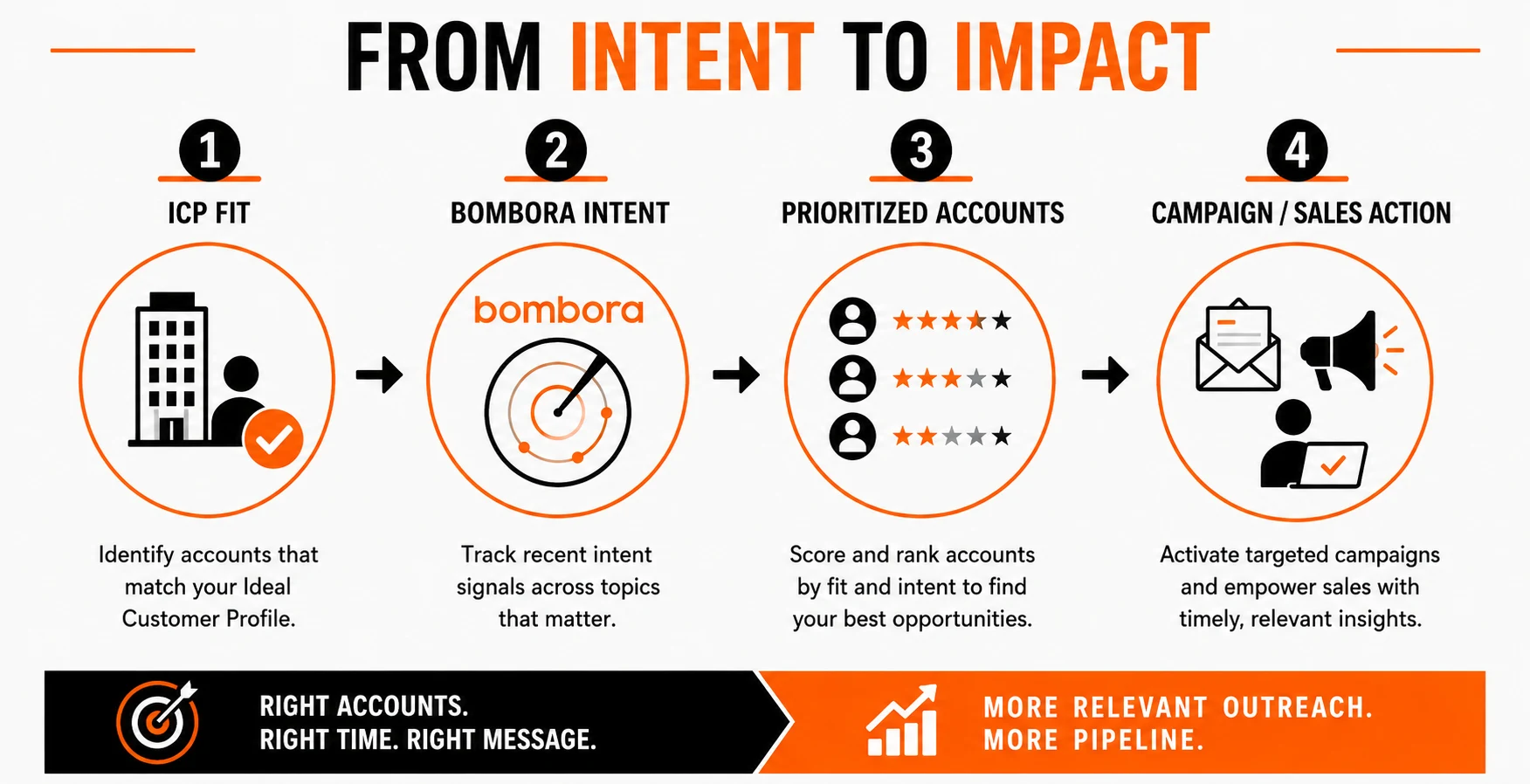
6sense: Best for predictive account prioritization
6sense extends beyond individual intent signals by combining different types of account activity to help revenue teams determine which accounts may deserve attention.
Its current Intent Model documents inputs that include CRM activity, marketing automation activity, web behavior, its B2B network and supported third-party intent sources. The resulting predictive intent score is used to estimate an account’s likelihood of opening an opportunity.
6sense also uses Predictive Buying Stages to organize accounts from Target through Purchase based on modeled intent and activity.
That matters because raw intent leaves an important question unanswered:
What should the revenue team do with the signal?
One account may be researching relevant topics but still be early in its buying journey. Another may combine strong account fit, external research and increasing engagement with your company.
Those accounts may require different actions.
Where 6sense fits into the workflow
6sense is most relevant when intent is only one part of a broader account-prioritization strategy.
Teams evaluating it are generally looking beyond a simple list of companies showing research activity. They want a system that interprets several signals and helps prioritize accounts for marketing and sales action.
What buyers should evaluate
The more sophisticated the model, the more important explainability becomes.
During an evaluation, ask:
- What inputs affect the account’s score?
- How is its buying stage calculated?
- Can marketers and sellers understand why the score changed?
- How much historical first-party data is needed?
- What does implementation require?
- How quickly can sellers use the output?
A predictive score has limited value if the people expected to act on it cannot understand or trust it.
Bombora: Best for third-party topic intent
Bombora specializes in helping B2B organizations identify companies showing increased research activity around relevant business topics.
Its Company Surge intent data is derived from research and content consumption across its B2B Data Cooperative. Bombora says its methodology uses account-specific historical behavior to assess relative changes in research activity rather than treating every isolated content interaction as equal.
The core idea is the surge.
Rather than assuming that a single article view means a company is ready to buy, the model attempts to identify meaningful changes in research behavior.
Bombora’s topic taxonomy organizes the business subjects used to derive Company Surge signals.
Where Bombora fits into the workflow
Bombora is particularly worth evaluating when a company already has the core pieces of its GTM stack.
You may already be satisfied with your CRM. Your ABM platform may already support account-based programs. Sales may already have prospecting tools.
In that situation, the objective may not be to replace those systems. It may be to add third-party topic intent as another prioritization signal.
Bombora also supports numerous integrations and activation options, which is important when intent needs to flow into an existing stack rather than become another isolated interface.
What buyers should evaluate
Start with topic relevance.
A large taxonomy has little value if the topics you can monitor do not accurately represent what your buyers research.
Then test coverage against your actual target-account universe.
Instead of relying only on a provider’s broad coverage claims, bring a representative sample of your TAM into the evaluation and see how consistently those accounts can be identified and surfaced.
Demandbase: Best for enterprise ABM and account intelligence
Demandbase positions intent as one component of a broader account-intelligence and account-based GTM workflow.
Its current B2B buyer intent offering is designed to identify accounts showing interest in a company, category, or competitor and connect those signals with campaign and account workflows.
Demandbase’s broader Account Intelligence approach combines a company’s own first-party data with Demandbase intelligence to support account prioritization, predictive models, journey-stage mapping and activation.
That makes Demandbase relevant when the objective goes beyond giving sales a list of companies researching a subject.
The larger question becomes:
How can marketing and sales understand which target accounts deserve attention, what those accounts appear interested in, and how engagement should be coordinated?
That is an account-intelligence and ABM problem, not just an intent-feed problem.
Where Demandbase fits into the workflow
Demandbase makes the most sense when intent needs to inform a broader account-based GTM motion.
The signal is not simply an endpoint. It becomes one factor in deciding which accounts to prioritize, how campaigns should engage them, and what sellers should do next.
What buyers should evaluate
Inspect the full path from identification to action.
Ask how accounts are identified, how intent affects prioritization, how the information reaches your CRM and what a seller actually sees when an account is surfaced.
A seller should be able to understand why an account deserves attention without moving through several unexplained scores and disconnected tools.
G2 Buyer Intent: Best for software-marketplace research signals
G2 Buyer Intent is differentiated by the environment in which much of its buyer activity occurs.
Its current Buyer Intent documentation includes signals created when buyers view product profiles, pricing information, alternatives and comparisons. G2’s documentation also says its Buyer Intent offering now includes research activity from G2, Capterra, Software Advice and GetApp.
For software vendors, this can provide valuable context.
Consider two scenarios.
A target account visits your website once.
That is useful, but the reason for the visit may be unclear.
Now imagine the account also researches your software category, views your product or evaluates competing options within a software-research marketplace.
The second scenario gives the revenue team more information about what that organization may be evaluating.
G2’s Buyer Intent data reference identifies fields such as buyer organization, company domain, signal type and visit information for workflow integrations.
Where G2 Buyer Intent fits into the workflow
G2 Buyer Intent can complement first-party engagement data with software-research activity that occurs outside your owned properties.
For software companies, that can help identify organizations researching the category, reviewing products, or comparing competing options.
What buyers should evaluate
The main question is whether your target buyers and product category generate enough meaningful activity across the available marketplaces.
Signal access can also vary by G2 product plan, so buyers should confirm exactly which signal types and integrations are included.
Ask for activity relevant to your specific category and target accounts rather than relying only on marketplace-wide figures.
Valasys VAIS: Best for ICP-fit and intent-based campaign prioritization
VAIS approaches account prioritization by combining account or product fit with buyer-intent information rather than treating intent as a standalone indicator.
Valasys positions the platform around lead and account scoring, sales intelligence, prioritization and campaign management. Its current VAIS product information describes the platform as using buyer-intent data and AI-based scoring to help teams identify and prioritize prospects.
The distinction between fit and intent is important.
Imagine two accounts:

Account A shows a strong research surge but sits well outside your ideal customer profile.
Account B closely matches your ICP and is also showing relevant intent.
Those accounts may generate similar intent signals, but they do not necessarily deserve the same priority.
Valasys describes VAIS as evaluating how strongly an account aligns with a particular product. Its published VAIS scoring methodology explains that higher scores represent stronger account-to-product alignment.
Teams exploring fit-based prioritization can also review Valasys’ guidance on AI-driven ICP scoring.
Where VAIS fits into the workflow
VAIS is most relevant when a team wants to move from identifying target accounts to prioritizing them using both fit and intent.
Instead of treating every company showing research activity as equally valuable, teams can evaluate intent in the context of ICP alignment and campaign priorities.
Valasys’ current guidance on building high-intent ABM lists with VAIS describes combining product data, Bombora intent and AI scoring to create prioritized account lists.
What buyers should evaluate
During a VAIS demo, use your own target-account list rather than relying only on sample data.
Ask:
- How are these accounts scored?
- What contributed to each account’s prioritization?
- Which intent signals come from Bombora?
- How recent is the activity?
- How does an account move from insight to an actual campaign or sales action?
- What information can be passed into systems our team already uses?
The purpose of the test is not simply to see whether a score exists. It is to see whether combining fit and intent produces a priority order your revenue team trusts.
ZoomInfo: Best for intent with company and contact intelligence
ZoomInfo brings intent signals into an environment already centered on company, contact and prospecting intelligence.
ZoomInfo’s current Account-Level Intent functionality is designed to identify companies showing research activity around selected topics. Its current Intent search documentation distinguishes between account-level intent for companies and person-level intent for named contacts associated with some research activity.
That distinction matters:
Account-level intent and person-level intent are not the same thing.
An account-level signal may indicate that a company is researching a relevant topic. It does not automatically reveal the individual responsible for the activity.
ZoomInfo’s Person-Level Intent documentation describes person-level identification as a best-effort resolution that should be used directionally rather than treated as confirmation that a particular contact generated the research activity.
Where ZoomInfo fits into the workflow
ZoomInfo is most relevant when prospecting, company intelligence, contact discovery and buying signals need to sit close together in the sales process.
For teams already dependent on company and contact intelligence, that can reduce the distance between identifying an interesting account and researching who might be relevant to engage.
What buyers should evaluate
Ask:
- Which signals are available at the account level?
- Which signals can potentially be resolved to a person?
- What confidence or limitations apply to person-level resolution?
- What context does the seller see alongside the signal?
- How does intent affect account or prospect prioritization?
- Which capabilities depend on particular products, packages or modules?
The goal is to understand not only whether ZoomInfo can surface buying activity but whether sellers receive enough reliable context to decide what to do next.
Quick decision guide
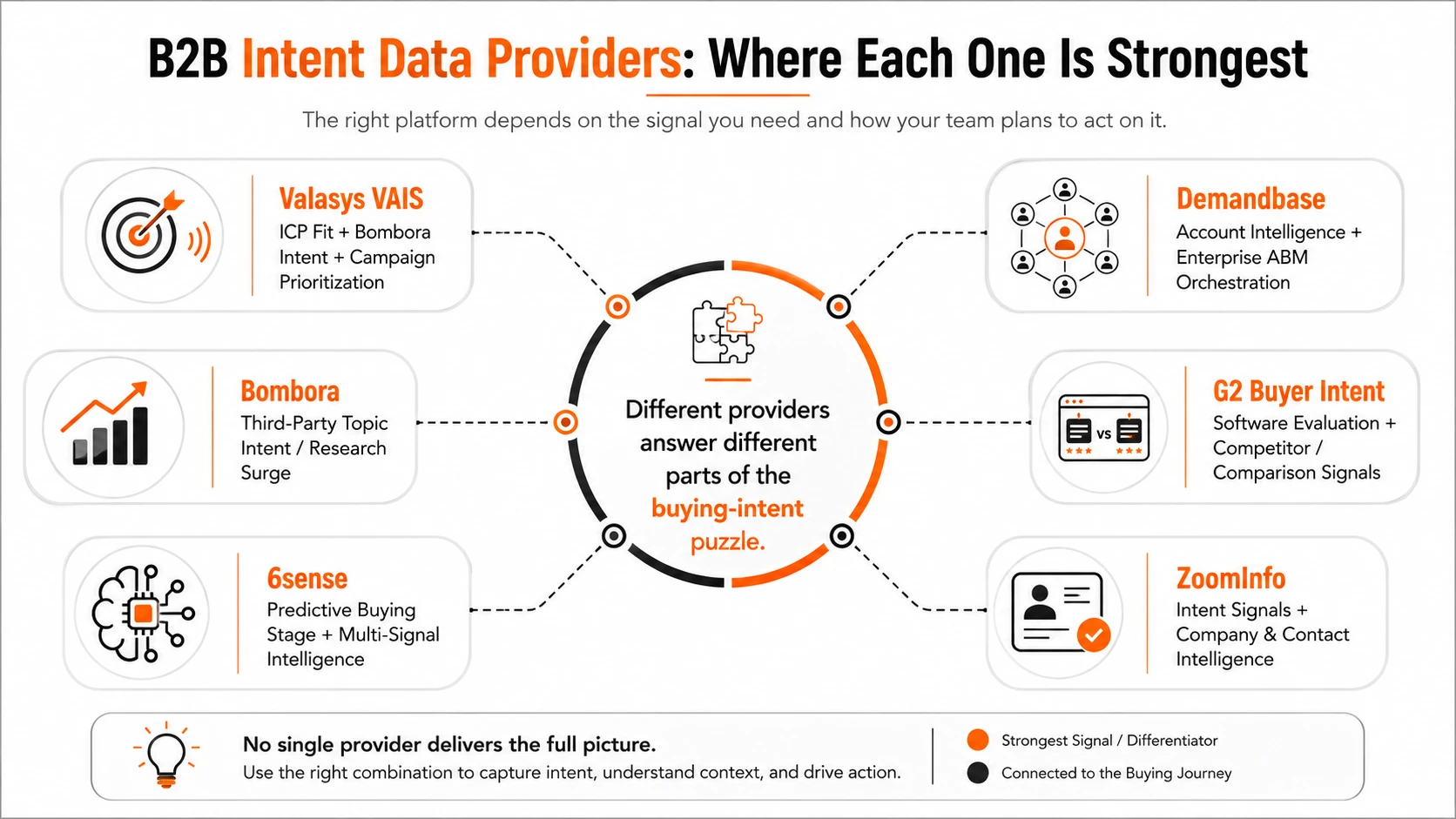
Choose 6sense when predictive buying-stage intelligence and multi-signal account prioritization are central to your revenue strategy.
Choose Bombora when you primarily need third-party topic-level intent that can plug into an existing GTM stack.
Choose Demandbase when account-based GTM is central to your strategy and intent needs to sit inside broader account intelligence and orchestration.
Choose G2 Buyer Intent when you sell B2B software and software-marketplace research, comparisons and competing-product activity are especially valuable signals.
Consider Valasys VAIS when you want to prioritize accounts using ICP or product fit alongside intent and connect that prioritization with campaign activity.
Choose ZoomInfo when sales benefits from having intent close to company, contact and prospecting intelligence.
The decision still depends on your own market. A provider that looks strongest on paper may have weak coverage for the accounts, regions or topics that matter to your business.
Use the TRACE test before buying any intent platform
Use the TRACE framework to evaluate an intent-data provider across signal origin, account resolution, context, activation and commercial impact.
T: Trace the signal
Ask where the signal originated.
Was it generated by publisher research? Your own website? A review marketplace? A partner network? Search or content-consumption behavior?
If the provider cannot explain the signal clearly, an attractive score should not distract from that limitation.
R: Resolve it to your market
Bring 100 to 500 real target accounts into the evaluation.
Test:
- How many can the provider identify?
- How many generate usable signals?
- Which geographies or market segments are weak?
- Can the provider distinguish relevant accounts from companies outside your ICP?
This is generally more useful than evaluating a broad coverage percentage in isolation.
A: Add context
Intent should rarely operate alone.
Combine it with ICP fit, first-party engagement, existing opportunities, previous sales activity, buying-stage information and relevant contacts or buying groups.
A surge from an existing customer means something different from a surge from a perfect-fit net-new account.
Context makes the signal useful.
C: Connect it to action
Decide what should happen before you buy the platform.
| Signal | Possible action |
| Early topic research + strong ICP fit | Add to targeted advertising or nurture |
| Intent + website engagement | Prioritize for SDR research |
| Competitor comparison + active opportunity | Alert the account owner |
| Strong fit + several buying signals | Move into a high-priority account play |
| Weak fit + isolated surge | Monitor rather than immediately contact |
Not every intent signal deserves an email from sales.
That is basic signal hygiene.
E: Evaluate commercial lift

Do not measure success by how often people log into the platform.
Measure whether the program changes outcomes.
Track high-intent-account-to-meeting conversion, opportunity creation, pipeline generated, opportunity progression, sales-cycle movement, rep adoption and signal-to-action time.
Review performance after 30, 60 and 90 days.
Where practical, compare accounts receiving intent-driven treatment with an appropriate baseline or control cohort.
If the program creates more notifications but not better decisions, something is wrong.
Already have a target-account list?
Instead of evaluating intent platforms only through a polished demo dataset, test a sample of your own accounts.
If VAIS is on your shortlist, test VAIS against your own ICP and target-account criteria and examine whether adding intent changes the priority order in a useful way.
Intent data buyer checklist
Take these questions into your next provider evaluation:
- Where does your intent data come from?
- What exact behavior creates a signal?
- Is the signal account-level, person-level or both?
- How frequently is the data refreshed?
- Can you test coverage against our actual target accounts?
- How do you resolve anonymous activity to companies?
- Can users see why an account received its score?
- How are topics, keywords or categories configured?
- Can the data sync with our CRM and marketing platforms?
- What does the seller see?
- Can we create different actions for different signal strengths?
- Which functionality requires additional modules?
- What would a 60- or 90-day pilot measure?
One more request is worth making:
“Show me what happens after the signal.”
That demonstration can reveal whether the product produces actionable intelligence or simply another dashboard for the team to monitor.
Three implementation mistakes to avoid
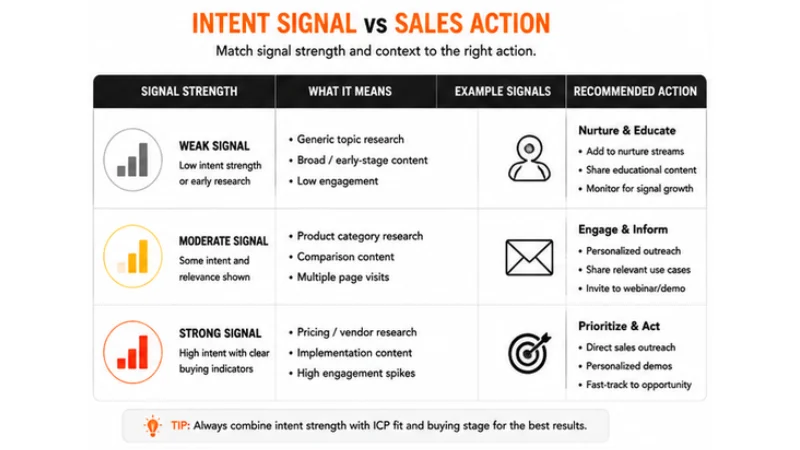
Mistake 1: Treating signal strength as qualification
A strong intent signal should trigger investigation, not automatic outreach.
Combine intent with ICP fit, engagement, opportunity status and CRM context before deciding what should happen next.
A high-intent account that is a poor fit may still deserve less attention than a strong-fit account showing several relevant signals.
Mistake 2: Sending alerts without clear ownership
Decide who receives each type of signal, what context they receive with it and how quickly they are expected to respond.
If every signal becomes an alert and nobody knows who owns the next action, intent quickly turns into background noise.
Design the workflow before increasing signal volume.
Mistake 3: Measuring alerts instead of outcomes
Do not judge an intent program by how many accounts were flagged.
Measure meetings, opportunity creation, pipeline, progression, conversion and signal-to-action time.
Ten useful signals that change commercial decisions can be more valuable than hundreds of alerts nobody uses.
Which B2B intent data provider should you choose?
Choose based on the signal your team needs and the workflow it can actually support.
Start by testing providers against your real target-account list. Then compare signal relevance, resolution, freshness, explainability, activation and measurable commercial impact.
Do not treat an intent score as proof of purchase readiness. Combine it with account fit, first-party engagement, opportunity context and seller judgment.
Before signing a contract, ask the provider to demonstrate three things:
- Can it identify the accounts you care about?
- Can it explain why those accounts appear to be in-market?
- Can your team turn that information into a useful action quickly?
If those three things are clear, the platform may be worth piloting.
Frequently Asked Questions
1. What is B2B intent data?
B2B intent data is behavioral information suggesting that a company may be researching a business problem, topic, category, product or vendor.
Revenue teams use it to identify accounts that may deserve additional attention and to improve the timing and context of marketing or sales activity.
2. How accurate is buyer intent data?
Intent data is not perfectly predictive.
Its usefulness depends on the signal source, account resolution, coverage, relevance, freshness and supporting context.
Treat intent as evidence of possible buying activity rather than confirmation that a company has made a purchase decision.
3. What is the difference among first-party, second-party and third-party intent data?
First-party intent data comes from properties and systems your organization controls, such as your website, product, CRM, email engagement or marketing automation platform.
Second-party intent data is another organization’s first-party data that is shared with or provided to your business. Software-marketplace research is one example: activity collected directly by the marketplace is first-party data to that marketplace and can become second-party data when provided to a software vendor.
G2 explicitly describes its marketplace activity as first-party data to G2 and second-party data to organizations using G2 Buyer Intent.
Third-party intent data comes from external providers that aggregate or derive behavioral signals from networks and data sources outside your owned properties.
The distinction describes where the activity originated and your relationship to the organization that collected it.
For a practical workflow that combines owned and external signals, see how to combine first-party and third-party intent data.
4. Can B2B intent data identify individual buyers?
Sometimes, but much B2B intent data remains account-level.
Some providers offer person-level signals or resolution for certain types of activity, but availability and confidence vary.
Always ask whether a specific signal identifies a company, an individual, or both, and how that identification was made.
5. What is the difference between Bombora and 6sense?
Bombora primarily specializes in company-level topic intent. Its Company Surge approach looks for meaningful changes in account research behavior around B2B topics.
6sense combines intent with additional first-party and third-party account activity and predictive models designed to support buying-stage estimation and account prioritization.
6. How should sales teams use buyer intent data?
Sales teams should use intent to determine which accounts deserve research, when engagement may be appropriate and what context could make outreach more relevant.
Intent should normally be combined with account fit, existing engagement, opportunity status and CRM information rather than used as an automatic outbound trigger.
7. How much does B2B intent data cost?
Pricing varies by provider, package, user seats, data volume, modules, integrations and contract structure.
Instead of comparing subscription cost alone, evaluate total cost against target-account coverage, implementation requirements, workflow adoption and measurable commercial outcomes.
8. Should I use more than one intent data source?
Possibly, but more sources are not automatically better.
Multiple sources make sense when they provide meaningfully different information—for example, broad third-party topic research combined with software-marketplace activity and first-party website engagement. The objective should be complementary context, not simply more alerts.
Ready to test your own accounts? Request a VAIS demo or validate an account list.