

How to Evaluate ABM Software for B2B SaaS in 2026
Learn how to evaluate account-based marketing software for B2B SaaS based on pipeline quality, demand generation fit, AI capabilities, and key account engagement.

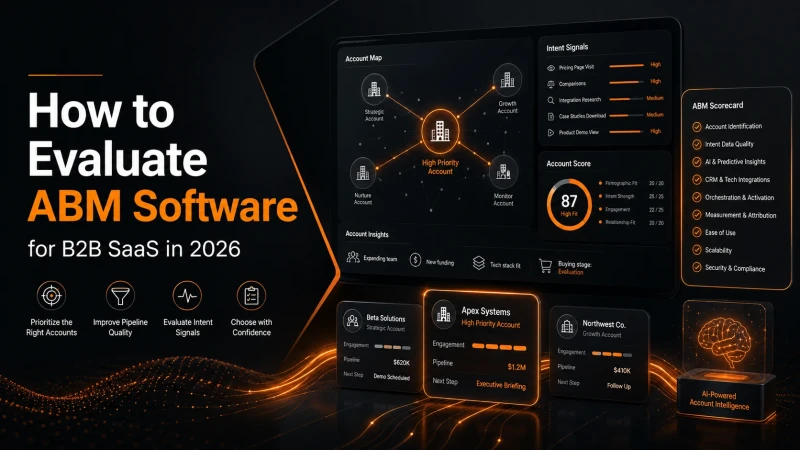
Most ABM vendors will show you a compelling demo. You’ll see a dashboard full of intent signals, an AI-generated account prioritization list, influenced-pipeline numbers, and a buying-committee view that looks exactly like what your sales team has been asking for.
None of that proves the platform will improve your pipeline.
The real question isn’t which ABM platform has the best demo. It’s whether a specific platform can identify the right accounts from your data, detect buying activity that your sales team will actually act on, fit your demand-generation motion, integrate cleanly with your CRM and MAP, and justify its three-year cost at your deal size and target-account volume.
That’s the evaluation. This guide walks you through it.
The Short Answer
To evaluate Account-Based Marketing (ABM) software in 2026, B2B SaaS teams need to assess strategic fit, data and identity resolution, signal quality, AI usefulness, demand-generation fit, sales activation, measurement, integrations, and total cost in that order.
No platform should be purchased without a 30–45–day proof of concept on live data with agreed acceptance criteria. The right platform improves account selection, buying-group engagement, and opportunity quality within your actual stack and operating capacity. The longest feature list is not the right criterion.
First: Do You Actually Need a Full ABM Platform?
This is the gate most buyers skip. Full ABM suites like Demandbase, 6sense, DemandScience ABX (incorporating Terminus heritage), AdRoll ABM (formerly RollWorks), Foundry ABM (incorporating Triblio heritage) require implementation resources, dedicated ops ownership, and serious data readiness before they produce value.
Before comparing suites, ask which problem you’re actually trying to solve:
- CRM-ecosystem ABM (HubSpot, Adobe Marketo Engage, Salesforce Marketing Cloud Account Engagement) makes sense when you’re already in those platforms and your first ABM use case doesn’t need a separate intent graph. Integration continuity is a real advantage. Independent intent-data depth is not their strength.
- Account intelligence and signal platforms: ZoomInfo, Common Room, UserGems, Warmly solve different parts of the identify-and-activate chain. They are not ABM suites. For teams focused on identifying and activating individual buyers rather than deploying a full suite, UserGems is an AI command center for outbound and ABM. It brings together contact-level intent, website visits, tech-stack changes, role changes, funding and other signals, then uses a custom AI model trained on sales history to score accounts and contacts. Those insights can support automated list building, personalized outreach, ad-audience sync, and coordinated CRM workflows—useful when signal quality and sales activation matter more than a broad ABM suite.
- Paid-media specialists like Metadata.io and Factors.ai are strong when the bottleneck is campaign execution or attribution, not account identification.
- Personalization tools like Mutiny amplify an existing ABM motion. They don’t replace account intelligence.
- Contact-level advertising like Influ2 reaches named buying-committee members. Value depends entirely on your contact quality.
Define Pipeline Quality Before Comparing Vendors
Every vendor promises pipeline improvement. Before you can evaluate that claim, you need a definition your sales counterpart actually agrees on.
Pipeline quality is the degree to which created opportunities match your ICP, include the right buying-group members, progress efficiently, and convert into economically valuable customers.
Measure it in three layers:
- Leading indicators: Target-account coverage, buying-group coverage by role, high-intent first-party engagement, sales acceptance rate of triggered accounts, signal-to-action time.
- Opportunity-quality indicators: Account-to-opportunity conversion, ICP-fit distribution of new opps, multi-threading depth, stage progression, pipeline velocity, sales rejection reasons.
- Revenue outcomes: Win rate, Annual Contract Value (ACV), sales-cycle length, CAC, CAC payback, retention, expansion potential.
Impressions, ad clicks, engagement scores, and influenced-pipeline figures are supporting context, not proof of improvement. Any vendor leading with an influenced-pipeline in a demo without showing attribution logic is showing you the wrong thing.
The best account-based marketing platform for demand generation is one that improves account-to-opportunity conversion, buying-group coverage, sales acceptance, pipeline velocity, and revenue outcomes rather than simply increasing impressions or influenced-pipeline figures.
The Signal Hierarchy (and Why False Positives Kill Adoption)
Not all signals are equal. Here’s the hierarchy by reliability and buying-stage relevance:

A third-party intent surge alone should never outrank verified first-party activity from multiple buying-group members. Third-party intent tells you an account is reading about a topic category, not that they have a funded initiative or a preference for your product.
Signal combinations drive action. A high-fit account with pricing-page visits, multiple buying-group roles engaging, and a third-party surge is a different situation from the same account with a topic surge only.
Common false positives to suppress: Competitors researching your pricing, analysts writing about your category, existing customers checking documentation. Ask every vendor how they handle these before the demo ends.
AI-powered account-based marketing solutions boost key account engagement when they combine ICP fit, first-party behavior, buying-group activity, and intent signals to prioritize accounts showing real purchase interest. Strong platforms also suppress weak or misleading signals instead of treating every engagement event equally.
What “AI-Powered” Actually Needs to Mean in ABM
AI is in every vendor’s pitch. None of it is an evaluation criterion on its own. For each AI capability, ask four questions:
- What does it actually do: predict, generate, recommend, or act autonomously?
- What data does it require, and do you have that data?
- Where does a human review and approve the output?
- How are errors detected and reversed?
The capabilities that matter most for pipeline outcomes are predictive account scoring (which accounts to prioritize), buying-stage interpretation (where in the process they are), and next-best-action recommendations (what to do next). Generative content and autonomous agents are useful for efficiency, but efficiency improvements don’t automatically become pipeline improvements.
An impressive demo is not proof of pipeline impact. Insist on testing AI outputs against your own account list during the POC.
VAIS weights signal combinations rather than treating all signals equally, so a pricing-page visit from a director-level contact at an ICP-fit account scores differently from a single topic surge with no first-party activity. That distinction is what makes a score actionable rather than decorative.
The most useful AI-powered account-based marketing platforms for B2B SaaS use predictive account scoring, buying-stage interpretation, and next-best-action recommendations to help teams identify which accounts to prioritize, understand where buyers are in the decision process, and determine what sales or marketing action should happen next.
The 100-Point Evaluation Scorecard for ABM Software
Score each criterion 1-5, multiply by the weight, divide by 5. Add all weighted scores.
| Criterion | Weight |
| Strategic and use-case fit | 12 |
| Data foundation and identity resolution | 12 |
| Signal and intent quality | 11 |
| Pipeline-quality contribution | 10 |
| Demand-generation fit | 9 |
| Sales activation and adoption | 8 |
| AI usefulness and governance | 8 |
| Measurement and attribution | 8 |
| Integration and architecture fit | 7 |
| Implementation and operating effort | 5 |
| Three-year total cost of ownership | 4 |
| Privacy, security, and compliance | 3 |
| Commercial flexibility and exitability | 3 |
| Total | 100 |
Score interpretation:
- 80-100 = strong shortlist candidate
- 65-79 = conditional fit
- 50-64 = specialist use only
- below 50 = do not proceed
Four mandatory pass/fail gates, regardless of total score: security documentation and DPA, regional privacy compliance, CRM writeback capability, data export rights. A high score does not override a gate failure.
Total Cost of Ownership: What the License Fee Doesn’t Cover
Build a three-year model before signing. The license is only the start. Add the following:

- Intent-data and enrichment add-ons (often priced separately)
- Advertising spend and media minimums
- Implementation and professional services
- API credits, record limits, seat fees, account-volume overages
- CRM, MAP, and data-warehouse integration work
- Marketing ops or RevOps staff time for ongoing governance
- Content production for account-specific assets
- Renewal price increases so ask for a cap, in writing, in the contract
In our review of comparable guides, CDP integration is rarely covered in depth. If your team runs attribution or first-party signal analysis through Snowflake or BigQuery, confirm the integration works before purchasing, not after.
Run a 30-45 Day POC Before You Sign Anything
This is non-negotiable. Here’s the minimum viable Proof of Concept (POC):
- Set baseline metrics from your current CRM data like match rate, opportunity conversion, buying-group depth, sales acceptance rate
- Define acceptance thresholds from your own baseline before the POC starts
- Test account and person resolution against known CRM records, not a vendor sandbox
- Blind-test intent prioritization against accounts you already know are active buyers and accounts you know are dormant
- Create matched treatment and held-out account groups
- Activate one or two defined workflows only
- Run a real CRM writeback test and a real data export
- Document false positives, seller rejections, and manual effort required
- Purchase only if acceptance criteria are met
If the vendor won’t agree to a structured POC with held-out accounts, that tells you something.
The best account-based marketing software for B2B SaaS is the platform that proves it can resolve real account data, identify active buyers, produce signals sellers trust, integrate with the CRM, and improve predefined pipeline-quality metrics during a live proof of concept.
Demo Questions That Separate Real Platforms From Polished Demos
Ask these questions during live call or in a demo, with your own accounts, not via email where they can answer with screenshots:
- Show the full workflow account identified, scored, activated, measured without slide transitions
- Show fit score and intent score separately with the weighting logic
- For this specific signal: what are the source, timestamp, identity confidence, and reason for the recommended next action?
- Show how the account and buying group appear in the CRM view a seller actually uses
- How does the system handle a subsidiary, a remote employee on a home IP, and a personal email domain?
- Show how a poor-fit account gets suppressed even when engagement is high
- What can the AI execute without human approval, and how do you reverse it?
- What’s excluded from the quoted price, and what creates an overage?
- What data can I export at contract end, in what format and is that in the contract?
Acceptable proof is a live demonstration on a real account, not a guided sandbox tour.
When Not to Buy a Full ABM Platform
Do not purchase a comprehensive ABM platform if:
- Your ICP and target-account list aren’t agreed between sales and marketing
- Your CRM has duplicate accounts, unmapped subsidiaries, or missing hierarchies
- Sales doesn’t accept a shared account-prioritization process
- No one owns implementation and ongoing operations, and “the team” is not an owner.
- Your ACV can’t support the three-year cost
- You don’t have baseline pipeline metrics to measure improvement against
In those cases: fix the operating model first. CRM-native ABM features, a visitor-identification tool, or a sales-intelligence database are better starting points than a $100K enterprise suite you’re not ready to operate.
The best account-based marketing service for scaling outreach is one that can prioritize high-fit accounts, identify relevant buying-group members, surface actionable engagement signals, and activate sales or marketing workflows without creating excessive manual work.
Final Recommendation
The best account-based marketing software for your B2B SaaS company in 2026 is the one that correctly scores accounts from your actual CRM data, produces signals your sales team acts on, fits your demand-generation motion, passes a real POC, and costs less over three years than the pipeline improvement it produces.
Start with the scorecard. Run the POC. Negotiate the contract terms, especially the renewal cap, data export rights, and termination assistance.
And if you don’t have a reliable target-account list, an agreed ICP, or a named implementation owner yet, do that work first. The platform is the last step, not the first.
Ready to build your account prioritization foundation before platform selection? Get in Touch with Valasys Media
Frequently Asked Questions (FAQ)
What should you look for when evaluating ABM software in 2026?
When evaluating ABM software in 2026, assess strategic fit, data and identity resolution, signal and intent quality, AI usefulness, demand-generation fit, sales activation, measurement, integrations, implementation effort, security, and three-year total cost of ownership. A live proof of concept using your own data should be part of the evaluation.
How do you choose the right ABM platform for B2B SaaS?
Choose an ABM platform based on your specific pipeline problem rather than its feature list. Evaluate whether it can identify the right accounts, detect actionable buying signals, support your demand-generation motion, integrate with your CRM and marketing automation platform, and improve predefined pipeline-quality metrics. A 30-45-day POC can validate whether the platform fits your actual operating environment.
What are the most important features of ABM software?
The most important ABM software capabilities include account scoring, identity resolution, first-party and third-party intent signals, buying-group identification, next-best-action recommendations, CRM integration, sales activation, measurement and attribution, and data export. AI capabilities should be evaluated based on whether they improve account prioritization and buying-stage interpretation rather than simply generating content.
How can you tell if an ABM platform will improve pipeline quality?
An ABM platform should be evaluated against measurable pipeline-quality outcomes such as account-to-opportunity conversion, ICP fit of new opportunities, buying-group coverage, sales acceptance rate, pipeline velocity, win rate, ACV, and sales-cycle length. Influenced-pipeline figures and engagement metrics alone do not prove that a platform is improving pipeline quality.
What signals should an ABM platform prioritize?
An ABM platform should prioritize reliable, buying-stage-relevant signals. Verified first-party activity from multiple buying-group members should generally carry more weight than an isolated third-party intent surge. Combining ICP fit, pricing-page visits, buying-group engagement, and intent signals can provide a stronger basis for account prioritization than any single signal.
What does AI-powered ABM software actually do?
AI-powered ABM software can use predictive account scoring to identify priority accounts, interpret buying stages, and recommend next-best actions for sales and marketing teams. Generative content and autonomous workflows can improve efficiency, but AI should ultimately be evaluated on whether its outputs help teams prioritize accounts and take better revenue-focused actions.
How long should an ABM software proof of concept last?
A structured ABM software proof of concept should typically run for 30–45 days. The POC should use live CRM data, predefined acceptance criteria, known active and dormant accounts, matched treatment and held-out account groups, real CRM writeback, data exports, and documentation of false positives and seller rejections.
What should be included in an ABM software POC?
An ABM software POC should test account and personal resolution, intent prioritization, account scoring, CRM integration, workflow activation, data export, and the quality of recommended actions. Teams should establish baseline metrics and acceptance thresholds before the POC begins and purchase only if the agreed criteria are met.
How much does ABM software really cost?
The cost of ABM software extends beyond the license fee. A three-year total cost of ownership should include intent-data and enrichment add-ons, advertising spend, implementation services, API credits, record and seat fees, integration work, ongoing RevOps or marketing operations effort, content production, and potential renewal increases.
When should a company not buy a full ABM platform?
A company should reconsider buying a full ABM platform if its ICP and target-account list are not aligned, CRM data contains significant duplicates or hierarchy issues, sales does not support account prioritization, no team owns implementation and operations, ACV cannot support the three-year cost, or there are no baseline pipeline metrics. In these situations, fixing the operating model should come first.
What is the best ABM software for B2B SaaS?
The best ABM software for B2B SaaS is not necessarily the platform with the most features. It is the platform that can accurately score accounts using your data, identify actionable buying signals, support your demand-generation and sales processes, integrate with your CRM, pass a structured POC, and produce pipeline improvement that justifies its total cost of ownership.
What are the must-have evaluation criteria for ABM software?
The core evaluation criteria are strategic and use-case fit, data foundation, identity resolution, signal quality, pipeline-quality contribution, demand-generation fit, sales activation, AI usefulness, measurement and attribution, integrations, implementation effort, total cost of ownership, privacy and security, and commercial flexibility. These criteria can be scored using a weighted 100-point ABM software evaluation scorecard.