Valasys Media

Lead-Gen now on Auto-Pilot with Build My Campaign

ROI Calculator new

How to Nurture Multiple Stakeholders with ABM in Buying Committee

Learn how to nurture multiple stakeholders in B2B buying committees using ABM strategies to personalize engagement & accelerate deal closure.

Mansi Hake

Last updated on: May. 6, 2026

How to Nurture Multiple Stakeholders with ABM in Buying Committee

Win every stakeholder in your target account

Map all stakeholders and their roles in one place, track influence levels and engagement status, and turn complex buying groups into closed deals with the right data.

In all transparency, multi-stakeholder ABM is the discipline of running coordinated, persona-specific campaigns across every member of a B2B buying committee simultaneously. Instead of nurturing a single champion and hoping they sell internally, you engineer influence across the entire Decision-Making Unit (DMU), so your deal has momentum from every angle.

Selling to a modern enterprise account is less like a conversation and more like steering a ship through a committee storm. You’re not persuading one person, you’re navigating up to 13 stakeholders who all have different agendas, different fears, and different definitions of ‘value.’ Miss even one of them, and your deal stalls at exactly the wrong moment. And if your nurture strategy isn’t built for a committee, it’s built for failure.

What Is Multi-Stakeholder ABM and Why Does It Matter Now?

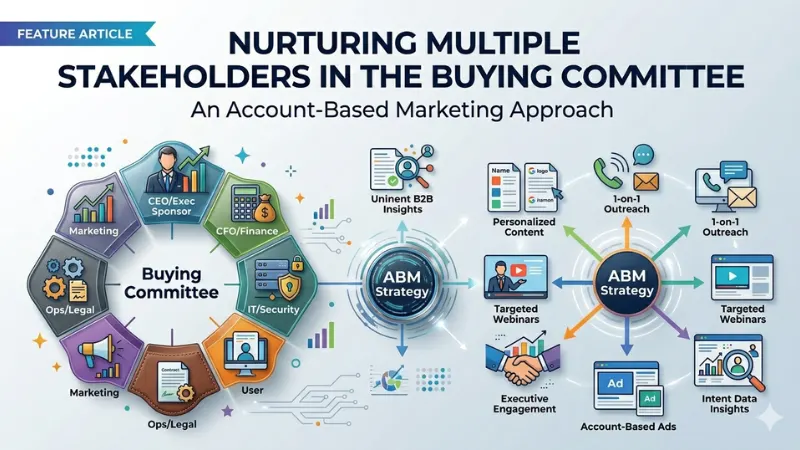
Multi-stakeholder ABM is an account-based marketing approach that maps, segments, and nurtures every member of a buying committee with role-specific content and messaging rather than treating the account as a single entity. It matters because no single stakeholder controls the modern B2B purchase decision alone.

Traditional ABM targeted only the ‘economic buyer’ and called it a day. Modern ABM recognizes that the CFO’s approval means nothing if the IT lead hasn’t signed off on security, the end users haven’t bought in on adoption, and procurement hasn’t cleared the contract language. 

You’re not closing a deal, you’re building internal alignment across people who may never be in the same room.

This is the friction point most competing content ignores: the war between the Economic Buyer and the Technical Buyer. The CFO wants a 3 year ROI story. The CTO wants to know how your platform integrates with 14 existing tools without breaking the data pipeline.

These two stakeholders are speaking different languages and sending them the same email nurture sequence is the professional equivalent of handing someone a French menu when they only read Mandarin. 

How to Nurture Multiple Stakeholders with ABM in Buying Committee

Win every stakeholder in your target account

Map all stakeholders and their roles in one place, track influence levels and engagement status, and turn complex buying groups into closed deals with the right data.


Mapping the Buying Committee: Finding the People Who Never Raise Their Hands

You identify all stakeholders in an ABM account by combining intent data signals, CRM contact mapping, LinkedIn organizational research, and technographic intelligence. The critical challenge is identifying the ‘silent majority’, the 80% of the buying committee that influences the decision but never formally engages with your sales team.

Here’s the uncomfortable reality: the stakeholders who kill your deal are usually the ones you’ve never spoken to. They’re the mid-level manager who flags a concern in an internal Slack channel. The security analyst who runs a quiet compliance check on your product and doesn’t like what they find. The department head who’s never on a call but votes ‘no’ when it matters.

Herding these digital beings requires a layered identification approach:

  •       Intent data mapping: Platforms like Valasys Intent Data identify which contacts within a target account are consuming content about your solution category even if they’ve never touched your site
  •       LinkedIn organizational mapping: Build a visual org chart of every relevant title within the DMU, including roles that typically influence but don’t decide
  •       CRM cross-referencing: Flag every contact at an account who has opened an email, attended a webinar, or visited a landing page, then identify the gaps
  •       VAIS account scoring: Valasys Artificial Intelligence Score (VAIS) aggregates contact-level engagement signals into account-level intelligence, surfacing hidden influencers based on behavioral patterns, not just job titles

The Silent Majority: Nurturing People Who Won’t Identify Themselves

The ‘silent majority‘ of a buying committee the influencers, validators, and internal champions you can’t directly reach are best engaged through three channels:

  •       Programmatic ABM advertising: Serve role-specific ads to every known and anonymous contact at a target account and your IT personas see security content; your finance personas see cost-efficiency messaging
  •       Content-led nurture: Ungated thought leadership, industry benchmarks, and peer comparison data that circulate organically inside the account once one stakeholder shares them
  •       Email sequences mapped to personas, not accounts: More on this below but the principle is that every email touchpoint should be written as if it’s landing in the inbox of one specific role, not ‘the buying team’

Multi-Threading Your Outreach: The CFO vs. CTO Problem

Multi-threading means running simultaneous, role-specific engagement tracks across multiple stakeholders within the same account. The best content types differ sharply by role: CFOs respond to ROI quantification and risk reduction; CTOs respond to technical architecture and integration depth; end users respond to workflow simplicity and peer validation.

This is where most ABM programs fall flat. They build one content track for ‘the account’ and blast it to every contact. In 2026, sending the same email to the CTO and the CFO isn’t just ineffective, it’s the fastest way to get marked as spam and lose credibility with both.

Below is the role-specific messaging matrix that elite ABM teams operate from: 

Stakeholder Primary Fear Content Hook Email Tone
CFO / Economic Buyer Budget overrun / poor ROI ROI calculators, TCO( Total Cost of Ownership) comparisons Concise, data-led, outcome-first
CTO / Technical Buyer Integration risk / downtime Architecture docs, security briefs Detailed, technical, risk-aware
End User / Practitioner Workflow disruption How-to demos, peer reviews Empathetic, practical, jargon-free
Procurement / Legal Compliance & contract risk SLAs, compliance certifications Formal, evidence-based, thorough
Mid-Manager / Influencer Looking bad to leadership Internal pitch decks, case studies Confidence-building, politically aware

 The insight most competitive content misses: the Mid-Manager is the most dangerous persona to neglect. They don’t sign the contract. They don’t have budget authority. But they absolutely have veto power  and they exercise it quietly.

A mid-manager who feels bypassed or undervalued in the buying process becomes an internal blocker. The fix is giving them content that makes them look smart to leadership: internal pitch templates, ROI summary decks, and vendor comparison frameworks they can claim credit for presenting.

Email Nurture for a Committee: Segmentation Is Not Optional

Email nurture changes fundamentally when targeting a buying committee rather than an individual. Instead of a single linear sequence, you run parallel tracks, one per persona with content, cadence, and tone calibrated to each role’s stage in the decision process. Segmentation is the foundation. Without it, personalization is theater.

Think of single-threaded email nurture as a one-lane road. You can only move as fast as the slowest driver, your primary contact. Multi-threaded email nurture is a six-lane highway: each persona moves at their own pace, in their own lane, consuming what matters to them. The account-level engagement score rises across the board.

Why ABM Deals Stall at the Middle-Manager Level

ABM deals stall at the mid-manager level because revenue teams over-invest in the economic buyer and under-invest in the people who manage internal consensus.

Mid-managers control information flow, internal project timelines, and stakeholder meetings, making them the de facto gatekeepers of deal velocity, regardless of their official authority level.

The mid-manager is the unsung power broker of B2B sales. They’re not in your executive briefing. They’re not on your champion’s radar. But they’re in every internal review meeting, every Slack channel where your proposal gets discussed, and every hallway conversation about whether to move forward.

Ignore them, and they become the person who says ‘we should wait until Q2’ and suddenly your Q4 deal is your Q2 problem.

The fix is targeted, confidence-building content delivered through persona trackers: 

  •       Internal justification assets: One-page ROI summaries and vendor comparison frameworks that mid-managers can present as their own research
  •       Proof-of-concept support: Trial frameworks, sandbox environments, and implementation timelines that reduce the perceived risk of advocating for your solution
  •       Recognition-first messaging: Email subject lines and copy that acknowledge their role as a key evaluator not an afterthought which will increase open rates and build political alignment

One Deal, Many Conversations

Multi-stakeholder ABM is not a tactic, it is a revenue framework. It requires mapping every person who can say ‘yes’ or ‘no’ to your deal, understanding what they care about and what they fear, and then delivering precisely the right content, at precisely the right moment, through precisely the right channel.

The teams that master this don’t just close more deals, they close them faster. When the CFO, CTO, mid-manager, end user, and procurement lead are all moving simultaneously through role-specific nurture tracks, you stop waiting for internal consensus to happen and start engineering it.

Frequently Asked Questions (FAQs) 

What is a multi-stakeholder ABM?

Multi-stakeholder ABM is the practice of simultaneously engaging every member of a target account’s buying committee with personalized, role-specific campaigns, rather than focusing on a single decision-maker. It recognizes that enterprise B2B purchases are consensus-driven and that influence exists at every level of the stakeholders. 

What are the best content types for different buying committee roles?

The content type that works across all personas is the third-party validated case study, particularly one featuring a reference customer in the same industry, same company size, and same technology stack. Social proof dissolves internal skepticism faster than any vendor-produced ROI claim.

How does email nurture change when targeting a committee vs. an individual?

When targeting a committee, email nurture shifts from a linear sequence to parallel persona-specific tracks. Each track has its own content, cadence, and tone calibrated to the recipient’s role and stage in the buying process. Sending the same email to the CFO and the IT lead is a segmentation failure that undermines credibility with both.

Why do ABM deals often stall at the ‘Middle-Manager’ level? 

ABM deals stall at the mid-manager level because vendors focus their energy on executive stakeholders and neglect the people who control internal information flow, meeting agendas, and consensus-building timelines. A mid-manager who feels bypassed or who lacks the internal ammunition to advocate, becomes a passive blocker. The solution is giving them role-specific content that makes internal advocacy easy and politically safe.

How to Nurture Multiple Stakeholders with ABM in Buying Committee

Win every stakeholder in your target account

Map all stakeholders and their roles in one place, track influence levels and engagement status, and turn complex buying groups into closed deals with the right data.

Mansi Hake

In this Page +
Scroll to Top
Valasys Logo Header Bold
Privacy Overview

This website uses cookies so that we can provide you with the best user experience possible. Cookie information is stored in your browser and performs functions such as recognising you when you return to our website and helping our team to understand which sections of the website you find most interesting and useful.