
8 Best ABM Services for Mid-Market SaaS Teams in 2026
Meta description: Compare eight ABM services for mid-market SaaS teams by SaaS expertise, intent data, execution, RevOps, pricing, and US–APAC support

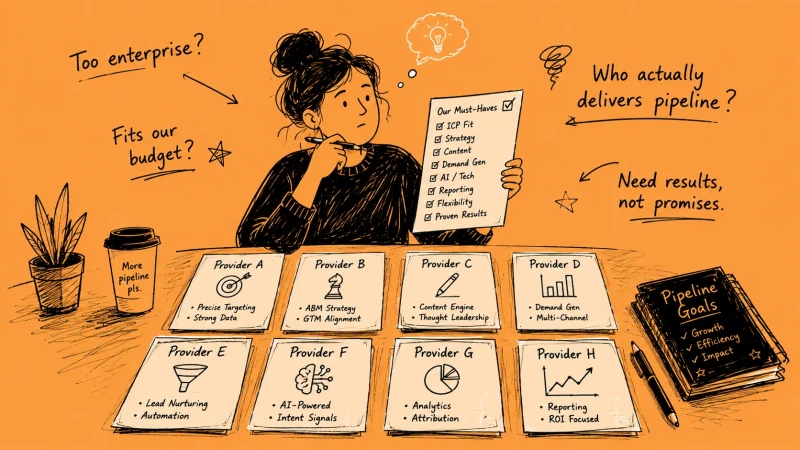
Before you start comparing ABM providers, get clear on the problem you need one to solve. The best partner for weak account data may be the wrong choice for a team that already has strong intent signals but lacks campaign capacity or revenue attribution.
Valasys Media is strongest for intent-led account intelligence and managed activation. Directive stands out for performance marketing and revenue operations. SaaSMQL offers the clearest packaged program, while 2X is a practical choice for teams that need additional execution capacity.
ABM has a habit of looking more mature in a presentation than it does inside the CRM. A polished target-account spreadsheet means little when account ownership is unclear, buying groups are incomplete, campaign signals are disconnected, and sales does not know which accounts to contact first.
The right provider should help your team answer four practical questions:
- Which accounts are worth pursuing?
- Which people influence the purchase?
- Which action should marketing or sales take next?
- How will the program connect to qualified pipeline?
This comparison evaluates eight managed ABM providers based on SaaS relevance, account intelligence, campaign execution, revenue measurement, commercial transparency, and suitability for US and APAC programs.
There is no universal winner for every SaaS company. A team with poor account data needs a different partner from one that already has reliable intent signals and experienced operators but cannot create campaigns quickly enough. The rankings below reflect overall suitability for a mid-market SaaS team, while each provider is also evaluated for the specific situation in which it is most useful.
Editorial disclosure: Valasys Media publishes this comparison and is included in the ranking. Every provider was assessed using the same documented criteria and publicly available evidence verified through July 2026. Provider-reported results are presented as case examples.
Key Takeaways
- Valasys Media is suitable for intent-led account intelligence and managed multichannel activation.
- Directive is the strongest alternative when paid media, conversion, CRM workflows, attribution, and RevOps are the primary requirements.
- SaaSMQL offers the clearest public pricing: its Starter plan begins at $6,000 per month for 100–200 accounts, while Growth begins at $8,000 per month for 200–500 accounts. Direct-mail spending is separate, and its standard engagement is six months.
- 2X is best for execution capacity when an internal team needs recurring campaign, content, data, MarTech, and operations support.
- INFUSE is best for global buying-group activation, with publicly documented support across more than 60 countries and 40 languages.
- The ABM Agency is best for intensive 1:1 and 1:few programs, while Ironpaper is most differentiated around active, high-value opportunities.
- No provider should be selected from a ranking alone. Ask at least two shortlisted firms to propose the same pilot using identical account, budget, staffing, and measurement requirements.
Does This Guide Compare ABM Services or ABM Software?
This guide compares managed ABM services and agencies, not standalone ABM platforms.
Search results often mix service providers with platforms such as 6sense, Demandbase, RollWorks, HubSpot, Terminus, Recotap, and ZoomInfo. These categories overlap, but they are not interchangeable.
Salesforce defines account-based marketing as a strategy supported by products rather than a product by itself. Software can provide account data, advertising, orchestration, personalization, intent signals, or analytics. A managed provider supplies the people and processes needed to turn those capabilities into an operating program.
Choose an ABM platform when your company already has:
- A validated ideal customer profile
- An experienced ABM owner
- Reliable account and contact data
- Paid-media and campaign expertise
- Content-production capacity
- CRM and marketing-operations support
- Sales participation
- Account-level reporting
Choose an ABM service when several of those elements are missing, disconnected, or under-resourced.
Looking for software instead of managed services?
If your team already has an experienced ABM owner, mature CRM processes, and campaign execution capabilities, compare the leading AI ABM platforms before choosing a managed provider. Read our guides:
What Are ABM Services?
Account-based marketing services are strategy, data, campaign, technology, and sales-alignment services used to acquire or expand a defined set of high-value business accounts.
ABM organizes marketing and sales activity around named companies and their buying groups. It differs from conventional lead generation because an individual contact is not treated as the complete opportunity.
ABM services may include:
- Total addressable market analysis
- Ideal customer profile development
- Account identification and tiering
- Firmographic and technographic enrichment
- Intent-data analysis
- Buying-committee mapping
- Contact discovery
- Account-specific messaging
- Paid search, social, display, and programmatic media
- Email, direct mail, content syndication, webinars, and events
- CRM and marketing-automation workflows
- Sales alerts and enablement
- Attribution and executive reporting
A practical account-based marketing framework connects account selection, tiering, stakeholder mapping, personalized activation, sales follow-up, and revenue measurement. Valasys also provides separate guides to building an ICP from total addressable market data and mapping B2B buying committees.
Quick Comparison of the Best ABM Services
| Rank | Provider | Best for | Pricing visibility | Main limitation |
| 1 | Valasys Media | Intent-led account intelligence and managed activation | Complimentary VAIS access is promoted; managed services require a quote | upfront alignment may be needed to define scope and pricing. |
| 2 | Directive | Performance marketing, attribution, and RevOps | Custom pricing | Broad engagements may exceed the needs of a focused pilot |
| 3 | SaaSMQL | Packaged SaaS ABM and direct mail | Starts at $6,000 per month | Direct mail, media, and related costs are separate |
| 4 | 2X | Outsourced campaign and marketing-operations capacity | Custom subscription scope | Requires strong internal prioritization and governance |
| 5 | INFUSE | Global buying-group and content-led activation | Custom pricing | Engagement and intent definitions require careful review |
| 6 | Gripped | Integrated digital ABM for SaaS | From £3,500; broader plans start at £7,500 and £15,000 | Primarily UK- and Europe-centered |
| 7 | The ABM Agency | High-touch 1:1 and 1:few ABM | Custom pricing | Enterprise positioning may not fit every mid-market budget |
| 8 | Ironpaper | Deal-based ABM and sales enablement | Custom pricing | Less public evidence of broad APAC execution |
How Were the Providers Evaluated?
Every provider was assessed across six areas:
- Mid-market SaaS relevance: Does the provider document SaaS expertise or a service model appropriate for an established but resource-constrained SaaS team?
- Managed execution: Can the provider move beyond advice and support campaign production, activation, and optimization?
- Account intelligence: Does it document account selection, intent, enrichment, contact mapping, or buying-group capabilities?
- RevOps and measurement: Does it support CRM integration, routing, attribution, dashboards, sales alignment, or pipeline reporting?
- US and APAC applicability: Is there documented evidence of locations, global delivery, regional experience, languages, or time-zone coverage?
- Commercial transparency: Are prices, account volumes, engagement terms, staffing, or delivery details public?
Evidence Labels
- Strong evidence: Current official documentation identifies the capability and provides meaningful details about how it works, where it operates, what is included, or who it serves.
- Moderate evidence: The capability is documented, but public information about implementation, staffing, scope, regional delivery, or commercial terms is incomplete.
- Limited public evidence: The provider may offer the capability, but current public documentation is too broad or sparse to evaluate confidently.
The ranking order reflects the complete mid-market SaaS use case, not a claim that one firm will outperform every other firm in every engagement.
Provider case studies were treated as evidence that a type of work has been delivered. They were not treated as independently audited benchmarks or typical customer results.
The 8 Best ABM Services for Mid-Market SaaS Teams
1. Valasys Media: Best Overall for Intent-Led ABM
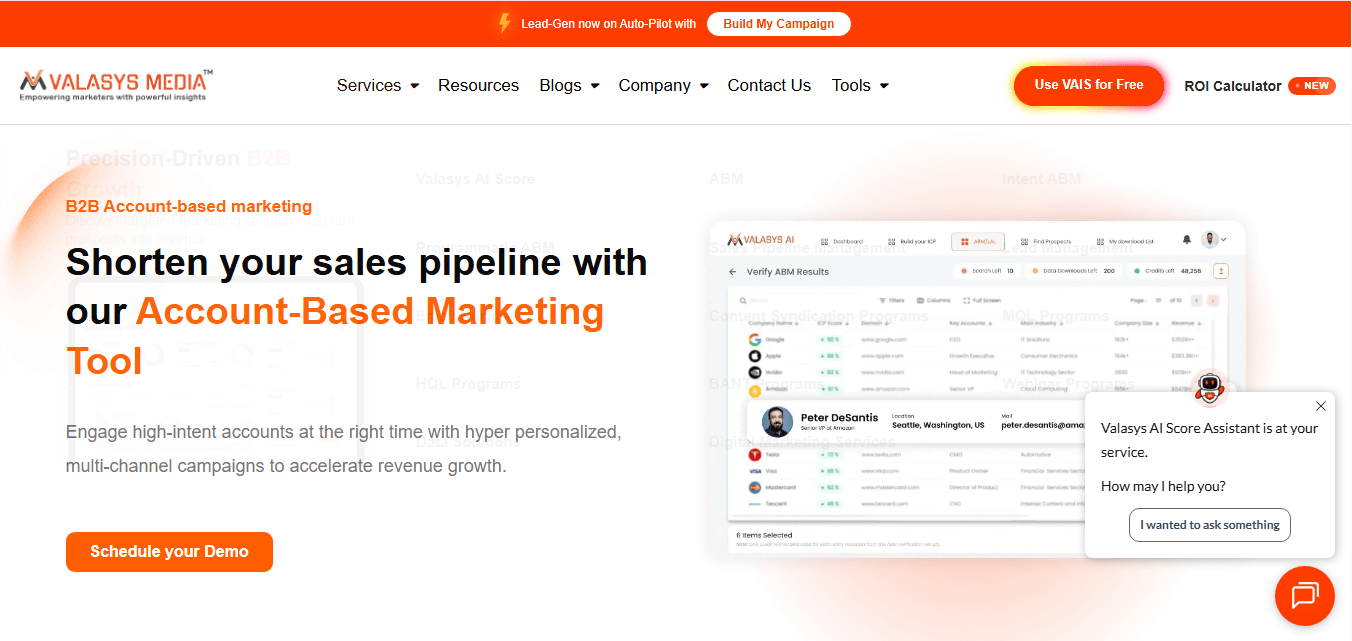 Valasys Media combines account intelligence, buyer intent, contact discovery, programmatic advertising, content syndication, nurture, and managed ABM services.
Why Valasys Ranks First
Valasys ranks first because its documented service portfolio covers the complete path from identifying suitable accounts to activating them across paid and owned channels.
Its intent-based ABM service uses account fit and behavioral signals to prioritize companies showing relevant research activity. The company states that its intent information can come from B2B data providers, third-party publishers, and proprietary platforms.
Its programmatic ABM service supports targeting through channels including LinkedIn, programmatic display, native advertising, video, email, and retargeting.
VAIS adds account-building, fit scoring, intent analysis, prospect discovery, campaign recommendations, and account prioritization. A July 2026 Valasys guide describes a workflow combining ICP criteria, firmographics, technographics, and Bombora topic intent to create ranked account lists.
Best for: SaaS teams that need better account selection, intent prioritization, contact coverage, and managed activation.
Main advantage: Account intelligence and campaign execution are available within the same service ecosystem.
Main limitation: Teams may need a little upfront alignment to choose the right mix of services.
Practical Use Case
A cybersecurity SaaS company could begin with 2,000 possible accounts across the United States and APAC. Valasys could help narrow that universe using industry, company size, installed technology, product fit, and intent activity.
The highest-fit accounts could move into sales outreach, programmatic advertising, content syndication, or nurture based on their apparent funnel stage. The team could refresh its account list as buying activity changes rather than treating the original list as permanent.
Valasys has offices in the United States, India, and the UAE.
Choose Valasys When
Choose Valasys when the primary problem is not simply campaign production. Choose it when your team also needs help deciding which accounts fit, which appear active, which contacts matter, and which activation path is appropriate.
Avoid or Narrow the Scope When
A broad managed engagement may be unnecessary when your team already has:
- Clean account and contact data
- Established intent sources
- An internal ABM leader
- Mature campaign operations
- Paid-media expertise
- Reliable account-level reporting
Closest alternatives: INFUSE for global buying-group activation and Directive for performance marketing and RevOps.
2. Directive: Best for Revenue-Focused SaaS Growth
 Directive connects ABM with paid media, conversion optimization, CRM processes, attribution, and revenue operations.
Why Directive Ranks Second
Directive is the strongest alternative for companies that know which accounts they want but struggle to turn account engagement into a measurable pipeline.
Its RevOps service documents support for attribution, reporting, scoring, routing, integrations, and ABM or ABX initiatives. Directive defines RevOps as the alignment of marketing, sales, and customer success through shared processes, technology, data, and reporting.
Directive also publishes SaaS-focused ABM guidance that connects account strategy to annual contract value, sales-cycle length, buying-group complexity, integration requirements, and the level of human coverage required to win.
Best for: SaaS companies that need account-based paid media and stronger revenue measurement.
Main advantage: Strong documented alignment between campaign execution, conversion, CRM operations, and attribution.
Main limitation: A broad performance engagement may be more than a focused ABM pilot requires.
Practical Use Case
A workflow-automation company could target 300 financial-services accounts. Directive might build separate campaigns for operations, IT, finance, and security buyers, improve landing-page conversion, configure sales routing, and report on qualified opportunities and pipeline.
The benefit is not merely better advertising. It is a clearer connection between account engagement, sales action, and commercial progression.
Choose Directive When
Choose Directive when the target market is reasonably clear but your paid channels, conversion paths, CRM workflows, and attribution system do not work together.
Avoid or Narrow the Scope When
Directive may not be the best fit when your only need is:
- Account data
- Contact discovery
- A direct-mail campaign
- Short-term production support
- Research for a small number of strategic accounts
Closest alternative: Gripped for integrated SaaS digital marketing with more public pricing information
3. SaaSMQL: Best for Packaged SaaS ABM
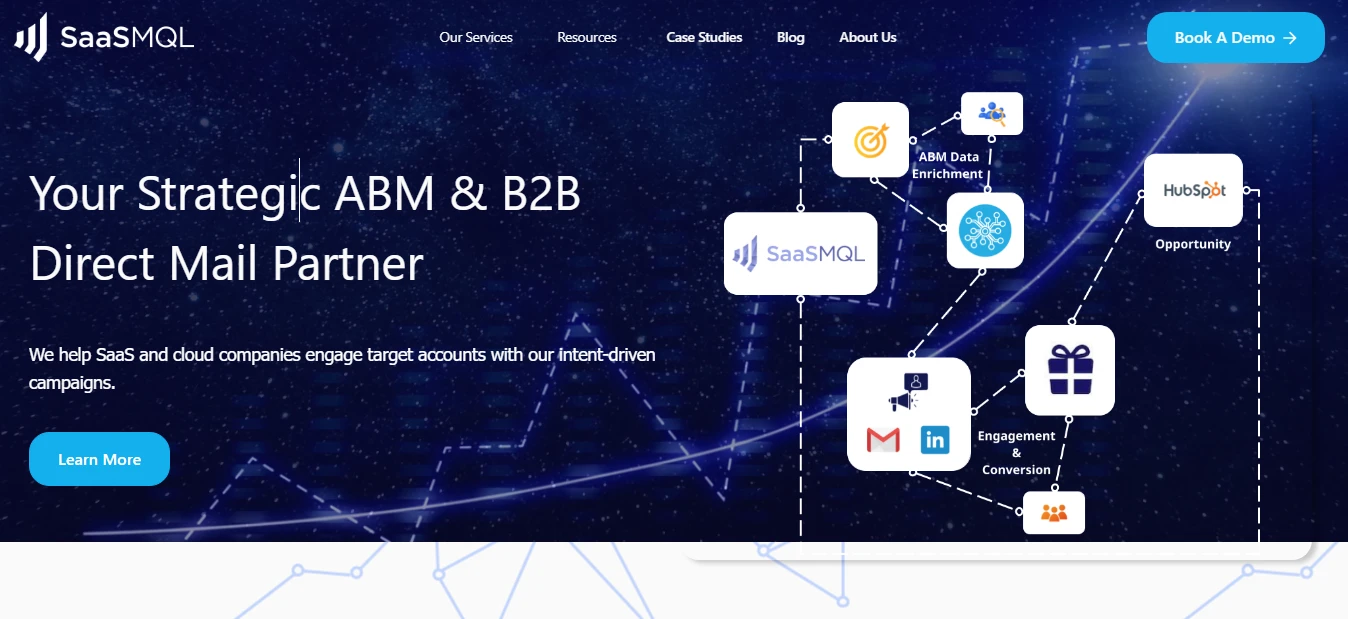 SaaSMQL is a SaaS-focused ABM agency that combines account selection, contact mapping, email, paid media, personalized landing pages, direct mail, sales alerts, and pipeline reporting.
Why SaaSMQL Ranks Third
SaaSMQL provides the strongest commercial transparency in this comparison.
As of July 22, 2026, its Starter plan begins at $6,000 per month for 100–200 accounts. Its Growth plan begins at $8,000 per month for 200–500 accounts. Enterprise pricing is custom. Direct-mail spending is invoiced separately, and the standard engagement is six months.
The provider documents a three-part model:
- Build and tier the account universe
- Engage buying roles through coordinated channels
- Route activity to sales and measure opportunities and revenue
Its default channel mix can include LinkedIn, email, personalized landing pages, direct mail, retargeting, content syndication, and event activation.
Best for: SaaS teams that want a defined, done-for-you program with direct mail.
Main advantage: Transparent pricing, account ranges, channels, and engagement terms.
Main limitation: The base retainer does not represent the complete cost once direct mail, media, production, data, and internal labor are included.
Practical Use Case
A cloud-data company could place 150 priority US accounts into the Starter program. Different messages could be created for engineering and finance stakeholders, with direct mail used selectively for top-tier accounts and email or LinkedIn used across the broader group.
Sales could receive alerts after meaningful engagement rather than working through the list in alphabetical order.
Choose SaaSMQL When
Choose SaaSMQL when 100–500 accounts fit your initial motion, the six-month term fits your sales cycle, and direct mail is relevant to your audience.
Avoid or Narrow the Scope When
Direct mail may be a poor fit when:
- Account value is too low to justify production and shipping
- Buyers work remotely or addresses are difficult to verify
- Target accounts span markets with complex customs or privacy requirements
- Your internal team already manages account orchestration
Closest alternative: The ABM Agency for deeper 1:1 research and personalization.
4. 2X: Best for Scaling Execution Capacity
2X is a managed marketing and GTM services provider offering campaign operations, content, data, MarTech, revenue operations, creative production, and GTM engineering.
Why 2X Ranks Fourth
2X is most useful when strategy exists but the internal team cannot complete the operating workload.
Following its 2026 acquisition of The Kiln, 2X reported nearly 1,300 team members across the United States, Malaysia, and the Philippines. Its documented services include GTM engineering, marketing operations, MarTech management, campaign building, optimization, content, creative production, RevOps, sales technology, and consulting.
This delivery footprint can be particularly relevant to US companies that need APAC time-zone coverage or a larger operating team without hiring each role separately.
Best for: Lean marketing teams with a recurring campaign and operations backlog.
Main advantage: Broad execution capacity across marketing and revenue systems.
Main limitation: A capacity model can generate activity without commercial focus unless internal ownership and prioritization are strong.
Practical Use Case
A mid-market SaaS company with roughly 100 employees and a lean marketing team might already use Salesforce, HubSpot, LinkedIn, and an intent platform but employ only one demand-generation manager.
2X could supply campaign operations, data maintenance, creative production, marketing automation, dashboard support, and paid-media execution. The internal team would retain ownership of product positioning, account economics, and sales priorities.
Choose 2X When
Choose 2X when your team knows what needs to be done but cannot complete the work consistently.
Avoid or Narrow the Scope When
2X is less appropriate for:
- A one-time account list
- A short research engagement
- A single creative campaign
- Executive strategy without ongoing execution
Require the proposal to distinguish dedicated staff from shared specialists and name each person’s seniority, location, expected capacity, and responsibilities.
Closest alternative: Directive when pipeline performance and attribution matter more than broad execution capacity.
5. INFUSE: Best for Global Buying-Group Activation
INFUSE combines buying-group intelligence, content activation, demand generation, account engagement, and real-time program reporting.
Why INFUSE Ranks Fifth
INFUSE offers the strongest public evidence of global reach among the providers reviewed.

Its official technology page states that INFUSE supports clients across more than 60 countries and 40 languages. The company also documents buying-group identification, real-time program analytics, ABM reach, intent scoring, conversion reporting, CRM-connected engagement insights, and 24/5 client support.
INFUSE can also work with ABM platforms such as 6sense and Demandbase, combining partner intent data with demand execution and buying-group engagement.
Best for: SaaS companies running content-led programs across multiple countries and buying roles.
Main advantage: International delivery and documented buying-group capabilities.
Main limitation: Buyers must establish precise definitions for engagement, intent, qualified accounts, and sales readiness.
Practical Use Case
An observability platform could target 600 accounts across the United States, India, Singapore, Japan, and Australia.
INFUSE could distribute role-specific content to engineering, security, finance, and procurement audiences, then identify accounts where engagement extends across several parts of the buying group.
The operational benefit is broader stakeholder coverage. Sales receives account context rather than a disconnected collection of content downloads.
Choose INFUSE When
Choose INFUSE when global reach, content activation, and buying-group participation matter more than customized treatment for a handful of accounts.
Avoid or Narrow the Scope When
Do not treat content consumption as proof that an account has entered a purchase process.
Ask the provider to define:
- Engagement
- Intent
- Qualified account
- Complete buying group
- Sales-ready account
- Sourced pipeline
- Influenced pipeline
Closest alternative: Valasys for stronger emphasis on intent-led account discovery and programmatic activation.
6. Gripped: Best for Integrated Digital ABM
 Gripped is a B2B SaaS and technology agency offering ABM alongside paid media, content, SEO, conversion optimization, and digital strategy.
Why Gripped Ranks Sixth
Gripped is a practical choice when an ABM campaign would be undermined by weak positioning, limited content, poor landing pages, or disconnected digital channels.
Its ABM service documents account-specific campaigns across LinkedIn, personalized landing pages, customized content, and coordinated sales outreach.
Gripped also provides unusually useful pricing guidance. Its Advisory or Execution model begins at £3,500 per month plus project fees. Performance engagements begin at £7,500 per month, while its Scale model begins at £15,000 per month. It states that typical strategic engagements range from £5,000 to £15,000 per month and that paid-media budgets are separate.
Best for: SaaS teams that need ABM integrated with digital demand generation.
Main advantage: SaaS specialization and transparent pricing guidance.
Main limitation: Most clients are based in the UK or Europe, although Gripped states that it has run campaigns in North America and APAC.
Practical Use Case
A UK-based HR software provider expanding into the United States could use Gripped to refine its positioning, create buyer-specific content, run target-account advertising, and improve account landing pages.
The result would be a coordinated digital experience rather than an ABM campaign disconnected from the company’s website and core messaging.
Choose Gripped When
Choose Gripped when your account strategy depends on repairing or scaling the broader digital marketing system.
Avoid or Narrow the Scope When
Gripped is not the strongest option for global content syndication, extensive intent-data operations, direct-mail logistics, or deeply researched 1:1 campaigns.
Closest alternative: Directive for deeper attribution and RevOps support.
7. The ABM Agency: Best for High-Touch 1:1 ABM
The ABM Agency specializes in enterprise 1:1, 1:few, and 1:many programs involving research, strategy, creative, media, direct mail, events, technology, and sales enablement.
Why The ABM Agency Ranks Seventh
The ABM Agency may be the strongest option on this list for one narrow use case: a small group of highly valuable accounts that justify intensive research and custom creative.
Its official site documents SaaS experience, 1:1 and 1:few campaigns, pilot programs, content, paid search, programmatic advertising, LinkedIn, marketing automation, direct mail, gifting, digital out-of-home advertising, events, technology consulting, and sales enablement.
The provider states that 1:few programs typically group five to 15 accounts and that pilot campaigns can often launch within 21 days. It also says it can support campaigns across North America, Latin America, EMEA, and APAC. These are provider-stated capabilities and timelines that should be confirmed in the contract.
Best for: Strategic accounts, high-ACV opportunities, and enterprise expansion.
Main advantage: Deep specialization in account-specific and cluster-specific ABM.
Main limitation: Enterprise positioning and high-touch production requirements may exceed many mid-market budgets.
Practical Use Case
A compliance SaaS company could select 12 international financial institutions for individual research, buying-group mapping, account-specific business cases, executive outreach, personalized media, and sales enablement.
This approach can create meaningful relevance, but it requires significant participation from sales and subject-matter experts.
Choose The ABM Agency When
Choose this provider when each selected account is commercially important enough to justify custom research and creative work.
Avoid or Narrow the Scope When
Do not use high-touch 1:1 ABM when one successful contract would not comfortably cover the complete cost of strategy, research, content, media, sales time, and production.
Closest alternative: SaaSMQL for a more standardized SaaS-focused program.
8. Ironpaper: Best for Deal-Based ABM
 Ironpaper is a US-based B2B marketing agency offering ABM strategy, buyer-focused content, advertising, sales enablement, and deal-based ABM.
Why Ironpaper Ranks Eighth
Ironpaper has a more focused position than the other providers: applying account-based marketing to active, valuable opportunities.
Its deal-based ABM service concentrates marketing resources on named opportunities already in the pipeline. Ironpaper describes the model as a way to align sales and marketing around critical deals, educate stakeholders, strengthen the business case, improve win rates, and protect existing pipeline.
Its SaaS ABM offering also documents targeted advertising, buyer-focused messaging, personalized content, sales enablement, and conversion support.
Best for: High-value SaaS opportunities that are active, competitive, or stalled.
Main advantage: A clear focus on deal progression rather than only top-of-funnel account acquisition.
Main limitation: Less evidence of large-scale APAC delivery, global syndication, or a proprietary account-intelligence layer.
Practical Use Case
A healthcare SaaS company could select 15 enterprise opportunities that have stalled after technical evaluation.
Ironpaper could help identify missing buying roles and create security, implementation, ROI, and executive-level content. Marketing could then support sales with targeted advertising and role-specific follow-up.
Choose Ironpaper When
Choose Ironpaper when the immediate priority is moving important opportunities already in the pipeline.
Avoid or Narrow the Scope When
Ironpaper is not the clearest fit for broad global audience activation, extensive intent-data implementation, offshore marketing operations, or large content-syndication programs.
Closest alternative: Gripped for broader digital demand generation.
How Should a Mid-Market SaaS Team Choose?
Select the provider that resolves your most expensive operating constraint.
| Your main constraint | Best-fit provider |
| Weak account selection, intent, or contact data | Valasys Media |
| Poor paid-media performance or revenue attribution | Directive |
| Need for a defined SaaS package and direct mail | SaaSMQL |
| Insufficient execution and marketing-operations capacity | 2X |
| Need for international buying-group activation | INFUSE |
| Weak content, positioning, website, or digital demand | Gripped |
| A small number of highly valuable strategic accounts | The ABM Agency |
| Important active opportunities are stalled | Ironpaper |
A RevOps Scenario
A RevOps leader at a Series C SaaS company inherits 2,400 named accounts, three separate intent feeds, inconsistent account ownership, and no shared definition of an engaged account. Marketing reports rising engagement while sales reports little change in qualified pipeline.
The company does not need another dashboard first. It needs account-matching rules, tier definitions, buying-group coverage, sales-response criteria, and one reporting model.
A provider strong in account intelligence and operations would be more useful than a specialist creative agency in that situation. Once the operating foundation works, the company can add more sophisticated personalization and media.
This is the central buying principle: select the provider for the problem that exists, not the ABM program you hope to have two years from now.
How Do You Implement an ABM Services Engagement?
1. Define One Commercial Result
Choose one primary result for the initial program, such as:
- Qualified opportunities
- New-logo pipeline
- Expansion pipeline
- Deal acceleration
- Penetration of a strategic account group
“Improve awareness and generate demand” is too broad.
A stronger objective is: “Create 12 sales-accepted opportunities from 120 named cybersecurity accounts within six months.”
2. Build a Defensible ICP
Analyze:
- Closed-won customers
- Retention and expansion
- Industries
- Company sizes
- Geographies
- Technology environments
- Implementation requirements
- Common buying triggers
- Reasons opportunities are lost
The output should include both inclusion and exclusion criteria. A large total addressable market is not an actionable account list. The guide to using TAM to build an ICP provides a practical starting point.
3. Tier Accounts by Economic Value
Use a simple model:
- Tier 1: Individual account research and custom treatment
- Tier 2: Small clusters with shared business needs
- Tier 3: Scaled account targeting with lighter personalization
Do not call every recognizable logo a Tier 1 account. The expected contract value, likelihood of winning, margin, and required effort should justify the tier.
4. Map the Buying Committee
Identify the roles involved in:
- Problem definition
- Evaluation
- Technical approval
- Security
- Budget
- Procurement
- Implementation
- Adoption
- Executive sponsorship
HubSpot’s ABM documentation uses target accounts and buying roles as distinct data elements, reinforcing the need to connect contacts to account-level activity.
Valasys provides detailed guidance on buying-committee mapping and interpreting buying-committee intent signals.
5. Establish the Data and Routing Model
Before activating campaigns, document:
- Account hierarchy
- Domain-matching rules
- Contact-to-account association
- Duplicate handling
- Intent sources
- Consent and retention
- Sales ownership
- Engagement thresholds
- Alert routing
- Opportunity attribution
- Regional privacy requirements
Technology cannot repair a strategy the team has not defined. Valasys discusses this problem in its guide to fixing ABM software adoption.
6. Build Role-Relevant Campaigns
Different stakeholders need different information.
- A CFO may need a cost and risk case.
- A technical buyer may need architecture and integration details.
- A security reviewer may need controls and data-handling documentation.
- An operations leader may need an implementation plan.
- An executive sponsor may need strategic and organizational outcomes.
Changing the company name in generic copy is not meaningful personalization.
7. Launch a Controlled Pilot
Start with a manageable account group, limited channels, and a predefined review date.
A pilot should test:
- Account accuracy
- Buying-group coverage
- Message relevance
- Channel performance
- Sales follow-up
- Opportunity creation
- Reporting reliability
- Provider responsiveness
Do not scale because impressions or clicks increased. Scale when the operating model shows credible account and opportunity progression.
8. Measure Revenue Progress
Track:
- Target-account reach
- Engaged accounts
- Buying-group coverage
- Sales-accepted accounts
- Qualified opportunities
- Pipeline created
- Pipeline influenced
- Win rate
- Deal velocity
- Cost per opportunity
- Revenue per target account
Keep sourced, influenced, and assisted pipeline separate. Valasys has a B2B SaaS ROI calculator for translating campaign inputs into pipeline and profitability measures.
ABM Provider Decision Checklist
Before signing, verify that:
- The provider has experience with a SaaS sales motion similar to yours.
- The program has one primary commercial objective.
- Account criteria use customer and pipeline evidence.
- Every account has a documented tier and sales owner.
- Minimum buying-group coverage is defined.
- Data and intent sources are disclosed.
- Account matching and CRM routing have been tested.
- Sales has agreed to response times and required actions.
- Engagement and qualified intent have separate definitions.
- Sourced and influenced pipeline are reported separately.
- The proposal names the delivery team, seniority, and locations.
- Dedicated and shared resources are distinguished.
- Total cost includes data, media, production, software, and internal labor.
- Deliverables and revision limits are documented.
- US and APAC privacy requirements have been reviewed.
- Exit terms cover account data, creative files, reports, and documentation.
- A formal scale, revise, or stop date is scheduled.
Common ABM Mistakes
| Mistake | Consequence | Correction |
| Starting with a purchased list | Sales rejects accounts and media is wasted | Build the list from ICP, customer, pipeline, and intent evidence |
| Treating one contact as an account | Deals stall when unknown stakeholders appear | Define minimum buying-group coverage |
| Treating intent as proof of purchase | Sales receives premature or misleading alerts | Combine intent with fit, first-party behavior, and sales evidence |
| Personalization theater | Production costs rise without improving relevance | Personalize around a verified problem, role, or business trigger |
| Optimizing for MQL volume | Teams pursue contacts rather than account progression | Measure opportunities, pipeline, and revenue by account |
| Scaling too early | Operational problems become more expensive | Set pilot success criteria before launch |
| Ignoring total cost | The financial case collapses after extra fees appear | Model services, media, data, production, and internal labor |
| Copying US campaigns into APAC | Messages, channels, or processes underperform | Review language, privacy, timing, culture, and local buying behavior |
| Outsourcing account strategy completely | The program drifts away from business priorities | Retain executive ownership of ICP and account economics |
| Crediting every touched deal to ABM | ROI becomes inflated and unreliable | Separate sourced, influenced, and assisted pipeline |
DIY ABM vs. Professional Support
| Factor | DIY ABM | Professional support |
| Cost | Lower external fees but requires internal salaries and tools | Service fees plus media, data, and production |
| Control | Maximum direct control | Shared control governed by the contract |
| Speed | Fast only when skills and systems already exist | Can add specialists and operating capacity quickly |
| Expertise | Must exist internally | Provider supplies several disciplines |
| Knowledge retention | Stays inside the company | Requires documentation and knowledge transfer |
| Main risk | Underused tools and inconsistent execution | Vendor dependency, generic work, or hidden costs |
| Best suited for | Mature teams with an ABM owner | Lean teams or companies building a new motion |
Choose DIY when you already have a credible ICP, experienced leadership, clean data, campaign capacity, sales alignment, and reliable measurement.
Choose professional support when two or more of those capabilities are missing or when the internal team cannot add them within the required planning period.
To sum it up
Valasys Media is the best overall provider of ABM Services for Mid Market SaaS Teams tha