Win every stakeholder in your target account
Map all stakeholders and their roles in one place, track influence levels and engagement status, and turn complex buying groups into closed deals with the right data.
 Lead-Gen now on Auto-Pilot with
Build My Campaign
Lead-Gen now on Auto-Pilot with
Build My Campaign

Discover how intent data reveals buying committee signals, helping B2B teams identify decision-makers, track engagement, and close deals.

Win every stakeholder in your target account
Map all stakeholders and their roles in one place, track influence levels and engagement status, and turn complex buying groups into closed deals with the right data.
The Short Answer: To identify and engage the full B2B buying committee, map known contacts to buying roles, use first-party and third-party signals to spot missing stakeholders, then tailor outreach to each role’s priorities. Update the map as the deal progresses.
They need to map who is involved in the purchase, understand what each stakeholder cares about, and use behavioral, intent, firmographic, and technographic signals to find the people they haven’t met yet. Then they need to engage each stakeholder differently, with a reason that actually makes sense to that person. The rest of this article shows you how.
The problem most teams run into isn’t a lack of signals. It’s not knowing whose signals they’re reading, or who they’re still missing entirely.
According to Gartner’s B2B Buying Survey, the average B2B buying group involves 6–10 decision-makers, with each stakeholder conducting independent research and bringing different priorities to the decision. The CFO is scrutinizing ROI. The IT lead is stress-testing your security posture. The end user is checking review sites. Procurement is benchmarking your pricing against competitors.
Each of them leaves a trail. Intent data gives you the composite picture. But tracking signals is only half the job. The harder question is who those signals are coming from, what role those people play, and who you still haven’t found.
Before you can close those gaps, though, you need to understand what happens when your team only has one relationship inside the account.
Deals die in the dark, in conversations you were never part of. Forrester’s 2025 Buyers’ Journey Survey found that 68% of B2B buyers already have a front-runner vendor in mind at the very start of the purchasing process, and that front-runner wins 80% of the time. By the time your team is monitoring direct website traffic from one contact, the buying group may already have formed preferences across third-party review sites, industry publications, LinkedIn, and competitor comparison pages. You’re not necessarily watching the beginning of the decision. You may be watching a validation process already underway.
So the goal is not simply to find more contacts. It’s to understand which people actually matter to the decision and what role each one plays.
Win every stakeholder in your target account
Map all stakeholders and their roles in one place, track influence levels and engagement status, and turn complex buying groups into closed deals with the right data.
Multi-threaded signal monitoring, tracking intent across all stakeholders in an account, not just your primary contact, is what separates elite ABM teams from average ones.
Buying committee composition varies by deal, company size, solution, and buying context. These roles are a working framework, not a rigid checklist. In some deals, one person fills multiple roles; in others, certain roles don’t apply at all.
The goal isn’t to assign every contact a label. It’s to use behavioral, intent, firmographic, and technographic signals to determine which roles are represented, which are missing, and who your team should engage next.
| Role | Signals That May Identify Them | Coverage Check | If the Role Is Missing |
| Champion | Repeat content engagement, case study downloads, demo requests, active conversations with sales | Is someone actively advocating for the solution internally? | Look for the stakeholder showing the strongest sustained engagement and build a relationship around their business case. |
| Decision-maker | Executive-level content engagement, strategic topic research, competitor comparisons, seniority signals | Do you have access to someone who can influence or approve the decision? | Use account and organizational signals to identify the relevant senior stakeholder and determine whether they are engaged. |
| Economic buyer | ROI calculator engagement, repeat pricing page visits, financial or business-case content | Is someone with budget authority identified and engaged? | Look for senior financial or business stakeholders showing relevant intent and prioritize them for outreach. |
| Technical evaluator | Security document downloads, API documentation visits, technical specification engagement | Has someone responsible for technical evaluation entered the conversation? | Use role, technology, and engagement signals to identify the likely technical stakeholder and address the gap before late-stage evaluation. |
| Procurement | Pricing page visits, vendor comparison activity, late-stage re-engagement | Is procurement known before commercial discussions begin? | Identify procurement stakeholders through organizational data and prepare to engage them before contracting. |
| Legal | Privacy policy visits, DPA/MSA requests, compliance-content engagement, late-stage activity | Is the stakeholder responsible for contractual or compliance review known? | Identify the relevant legal or compliance stakeholder early enough to prevent an unexpected late-stage gap. |
| User influencer | Product-page engagement, feature or use-case research, product reviews, implementation-content engagement, repeated interaction with solution-specific content | Is someone who will use, recommend, or influence adoption of the solution represented? | Identify stakeholders whose role, workflow, or day-to-day responsibilities align with the solution and engage them around usability, fit, and practical outcomes. |
The point of the framework is not to assume that a particular title equals a particular buying role. Signals help validate the role a person is actually playing in the purchase. A VP of Marketing might be the champion in one deal, the decision-maker in another, or simply an influencer in a larger buying group.
Once you have a working picture of the roles involved, the next challenge is figuring out who actually fills those roles inside a target account, which roles remain dark, and who your team should engage next. That’s where the identification process begins.
Establish the target account and buying context first. What problem are they solving, and what signals suggest they’re in-market? This determines which buying roles are likely relevant to this deal.
Pull every existing contact from your CRM and map them against the framework above, using engagement behavior, seniority, and what they’ve been consuming, rather than job title alone. A “VP of Marketing” might be the champion or a secondary stakeholder depending on the deal.
Compare your contact map against the roles that typically matter for this purchase type. Use CRM data, organizational research, and sales discovery to identify who may fill those roles; then use intent signals to prioritize which missing stakeholders and gaps matter most. Common gaps include no economic buyer identified, no technical evaluator engaged, procurement unknown, or legal never surfaced.
Determine which roles are well covered, partially covered, or completely dark. A contact you haven’t heard from in three months is not “covered.” Be honest about where you’re single-threaded and what that risk looks like if your champion leaves or loses internal support.
Decide who needs to be engaged, by whom, and with what message based on what each stakeholder actually cares about. This is not about contacting everyone at the company. It’s about building relevant relationships with the specific stakeholders who influence this purchase.
Mapping the committee gives you visibility, but visibility alone doesn’t tell you whether the account is well covered. You can know several people at an account and still have a major gap in the buying process.
Having six contacts at an account is not the same as having six meaningful relationships across the relevant buying roles. You could have six contacts who all report to the same VP, share the same perspective, and none of whom can approve the budget.
Real account coverage means:
The team that answers these questions honestly and acts on the gaps is the team that stops losing deals they thought they were winning.
Multithreading doesn’t mean blasting everyone with the same message. Each stakeholder needs a reason to engage that’s relevant to them.
Champion: Give them internal advocacy tools. Business case templates, ROI summaries, competitive one-pagers, basically, materials they can take into rooms you’ll never be in.
Decision-maker: Focus on strategic priorities, organizational impact, and decision risk. Show how the solution supports broader business objectives and why the decision makes sense beyond the immediate problem.
Economic buyer: Focus on financial outcomes, payback period, and risk mitigation. They often don’t want to be in the weeds of the evaluation, but they need to feel confident about the financial logic.

Technical evaluator: Be specific. Provide architecture diagrams, integration documentation, security certifications, and where possible sandbox access. Vague answers to technical questions are a red flag for this persona.
Procurement: Make commercial terms easy to evaluate. Proactive pricing transparency and clear vendor differentiation reduce friction at a stage where friction is expensive.
Legal: Don’t wait for them to ask. Surface your DPA, relevant certifications, and compliance documentation early. Delays at legal are almost always caused by surprise.
User influencer: Focus on practical value, usability, and day-to-day impact. Give them product walkthroughs, use-case examples, implementation details, and proof points that help them assess whether the solution actually fits their workflow. When users can see how the solution makes their work easier or more effective, they’re more likely to become internal advocates.
Even with a thoughtful multithreading strategy, some gaps are easy to miss. In practice, the problem is often less about having no contacts and more about having the wrong coverage at the wrong stage of the deal.
Finding these gaps manually isn’t always easy, especially when buying activity is happening across multiple people and channels. That’s where intent data can help connect the dots.
Think of intent data as sonar for your revenue team. Without it, you’re navigating by sight. With it, you’re detecting movement at depth: accounts warming, committees assembling, and decisions taking shape before the surface tension breaks into an RFP. By identifying buying intent before procurement begins, organizations can prepare more effectively for the proposal stage, where RFP AI can accelerate response creation and improve the quality of submissions.
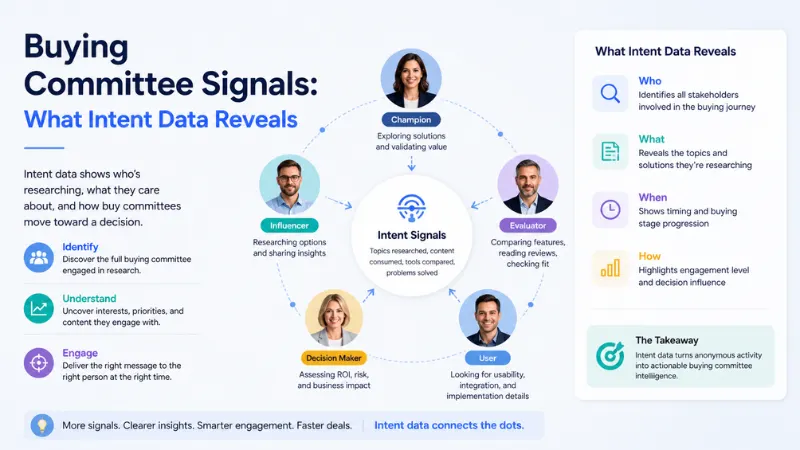
The signals that matter most map directly to buying committee roles:
These are indicators, not certainties. Signals in combination, across multiple contacts at the same account, are what build a coherent picture.
For teams that need to turn account signals into a usable stakeholder map, ZoomInfo combines firmographic, technographic, and intent data with decision-maker and organizational insights. It can help revenue teams uncover high-fit accounts, identify hidden stakeholders in multithreaded buying groups, and prioritize outreach based on buying signals. Its data-enrichment and routing capabilities also help keep CRM records current and move relevant leads to the right reps.
Intent ABM helps revenue teams move from raw signal data to account-level intelligence, surfacing which accounts are in-market and where engagement is concentrated. VAIS (Valasys AI Scoring) takes it further by helping teams operationalize that intelligence: scoring accounts, identifying coverage gaps, and connecting signal data to the ABM workflows that move the pipeline.
None of these require new technology. They require deliberate tracking of information your team is already generating.
The buying committee has always been a complex machine. What’s changed is that it now leaves a measurable trail.
Signals are being generated constantly in your content, on third-party sites, in hiring patterns, in technology adoption cycles, and in the research habits of six to ten stakeholders making a decision that could define your next quarter.
The teams that win are not necessarily the ones with the best product. They’re the ones who identify every relevant stakeholder early, reach the right people at the right moment, and arrive at each conversation already knowing what that specific person cares about.
Ready to close your buying committee gaps? Contact Valasys Media to learn how our intent data and VAIS platform help you map, prioritize, and engage every stakeholder before the deal is decided
Buyer intent signals are behavioral data points that indicate a prospect or buying committee is actively researching a purchase decision. They include actions like visiting pricing pages, downloading comparison guides, engaging with industry content, and searching for solution-specific keywords.
Buying signals are important because they shift your revenue team from reactive to proactive mode. They tell you which accounts to prioritize, which stakeholders to engage, and which message to lead with before the prospect formally enters your pipeline.
More practically, buying signals matter because they:
A buying signal is any observable behavior that suggests a prospect is actively evaluating a purchase. For B2B salespeople, the most actionable signals fall into five categories: engagement signals, intent topic signals, technographic signals, organizational signals, and third-party validation signals.
Here’s a practitioner-grade breakdown of the main buying signals B2B sales teams should actively monitor:
You should update a buying committee map whenever there is a meaningful change in account engagement, buying roles, or deal stage, rather than treating it as a one-time exercise. New stakeholders can enter the process, existing contacts can become inactive, and a stakeholder’s role can change as the evaluation progresses.
At minimum, review the map at key deal stages and when new signals or sales conversations reveal changes in stakeholder activity. The goal is to keep your view of who is involved, which roles are covered, and where gaps remain current enough to guide the next engagement.
Win every stakeholder in your target account
Map all stakeholders and their roles in one place, track influence levels and engagement status, and turn complex buying groups into closed deals with the right data.