
Common Content Syndication Mistakes That Hurt Lead Quality and Pipeline Growth
Discover the most common content syndication mistakes that reduce B2B lead quality, waste marketing budgets, and prevent pipeline growth.

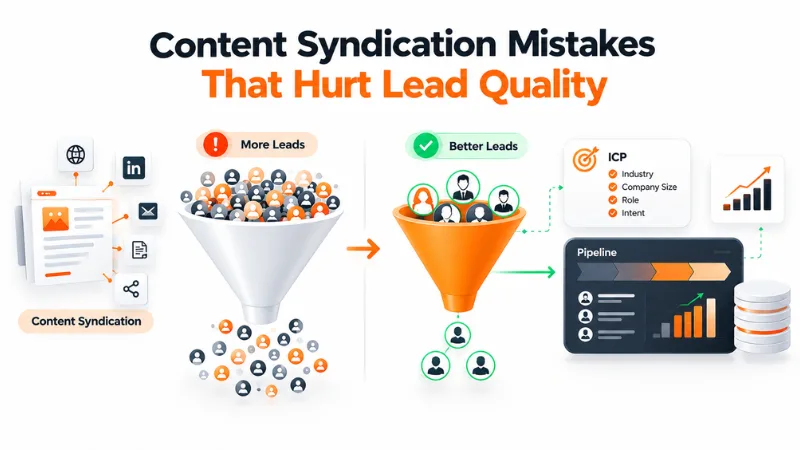
Content syndication can be a powerful B2B demand generation channel, but its impact depends on how strategically it is executed. Many campaigns underperform because they attract engagement without creating meaningful opportunities for sales teams.
The real challenge is not generating downloads, it is reaching the right professionals, from the right accounts, with content that addresses genuine business needs.
When syndication campaigns focus too heavily on volume metrics, they often collect contacts that show surface-level interest but lack purchase intent. Without proper audience targeting, relevant content, effective follow-up, and revenue-focused measurement, content syndication can become a simple database-building activity rather than a pipeline growth strategy.
A content download is an indication of interest, but it does not always represent buying intent.
Understanding this difference helps marketers build campaigns that contribute to qualified opportunities instead of just increasing lead counts.To understand how to build an effective approach, explore our Content Syndication Strategy for B2B Demand Generation
What Are the Common Content Syndication Mistakes That Hurt Lead Quality?
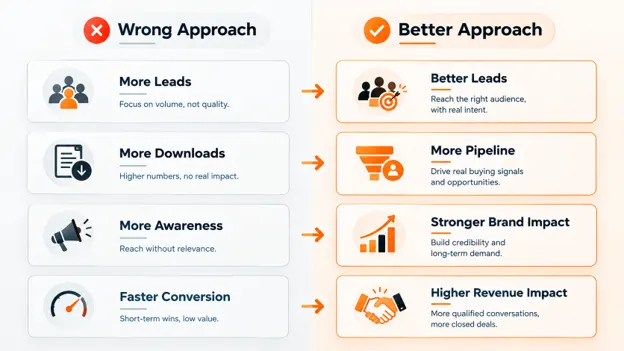
The most common content syndication mistakes that hurt lead quality include poor audience targeting, focusing on lead volume instead of lead relevance, promoting content that attracts attention but lacks buyer intent, treating every download as a sales-ready opportunity, measuring success only through downloads or cost per lead, and failing to nurture prospects after engagement. These issues often result in irrelevant leads, wasted marketing spend, and limited pipeline impact. A successful content syndication strategy requires alignment between audience selection, content relevance, nurturing efforts, and revenue-focused measurement.
Key Takeaways
- Content syndication works best when audience quality matters more than lead volume.
- A lead is valuable only when it matches your ideal customer profile and business context.
- Strong syndication programs connect content, targeting, nurturing, and sales alignment.
- Measuring downloads alone hides whether campaigns actually influence revenue.
- The future of B2B syndication is moving from contact collection toward intent-driven engagement.
The Quiet Problem Behind Modern Content Syndication
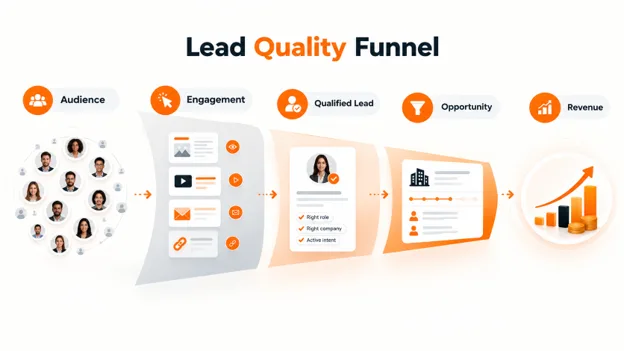
A feeling marketing teams are way too familiar with is when a campaign launches. The numbers start moving. The dashboard fills with green indicators. Hundreds of new contacts enter the CRM.
For a moment, everything looks successful. Then sales begins reviewing the list.
Some people downloaded the content months ago but do not remember the company. Some work outside the target market. Some have no buying authority. Some were simply curious.
The question appears again:
“Why do we have more leads but not more conversations?”
This is the uncomfortable reality of modern B2B marketing.
The internet has made attention easier to capture but harder to understand.
A form fill does not always indicate buying intent. They may be researching, comparing solutions, planning for the future, or simply downloading multiple resources without immediate interest.
The digital environment has created a strange contradiction:
Visibility is easier. Trust is harder.
Content syndication sits directly inside this contradiction.
It helps companies reach audiences beyond their own channels, but the challenge is identifying who is genuinely moving toward a business decision versus those who simply interacted with content.
Successful syndication is driven by relevance, not just reach.
What Is B2B Content Syndication?
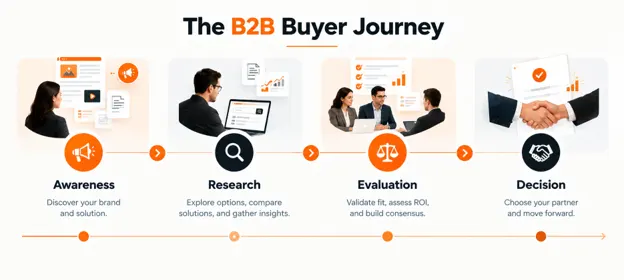
B2B content syndication is the process of distributing valuable content through third-party platforms, publisher networks, industry communities, and media channels to reach potential buyers outside a company’s owned audience.
The content can include:
- Whitepapers
- Research reports
- Industry guides
- Webinars
- Case studies
- Buying guides
- Benchmark reports
The purpose is to introduce valuable information to professionals who may have never discovered the brand through traditional channels.
However, there is an important distinction:
Content syndication creates access, not automatic demand.
A person downloading a report gives a company permission to begin a conversation.
It does not mean the buyer is ready for a sales call.
This is where many companies misunderstand the role of syndication.
They treat the first interaction as the final stage.
But for complex B2B purchases, especially in SaaS, technology, cybersecurity, cloud, and enterprise services, the buying journey is often much longer.
Multiple people influence decisions. Different departments evaluate different risks.
Budget conversations happen internally before vendors ever enter the picture.
That is why B2B Content Syndication for Higher-Quality Leads is about creating relevant engagement, not just generating downloads.
Effective syndication requires more than content distribution. It requires the right audience, targeting strategy, and measurement approach.
Explore how Valasys Media’s Content Syndication Services help businesses reach relevant B2B audiences and create meaningful pipeline opportunities.
#1: Optimizing for Lead Volume Instead of Lead Quality
The Mistake:
Many companies measure syndication success by the number of leads generated instead of the quality and sales potential of those leads.
A high download count may look impressive, but if those contacts do not match the ideal customer profile or show buying intent, they add little pipeline value.
Why This Happens
This mistake usually happens when teams focus on easily measurable metrics instead of business outcomes.
Common areas where companies go wrong:
- Prioritizing lead quantity: Focusing on generating more contacts rather than reaching the right audience.
- Ignoring ICP alignment: Syndicating content without clearly defining target industries, company sizes, or decision-makers.
- Over-relying on CPL: Treating lower cost per lead as a success metric without evaluating lead quality.
- Tracking engagement only: Measuring downloads and form fills while ignoring sales acceptance, conversion, and pipeline impact.
A larger audience does not always create better opportunities. Relevance drives results.
How to Avoid This Mistake
Build every syndication campaign around your Ideal Customer Profile (ICP).
Before launching, define:
| Category | Questions to Answer |
| Industry | Which sectors have the strongest need? |
| Company size | Which businesses fit your solution? |
| Geography | Which markets matter most? |
| Job roles | Who influences the buying decision? |
| Pain points | What challenges are they solving? |
| Buying signals | What shows active interest? |
Instead of asking about the number of leads generated, ask about the potential customers?
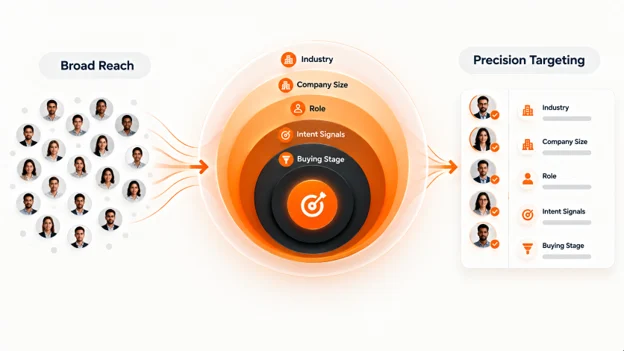
Example: Lead Volume vs Lead Quality
A cybersecurity company launches a content syndication campaign to promote an enterprise threat detection report.
The company’s objective is to generate higher-quality, intent-driven leads that can progress through the sales funnel. The sales team specifically needs prospects who can be nurtured through targeted email communication, further qualified over time, and eventually engaged through SDR outreach, which is a common progression path for complex cybersecurity purchases.
Campaign A focuses on volume:
- 5,000 downloads
- Average CPL: $15
- 12% from target companies
- 8% decision-makers
- 20 sales conversations
Campaign B focuses on relevance:
- 600 downloads
- Average CPL: $40
- 68% from target companies
- 55% decision-makers
- 95 sales conversations
Although Campaign A generates more leads, Campaign B creates stronger business opportunities.
The lesson: More contacts do not always mean more pipeline. Quality and relevance determine commercial impact.
Improving lead quality starts with reaching the right audience. Valasys Media’s Content Syndication Services help B2B companies build targeted campaigns designed around audience relevance, intent, and pipeline growth.
#2: Choosing Content That Attracts Attention but Not Intent
The Mistake
Many companies syndicate content that generates clicks and downloads but fails to attract audiences with real buying intent.
High engagement does not always mean high business value.
Why This Happens
This mistake usually happens when teams focus on content performance rather than audience intent.
Common gaps include:
- Choosing popular content over relevant content: Promoting topics that attract maximum traffic but do not connect with customer problems.
- Ignoring the buyer journey: Using awareness-stage content to target audiences who are closer to making decisions.
- Optimizing for downloads: Selecting assets based on conversion rates instead of commercial relevance.
- Lack of content-audience alignment: Distributing content without defining who should engage with it and why.
A piece of content can attract attention without attracting the right audience.
How to Avoid This Mistake
Before syndicating any asset, evaluate:
- Who is this content designed for?
- What problem does it solve?
- Which stage of the buying journey does it support?
- What action should happen after engagement?
Choose content that helps buyers move forward, not just content that generates activity.
A strong content syndication campaign brief should connect:
Audience + Problem + Buying Stage + Desired Action
For a better understanding, refer to our How to Build a Content Syndication Campaign Brief guide.
Example: Attention vs Intent
Consider a SaaS company promoting an AI security platform in a competitive technology market. The company wants to increase awareness among potential buyers while ensuring that the content attracts professionals who have a genuine business need. The challenge is identifying whether an asset is bringing in curious audiences or decision-makers who are actively exploring solutions.
Asset A:
“10 Emerging AI Trends to Watch in 2026”
Attracts:
- Researchers
- Students
- Curious professionals
- Early explorers
Asset B:
“How Enterprise Teams Evaluate AI Security Platforms Before Adoption”
Attracts:
- IT leaders
- Security teams
- Decision-makers
- Active buyers
Asset A may generate more downloads. Asset B may generate fewer leads but stronger sales conversations.
The lesson: Content syndication works best when the content attracts the right intent, not just the most attention.
#3: Treating Every Download as a Sales Opportunity
The Mistake
Many companies assume every content download represents a ready-to-buy prospect.
A download shows interest, not purchase intent.
Why This Happens
This usually happens when teams fail to understand the buyer’s research process.
Common mistakes include:
- Assuming engagement equals readiness: Treating every interaction as a sales signal.
- Skipping intent analysis: Not evaluating why someone downloaded the content.
- Poor sales alignment: Sending every lead directly to sales without qualification.
- Ignoring the research phase: Forgetting that buyers often explore solutions before speaking with vendors.
A person downloading a report may be researching, comparing options, or gathering information for future needs.
How to Avoid This Mistake
Treat every download as the beginning of a relationship, not the end of the funnel.
Use:
- Educational follow-ups
- Related resources
- Case studies
- Industry insights
- Practical frameworks
The goal is to build trust until the buyer shows stronger intent.
Example: Wrong Timing vs Right Approach
Consider a cloud technology company targeting businesses that are looking to improve infrastructure efficiency. Since cloud-related decisions often involve research, evaluation, and approval from multiple stakeholders, a content download may represent an early research stage rather than immediate purchase intent. The company needs to understand where prospects are in their journey before starting a sales conversation.
A cloud technology company publishes a report:
“How Businesses Can Reduce Cloud Infrastructure Costs.”
A visitor downloads it.
Wrong approach:

The next day:
Sales reaches out with a soft nudge to map the prospect readiness to start the conversation
This often leads to pushback and prospect might unsubscribe from the list
Better approach:
Day 1: Deliver the report
Day 5: Share infrastructure and security optimization tips
Day 10: Provide a relevant case study
Day 20: Introduce solution-based discussion/demos
The conversation happens when the buyer is ready.
The lesson: Content engagement starts the journey; nurturing moves it forward.
Learn how to nurture syndication leads effectively with our Email Nurture Flows for Syndication Leads guide.
#4: Measuring Downloads Instead of Pipeline Influence
The Mistake
Companies often measure syndication success through downloads and leads instead of tracking whether campaigns influence revenue.
Why This Happens
This happens when teams focus on metrics that are easy to report but difficult to connect with business outcomes.
Common gaps include:
- Overvaluing volume metrics: Celebrating impressions, downloads, and registrations.
- Ignoring lead quality: Not tracking whether contacts match the target audience.
- Lack of sales feedback: Measuring marketing activity without sales outcomes.
- No pipeline connection: Failing to understand which campaigns create opportunities.
Downloads show activity. Pipeline shows impact.
How to Avoid This Mistake
Build measurement around business outcomes:
| Metric | Purpose |
| Cost Per Lead | Measures acquisition efficiency |
| Qualified Lead Rate | Measures audience relevance |
| Sales Acceptance Rate | Measures marketing-sales alignment |
| Opportunity Conversion | Measures business impact |
| Pipeline Influence | Measures revenue contribution |
Move from:
“How many leads did we generate?”
to:
“How many relevant opportunities did we influence?”
Example
Consider two content syndication campaigns launched by a B2B technology company targeting enterprise buyers. Both campaigns generate engagement, but the marketing team wants to understand which campaign is creating meaningful business impact rather than simply collecting more contacts. By comparing lead quality, sales engagement, and opportunity creation, the company can identify which approach contributes more effectively to pipeline growth.
Campaign A:
- 5,000 downloads
- 100 qualified leads
- 10 opportunities
- CPL: $45
- Sales Acceptance Rate: 25%
Campaign B:
- 800 downloads
- 250 qualified leads
- 40 opportunities
- CPL: $55
- Sales Acceptance rate: 45%
Campaign A wins on volume. Campaign B creates stronger commercial value. With an assumption of $40K retainer across 3 months and 25% opportunity to closure the leads from campaign B was able to create a pipeline of $800K (Assuming 6-months nurture cadence from CS-to-SRL)
The lesson: A bigger database does not always mean a stronger pipeline.
#5: Ignoring Lead Nurturing After the Download
The Mistake
Many companies stop at lead generation and fail to build relationships after someone engages with content.
Why This Happens
This occurs when companies expect immediate conversion from early-stage interactions.
Common mistakes include:
- Moving to sales too quickly
- Sending generic follow-ups
- Ignoring buyer education
- Failing to provide additional value
The buyer is still learning while the company is already trying to sell.
How to Avoid This Mistake
Create a nurture journey that matches buyer readiness.
Example:
| Timeline | Action |
| Day 1 | Deliver requested content |
| Day 5 | Share related insights |
| Day 10 | Provide useful frameworks |
| Day 20 | Share customer examples |
| Day 30+ | Start sales conversation |
The goal is not chasing leads. The goal is staying relevant.
Example
Consider a financial technology company targeting finance leaders who are researching ways to improve reporting processes. Since these buyers often evaluate multiple solutions before making a decision, the company needs to build trust through relevant education rather than immediately pushing a sales conversation after the first interaction.
A finance leader downloads:
“Guide to Improving Financial Reporting.”
Immediate sales pitch:
“Book a demo today.”
Better nurture:
- Share reporting benchmarks
- Provide industry examples
- Send implementation guides
- Offer consultation when relevant
The second approach creates trust before conversion.
#6: Not Understanding Audience Discovery
The Mistake
Companies focus only on finding contact details instead of understanding the people behind those contacts.
Why This Happens
Modern audience discovery is complex, and many teams still rely only on basic demographic data.
Common gaps include:
- Looking only at job titles
- Ignoring behavioural signals
- Missing buying triggers
- Collecting contacts without understanding context
A name and email address do not explain buying intent.
How to Avoid This Mistake
Modern audience discovery should consider:
Professional Signals
- Job role
- Industry
- Company size
- Seniority
Behavioural Signals
- Content consumed
- Topics researched
- Events attended
- Communities joined
Business Signals
- Hiring activity
- Expansion plans
- Technology adoption
- Leadership changes
Example
Consider a B2B marketing company using content syndication to reach professionals interested in improving their marketing efforts to help sales influence a stronger pipeline. While multiple people may engage with the same content asset, their business responsibilities, buying influence, and level of interest can vary significantly. Understanding these differences helps marketers separate genuine opportunities from simple content engagement.
Two marketing managers download the same report.
Person A:
- ABM Specialist downloads the reports
- No buying responsibility
- No company need
Person B:
- C-suite Marketer at a growing SaaS company
- Recently expanded team
- Researching solutions
Both downloaded the content.
Only one represents a meaningful opportunity.
The lesson: Effective syndication is not about finding more people; it is about understanding the right people.
A Practical Content Syndication Framework: The REACH Model
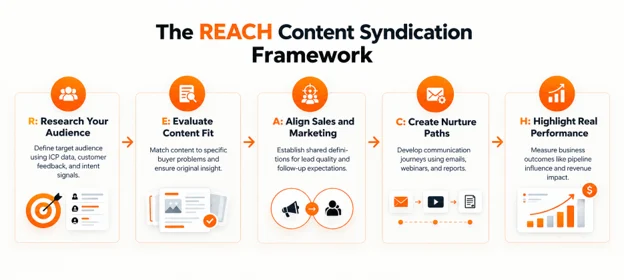
A successful content syndication campaign requires a structured approach.
The REACH framework helps businesses align audience targeting, content selection, lead nurturing, and performance measurement to generate better outcomes.
The framework focuses on five key stages:
- Research the right audience
- Evaluate content relevance
- Align sales and marketing goals
- Create nurture journeys
- Highlight measurable outcomes
Together, these steps turn content syndication from a simple distribution activity into a strategic demand generation process.
Need support implementing a structured syndication strategy? Valasys Media’s Content Syndication Services combine audience targeting, content distribution, and performance tracking to support B2B growth.
Content Syndication Readiness Checklist
- Right audience identified
- Relevant content selected
- Lead criteria defined
- Sales process aligned
- Nurture plan prepared
- Tracking setup completed
- Pipeline goals established
DIY Content Syndication vs Professional Support
| DIY Approach | Professional Approach |
| Lower upfront cost | Strategic investment |
| Requires internal expertise | Access to specialists |
| Limited audience reach | Targeted audience networks |
| More manual effort | Structured execution |
| Good for testing | Built for scaling |
DIY can work for organizations with strong internal demand generation capabilities.
However, companies entering new markets, targeting enterprise accounts, or managing complex buying journeys often benefit from external expertise.
Recommended Tools and Methods
Audience Research
Tools:
- LinkedIn Sales Navigator
- 6sense
- Bombora
- G2 Buyer Intent
Marketing Automation
Tools:
- HubSpot
- Marketo
- Pardot
Analytics
Tools:
- Google Analytics 4
- CRM reporting dashboards
- Attribution platforms
The technology matters. But the strategy matters more.
A powerful tool with poor targeting simply creates faster mistakes.
Common Mistakes and Their Fixes
| Mistake | Why It Happens | Damage | Fix |
| Buying cheapest leads | CPL focus | Poor quality database | Optimize for qualified pipeline |
| Broad targeting | Desire for volume | Low relevance | Improve ICP |
| No nurture process | Expecting immediate sales | Lost opportunities | Build journeys |
| Weak content | Easy asset creation | Low engagement | Create buyer-focused assets |
| Poor measurement | Tracking convenience metrics | No ROI clarity | Measure pipeline |
Building a content syndication program requires more than distributing assets. Valasys Media helps B2B companies identify the right audiences, create targeted campaigns, and generate conversations that support revenue growth.
Building a successful syndication program requires expertise across targeting, content strategy, and lead qualification. Learn how Valasys Media’s Content Syndication Services can help turn content engagement into measurable business outcomes.
The Lead Generation Paradox
The internet has created an unusual situation.
Companies have more ways than ever to reach people. But reaching people has never guaranteed being understood.
Content syndication reflects a larger shift happening across digital marketing.
Attention has become measurable. Intent has become modeled. Human curiosity has become data.
And somewhere between those three things sits the challenge every marketer faces:
How do you recognize a person, not just a record?
The future of B2B demand generation will not belong to the companies that collect the most contacts.
It will belong to those that understand the difference between visibility and connection.
Because the internet can tell you who clicked.
It can tell you who downloaded. It can tell you who engaged. But it still cannot fully answer the oldest marketing question:
Was there a real person on the other side, looking for a solution, waiting to be understood?
Content syndication succeeds when quality, relevance, and follow-through replace volume as the primary goal.
By applying the REACH framework and avoiding the six mistakes outlined above, marketing teams can turn syndicated downloads into real pipeline.
Ready to transform your demand generation strategy? Contact Valasys Media to learn how our data-driven approach can accelerate your pipeline.
Frequently Asked Questions
- Why do content syndication leads fail to convert even when download numbers are high?
High download numbers often represent attention, not purchase intent. Conversion issues usually occur due to poor targeting, weak content alignment, or lack of nurturing after engagement.
- How can marketers identify whether a syndicated lead is worth sales follow-up?
Evaluate leads based on company fit, job role, engagement behaviour, buying signals, and ICP alignment instead of relying only on downloads.
- What should companies do when syndicated leads match their ICP but show no buying intent?
Move these leads into nurture programs instead of immediate sales outreach. Consistent education can turn early researchers into future opportunities.
- How can companies prevent content syndication from becoming a database collection exercise?
Measure success through qualified conversations, pipeline influence, and revenue impact rather than contact volume alone.
- How does content syndication change for enterprise buyers?
Enterprise campaigns require account-level targeting because buying decisions involve multiple stakeholders, longer cycles, and complex evaluations.
- What signals show that a content syndication campaign needs improvement?
Common signs include low sales acceptance, irrelevant leads, weak post-download engagement, limited opportunities, and rising CPL without pipeline growth.