Generate More B2B Leads With Webinars
Get proven strategies, templates, and tactics to generate qualified B2B leads through high-converting webinars.
 Lead-Gen now on Auto-Pilot with
Build My Campaign
Lead-Gen now on Auto-Pilot with
Build My Campaign

Learn how to use intent data to choose webinar topics that attract the right audience, boost engagement, and improve lead generation.


Generate More B2B Leads With Webinars
Get proven strategies, templates, and tactics to generate qualified B2B leads through high-converting webinars.
The most expensive sentence in webinar marketing might be:
“I think our audience would be interested in this.”
Not because the person saying it is wrong.
Because they are guessing.
A webinar topic chosen on assumptions can still attract registrations. It can still generate engagement. It can even earn compliments from attendees.
What it cannot reliably do is attract buyers who are actively trying to solve the problem you happen to be talking about.
That is where many webinar programs lose momentum before the first invitation is ever sent. The topic feels relevant internally, but it is not necessarily aligned with what target accounts are researching, discussing, or prioritizing right now.
Generate More B2B Leads With Webinars
Get proven strategies, templates, and tactics to generate qualified B2B leads through high-converting webinars.
The result? The webinar runs. Attendance looks reasonable. Engagement appears healthy. Yet weeks later, it is difficult to connect any of that activity to a meaningful pipeline.
The problem is not the webinar format. Webinars remain one of the most effective ways to engage buyers. The problem is how the topic gets chosen.
The smartest webinar programs do not begin with brainstorming. They begin with intent.
With VAIS, marketing teams can identify the topics that target accounts are actively researching, helping them build webinars around buyer intent rather than guesswork.
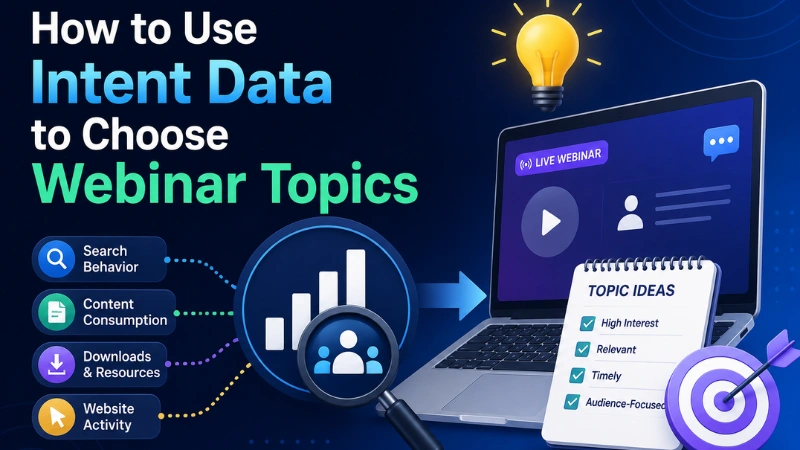
It refers to behavioral and contextual signals, drawn from website visits, content consumption, search activity, CRM data, sales conversations, and third-party publisher networks, that reveal what problems your target accounts are actively researching right now. Instead of using those signals only to prioritize who receives an invite, the smarter move is using them to decide which topic deserves a webinar in the first place.
Intent data splits into two broad categories. First-party data is behavior you observe directly: which pages a prospect visits, what they download, which past webinars they engaged with, and what they raise in sales calls. Third-party data is behavior captured off your own properties, including topic surges across publisher networks and review-site research that happens long before a buyer ever fills out a form.
Neither source works alone. First-party signals are high-confidence but narrow, since they only capture buyers who already found you. Third-party signals are broader but noisier, capturing the anonymous research phase where most B2B buyers spend the bulk of their journey. A strong topic strategy uses both, then checks them against sales intelligence before committing to a theme.
The traditional approach leans on editorial instinct, committee brainstorming, and backward-looking registration data. Each one has a structural flaw.
Editorial instinct usually reflects what the marketing team already knows, not what the market is urgently trying to solve. Brainstorming tends to surface internal priorities dressed up as audience interest. And past registration data tells you what worked before, not what an in-market account needs to hear this quarter.
The deeper issue is that most B2B buyers stay anonymous for the majority of their research. Only a small fraction of website visitors ever fill out a form, which means topic planning based on known contacts is working from a tiny, self-selected slice of actual demand.
Mismatched topics carry a documented cost as well. Generic, poorly targeted content is a recognized driver of slower engagement across demand-generation programs, and topic relevance is one of the few variables marketers can fully control.
Good topic decisions come from triangulation, not from any single input. Here is where the real signal lives.
First-party behavior: Your own analytics show which topics prospects keep returning to, which solution pages draw repeat visits, and which resources pull in the accounts you actually want. When the same cluster of themes keeps surfacing across multiple ICP accounts, that is a candidate webinar topic, not a coincidence.
Third-party intent surges: Intent platforms flag when accounts in your market show elevated research activity around a topic category. The useful insight is not which single account is surging. It is which topic is surging consistently across many accounts in the same vertical.
CRM and sales intelligence: The objections that stall late-stage deals and the questions reps hear over and over in discovery calls are intent signals wearing a different costume. Feeding them back into topic planning is one of the most underused moves in B2B demand generation. VAIS complements these insights by helping teams identify the topics target accounts are actively researching.
Teams that share buyer-journey insight between sales and marketing are meaningfully more likely to see higher conversion rates and stronger revenue growth. Yet most sales and marketing teams still collaborate on only a handful of the activities where it would actually matter, and frequent friction over priorities remains common.
Webinar engagement history: A prior attendee who replayed the pricing Q&A twice and clicked the ROI calculator is sending a specific, recent signal. On-demand viewers are far more likely to be tied to a near-term buying decision than the average registrant, and that behavioral intensity deserves to inform the next topic, not just the next follow-up email.
Pull signals from first-party behavior, third-party surges, CRM patterns, and sales input. Group them into pain-point clusters. Then score each cluster across four questions:

Clusters that score well across all four are ready to become a webinar. Clusters that score well only on curiosity tend to fill a room without moving a single deal.
The buying-group question deserves extra weight, because it is the one most teams skip. A large share of B2B buying teams report real internal conflict during the decision process, and content built for the whole group tends to support consensus far better than content aimed at one individual.
A topic that fails to resonate across a wider buying committee is likely to draw broad curiosity and very little real movement.
Topic inflation: Building a webinar around a trend everyone is already talking about feels safe, but it usually means competing for attention inside a category that has become background noise. When every vendor is running the same “AI trends” session, the topic has stopped being a differentiator.
For example, while the market is saturated with content about how AI is transforming business, a webinar titled “Are You Sick of AI Yet?” immediately stands out because it addresses audience fatigue rather than repeating the same narrative.
Intent data helps uncover these narrower, more relevant angles that are generating urgency among target accounts, which are often sharper and more compelling than the headline trend itself.
Single-persona bias: Buying groups have expanded, not shrunk. A webinar built entirely around one stakeholder’s view of the problem can deepen that person’s engagement while leaving the rest of the buying group cold. Intent-led planning should ask which stakeholder perspectives are signaling urgency at the same time, and shape the topic, and where possible the speaker lineup, around that wider reality.
Treating attendance as proof the topic worked: Attendance is a soft signal of interest, not a measure of commercial intent. A topic that pulls in eight hundred curious professionals is weaker than one that pulls in two hundred people from sixty named ICP accounts, several of whom send multiple colleagues and request a meeting afterward. As marketing budgets stay flat while pressure for accountability rises, content programs are increasingly expected to answer for outcomes, not just activity.
Even the right underlying theme needs different framing for different audiences. The complexity of a new compliance requirement looks nothing alike to a Chief Risk Officer, an implementation engineer, and a VP of Finance staring at the budget line.
Intent data earns its keep here. If third-party signals show a spike in research activity from finance titles at your target accounts, that tells you which stakeholder voice should lead the webinar angle. If first-party data shows your last webinar’s most replayed segment was the ROI walkthrough, that tells you which dimension of the topic actually resonates right now.
Buying-stage fit matters just as much. Using first-party data on role, industry, and product interest to shape the topic and format, then polling live attendees to refine that picture further, is now standard guidance for high-performing webinar programs. A topic built for an awareness-stage audience should look and sound different from one aimed at accounts already comparing vendors.
Topic selection is a hypothesis. The post-webinar data is how that hypothesis gets tested and how next quarter’s topic gets smarter.
Measurement should happen on two levels. The first is engagement, where success is measured by behavioral signals rather than headcount, such as Q&A participation, CTA clicks, and replay activity.
At the pipeline level, the only question that matters is whether the accounts that engaged actually progressed. Syncing webinar registration, attendance, and engagement data into the CRM, then attributing revenue when those contacts later appear in closed deals, is what turns a webinar from a brand expense into a documented pipeline contributor.
Strong topic-audience fit shows up in the engagement numbers too. Average webinar engagement time and call-to-action conversion rates have both been trending upward industry-wide, and that tends to be exactly what happens when the topic and the audience were genuinely well matched in the first place.
The choice of webinar topic only looks like a content question. Underneath, it is a commercial one. The teams whose webinars consistently turn into pipelines are the ones treating topic selection as a data-driven exercise instead of a creative brainstorm.
Intent data answers a question brainstorming never can: what are real accounts, at the right stage of a real buying cycle, urgently trying to figure out right now. That answer changes every quarter. The teams asking it systematically, with first-party behavior, third-party signals, CRM intelligence, and sales input all in the room, are quietly building an advantage while the rest of the market is still guessing its way past.
Stop asking what you should talk about. Start asking what your best accounts are already trying to solve.
Organizations seeking a more evidence-based webinar strategy use our solution, Valasys Media Webinar Tracker to connect account-level intent signals, topic engagement patterns, and pipeline outcomes, moving from topic intuition to a content program that can be measured, refined, and held accountable to revenue.
The most reliable approach combines multiple types. First-party data, such as page visits and past webinar engagement, gives high-confidence signals from buyers who already found you. Third-party data, such as publisher-network topic surges, captures buyers still in the anonymous research phase. CRM and sales input adds qualitative validation neither dataset can fully replace on its own.
Neither source is sufficient alone. First-party data is high-confidence but narrow, since it only reflects buyers who are already engaged with you. Third-party data is broader but noisier. The strongest approach uses third-party surges to spot candidate topics, then validates them against first-party behavior and sales input before committing.
A topic has strong pipeline potential when it fits your ICP, shows urgency signals across multiple accounts rather than one outlier, reflects mid-funnel evaluation rather than early curiosity, and speaks to more than one stakeholder in the buying group. A topic that scores well on broad interest but weak on ICP fit usually drives registrations without moving the pipeline.
B2B buying decisions now typically involve around ten stakeholders, and content built for the whole group supports consensus better than content built for one person. The most effective webinar topics address a problem that multiple roles in the buying group are trying to solve at the same time, not just the concern of the most vocal contact.
Yes. Third-party intent data can reveal which named accounts are actively researching a topic category, letting teams build sessions designed to reach those accounts at the right moment rather than running one generic program for everyone. First-party engagement from past webinars sharpens the picture further by showing which accounts send multiple attendees and follow through afterward.
Intent patterns shift with market conditions and product cycles, so topic strategy works best as a rolling review rather than an annual plan. A monthly check of intent cluster activity, paired with quarterly planning that folds in sales input, keeps topics responsive to real buyer urgency instead of locked to a calendar built months in advance.
Generate More B2B Leads With Webinars
Get proven strategies, templates, and tactics to generate qualified B2B leads through high-converting webinars.