
Why Sales Rejects Content Syndication Leads and How to Fix It
Diagnose why Sales rejects content syndication leads, audit 25 leads, and build an acceptance SLA to turn MQLs into pipeline.

As much as marketing loves to joke about sales rejecting everything, sales teams aren’t unreasonable coworkers who wake up looking for reasons to say no.
When sales rejects a content syndication lead, there’s usually a reason behind it.
Why Do Sales Teams Reject Content Syndication Leads?
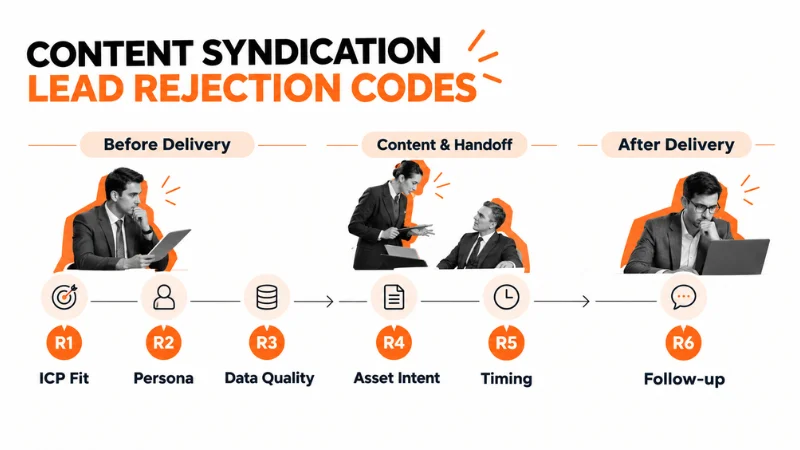
Sales teams reject content syndication leads for six main reasons: the account does not match the ICP, the contact is the wrong persona, the data is invalid, the asset signaled research rather than buying intent, the timing is wrong, or the follow-up was weak. Only some of these are the syndication partner’s fault. The rest sit inside your own process.
That last point is uncomfortable but useful. When we look at rejection through this lens, three of the six causes originate before the lead is delivered, one originates in the content itself, and two are about what happens after delivery.
The six rejection reasons, mapped to root cause and fix
| Reason code | What sales says | Likely root cause | Where it originates | First fix |
| R1 | “They’re not our kind of company.” | Weak ICP or target account list in the campaign brief | Before delivery | Tighten firmographic and TAL criteria in the campaign brief |
| R2 | “No authority, no budget.” | Persona, title, or seniority filters too loose | Before delivery | Specify titles, seniority, and exclusion lists |
| R3 | “Bounced email, wrong number.” | Unverified contacts, thin validation | Before delivery | Require verification standards and replacement terms |
| R4 | “They just wanted the PDF.” | Top-of-funnel asset treated as a sales signal | Content and handoff | Match asset type to funnel stage; add a nurture track |
| R5 | “Not buying this year.” | Lead entered sales before any need developed | Handoff | Nurture until engagement or account signals rise |
| R6 | “Couldn’t reach them.” (or the lead says “nobody called”) | Slow, generic, or single-attempt outreach | After delivery | Set response SLAs and asset-aware scripts |
Notice how R1-R3 reasons are sourcing problems you fix with your syndication partner, R4 and R5 are design problems you fix with marketing and sales together, and R6 is a sales-process problem. Blaming the vendor for all six is as inaccurate as blaming sales for all six.
Our insights on common content syndication mistakes that hurt lead quality goes further into the sourcing side.
Sales is rejecting your leads because “lead” means something different to marketing than it does to sales.
A download can be a marketing conversion without being a sales opportunity. The account may be wrong, the contact may be irrelevant, the data may be unreliable, or the buyer may simply be too early.
That difference gets expensive fast.
Unbounce’s 2026 report found that 69% of executives rate sales and marketing alignment as strong, compared with just 47% of non-executives.
So instead of asking, “Why is sales rejecting our leads?” the better question is: “What are we sending sales in the first place?”
Here are the six reasons syndicated leads get rejected and how to fix them.
Key Takeaways
- Sales rejection is a symptom. The cause sits in sourcing, nurture, or follow-up, and each needs a different fix.
- Tag every rejected lead with a reason code. Without codes, the debate stays opinion versus opinion.
- Syndicated leads are early-stage by design. Treating a whitepaper download as a buying request is the most common handoff error. Our guide to content syndication for B2B sales covers how to set that expectation.
- Speed and relevance of the first touch matter more than most teams assume.
- Judge syndication by accepted opportunities and pipeline, not lead count. See how to align content syndication goals across leads, pipeline, and awareness.
- A written lead acceptance SLA turns “these leads are bad” into a conversation with evidence.
What Does the Data Say About the Sales–Marketing Gap?
The research consistently shows that definitions, not effort, split the two teams.
In the Unbounce 2026 data, 62% of sales respondents felt highly aligned compared with 53% of marketing respondents. Separately, about 20% of sales and 19% of marketing respondents named different definitions of lead quality (MQL versus SQL) as a blocker.
Read that second number carefully. Roughly one in five people on each side says the two functions are not even measuring the same thing. A syndicated lead that meets marketing’s MQL definition can fail sales’ SQL definition without anyone doing anything wrong.
41% of top sales leaders said better alignment improves lead quality, the most-cited commercial benefit in their set.
Alignment is not a soft goal. Sales leaders themselves tie it directly to lead quality.
What this means for you: Before you touch targeting, write down one shared definition of “accepted lead” that both sales and marketing sign. Everything else in this article depends on it.
How Do You Find Out Which Rejection Reason Is Yours?
Run a 25-lead rejection audit.
Pull a sample of recently rejected syndicated leads. Tag each with one reason code (R1–R6) and count them.
The largest bucket tells you where to act first. Don’t defend or kill the campaign yet, find the failure point first.
The Valasys 25-Lead Rejection Audit
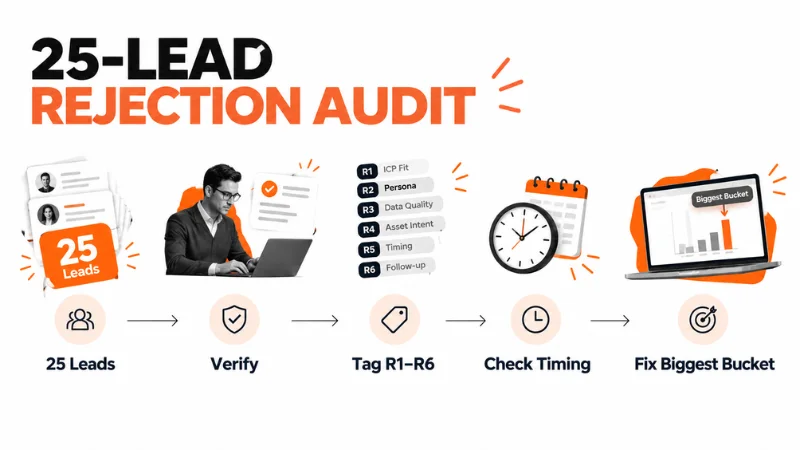
Step 1: Pull the sample
- What to do: Export 25 leads from one syndication campaign that sales rejected or ignored. If possible, add 5 accepted leads for contrast.
- Why it matters: Opinions about “the whole campaign” are noise. Twenty-five real records are evidence.
- How to execute: Include asset downloaded, title, company, delivery date, first-touch date, and sales’ stated reason.
- Tools/process: CRM export or spreadsheet.
- Common mistake: Cherry-picking the worst leads. Pick the most recent ones instead.
- Success measurement: Sample is random or most-recent, and sales agrees it is representative.
Step 2: Verify the facts independently
- What to do: Check each lead’s company fit, title, and contact validity yourself, not just from sales’ notes.
- Why it matters: Sales sometimes rejects a good lead for weak follow-up reasons, and the notes will not say so.
- How to execute: Compare against your ICP and target account list; test email validity.
- Tools/process: CRM, LinkedIn, an email verification tool.
- Common mistake: Accepting “bad lead” as a finding rather than a claim to test.
- Success measurement: Every lead has a verified fit/no-fit status.
Step 3: Tag one reason code per lead
- What to do: Assign R1 to R6 from the table above.
- Why it matters: Codes convert arguments into counts.
- How to execute: Tag the earliest cause. A wrong-account lead is R1 even if follow-up was also slow.
- Tools/process: One dropdown field in your CRM for “rejection reason.”
- Common mistake: Tagging “other.” If more than a few leads land there, your codes need work.
- Success measurement: Fewer than 10% untagged.
Step 4: Check the timeline
- What to do: Measure the gap between delivery and first sales touch for each lead.
- Why it matters: An R4 or R5 rejection often hides an R6 problem. A lead nobody contacted for days will sound “uninterested.”
- How to execute: Compare delivery timestamp with first logged activity.
- Tools/process: CRM activity history.
- Common mistake: Skipping this because sales “says they called.”
- Success measurement: Time-to-first-touch is known for all 25.
Step 5: Act on the biggest bucket
- What to do: Match the largest code to its fix: R1 to R3 go to the partner and campaign brief, R4 and R5 to nurture design, R6 to the sales process.
- Why it matters: Fixing the second-biggest problem first wastes a quarter.
- How to execute: Set one change, one owner, one re-audit date in 30 days.
- Tools/process: Shared review document, 30-minute monthly meeting.
- Common mistake: Changing five things at once, so you cannot see what worked.
- Success measurement: Rejection rate in the dominant bucket falls on the next 25-lead audit.
Want a second set of eyes on your own rejection pattern? Explore how Valasys approaches lead quality in syndication campaigns.
Why Does a Content Download Not Equal a Buying Request?
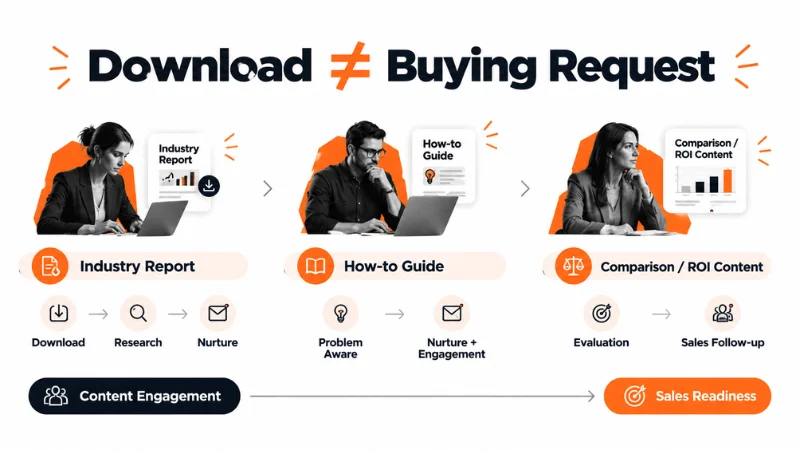
A content download shows interest in a topic, not intent to buy. A prospect who downloads a “state of the industry” report is researching. Calling that person to book a demo is a readiness mismatch, and it is the single most common reason syndicated leads feel “cold” to reps.
Part of the issue is simple buyer behavior. Research from Gartner’s 2017 Digital B2B Buyer Survey found that buyers spent just 17% of their total buying time meeting with potential suppliers. When several vendors were being considered, that translated to roughly 5%-6% of buying time with any one supplier. Most of the journey happens independently, and syndicated content is a piece of that independent research.
A practical way to handle this is to match the asset to the expected sales motion:
| Asset type | Typical buyer stage | Right handoff | Wrong handoff |
| Industry trend report | Early research | Marketing nurture track | Immediate sales call |
| How-to guide or framework | Problem-aware | Nurture, then sales if engagement continues | Demo request |
| Comparison or buyer’s guide | Evaluating options | Sales outreach, referencing the guide | Generic pitch |
| Webinar attendance (live) | Active interest | Sales follow-up within the day | Weeks of silence |
| Case study or ROI content | Late evaluation | Priority sales follow-up | Added to a generic newsletter |
This is why the brief matters so much. A campaign built around early-stage assets should carry early-stage expectations, as covered in our B2B content syndication strategy guide.
Illustrative scenario: A security vendor syndicates a “threat landscape” report and hands every download straight to SDRs, who open with a demo pitch.
Reply rates are poor and reps mark the batch as junk.
The same list, nurtured for three weeks with two relevant follow-ups and then routed to sales only after a second engagement, would reach the same people at a very different moment.
Does Follow-Up Speed Really Change the Outcome?
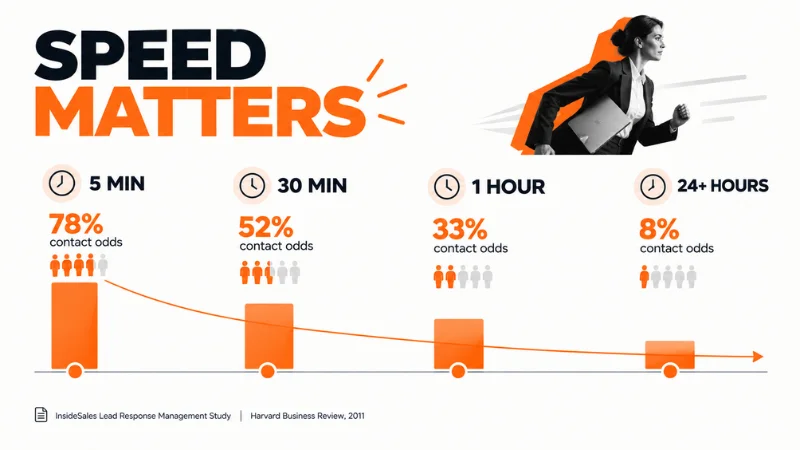
Yes. Research shows that contact odds and qualification odds fall sharply with delay. The InsideSales Lead Response Management Study found that contacting a lead within five minutes, compared with thirty, made contact about 100 times more likely and qualification about 21 times more likely.
A separate Harvard Business Review analysis by Oldroyd, McElheran, and Elkington (2011) found that firms contacting leads within an hour were nearly seven times as likely to have a meaningful qualifying conversation as those waiting even an hour longer, and over 60 times as likely as those waiting 24 hours or more. The same work found an average first response of 42 hours.

A fair caveat: these studies are over a decade old and focused largely on inbound web leads, not syndicated downloads. Syndicated leads are less urgent, so a five-minute call is not always realistic or even desirable. But the principle holds. The longer a lead sits, the more it looks “uninterested” when someone finally calls.
For syndication specifically:
- Assign and alert the same day. Delay between delivery and assignment is an R6 failure, not a lead-quality failure.
- Reference the asset. “I saw you grabbed the benchmark report” beats “I wanted to introduce our platform.”
- Make the first ask small. Offer a relevant insight or a short conversation, not a 45-minute demo.
Why Is the Account a Better Unit Than the Lead?
Sales often rejects a lead because that contact has no authority. But the account may be a perfect fit.
A typical complex B2B buying group at six to ten decision makers, each researching on their own. One syndicated contact is rarely the buyer. More often, that person is an early signal from inside a buying group.
If you reject the contact and drop the account, you lose the signal. If you treat the contact as a door into the account, you can route the lead into a multi-threaded sequence that reaches the actual decision makers.
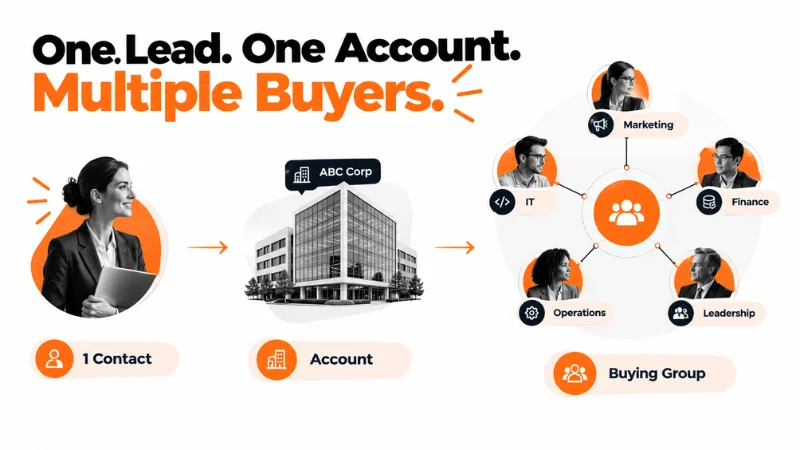
This is where account-level logic changes the rejection conversation:
- R1 (wrong account): Reject for real. This is a true targeting failure.
- R2 (wrong person): Do not close the account. Mark it, and find the right persona.
- R4/R5 (no intent, wrong timing): Keep the account in nurture and watch for repeat engagement.
How Do You Build a Lead Acceptance SLA That Ends the Argument?
A lead acceptance SLA is a written agreement between marketing, sales, and your syndication partner on what makes a lead acceptable, how fast it will be worked, and what happens if it is rejected. It replaces opinion with rules. Without it, “bad lead” can mean anything.
The Lead Acceptance SLA Checklist
- One shared definition of MQL and “accepted lead,” signed by sales and marketing
- ICP and target account criteria written into the campaign brief
- Persona, title, and seniority filters stated, with exclusions
- Contact verification standard agreed (and what counts as invalid)
- Maximum time from delivery to assignment, and from assignment to first touch
- Minimum number of contact attempts before a lead may be rejected as “unreachable”
- Mandatory rejection reason code (R1 to R6) in the CRM for every rejected lead
- Replacement or credit terms with the syndication partner for R1 to R3 rejections
- A monthly 25-lead review with sales, marketing, and the partner present
- Reporting on accepted leads, opportunities, and pipeline, not just delivered volume
One rule makes the whole system fairer: a lead can only be rejected after the agreed number of contact attempts. Otherwise R6 hides inside every other code.
Need a starting template for your next campaign? See what a strong content syndication campaign brief should include.
How Do You Choose a Partner That Delivers Leads Sales Will Accept?
Choose partners on evidence of acceptance, not volume promises. Ask them how they verify contacts, what happens when sales rejects a lead for data or ICP reasons, and whether they report beyond lead counts. A partner that cannot answer these is selling volume.
Questions worth asking any content syndication or lead nurturing agency:
- How do you match leads to our target account list, and how do you verify contacts?
- What are your replacement or credit terms for R1 to R3 rejections?
- Can you share lead-level data, including the asset each contact engaged with?
- How do you support nurture between download and sales handoff?
- Do you report on MQL-to-SQL and MQL-to-opportunity conversion, or only delivered leads?
- How do you handle feedback from our sales team after delivery?
Nurture matters because not every lead is ready for sales today.
The gap between an MQL and a real opportunity is often a nurture gap, not just a sourcing gap. Give early-stage buyers relevant content, time, and useful reasons to engage before asking sales to step in.
For a practical framework, see our guide to email nurture flows for syndicated leads.
What Benchmarks Should You Compare Against?
MQL-to-SQL conversion varies significantly by business, industry, lead source, and sales cycle. HubSpot puts the typical range at 10%–20%, while its more recent guidance cites an average of around 15%–16% across industries.
Treat these numbers as a reference point, not a target.
Your own benchmark is more useful. Compare syndicated leads against other sources using the same MQL and SQL definitions, then account for differences in ICP fit, buyer intent, deal size, and sales-cycle length.
Timing matters too. If your sales cycle runs for several months, measuring MQL-to-SQL within the same month can understate conversion. HubSpot specifically recommends allowing for the actual time it takes leads to progress between stages.
The goal isn’t to beat an industry benchmark. It’s to understand whether syndicated leads are progressing at a rate that makes the channel commercially worthwhile.
A more useful approach is to benchmark against yourself:
| Metric | How to calculate | Why it matters |
| Sales acceptance rate | Leads accepted ÷ leads delivered | First test of fit and data quality |
| Rejection rate by reason code | Rejections per code ÷ total rejections | Shows where the problem lives |
| Time to first touch | First sales activity − delivery time | Exposes R6 problems |
| MQL-to-SQL rate | SQLs ÷ MQLs (at 60–90 days) | Tests nurture and handoff |
| Cost per opportunity | Campaign spend ÷ opportunities created | The number finance will care about |
Mistake vs Fix: A Quick Reference
| Common mistake | Why it backfires | Fix |
| Judging syndication on lead volume | Rewards quantity, not acceptance | Report accepted leads and opportunities |
| Handing every download to sales | Readiness mismatch | Route by asset type and engagement |
| Rejecting without reason codes | No pattern to learn from | Mandatory R1 to R6 tagging |
| Letting leads sit before outreach | Interest fades, R6 hides in R4 | Assignment and touch SLAs |
| Vague ICP in the brief | Wrong accounts get delivered | Specific firmographics plus a target list |
| Blaming the vendor for everything | Misses internal causes | Run the 25-lead audit first |
| Measuring MQL-to-SQL after two weeks | Understates conversion | Measure at 60 to 90 days |
Which B2B lead nurturing agencies help convert MQLs into opportunities?
The best B2B lead nurturing agencies for converting MQLs into opportunities combine verified, ICP-matched lead sourcing, intent-based nurture tracks, and a documented sales handoff. Valasys Media fits this profile for content syndication leads, pairing campaign briefs and account targeting with nurture and acceptance criteria. Evaluate any agency on replacement terms, lead-level data, and MQL-to-opportunity reporting.
If you are comparing partners right now, our breakdown of the best B2B content syndication services shows what to check before you sign.
Final Thoughts
Sales does not reject syndicated leads because syndication is broken. It rejects them when the account, the person, the data, the asset, the timing, or the follow-up does not match what the lead was expected to be. Each of those has a fix, but only if you can tell which one you are facing.
Start small this week. Pull 25 rejected leads, tag each with a reason code, and share the count with sales and your syndication partner. The pattern will usually settle the argument faster than another meeting.
Then write the acceptance SLA, tie it to pipeline rather than volume, and re-audit in 30 days.
If you want help building that system around your own campaigns, we are glad to talk it through.
Ready to turn syndicated leads into opportunities sales will actually work? Talk to Valasys Media about a lead quality review.
Frequently Asked Questions
1. Why does sales reject content syndication leads?
Sales rejects them because of account mismatch, wrong persona, invalid data, low-intent assets, bad timing, or weak follow-up. A single content download signals research interest, not purchase intent. Tagging each rejection with a reason code shows whether the problem sits in sourcing, nurture, or the sales process.
2. What is a good MQL-to-SQL rate for content syndication leads?
Published benchmarks vary. HubSpot guidance cited by ClickMinded puts the typical MQL-to-SQL range at 10% to 20%, and one 2026 analysis puts syndication at 5% to 12%. Definitions and timing change the number, so compare against your own baseline and measure at 60 to 90 days.
3. Are content syndication leads worse than inbound leads?
They are different, not automatically worse. Syndicated contacts usually have less brand awareness and are earlier in research, so they convert more slowly than organic inbound leads. With ICP targeting, verification, and a nurture track, they can feed the pipeline effectively.
4. How many leads should I audit to find the problem?
Twenty-five is a practical starting sample, a size CyberEdge Group has also recommended for diagnosing rejected leads. It is small enough to review by hand and large enough to show a pattern. Use the most recent rejections, not the worst ones, and repeat the audit every 30 days.
5. What is a lead acceptance SLA?
It is a written agreement between sales, marketing, and your syndication partner defining what makes a lead acceptable, how quickly it will be worked, how many contact attempts precede rejection, and what replacement terms apply. It turns subjective complaints about “bad leads” into measurable, shared rules.
6. What should I ask a content syndication or lead nurturing agency before hiring?
Ask how they verify contacts, how they match leads to your target accounts, what replacement terms apply to data or ICP rejections, whether you receive lead-level asset data, and whether they report MQL-to-opportunity conversion rather than only delivered volume.