
Lead Volume vs Lead Quality in Content Syndication
Volume-led or quality-led syndication? Compare CPL, acceptance rate and pipeline cost, with a decision framework for US, UK and DACH teams.

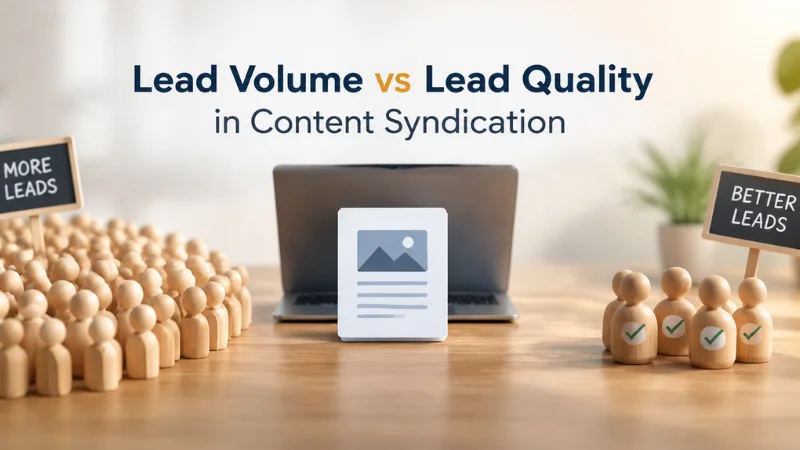
Less is more when those fewer leads are more likely to become pipeline. A large volume of contacts may look impressive, but if they don’t match your ICP or engage with your offering, they add little value.
What is the difference between lead volume and lead quality in content syndication?
In content syndication, lead volume measures how many contacts a campaign delivers, while lead quality measures how many of those contacts match your ICP, show real buying intent, and get accepted by sales. Volume-led programs optimize cost per lead; quality-led programs optimize acceptance rate and pipeline per dollar. For most B2B teams, quality wins.
Lead volume vs lead quality: the side-by-side comparison
| Dimension | Volume-led syndication | Quality-led syndication |
| Primary goal | Generate more contacts | Generate sales-accepted leads and pipeline |
| Targeting | Broader job functions and industries | Defined ICP, buying roles, and relevant intent signals |
| Qualification | Minimal filtering to maximize reach | Stricter fit checks, verified data, and qualifying questions |
| Typical CPL | Lower | Higher |
| Sales acceptance | Can be lower if targeting is broad | A key optimization priority |
| Main risk | High rejection and wasted sales effort | Insufficient top-of-funnel volume if targeting is too restrictive |
| Best suited for | Awareness, database growth, and new-market entry | Pipeline generation, ABM support, and sales handoff |
| Key metrics | Lead count and CPL | Sales acceptance rate, cost per accepted lead, and cost per opportunity |
Volume isn’t the villain here. It’s a measurement choice that goes wrong when it’s the only measurement.
Content syndication has an obvious appeal: it can put your content in front of a large, targeted audience and generate leads at scale. But scale creates a measurement problem. The easier it becomes to generate contacts, the easier it is to mistake activity for progress.
The real challenge is separating lead production from lead value.
This blog explores the trade-off between volume and quality, when each matters, and how B2B teams can build a measurement model that connects syndication activity to sales outcomes rather than stopping at CPL.
Why does CPL make volume look better than it is?
If you’re building the broader program first, see our guide to content syndication strategy for B2B demand generation for a deeper look at how syndication fits into a demand-generation strategy.
CPL divides spend by leads delivered. It says nothing about whether those leads are usable, so it always favors the cheapest, broadest option.
Let’s look at a hypothetical example:
| Campaign A (volume-led) | Campaign B (quality-led) | |
| Budget | $60,000 | $48,000 |
| Leads delivered | 1,000 | 400 |
| CPL | $60 | $120 |
| Sales acceptance rate | 10% | 45% |
| Accepted leads | 100 | 180 |
| Cost per accepted lead | $600 | $267 |
| Lead-to-opportunity rate (of accepted) | 15% | 15% |
| Opportunities | 15 | 27 |
| Cost per opportunity | $4,000 | $1,778 |
Campaign A looks twice as cheap on CPL and costs more than twice as much per opportunity. The CPL dashboard would have told you to scale the wrong campaign.
When does volume still make sense?
Volume is the right call in three situations.
- Awareness and education. If the goal is to get a new category, product, or market in front of many people, reach matters more than precision. Set expectations in the brief: these are not sales-ready leads.
- Database rebuilds. A depleted or outdated database needs fresh contacts to nurture and score.
- Entering a new market. In a market you haven’t touched, broader targeting teaches you which titles and industries respond.
The condition in all three is that volume leads go to nurture, not straight to SDR call lists. A structured email nurture flow for syndication leads can help turn early-stage engagement into stronger buying signals before a sales handoff. Pushing top-of-funnel downloads to sales as “hot leads” is how the volume trap sustains itself and how trust between the teams erodes.
What makes a lead “quality” in content syndication?
A quality lead meets four tests. Miss any one and it’s a contact, not a lead.
- Fit: industry, company size, region, and role match your ICP.
- Verified data: the email works, the title is current, and the company is real.
- Engagement: the person consumed the content, not just clicked through a thin form.
- Intent: there’s some signal of an active need, such as a qualifying-question answer, topic-level activity, or repeat engagement.
Define these with sales before launch, in writing. “Quality” that only marketing defines gets rejected by sales anyway. For a broader look at connecting syndication with the sales process, see content syndication for B2B sales.
The Valasys Volume-to-Value Framework
Use this framework to decide how to run, scale, and judge a syndication program. It works whether you’re buying 200 leads or 5,000.
Step 1: Define “accepted” before you buy
Start with a written definition of an accepted lead. Agree with sales on ICP criteria, required fields, and rejection reasons before briefing the vendor. A structured content syndication campaign brief can help document these requirements before delivery begins.
Run a short working session with an SDR lead and marketer, then document the criteria in your campaign brief and CRM.
Success measure: Sales signs off on the definition before launch.
Step 2: Set the goal tier
Label every campaign Awareness, Nurture, or Pipeline. The goal determines how much volume you need and where the leads should go next. For a deeper breakdown of these three campaign objectives, see our guide to content syndication goals: leads, pipeline, and awareness.
Awareness campaigns can use broader targeting and route contacts to nurture. Pipeline campaigns should use stricter filters and clearer sales handoff criteria.
Success measure: Every campaign has a defined goal and matching KPI before launch.
Step 3: Filter and screen at the source
Apply firmographic filters, add two or three qualifying questions, and require verified contact data. Give vendors both your inclusion criteria and exclusions, such as competitors, students, free-mail domains, or existing customers.
Success measure: Track how many delivered leads pass your initial fit check.

Step 4: Measure downstream, not at delivery
Track CPL alongside cost per accepted lead and cost per opportunity. Pull these figures by vendor and campaign so you can see which sources actually contribute to pipeline.
Success measure: Vendor performance is evaluated on downstream outcomes, not just leads delivered.
Step 5: Scale only what proves out
Increase volume only with vendors and segments that consistently meet your acceptance threshold. Pilot first, review the results, then scale in stages.
Success measure: Acceptance rate remains stable as volume increases.
Want to see how your current syndication program compares with this framework? Explore Valasys’ approach to quality-led content syndication.
How do US, UK and DACH rules change the volume decision?
Regional rules change what you’re allowed to do with a lead, and so what a lead is worth. Treat this as an operating overview and confirm specifics with your legal counsel.
US
US rules are generally more permissive for B2B outreach, although CAN-SPAM requires sender identification and an opt-out mechanism, while state privacy laws add further considerations. For syndication, this means teams may have more room to act on volume, but should still verify how contacts were sourced and what they agreed to receive.
UK
UK GDPR and PECR affect how organizations can use and contact syndicated leads. Corporate email can be treated differently from individual or sole-trader contacts, so marketers should understand what the vendor disclosed at opt-in and how consent and opt-outs are recorded.
DACH
DACH markets require particular care around privacy and electronic marketing rules. Germany, in particular, has strict requirements around unsolicited marketing communications. A smaller pool of clearly sourced, relevant contacts can therefore be more valuable than a larger list that creates compliance or usability concerns.
The common thread: where consent and relevance are scrutinized, quality is usable volume. A lead you can’t lawfully contact doesn’t count toward the pipeline.
Ask every vendor how consent is captured, what the lead saw at opt-in, and how opt-outs are honored, and ask for it in writing.
What are the most common mistakes in a volume-versus-quality decision?
Judging vendors on CPL alone: A low CPL can reward cheap, low-value leads. Rank vendors on cost per accepted lead and cost per opportunity.
Treating a download as an MQL: A content download doesn’t automatically indicate buying intent. Route early-stage contacts to nurture until they meet your qualification criteria.
No shared lead definition: Without agreed criteria, marketing and sales interpret “quality” differently. Define acceptance before launch.
Scaling after one good month: Early results may not hold as volume increases. Pilot first, then scale in stages.
Broad filters to hit volume: More contacts aren’t useful if they fall outside your ICP. Tighten targeting and exclusions.
Ignoring rejection reasons: If you don’t track why sales rejects leads, the same quality problems will continue. For a deeper look at the issues that commonly undermine syndicated lead quality, see common content syndication mistakes that hurt lead quality.
A checklist for evaluating volume vs quality in your program
- Sales and marketing share a written definition of an accepted lead
- Each campaign is tagged Awareness, Nurture, or Pipeline
- The brief lists exclusions as well as inclusions
- The vendor documents consent capture and opt-out handling
- The first lead sample is reviewed before full delivery
- CRM tracks syndication source through to opportunity
- Rejection reasons are logged and shared with the vendor
- Reports show CPL, cost per accepted lead, and cost per opportunity
- Volume is scaled only after acceptance holds in a pilot
Need a vendor-ready brief and lead-screening process? See how Valasys builds qualification into content syndication campaigns.
So which should you choose?
Use this simple decision guide.
- Pipeline is the goal → Quality-led.
- Awareness or database growth is the goal → Volume-led, but route to nurture.
- Both → Run separate campaigns with separate KPIs. Don’t blend them in one report.
- Unsure → Pilot a small quality-led campaign, measure cost per opportunity, then decide.
Quality-led doesn’t mean “never scale.” It means you earn the right to scale.
Conclusion
The volume-versus-quality debate sounds philosophical, but it’s arithmetic. Divide spend by accepted leads and by opportunities, and the cheaper-looking program often stops looking cheap.
Start by agreeing on what “accepted” means with sales. Then judge every campaign past the point of delivery.
Ready to move from lead volume to pipeline? Talk to Valasys about a quality-led content syndication program built around sales acceptance.
Frequently Asked Questions
- What is the difference between lead volume and lead quality in content syndication?
Lead volume is the number of contacts a campaign delivers. Lead quality is how many of those contacts fit your ICP, show intent, and are accepted by sales. Volume tells you how much you bought. Quality tells you how much of it you can use. - Is lead quality more important than lead volume?
For pipeline goals, usually yes, because only accepted leads can become opportunities. For awareness or database-building goals, volume matters more, as long as those leads go to nurture. The right answer depends on the campaign’s goal, so decide the goal first. - Why is CPL a misleading metric for content syndication?
CPL counts every delivered contact equally, including ones sales rejects. A low CPL can hide a low acceptance rate and a high cost per opportunity. Pair CPL with cost per accepted lead and cost per opportunity to see the real price of pipeline. - What is a good sales acceptance rate for syndication leads?
There’s no universal benchmark, because it depends on ICP strictness, offer type, and how sales defines acceptance. Set your own baseline from a pilot and track it per vendor. - How do I stop sales from rejecting syndication leads?
Agree on a written lead definition with sales before launch, tighten ICP filters and exclusions, add qualifying questions, and review a sample before full delivery. Log rejection reasons and share them with the vendor so the same problems don’t repeat. - How do GDPR and PECR affect syndication in the UK and DACH?
They affect how you can contact leads after delivery. Consent capture, what the lead was told at opt-in, and opt-out handling all matter. DACH rules, especially in Germany, are widely read as stricter for marketing email. Confirm requirements with legal counsel.