
Content Syndication Lead Quality Checklist
Use this content syndication lead quality checklist to validate leads, score them, and cut sales rejections. Includes a downloadable version.

A lead can have the right job title, company, and email address, and still be a bad lead. Quality depends on more than just the data captured on a form.
That’s why you need a clear lead quality checklist before leads reach sales.
This guide gives you a practical framework to validate, score, route, and measure syndicated leads, from the first delivery to pipeline impact.
What is a content syndication lead quality checklist?
A content syndication lead quality checklist is a set of pass/fail tests applied to every delivered lead: ICP fit, verified buying-role title, valid contact data, genuine content engagement, consent compliance, and no duplication with existing pipeline. Leads that pass all tests go to sales. Leads that fail are rejected or replaced under the vendor contract.
Key Takeaways: The Checklist at a Glance
- Align before launch: Sign a lead acceptance definition, ICP, buying roles, and suppression lists with sales.
- Vet the vendor: Confirm placements, consent handling, verification, and replacement terms.
- Audit in 24 hours: Test 25 to 30 random leads for email, phone, title, ICP fit, and duplicates.
- Evaluate every lead: Rate fit, role, data integrity, engagement, and compliance.
- Route by rule: Accept, review, or reject, with hard stops for missing consent and duplicates.
- Code every rejection: Tag a reason so you know whether to fix the brief, asset, or vendor.
- Prove it at 30, 60, and 90 days: Measure sales-accepted leads and pipeline, not cost per lead.
Why do good campaigns still end in sales rejections?
An SDR dials the first name on a fresh syndication list. The person who answers is polite, a little puzzled, and works in a different function entirely. “I downloaded a report a few weeks ago,” they say. “I’m not sure why you’re calling.”
The second call goes to a full voicemail box. The third email bounces.
None of this proves the campaign failed. It proves that nobody agreed before launch on what a usable lead looks like.
Marketing paid for contacts that matched a brief. Sales needed contacts who could actually buy. Those are two different standards, and the space between them is where the budget disappears.
Each rejected lead has already been paid for. It also costs SDR time, wears down sales trust in the channel, and gives leadership a reason to cut a program that could work.
This checklist closes the gap by settling the argument at the start of the campaign. It covers what to define before launch, what to test in the first 24 hours, how to score what arrives, and how to track what happens afterward.
Why do sales teams reject syndication leads?
Rejections nearly always trace back to one of five causes:
- The ICP was loose. “Mid-market SaaS” without employee ranges, geographies, or excluded industries invites vendors to fill volume with whatever fits loosely.
- The role was wrong. The title looks senior, but the person has no budget influence or sits in an unrelated function.
- The data was bad. The email bounces, the phone number is disconnected, or the company name is mistyped.
- The intent was thin. The contact downloaded a top-of-funnel e-book and was never going to take a sales call.
- The lead was already known. It’s an existing customer, an open opportunity, or someone who had unsubscribed.
Each cause maps to a specific check in the framework below. For a deeper look at upstream causes, see our breakdown of content syndication mistakes that hurt lead quality.
The Valasys 4-Gate Lead Validation Framework
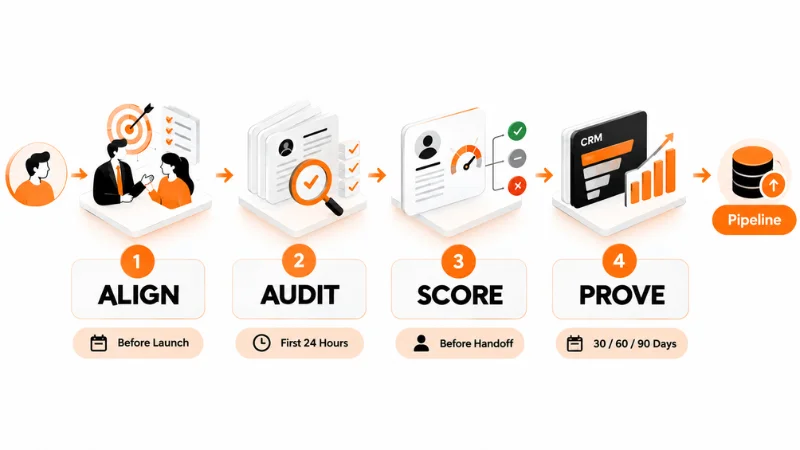
Most checklists are one long list, and long lists get skimmed and abandoned. This framework splits validation into four gates, each with its own timing. A lead moves forward only by clearing the gate in front of it.
| Gate 1: Align | Gate 2: Audit | Gate 3: Score | Gate 4: Prove | |
| When | Before launch | First 24 hours of delivery | Before sales handoff | 30, 60, 90 days |
| What to do | Write the ICP, buying committee, and lead acceptance definition into the brief; upload suppression lists | Test a random sample of delivered leads | Score each lead and route it to accept, review, or reject | Track accepted leads through to opportunity and revenue influence |
| Tools and process | Brief template, shared sign-off doc, CRM exports for suppression | Email verification tool, CRM duplicate check, LinkedIn or company-site role check | Lead scoring fields, routing rules, SLA for review queue | CRM campaign tracking, rejection reason codes, monthly review |
| Success looks like | Signed acceptance definition on file before campaign day one | Sample pass rate recorded and shared with the vendor the same day | Share of leads routed to sales that sales then accepts | SAL rate and pipeline influence by vendor and asset |
Gate 1: Align
Every later dispute gets easier when the standard was written down first. Build the acceptance definition into a structured content syndication campaign brief and get sales sign-off before the vendor sees it. The usual failure is briefing the vendor first and consulting sales only after the first rejections arrive, by which point the argument is about blame instead of criteria.
Gate 2: Audit
Problems found in hour one can be fixed or replaced. Problems found in week six cannot. Pull 25 to 30 leads at random and run them through the Gate 2 checklist below. The word random matters: teams that audit only the best-looking leads end up with a pass rate that flatters the vendor and tells them nothing.
Gate 3: Score
A score replaces opinion with a rule, which protects both the vendor relationship and sales trust. Apply the scoring criteria in your CRM or marketing automation platform so every lead lands in accept, review, or reject automatically. The mistake to avoid is sending everything to sales and letting SDRs sort it out, since that hands your validation work to your most expensive people.
Gate 4: Prove
A lead can be accepted and still go nowhere, so this gate tests whether your standard actually predicts the pipeline. Tag source, asset, and vendor on every record, then review conversion by tag. Many teams stop measuring at the MQL, which means they never learn whether their definition of “good” was right.
Want to see how your current acceptance process compares with this framework? Explore Valasys’ lead quality approach.
Gate 1 checklist: what to lock before the campaign launches
Use this as your pre-launch sign-off. Every item should have a yes before the brief goes out.
- ICP defined by industry, employee range, revenue band, and geography, including exclusions
- Buying committee titles and functions listed, not just “decision-makers”
- Lead acceptance definition written and signed by marketing and sales
- Suppression lists uploaded: customers, open pipeline, recent unsubscribes
- Campaign goal chosen: leads, pipeline, or awareness (see content syndication goals)
- Asset matched to funnel stage and goal
- Vendor has disclosed placements, partner networks, and distribution channels
- Vendor confirms consent handling and privacy compliance, including General Data Protection Regulation (GDPR) where relevant
- Replacement terms and timeline written into the contract
- Sales owner named for audit and review turnaround
The goal-setting step matters more than it looks. A campaign built for awareness will not produce sales-ready leads, and judging it as if it should is a common source of friction. Our content syndication strategy guide covers how to set that up.
Gate 2 checklist: how to audit delivered leads in the first 24 hours
Take a random sample of 25–30 leads and check:
- Email: Is the address valid and deliverable?
- Phone: Does the number connect to the right person or company?
- Title: Does the job title match the lead record?
- ICP: Does the company fit the agreed industry, size, and geography?
- Buying role: Is the contact in the agreed function/seniority range?
- Duplicate: Is the contact already a customer, opportunity, or suppressed record?
- Engagement: Is there evidence of the claimed asset download?
- Consent: Is the consent record present and documented?
Calculate the sample pass rate and send failed records to the vendor the same day.
How should you score a syndication lead?
Scoring turns “this feels weak” into a rule you can defend. The weights below are a starting model. Adjust them to your sales cycle and ICP.
Score every lead across five dimensions
Give each lead a quick rating across:
- ICP fit – Does the company match your target market?
- Role fit – Is the person relevant to the buying committee?
- Data integrity – Are the contact details accurate?
- Engagement strength – Does the asset and behavior indicate meaningful interest?
- Compliance & uniqueness – Is consent documented and the lead new?
Then route the lead:
Accept → Strong fit, relevant role, clean data, compliance clear.
Review → Good fit but weaker intent or one questionable data point.
Reject → Outside ICP, invalid data, duplicate, or missing consent.

Notice that compliance and duplication are hard stops, not points to trade off. A perfectly matched title with no consent record is still a reject.
What does “accepted” look like for different asset types?
The same score should not mean the same thing for every asset. Intent varies by what the person downloaded.
Match the lead to the asset
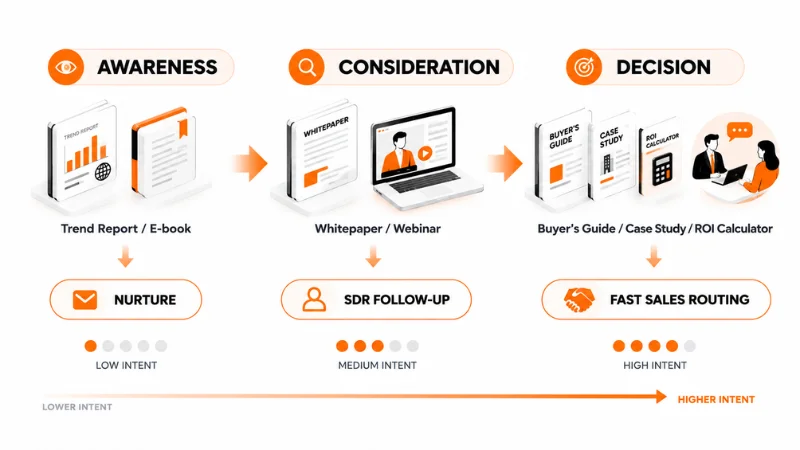
Not every download should trigger a sales call.
- Trend reports / e-books → Awareness: Route strong-fit contacts into nurture.
- Whitepapers / frameworks / webinars → Consideration: Consider SDR follow-up when fit and role are strong.
- Buyer’s guides / case studies / ROI calculators → Decision: Prioritize for faster sales routing.
The same lead score can mean different things depending on what the person actually downloaded.
This is why a blanket “sales rejected 40% of leads” number can mislead. If most of those leads came from an awareness e-book, the issue is routing and expectation, not necessarily vendor quality. For how this plays out in practice, read our guide to content syndication for B2B sales.
What should you ask a vendor before you trust their leads?
Vendor vetting still matters. It just shouldn’t be the only layer. Ask for:
- Exact placements and partner networks where your asset will appear
- How contacts are verified before delivery
- How opt-in consent is captured and stored
- How leads are filtered against your suppression lists
- Replacement policy: timeline, criteria, and who decides
- Reporting detail at the lead level, not just campaign totals
- References or case examples you can verify
If a vendor resists lead-level transparency, treat that as information. For a comparison of providers, see our list of the best B2B content syndication services.
How do you track and fix sales rejections?
Code every sales rejection
Don’t let SDRs simply mark a lead as “bad.”
Use six simple rejection codes:
Outside ICP → Tighten targeting
Wrong role → Add function + seniority rules
Invalid contact → Strengthen verification
Already in pipeline → Refresh suppression lists
Low intent → Route to nurture
No consent → Escalate and pause delivery
Review these monthly with sales in the room. If one code dominates, you’ve found the lever to pull. Our guide to improving lead quality in content syndication goes deeper on fixes for each.
Which metrics tell you whether the checklist is working?
Track six numbers:
- Sample pass rate
- Rejection rate
- SAL rate
- Duplicate rate
- Lead-to-opportunity rate
- Pipeline influenced
The first four tell you whether your lead process is working. The last two tell you whether your definition of a good lead actually predicts revenue.
Benchmarks vary widely by industry, asset, and deal size. Compare against your own baseline first, then trend it quarter over quarter.
What happens to leads that aren’t ready for sales?
Not every “review” lead is a loss. A well-fit contact who downloaded an awareness asset is a nurture candidate, not a reject. The mistake is dropping them into a generic newsletter.
Build a short sequence tied to the original asset and move them to sales when they show a second signal, such as a return visit, a reply, or a decision-stage download. We cover the sequencing in our guide to email nurture flows for syndication leads.
A simple illustration of the checklist at work
This is an illustrative scenario, not a client result.
A SaaS marketing team receives 200 leads from a whitepaper campaign. Their Gate 2 audit samples 30. Six fail on invalid email and two are existing customers. That’s a clear sign the suppression list was incomplete and verification was weak.
They send the failed records to the vendor the same day, request replacements under the contract, and update the suppression file. The remaining leads are scored. The strongest go to SDRs. The mid-tier go to a nurture track. Sales sees a cleaner queue, and marketing has evidence instead of anecdotes.
Ready to turn this checklist into a working acceptance process? Talk to Valasys about building lead quality standards into your next syndication campaign.
Final thought
Most lead quality arguments are really definition arguments. Settle the definition before launch, test a sample at delivery, score what arrives, and code every rejection. Do that for two or three campaigns and you’ll know which vendors, assets, and briefs deserve more budget.
Frequently Asked Questions
- What is a content syndication lead quality checklist?
It’s a set of pass/fail tests used to validate each lead from a syndication campaign. Tests cover ICP fit, buying role, contact data, engagement, consent, and duplication, so only qualified leads reach sales. - How many leads should I audit after delivery?
Start with a random sample of 25 to 30 leads. That’s large enough to expose recurring problems like invalid emails or off-ICP titles, and small enough to finish within hours of delivery. - What is a sales-accepted lead (SAL)?
A SAL is a lead that sales has reviewed and agreed to work because it meets the agreed criteria. It’s a better measure of syndication performance than raw lead volume or cost per lead. - Content syndication vs lead generation: which produces better-quality leads?
Neither wins by default. Quality depends on targeting, asset type, vendor transparency, and validation. Syndication can perform well when the brief is tight and leads are audited against agreed acceptance criteria. - What should a lead acceptance agreement include?
It should define ICP, target roles, required data fields, consent standards, duplicate handling, rejection reasons, and replacement terms. Both marketing and sales should sign it before the vendor receives the brief - Which tools help validate syndication leads?
Most teams use an email verification tool, CRM duplicate matching, a lead scoring setup in their marketing automation platform, and LinkedIn or company-site checks for roles. Start with what you already own.
Ready to transform your demand generation strategy? Contact Valasys Media to learn how our data-driven approach can accelerate your pipeline.