
What Is an HQL? Highly Qualified Leads Explained
Learn what HQLs are, how highly qualified leads differ from MQLs, and how businesses identify leads with strong buying intent.

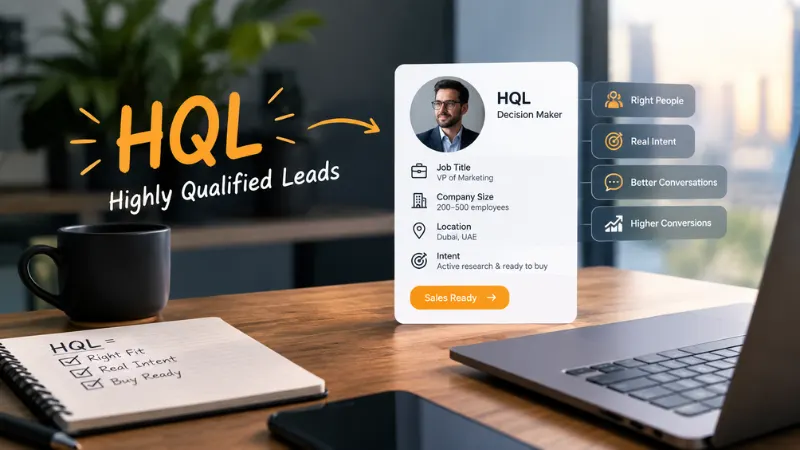
Lead qualification is rarely as simple as tracking who downloaded an asset, filled out a form, or crossed a lead-scoring threshold. For B2B teams, the more important question is whether there is enough relevant evidence to justify giving that lead further sales attention.
That is where the term Highly Qualified Lead (HQL) comes in. While the term is widely used, its meaning depends on how a business defines qualification.
What Is an HQL?
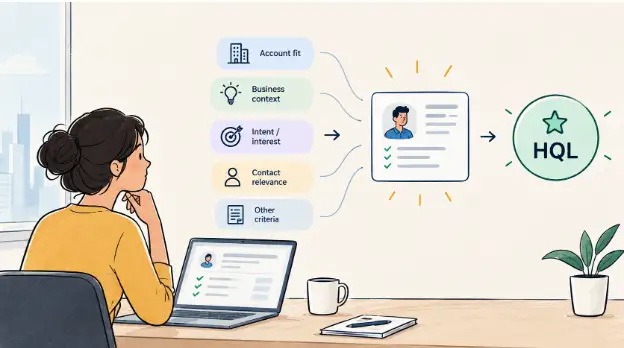
An HQL, or Highly Qualified Lead, is a lead that meets a business’s defined qualification criteria for further sales attention. The criteria can consider factors such as account fit, business context, relevant interest or intent, contact relevance, and other information the business considers important for sales-ready lead qualification.
There is no universal HQL formula. The threshold can depend on factors such as a company’s ICP, sales process, buying cycle, campaign objectives, and sales requirements.
Importantly, engagement alone does not make a lead an HQL. A form fill, content download, or high lead score can provide useful signals, but those signals need to be evaluated against the business’s qualification criteria.
Why Does the HQL Definition Matter?
An HQL definition gives Marketing and Sales a shared standard for determining which leads warrant further attention.
Without a defined standard, qualification can become dependent on individual assumptions. Marketing may consider a lead qualified because it generated strong engagement, while Sales may require additional evidence about account fit, business relevance, or the prospect’s role.
A clear HQL definition establishes what evidence needs to be present before a lead is considered highly qualified. That definition can then be applied consistently across campaigns while accounting for differences in market, sales motion, or campaign requirements.
This is also why an HQL should be treated as a qualification outcome, rather than a label automatically triggered by a particular marketing activity.
Why Isn’t There One Universal HQL Definition?
B2B buying processes and sales motions differ.
A SaaS company selling to enterprise organizations may require information about company size, technology environment, buying committee involvement, and business initiative. Another business may place greater emphasis on geography, industry, use case, or specific qualifier questions.
The evidence required before a lead is handed to an SDR may also differ from the evidence required before an opportunity is created.
For that reason, an HQL definition should be built around the company’s:
- Ideal customer profile
- Target market
- Sales motion
- Buying cycle
- Qualification requirements
- Campaign objectives
- Sales handoff process
The goal is to establish the evidence required for a lead to receive further sales attention.
What Makes a Lead Highly Qualified?
An HQL generally requires more than a single engagement signal. Qualification may consider account fit, business context, relevant interest or intent, contact relevance, and other requirements defined by the sales process.
What makes a lead highly qualified is how these factors come together to provide enough evidence for further sales attention.
The important question is whether the available evidence is sufficient to meet the HQL standard.
What Does an HQL Actually Look Like?
Consider two accounts that have both interacted with the same campaign.
Account A has downloaded multiple assets and opened several emails but does not match the target account profile and provides little evidence of a relevant business need.
Account B has had fewer interactions but matches the target account profile, represents a relevant role, and provides qualification information that aligns with the campaign’s requirements.
Account A may show stronger engagement, but Account B has stronger evidence for HQL qualification.
The distinction is important: HQL status depends on the combination of relevant evidence, not simply the amount of marketing activity.
HQL vs. MQL vs. SQL vs. BANT
HQL is often discussed alongside MQL, SQL, and BANT, but these terms describe different qualification concepts.
An MQL generally reflects a marketing-defined qualification threshold, while an SQL typically indicates that Sales has accepted or further qualified the lead.

BANT is a sales qualification framework based on Budget, Authority, Need, and Timeline.
An HQL is a business-defined standard for determining whether a lead meets a higher level of qualification, while MQL, SQL, and BANT serve different roles in the qualification process. Understanding the difference between HQL, MQL, SQL, and BANT helps clarify where each fits within the broader marketing and sales workflow.
How Does Valasys Define an HQL?
HQL criteria vary from company to company, but Valasys uses a qualification process designed to connect lead qualification with sales relevance.
For Valasys, an HQL is not defined simply by engagement volume, a lead score, or a single intent signal. The process includes qualifier questions presented while a lead engages with relevant POCs, assets, or landing pages, typically through a form submission. Valasys describes its HQL process as combining targeting, validation, human engagement, and qualifier questions to capture buyer insights for scoring.
The responses provide additional qualification evidence that can be evaluated against the client’s agreed requirements.
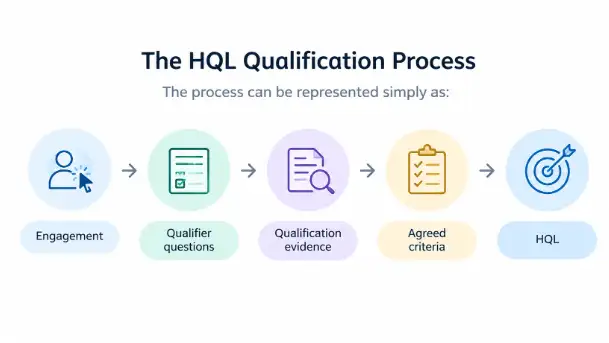
The questions are part of the qualification mechanism, not an automatic HQL trigger. Whether a lead qualifies depends on the requirements established for that client or campaign.
How Does VAIS Support HQL Qualification?
Valasys Media also uses VAIS (Valasys AI Score) to add account-level context to qualification. VAIS combines account signals such as firmographics, technology adoption, buying committee movement, and intent-related data to help assess account fit and relevance.
Its Intent Persona capability can add context around relevant personas and account-level research activity. Account Intelligence, powered by Bombora, adds company-level intent context by analyzing topic-level signals and changes in account activity. The feature classifies topic movement as Surging, Rising, Stable, Cooling, or Declining and uses AI to interpret those signals in terms of potential buying context and next steps.
These insights are supporting evidence, not automatic HQL decisions. The resulting interpretations are hypotheses that should be validated against the account and the client’s qualification requirements.
How Is HQL Quality Connected to Sales?
An HQL ultimately needs to be useful beyond the marketing dashboard. At Valasys, lead quality is mapped against SDR alignment and marketing effort-to-sales closure metrics.
In practical terms, this means looking at whether the lead meets the agreed qualification criteria, provides information Sales can act on, and can reasonably progress into a sales conversation. Where measurable, downstream sales outcomes and Sales feedback can also help refine the qualification criteria over time.
This does not mean every HQL becomes an opportunity or closed deal. It means the HQL definition is evaluated against whether the leads it identifies are useful to the sales process.
Before handing a lead to Sales, teams need to establish the criteria used to determine whether a lead is highly qualified, including the evidence that needs to be captured and validated.
The Bottom Line
An HQL is not simply a lead that looks active on a marketing dashboard.
It is a lead that meets a defined qualification standard based on the evidence a business considers relevant for sales follow-up.
The criteria can differ across sales processes, but the underlying principle remains consistent: qualification should establish why a lead deserves further attention, not simply confirm that the lead interacted with marketing.
For Valasys Media, that qualification includes defined questions captured during relevant lead engagement, with the responses evaluated against agreed qualification requirements. VAIS and Account Intelligence can add account-level and intent context to this process, while HQL quality is considered in relation to SDR alignment and downstream sales outcomes where measurable.
That makes the HQL definition a working agreement between Marketing and Sales, rather than a label attached to a lead after a single interaction.
Ready to Improve Your Lead Qualification? Contact Valasys Media to build a more targeted HQL program aligned with your sales requirements and campaign goals.
Frequently asked questions (FAQs)
What is the difference between a qualified lead and an HQL?
A qualified lead meets a defined set of requirements for further consideration, while an HQL represents a more specific standard a business uses to identify leads considered highly qualified. The distinction depends on how the business defines and applies qualification.
Can a lead be an HQL without showing purchase intent?
Yes. Purchase intent can be one part of HQL qualification, but it does not have to be the only requirement. A business may also consider account fit, business context, contact relevance, qualification responses, or other evidence.
Does an HQL always have to be a decision-maker?
Not necessarily. Some businesses may require a decision-maker for HQL status, while others may qualify relevant influencers or members of a buying committee. The requirement depends on the sales process and qualification criteria.
Can the same person be an HQL for one campaign but not another?
Yes. HQL status is contextual. A lead may meet the qualification requirements for one campaign because of its account fit, business need, or other relevant criteria while failing to meet the requirements of another campaign.
Does a higher lead score mean a lead is an HQL?
Not necessarily. A lead score can summarize selected signals, but HQL status depends on whether the lead meets the business’s defined qualification criteria. A high score alone does not establish that those requirements have been met.
Can an HQL definition change over time?
Yes. Businesses may revise HQL criteria as their ICP, products, markets, sales process, or campaign objectives change. Sales feedback and downstream performance can also provide evidence for refining the definition.