SDKs Emerge as Key Gateway to AI Advertising
Discover how SDKs are becoming key gateways to AI advertising, enabling smarter automation, targeting, and data-driven ad experiences.

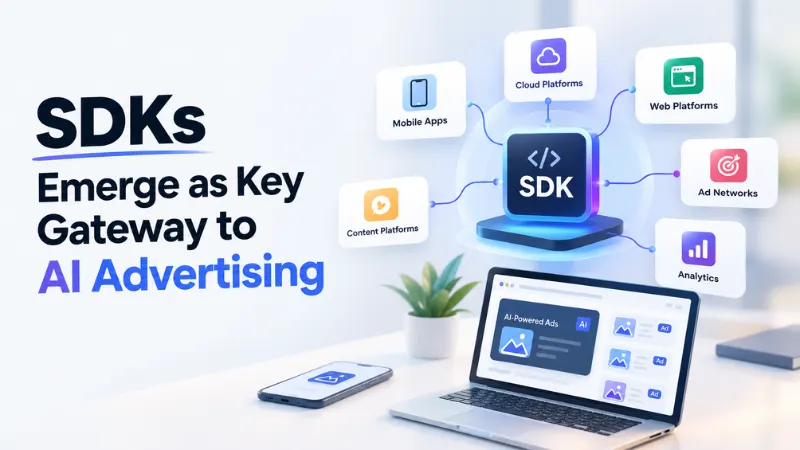
Oct 6, 2026: Software development kits (SDKs) could give independent advertising technology companies an advantage as advertising expands into AI assistants, lockscreens and agentic commerce, according to a report released by research and consulting firm Analysys Mason on Oct. 5.
The report, “The SDK Advantage: How independent adtechs won mobile and are positioned to win AI-native advertising,” said SDKs have become a key control point in the $400 billion in-app advertising market. It identified AppLovin, InMobi and Liftoff among independent adtech platforms with large SDK footprints that could be positioned to capture emerging AI advertising opportunities.
In-app advertising reached about $400 billion in 2025, growing 10.8% year on year to roughly five times its 2017 level, the report said. It accounted for about one-third of the $1.18 trillion global advertising market, while users spent more than 90% of their smartphone time inside apps.
The report said traditional web advertising tools have limited reach inside apps, increasing the importance of first-party signals collected through SDKs. Independent SDKs can reach up to 44% of Android app downloads and 31% of iOS app downloads, according to Analysys Mason.
“Apps broke the advertising playbook built for the web,” Ujjwal Chaudhry, partner at Analysys Mason, said. “Without cookies, tracking a user across apps no longer works, and the SDK has become the one place where the audience, the ad and the result can all be measured.”
The report said the next opportunity could come from AI-native products. Advertising could move beyond conventional app placements into AI assistants, lockscreens and agentic checkout, where there may be no traditional webpage or ad slot.
Chaudhry said AI products face significant operating costs as usage grows, making advertising a potential revenue source. “AI products are costly to run, and advertising is the most scalable way to keep them free for consumers,” he said.
But the growth of AI advertising also raises questions around measurement and attribution. Comscore, which expanded its measurement capabilities for sponsored advertising in AI-powered discovery environments in September, said independent measurement is needed to connect exposure in AI environments with downstream consumer behaviour.
Comscore’s findings point to an emerging challenge for advertisers: AI interactions do not always end with a conventional click or referral, making it harder to determine how an AI-mediated recommendation influences a purchase or other business outcome.
Its analysis of hotel-related ChatGPT prompts found sponsored-ad presence increased from 6% in March to 24% in May 2026.
For adtech companies, the Analysys Mason report suggests that an established SDK footprint could provide an advantage as advertising moves into AI-native environments. But that opportunity will depend not only on access to users, but also on how AI platforms handle advertising, privacy and measurement.