

What a Skid Mount Gas Air Compressor Asks of the Deck It Travels On
Understand the deck requirements for skid mount gas air compressors, including load capacity, structural support, vibration control

A compressor that travels is a different machine
A compressor bolted to a shop floor gets installed once and then ignored. One mounted on a skid lives a harder life: it is craned onto a truck deck, driven over frost heaves, set down on whatever ground is available, run for a few hours and then moved again. A skid mount gas air compressor does the same thermodynamic job as its stationary cousin, but almost everything that goes wrong with one comes from the traveling rather than the compressing.
That is worth saying plainly because the specification sheet does not cover it. Displacement, pressure and tank size describe what the machine delivers standing still. Nothing there tells you that a common cause of a seized pump on a portable unit is an oil level read on a slope.
Oil level is measured against gravity, not against the machine
Most reciprocating pumps are splash lubricated. A dipper on the connecting rod throws oil from the sump up onto the cylinder walls and bearings every revolution, which works beautifully as long as the sump is where the designer expected it to be.
Park the skid on a grade and the oil pools at one end of the sump. The sight glass, which sits on one side of the crankcase, now reads whatever the oil happens to be doing at that corner. On a modest slope it can show full when the pump is genuinely low, or show low when there is plenty, and both errors cause trouble: one leads to running dry, the other to overfilling and oil carryover into the air line.
The habit that solves it costs nothing. Check and top up the oil with the skid sitting level, not where it happens to be parked, and if the only available ground is sloped, note which way it tilts before trusting the glass. A gas air compressor that spends its life on uneven ground deserves that minute of attention more than one that never moves.
Vibration finds every loose fitting eventually
A single-cylinder engine driving a reciprocating pump produces vibration at several frequencies at once, and a steel skid transmits all of it. On a stationary machine isolation mounts and a concrete floor absorb much of that energy. On a skid, the frame is the floor.
The result is predictable: threaded joints back off, copper discharge lines work-harden where they are clamped, and fasteners tight in spring are finger-loose by midsummer. Leaks develop slowly enough that nobody notices the machine running more often than it used to, until the fuel consumption makes it obvious.
Transport adds a second kind of loading. Road shock through a truck deck is sharper than running vibration and acts in other directions, which is why the fittings that fail are often ones nobody has touched. Checking the line clamps and pump mounting bolts after the first few moves beats any scheduled interval.
The engine brings requirements the pump does not have
An electric air compressor starts whenever the switch closes. An engine has opinions. It needs fresh fuel, a charged battery or a sound recoil, oil at the right level in a second sump entirely, and air that it can actually draw through a clean filter.
Cold mornings are where this shows. Thick oil in both the engine and the pump means the starter is fighting more drag than usual at exactly the moment the battery is weakest, and a machine that started easily in the fall can refuse at the first hard frost with nothing broken.
Two details help more than they sound like they should. Letting the engine warm a minute before loading it gives oil time to reach the bearings in both sumps. Keeping the unloader working means the pump starts against no pressure, which removes most of the load that makes cold starting hard in the first place.
Securing it to the deck without damaging it
A skid is designed to be lifted and tied down, and it has specific points for both. Straps run over the tank or across the discharge line damage the parts least able to take it, and a tank that has been strapped hard enough to deform is a tank to retire rather than repair.
Lifting introduces its own hazard. Picking the unit up by the engine, the pump or a convenient handle rather than by the designated points sends the load through components that were never intended to carry the weight of the whole assembly, and the damage from doing it once may not show until something cracks months later.
What the tank collects between jobs
An air compressor tank accumulates condensate every time the machine runs, and a portable one has an extra problem: water that sits in the bottom sloshes when the truck moves and freezes solid when the truck is parked overnight in winter.
Draining before a move rather than after one takes the same thirty seconds and avoids the case where the valve is frozen shut exactly when you need it open. It also keeps that water out of the line on the next start, which matters more on a gas air compressor than on a shop unit because the first tool connected is often a long way from any filter.
Where it sits while it runs matters too
A gas air compressor needs air for two separate purposes: the pump draws it to compress, and the engine draws it to burn and to cool itself. Setting the skid tight against a wall, in a trailer, or behind a stack of material starves both.
Exhaust is the other consideration, and it is the one with consequences. An engine-driven unit cannot run inside a building or a partly enclosed space, and the usual failure of judgment is a loading bay or a garage with the door open, which is still an enclosed space as far as carbon monoxide is concerned.
The short list before each move
Five checks cover almost everything that goes wrong:
- Oil level: both sumps, on level ground
- Mounting bolts: pump and engine, after transport
- Discharge line: clamps tight, no chafe marks
- Tank drain: emptied before travel
- Tie-downs: designated points only
Buying for the way it will actually live
Judging a portable unit by output alone misses the point of the format. What matters is whether the skid is rigid enough to keep the pump and engine in alignment, whether the controls and drain are reachable once it is strapped down, and whether the fittings are serviceable without dismantling half the frame.
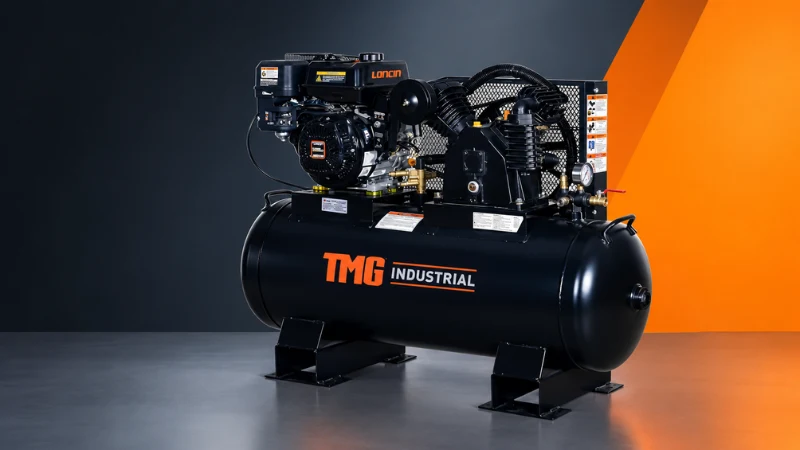
TMG Industrial builds this one as a forty gallon horizontal tank with a nine horsepower engine on a two stage pump, which is a sensible combination for work where mains power is not available. Whatever you choose, assume it will spend more hours on a truck than it does running, and buy accordingly.