
SurgeONE.ai Launches Avery Actions, Bringing Agentic AI to Financial Compliance and Cybersecurity
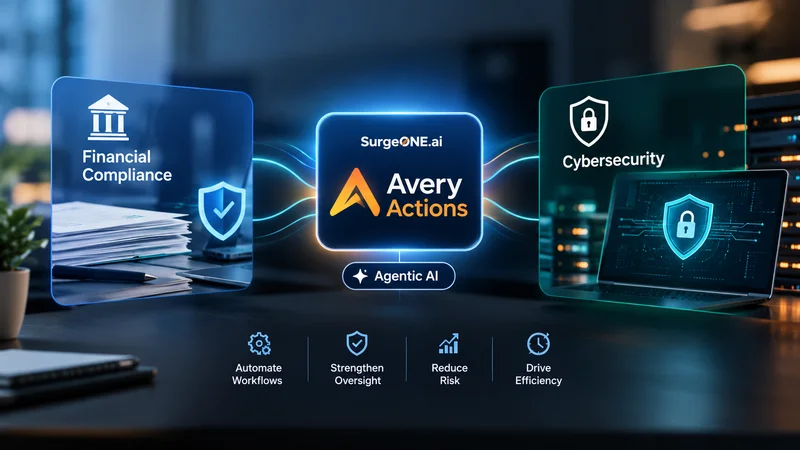
SurgeONE.ai launches Avery Actions, bringing agentic AI to strengthen financial compliance and cybersecurity through intelligent automation.

October 26, 2026
SurgeONE.ai has introduced Avery Actions, an agentic AI system designed to execute financial compliance, cybersecurity and data governance workflows, as regulated firms face growing pressure to manage fragmented systems and regulatory oversight.
SurgeONE.ai announced Avery Actions on Monday at the National Society of Compliance Professionals (NSCP) National Conference in Orlando, Florida. The launch expands its existing Avery AI assistant from providing information to performing operational tasks, including preparing regulatory documentation, reviewing disclosures and collecting audit evidence.
The development comes as financial institutions face increasing scrutiny over electronic communications, cybersecurity controls and employee use of artificial intelligence. Unlike conventional compliance tools focused on individual functions, SurgeONE is positioning Avery Actions as a unified operating platform. Whether that integration delivers measurable efficiencies remains to be demonstrated.
What Has Changed?
Avery Actions combines communications archiving, electronic communications review, off-channel monitoring, cybersecurity, vendor due diligence and AI governance within a shared workflow.
New capabilities include text-message archiving, messaging-app monitoring, custodian data feeds and video marketing review.
The platform can also draft compliance policies, organize vendor assessments and prepare responses to regulatory examination requests. SurgeONE says qualified experts review AI-generated outputs, while actions are recorded in a centralized audit trail.
Its TrustGate capability monitors employee AI usage, archives AI conversations and identifies unauthorized tools.
The company says Avery operates on each firm’s own data with role-based permissions and approval thresholds.
Why Does This Matter for Financial Institutions?
The announcement addresses a persistent challenge in financial services: critical compliance information often sits across disconnected platforms.
In August 2024, the US Securities and Exchange Commission announced that 26 financial firms had agreed to pay a combined $392.75 million to settle charges involving electronic recordkeeping failures.
Such enforcement actions highlight the importance of reliable communications monitoring, record preservation and supervisory controls.
For financial institutions, consolidating these workflows could reduce administrative complexity. However, automation does not remove regulatory accountability or guarantee that records are complete.
What Does This Mean for Enterprise Leaders?
For compliance leaders, Avery Actions could streamline regulatory reviews, evidence collection, and audit preparation. However, human oversight remains essential to ensure accuracy and regulatory accountability.
Technology and cybersecurity teams may gain greater visibility across enterprise systems, but integration complexity, data security, and access controls remain critical considerations.
For marketing teams, video content review could simplify the monitoring of regulated communications while supporting existing approval workflows.
Finance and procurement leaders may identify opportunities for software consolidation and operational efficiency, although pricing details and measurable cost savings remain undisclosed.
For senior executives, the strategic opportunity extends beyond task automation. Agentic AI could reshape how enterprises manage compliance, reduce operational friction, and coordinate workflows across departments.
The real value of Avery Actions will not be measured by how many tasks it automates, but by whether it delivers measurable efficiency gains without compromising compliance, security, or accountability.
Enterprise leaders should prioritize controlled pilot programs, clear governance frameworks, and measurable performance indicators before committing to broader adoption. Ultimately, the competitive advantage will belong to organizations that can scale AI-driven operations while maintaining transparency, human oversight, and regulatory trust.
How Does Avery Actions Compare With Existing Platforms?
SurgeONE enters a market that already includes established compliance technology providers such as Smarsh, Global Relay and Microsoft Purview.
These companies offer capabilities spanning communications archiving, surveillance, information governance and compliance monitoring.
SurgeONE’s proposed differentiation lies in combining compliance execution, cybersecurity, data operations and expert-reviewed AI workflows within one environment.
However, its claim of uniquely comprehensive coverage has not been independently established through comparative testing.
What Remains Unclear?
SurgeONE has not publicly disclosed Avery Actions’ pricing, typical deployment timelines, independently verified accuracy rates or quantified productivity improvements.
The effectiveness of its unified approach will also depend on the quality of third-party integrations and existing customer data.
Although the company included customer endorsements in its announcement, these do not establish independent performance results for every newly introduced capability.
The Bottom Line
Avery Actions reflects a broader enterprise technology shift from AI tools that generate information toward systems designed to execute regulated business processes.
For compliance teams, the potential benefit is faster documentation and improved workflow coordination. For technology and security leaders, the challenge is balancing integration and automation with control, accountability and resilience.
SurgeONE’s announcement establishes a new product direction, but enterprise adoption will ultimately depend on demonstrable accuracy, operational savings and regulatory reliability.