
The Ultimate Guide to TAM Tools: Which ONE Will Transform Your Business in 2025?
Discover the ultimate guide to TAM tools, exploring key features that make them worth investment. Compare enterprise solutions like Pitchbook and Gartner with mid-market options like Valasys and Crunchbase to find the perfect Total Addressable Market tool for your business strategy in 2025.


Have you noticed how some companies can easily tell you their market size but some have trouble doing the same. That’s because they don’t have that one tool they can trust completely.
TAM tools are the foundation of contemporary business strategy, taking companies from ambitious startups to Fortune 500 behemoths in making more informed decisions about where to spend their valuable time and resources. These platforms offer the intelligence needed to spot unexplored prospects and persuade potential investors showing that your company is worthwhile.
In this blog, we’ll discuss the unique features of the best TAM tools available Today. We will assess their advantages and disadvantages so that by the time you finish reading this, you will be able to determine which one should be a part of your tool-kit.
What Makes a TAM Tool Worth Your Investment?
Before getting into specific platforms, let’s understand what makes these TAM tools stand out.
Having a group of market research professionals working for your company around the clock is what a great TAM tool should feel like. The most effective platforms give you insights that would take months to compile manually by fusing intelligent analytics with enormous databases.
The cornerstone of any useful TAM tool is data accuracy.
Making business decisions based on unstable market data is like trying to build a house with playcards. Prominent tools obtain data from several validated sources, such as government databases, trade publications, and exclusive research networks. Furthermore, they update their data frequently because what was accurate yesterday could be an expensive error today.
User experience heavily influences whether a tool becomes your daily companion or an expensive dust collector. Great platforms enable users to produce boardroom-ready insights without spending weeks learning complicated software. They offer customizable reports, lucid visualizations, and the capacity to delve deeply into a particular market segment without getting bogged down in data.
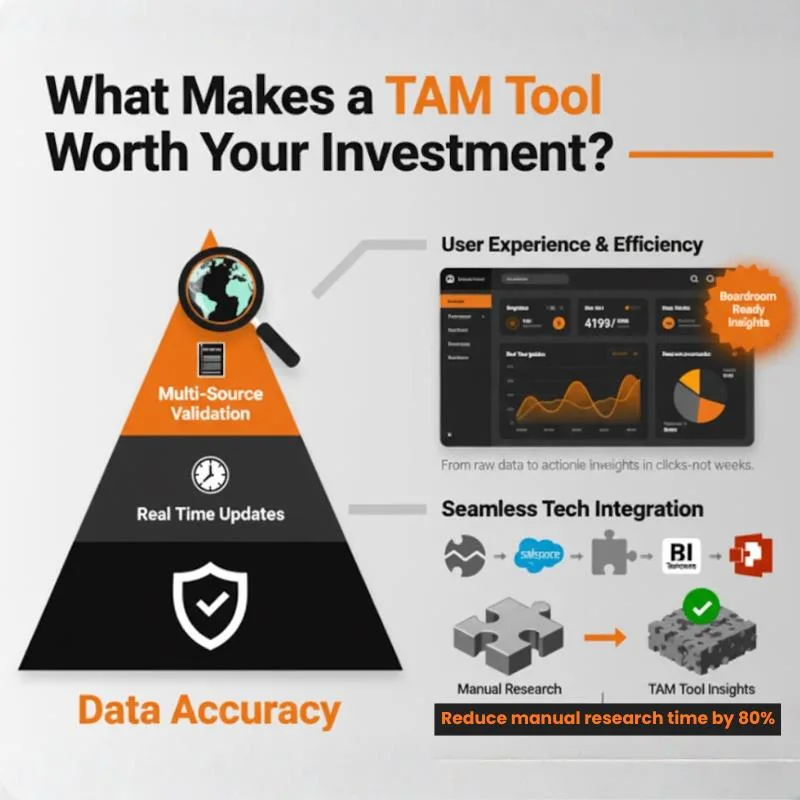
Your TAM tool should work well with your current tech stack instead of being used in isolation. The top platforms provide smooth integration with presentation software, business intelligence tools, and CRM systems. This connectivity makes sure that market insights are disseminated efficiently throughout your company.
The Heavy Hitters: Enterprise-Level TAM Solutions
Some platforms stand out as the leaders of enterprise-grade TAM tools, by continuously providing market intelligence to the most demanding companies in the world. These solutions are usually expensive, but their data depth is unmatched and analytical power makes them worth the price.
-
Pitchbook
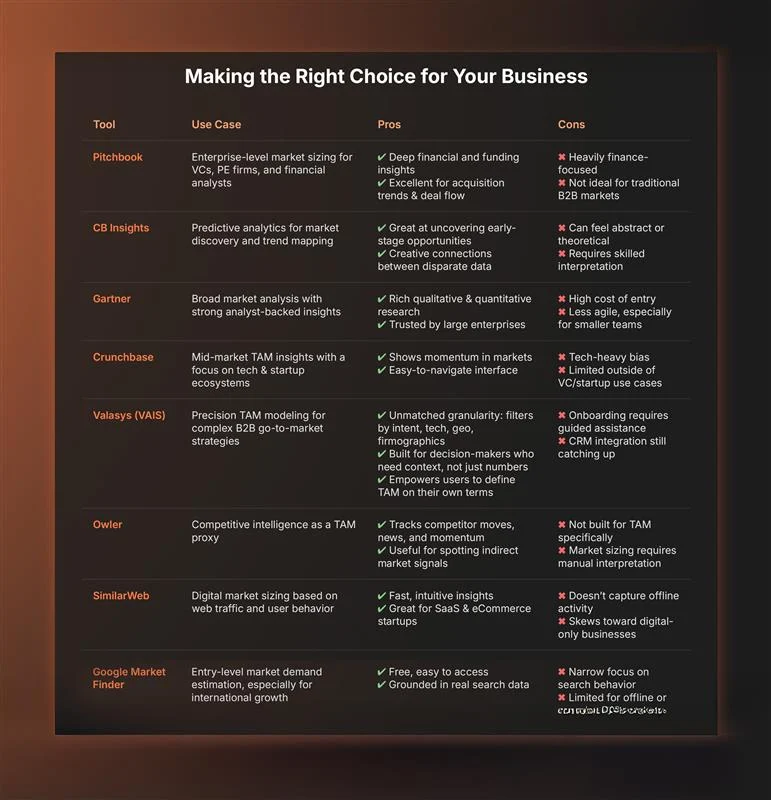
Pitchbook is one of the most reputable brands in its field, especially for brands in the venture capital and private equity sectors. Pitchbook is unique because it can monitor not only the state of the market in real time but also funding flows, acquisition activity, and new trends that could indicate changes in the market down the road. Certain features, however, may not be as relevant to the needs of some traditional businesses due to their emphasis on financial markets.
-
CB Insights
CB Insights has established a unique position by fusing market research, trend analysis, and competitive intelligence. Their platform is good at spotting new markets before they are widely recognized. The tool’s strength is its capacity to uncover undiscovered market opportunities by tying together seemingly unrelated data points. But the drawback? Sometimes, their creative approach yields insights that need careful interpretation before turning into workable business plans.
-
Gartner
Gartner’s market research platform brings decades of industry experience to the TAM tool category. Their specialty is giving context for raw market data. In addition to their quantitative data, Gartner’s analyst network offers qualitative insights that present a more comprehensive picture of market dynamics. The problem with Gartner is that their knowledge is expensive, and smaller businesses may find it difficult to make the investment.
The Rising Stars: Mid-Market TAM Solutions
-
Valasys
Valasys gives you accurate TAM predictions in this category, owing to its extensive proprietary database and data-backed modeling. Their tools are designed for business-to-business (B2B) marketers who value contextual insights, accuracy, and customization. Their level of detail sets them apart as users can customize their TAM definitions according to buyer intent signals, firmographics, geography, and even technology. Valasys is particularly useful for intricate B2B go-to-market teams because of its granularity. The flip side? This depth makes onboarding a little overwhelming without assistance (The good news is, a new update is coming that will help with this too.). But Valasys cannot be integrated with other marketing automation tools.
-
Crunchbase
Crunchbase was just a startup database but has developed into an all-around market intelligence platform that is especially useful for tech companies. Crunchbase sets itself apart with its capacity to display not only market size but also market momentum. They pinpoint market niches that are drawing more attention and investment. The platform’s bias towards the technology sector is also its weakness, which may limit its applicability to B2B markets outside the tech ecosystem or traditional industries.

-
Owler
Owler adopts a different strategy by emphasizing competitive intelligence to gain insight into the market. Their platform monitors news, growth signals, and competitor activity to give users a comprehensive understanding of market dynamics. Owler’s competitive insights can offer useful information for determining market size and identifying trends, even though they aren’t typically regarded as TAM tools. Their ability to understand what is changing in the market, as well as which companies are driving said change, is their strongest suit. The drawback is that users must put in more effort to convert competitive insights into thorough market sizing.
The Agile Alternatives: Startup-Friendly TAM Tools
For start-ups or small businesses, the TAM tool landscape has several platforms designed specifically for organizations with limited budgets but unlimited ambition. These tools prioritize ease of use & quick insights over comprehensive data coverage, making them ideal for entrepreneurs who need to understand their markets quickly.
-
SimilarWeb
SimilarWeb has become increasingly popular among startup founders for its ability to provide market insights through web traffic analysis & digital behavior data. Their TAM calculations often focus on digital markets, using website traffic, app downloads, & online engagement patterns to estimate market size & opportunity. This approach works particularly well for digital businesses, e-commerce companies, & SaaS startups that operate primarily online. The platform excels at delivering real-time market signals based on user behavior—far more actionable than survey data or static industry estimates. However, businesses with significant offline components might find their market sizing incomplete.
-
Google Market Finder
Google Market Finder represents one of the most accessible entry points into market intelligence, particularly for companies considering international expansion. While not a traditional TAM tool, Market Finder provides valuable insights into market demand, competition levels, & opportunity assessment across different geographic regions. The platform leverages Google’s vast data resources to provide insights grounded in actual search behavior & online activity. Its limitation lies in its focus on digital demand signals, which might not capture the full picture for all business types.
Making the Right Choice for Your Business
Choosing the right TAM tool is about finding the one that best matches your specific needs, budget, & business context. The decision requires careful consideration of multiple factors that extend beyond simple feature comparisons.
Start by honestly assessing your current market knowledge & research capabilities. If you’re operating in a well-established industry with plenty of existing research, you might benefit more from a tool that helps you analyze & interpret existing data rather than one that focuses on primary research. Conversely, if you’re pioneering a new market category, you’ll need a platform that can help you build market understanding from the ground up using alternative data sources & innovative methodologies.
Consider your team’s technical sophistication & available time for learning new tools. The most advanced platform becomes worthless if your team can’t or won’t use it effectively. Some organizations benefit from simpler tools that provide quick insights, while others have the resources to maximize sophisticated platforms that require significant learning investments. Think about whether you need a tool that provides answers or one that helps you ask better questions.
Budget considerations extend beyond simple subscription costs to include implementation time, training requirements, & ongoing maintenance needs. Some platforms require significant setup & customization to provide value, while others offer immediate utility but might lack the depth needed for complex market analysis. Factor in the total cost of ownership when making your decision.
The right TAM tool can transform how you understand & approach your market, providing the intelligence needed to make confident strategic decisions in an uncertain business environment. Whether you choose an enterprise powerhouse or an agile startup solution, the key is selecting a platform that fits your organization’s unique needs & actually gets used consistently. Remember, the best TAM tool is the one that helps you discover opportunities you wouldn’t have found otherwise & gives you the confidence to pursue them aggressively.
Take the time to try multiple platforms, involve your team in the evaluation process, & choose based on your specific use cases rather than general feature lists. Your market is waiting to be understood – and only the right tool will help you win it.
The investment in the right TAM tool today could be the foundation of your market leadership tomorrow.
FAQ’s
- What tools can help calculate TAM?
: Different platforms can help you calculate your Total Addressable Market (TAM), depending on your company’s size and goals. For enterprise-level analysis, Pitchbook, CB Insights, and Gartner offer deep financial and trend data ideal for large-scale strategy. Mid-market players like Valasys (VAIS), Crunchbase, and Owler provide more customizable insights, especially for B2B marketers who need precision and context. For startups, SimilarWeb and Google Market Finder deliver quick, data-backed estimates based on digital behavior and search demand. - What factors should I prioritize when choosing a TAM tool for my business?
: Start with your business maturity and data needs. If you already have strong internal data and just need validation, go for a tool that integrates easily and enhances your existing insights, something like Valasys or Gartner. But if you’re still building your market understanding, a discovery-first platform like CB Insights or SimilarWeb might make more sense. Ultimately, the best TAM tool is one that fits your workflow, provides reliable data, and actually gets used by your team. - Why do businesses trust Valasys for TAM modeling?
: Valasys stands out because it’s built for the realities of B2B decision-making. Its proprietary database combines buyer intent, firmographics, and behavioral signals to give a precise, contextual view of your total addressable market. Unlike generic market tools, Valasys lets you define TAM your way—by geography, tech stack, or even deal stage. That level of control and accuracy makes it a favorite among complex go-to-market teams that can’t afford to rely on guesswork.