What is RevOps? A B2B Marketer’s Complete Guide
You ran the campaigns. You hit your MQL targets. The dashboards are green. And yet, revenue is still not moving the way it should.


You ran the campaigns. You hit your MQL targets. The dashboards are green. And yet, revenue is still not moving the way it should.
Sound familiar?
Sales says the leads are bad. Marketing says Sales never followed up. Customer success is quietly dealing with churn. Everyone has a spreadsheet. Nobody trusts the spreadsheet.
This is not a people problem. It is a systems problem. And that system has a name: RevOps.
What Is RevOps? (Simple Definition)
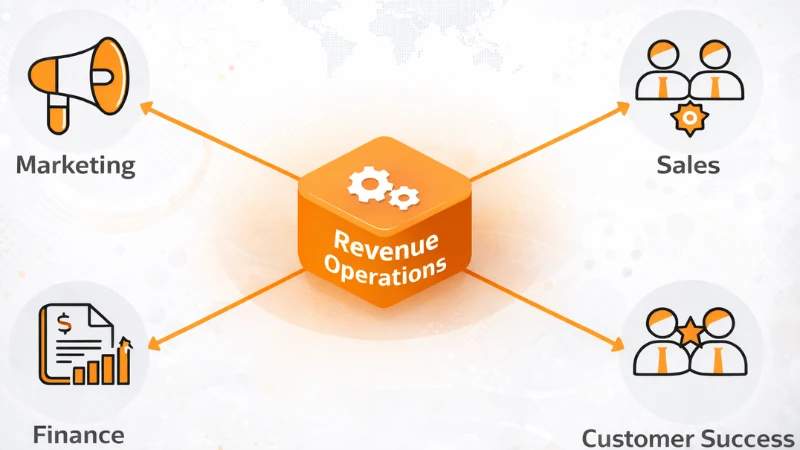
RevOps, short for Revenue Operations, is the operating system that makes revenue predictable. It does this by connecting three teams that usually work in silos:
- Marketing : generates leads and pipeline
- Sales : converts leads into customers
- Customer Success : retains and grows those customers
RevOps gives all three teams:
- A shared definition of what “qualified” means
- Clear rules for handing leads between teams
- Clean, trusted data
- One dashboard everyone can actually rely on
Think of it like a kitchen. You can have great ingredients (your campaigns, your SDRs, your CS team), but if the kitchen is messy and everyone is cooking by different rules, dinner is going to be a disaster.
RevOps is the kitchen that actually works.
Why Does RevOps Matter for B2B Marketers?
As a B2B marketer, you already feel the symptoms of a broken revenue system:
From leads that go nowhere after marketing hands them off to the pipeline that looks healthy until it slips at the end of the quarter to Customers who churn because no one gave CS the right context.
RevOps gives you a structured way to fix all three, not by working harder, but by removing the friction between teams.
RevOps vs. Marketing Ops vs. Sales Ops: What’s the Difference?
This is one of the most common points of confusion. Here’s a simple breakdown:
| Team | What They Own | Where They Operate |
| Marketing Ops | Campaigns, automation, lead scoring, attribution | Inside Marketing |
| Sales Ops | CRM hygiene, pipeline stages, quota design | Inside Sales |
| CS Ops | Onboarding, health scoring, renewal cadence | Inside Customer Success |
| RevOps | Shared definitions, handoffs, forecasting, unified reporting | Across all three |
The easiest rule: If a problem lives inside one team, it’s a functional ops problem. If it shows up between teams, it’s a RevOps problem.
The Full RevOps Lifecycle (And Where Marketing Fits)
RevOps does not just cover the top of the funnel. It spans the entire customer journey:
1. Target Account – identified as a good-fit account
2. Engaged Account – showing intent signals (visiting key pages, downloading content)
3. Inquiry / Lead – someone raises their hand
4. MQL – meets your agreed qualification thresholds
5. SQL / SAO – Sales accepts the lead
6. Opportunity – an active deal is open
7. Closed Won / Lost – a decision is made
8. Expansion / Renewal – the customer grows or renews
Marketing owns stages 1–4. But what happens at stage 4, the handoff is where most revenue gets lost.
RevOps owns the rules that govern every transition in this chain.
The 5 Core Problems RevOps Solves
1. Misaligned Definitions
Marketing calls something an MQL. Sales calls it too early. When no one agrees on what “qualified” means, every pipeline meeting becomes an argument instead of a plan.
2. Leaky Handoffs
A prospect fills out your form and gets a call, two weeks later. By then, they’ve bought from a competitor or forgotten why they signed up. RevOps enforces speed-to-lead SLAs so this stops happening.
3. Bad Data
Duplicate contacts. Invalid emails. Leads that never get enriched. Bad data is the quiet killer of every pipeline. RevOps installs data quality as a process, not an afterthought.
4. Reporting Theater
Dashboards that look impressive but that no one actually trusts. RevOps replaces vanity metrics with one shared view of truth that every team inputs into and agrees on.
5. Misaligned Incentives
Marketing is rewarded for MQL volume. Sales is rewarded for closed deals. CS is rewarded for retention. Without RevOps, these incentives actively work against each other.
RevOps KPIs Every B2B Marketer Should Track
Leading Indicators (Are you attracting the right accounts?)
– ICP coverage (% of your total addressable market you are actively engaged with)
– Account engagement rate
– Website conversion rate
– Meeting show rate
Mid-Funnel Health (Is the system converting?)
– MQL to SQL conversion rate
– Speed-to-lead (time from form fill to first contact)
– Meeting-to-opportunity rate
Pipeline Quality (Is revenue actually predictable?)
– Pipeline velocity
– Stage-by-stage conversion rates
– Sales cycle length
– Win rate
Data Quality (Is your engine running clean?)
– Invalid email rate
– Duplicate lead rate
– Enrichment completeness score
The 4 RevOps Systems That Actually Move the Needle
System 1: The Handoff System
Defines exactly when a lead moves from marketing to sales — and what happens next.
- Clear trigger points (e.g., demo request, score threshold hit)
- Speed-to-lead SLAs (high-intent leads contacted within a defined window)
- Lead acceptance criteria for Sales
- Rejection taxonomy with standardised reason codes
- Weekly review between marketing and SDR/BDR teams to fix leaks
System 2: The Fit + Intent Scoring System
Ensures the best leads get prioritised, not just the most recent ones.
- ICP fit scoring (firmographics like industry, company size)
- Intent scoring (behaviour like page visits, downloads, signals)
- Combined score used for routing, prioritisation, and outreach timing
- Thresholds that define when a lead becomes sales-ready
System 3: The Webinar and Event Qualification System
Turns event engagement into clear next steps, not generic follow-ups.
- Segmentation by behaviour (attended live, on-demand, no-show)
- Engagement depth (questions asked, watch time, interaction level)
- Defined follow-up paths for each segment
- Sales alerts for high-intent engagement signals
System 4: The ABM Orchestration System
Aligns marketing and sales around a shared plan for target accounts.
- Tiered account strategy (Tier 1: 1:1, Tier 2: persona-based, Tier 3: scaled)
- Coordinated outreach across ads, SDR, and content
- Shared messaging across all touchpoints
- Defined ownership and timing between teams
The RevOps Maturity Model: Where Does Your Team Stand?
Most B2B companies are at Level 1 or Level 2. Here’s how to self-diagnose:
| Level | Name | What It Looks Like |
| 1 | Reactive | Every team works independently. No shared definitions. Lots of fire-fighting. |
| 2 | Coordinated | Teams talk to each other but still have separate data and processes. |
| 3 | Integrated | Shared lifecycle definitions, clean data, one dashboard, enforced SLAs. |
| 4 | Predictive | Machine-learning scoring, automated routing, real-time forecasting. |
| 5 | Outcome-Optimised | Revenue is fully predictable. Every lever is measured and tested. |
The goal isn’t Level 5 immediately. Moving from Level 1 to Level 3 will already dramatically improve your pipeline conversion and marketing attribution.
Your 90-Day RevOps Roadmap (Marketer-Led)
You do not need a $500K consulting engagement to get started. Here’s a practical roadmap:

Days 1–30: Stabilise the Truth
– Document your lifecycle stages (even if imperfect)
– Get sales and marketing to agree on one MQL definition
– Audit your CRM for duplicates and invalid data
– Set your first speed-to-lead SLA
– Build one shared dashboard (not perfect, just trusted)
Days 31–60: Enforce the System
– Add validation rules to your forms and CRM
– Start tracking SLA adherence weekly
– Introduce a lead rejection taxonomy
– Launch a basic fit + intent scoring model
Days 61–90: Automate and Integrate
– Automate lead routing based on fit and intent
– Integrate your marketing automation with CRM
– Apply an attribution model (even a simple one)
– Establish a weekly revenue review cadence with sales
3 RevOps Myths Worth Killing
Myth 1: “RevOps is a tool problem.”
No. Tools are part of it, but buying a new MAP or CRM does not fix broken processes. Fix the process first. Then automate it.
Myth 2: “RevOps is just better reporting.”
Reporting is an output of RevOps, not the point of it. RevOps is about fixing what causes the numbers to be bad, not just displaying them more nicely.
Myth 3: “RevOps is only for enterprise companies.”
Even a 20-person B2B company loses revenue to bad handoffs, missing SLAs, and duplicate data. You do not need to be at Series D to benefit from clean systems.
Quick-Reference RevOps Checklist
Use this to diagnose your current state:
☐ Lifecycle stages documented and agreed across teams
☐ MQL definition signed off by both marketing and sales
☐ Speed-to-lead SLAs defined and tracked
☐ Lead rejection taxonomy in place
☐ Fit and intent scoring model live
☐ One shared dashboard that leadership trusts
☐ Data quality metrics tracked weekly
☐ Weekly revenue review cadence with sales
☐ Attribution model applied (even first/last touch to start)
☐ Clean sales-to-CS handoff process defined
If you can check fewer than five boxes, you are at Level 1. That’s okay, that’s where most teams are. Now you know where to start.
The Bottom Line
Marketing hitting its targets while revenue still stalls is not a marketing problem. It is a systems problem.
RevOps is the framework that closes the gap, not by working harder, but by removing the friction between the teams that are supposed to be working toward the same number.
The fastest wins are simple:
1. Agree on what “qualified” means
2. Enforce speed-to-lead
3. Build one dashboard everyone trusts
Revenue is a system. Build the system, and the results follow.
Frequently Asked Questions (FAQs)
What does RevOps stand for?
RevOps stands for Revenue Operations. It is the function that aligns marketing, sales, and customer success around shared data, processes, and goals to make revenue more predictable.
Who should own RevOps?
Ideally, a dedicated RevOps leader or team. In smaller companies, it often starts with the Head of Marketing Ops or a senior marketer who has visibility across the full funnel. What matters most is that someone owns the cross-functional view.
Is RevOps only for large companies?
No. Any B2B company that has a sales team and a marketing function can benefit from RevOps principles. The basic shared lifecycle definitions, speed-to-lead SLAs, one trusted dashboard can be implemented at any company size.
What is the difference between RevOps and GTM strategy?
GTM strategy defines where you play (which markets, which buyers, which messages). RevOps is the system that executes the GTM strategy consistently and predictably.
How does intent data support RevOps?
Intent data tells you which accounts are actively researching your category or competitors right now. In a RevOps system, intent signals feed into your scoring model to prioritise routing and outreach, so your sales team focuses on accounts that are actually in-market, not just a good fit on paper.
How long does it take to implement RevOps?
The 30-60-90 day roadmap above gets you from reactive to integrated. The first 30 days alone, agreeing on definitions, cleaning your CRM, setting SLAs, can produce visible improvement in pipeline conversion within one quarter.