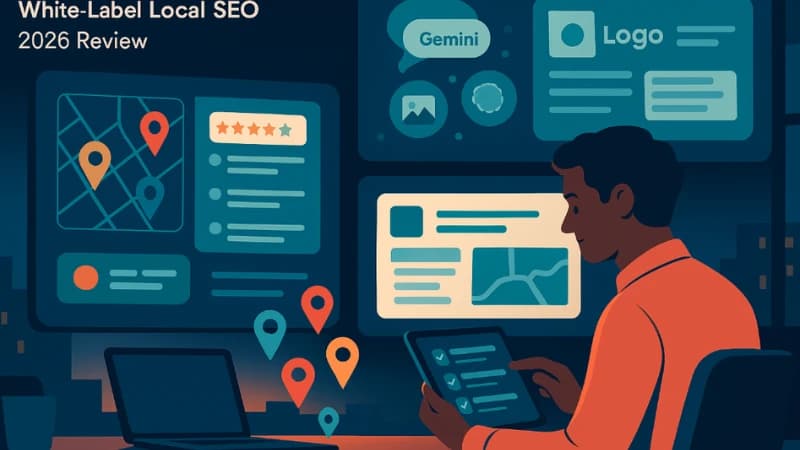
Local SEO just got tougher. In 2025, Google Business Profile suspensions jumped 80 percent, stretching appeals to about five weeks, and Google’s new Gemini AI now auto-suggests photos, service areas, and copies inside those same profiles (DataDab). Agencies are fighting back by white-labeling the heavy lifting—outsourcing citations, links, and reinstatements while keeping client relationships in-house. We pressure-tested 12 platforms against a seven-pillar scorecard—onboarding, branding, pricing, local depth, tech/AI, sales help, and reporting—and ranked the five that will keep your margins healthy in 2026.
How We Picked the Winners
We started with a seven-pillar scorecard derived from DataDab’s 2025 comparison. The pillars are onboarding, white-label branding, pricing, local-SEO depth, tech and AI, sales enablement, and reporting, and DataDab lists all seven.
Next, we built a pool of 12 providers: the eight vendors in DataDab’s 2025 ranking plus four names from Propellant Media’s 2024 “Top SEO Reseller Companies” roundup. Any platform without a documented product update in 2024 or 2025 was removed.
To clear the first hurdle, each contender had to:
- deliver core local-SEO tasks (citations, Google Business Profile optimization, review prompts)
- provide a client-ready, white-label dashboard
Ten vendors made it through.
We opened test accounts under an agency alias, timed the kickoff workflow, filed real support tickets, and priced a standard local campaign capped at a 500-dollar wholesale budget. Public G2 reviews and anonymized chat transcripts confirmed marketing claims.
Finally, we rolled every raw score into a weighted index. The five programs that followed didn’t merely pass; each led at least one pillar outright, whether that was margin control, AI-driven efficiency, or enterprise-grade support. Feel free to reuse the same rubric with confidence.
1. AgencyPlatform – Best for Flexible, Data-Rich Reporting

AgencyPlatform centers everything on a white-label dashboard that you host under your own domain. Weekly and monthly reports pull live data from Google Analytics, Search Console, Semrush, Ahrefs, and CallRail, then send email from your address with no vendor logos in sight.
Branding and Access
- Custom URL, logo, and sender ID
- Automated summaries sent every Monday (partners report email open rates above 60 percent after migration)
Fulfillment
Its SEO Reseller packages start at 178 dollars per location and include a 15-day free trial. You can also add one-off jobs like a 300-directory cleanup (249 dollars) or a forensic technical audit (399 dollars) straight from the service cart.
Membership Pricing
Bronze, Silver, Gold, and Platinum plans run from 5 to 42 dollars per month when billed annually. Higher tiers unlock up to a 10 percent wholesale discount and extra pre-sales audit credits. Every tier includes a named account manager for Google Business Profile emergencies.
Known Limitations
The UI still shows a 2019 design language, and only twenty-five native integrations are available, fewer than Vendasta’s 250-app marketplace. Recent additions of Semrush, Ahrefs, and CallRail close the biggest gaps, but agencies that need niche CRMs will depend on Zapier.
Bottom Line
Choose AgencyPlatform if you win and keep clients by showing granular results and want the freedom to purchase services project by project instead of locking into rigid bundles.
2. Boostability – Best for Volume and Predictable Margins

Founded in 2009, Boostability has grown from a basement startup to a 400-person fulfillment team that supports more than 26,000 small-business campaigns worldwide. The playbook is simple: document every recurring task—on-page tweaks, citation builds, monthly backlinks—and run them through LaunchPad, the company’s workflow engine.
Why Agencies Pick It
- Low entry cost. Wholesale packages start under 400 dollars, so you can resell an under-700-dollar plan and still keep a healthy margin.
- Predictable delivery. The dashboard lists tasks, due dates, and ranking lifts in plain language, and it flags dropped links or NAP errors before clients notice.
- Volume ready. Standard operating procedures scale smoothly from a single florist to a 100-location franchise without extra headcount.
Where It Falls Short
Boostability’s cadence—three to five local links per month and capped blog-length content—can stall in hyper-competitive niches such as personal-injury law. Agencies serving those verticals may need to add bespoke PR links or long-form content from another vendor.
Bottom Line
If your agency manages dozens of plumbers, dentists, or storefront retailers on retainers under 1,000 dollars, Boostability’s conveyor-belt model keeps work moving and margins intact. For clients who need heavyweight authority building, keep a specialist partner on standby.
3. SEOReseller – Best for Competitive Niche Rankings

SEOReseller focuses solely on SEO, with no PPC upsells or social add-ons, so the team can dedicate every resource to local rankings. Each campaign starts with a multi-point audit that checks NAP accuracy, on-page structure, backlink authority, and Google Business Profile health. The company audits more than 3,000 sites each year and feeds the findings back into its process.
What Agencies Like
- Modular pricing. One-time services such as a Google Business Profile cleanup start at 299 dollars wholesale, and recurring local packages begin at 499 dollars and scale with keyword count.
- Competitor-grade outreach. In legal, medical, and home-service niches, the team pairs directory work with hand-picked local media placements and guest posts, a tactic that can still push Map Pack rankings when generic link blasts stall.
- Lean reporting. A white-label portal displays ranking lifts, new links, and completed tasks without the feature bloat that overwhelms small-business owners.
Where It Falls Short
The entry package includes four to seven outreach links per month, which can feel light for enterprise brands. Agencies that support national chains may need an additional PR link partner or an in-house content crew.
Bottom Line
Pick SEOReseller when the promise is clear—higher local rankings—and you prefer depth of execution over a bundle of extra channels.
4. DashClicks – Best All-in-One Platform for Budget-Conscious Agencies

DashClicks keeps overhead low by bundling SEO, PPC, social, and reporting into one 199-dollar-per-month software subscription that includes unlimited users and sub-accounts. Fulfillment services such as local SEO, Google Business Profile posts, and citation cleanup live in a pay-as-you-go marketplace, so a 400-dollar client retainer still leaves room for margin.
Onboarding is quick. Partner setup comes with a one-hour Zoom session, tutorial videos, and pre-built sales assets like InstaReports and InstaSites that generate branded audits in minutes. Agencies can pitch a prospect on Friday and begin work the following Monday.
Inside the Dashboard
- One login covers rank tracking, citation status, review requests, and ad spend, which cuts time lost to tab-hopping.
- AI helpers draft content snippets and flag ranking anomalies. A 2025 Lifewire survey shows 74 percent of marketers already use generative AI, though only one-third receive formal training; DashClicks’ guided prompts lower that barrier.
Support Trade-offs
Help-center articles, a Facebook community, and live chat handle most issues, but one-on-one strategic advice costs extra. Agencies that need deep campaign coaching should pair DashClicks with an in-house strategist.
Bottom Line
If you manage five to fifty clients and every subscription line on the profit-and-loss sheet must earn its keep, DashClicks provides an affordable launchpad without sacrificing essential features.
5.Stan Ventures
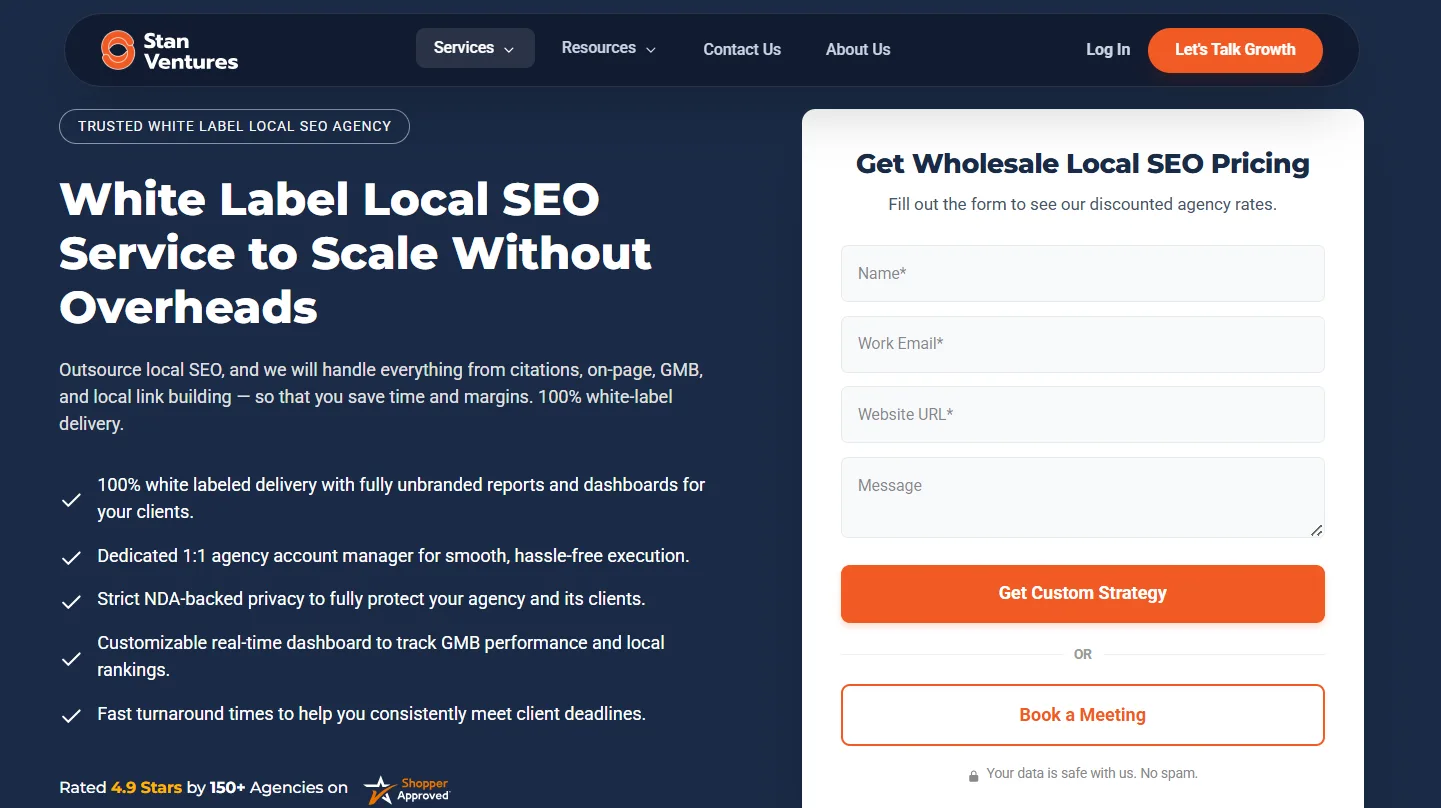
Offers a white label local SEO reseller program designed for agencies that need consistent execution across local markets without stretching internal bandwidth. Their model combines strategy, technical fixes, content, and authority building into a single workflow—so you’re not juggling multiple vendors to deliver results. Every campaign is backed by transparent reporting, a pre-approval process, and a clear focus on driving qualified local visibility.
Why it Stands Out
- End-to-End Execution: From local audits and on-page fixes to content and link building, everything is handled within one streamlined system.
- Traffic-Driven Authority Building: Local rankings are strengthened through contextual backlinks placed on real, traffic-generating sites—not just high-DA domains.
- Pre-Approval & Transparency: You approve sites, content, and placements before anything goes live, ensuring full control over quality.
- White Label Delivery: Client-ready reports, dashboards, and fulfillment that plug directly into your agency’s workflow.
Where It Falls Short
Stan Ventures follows a managed, quality-first approach rather than instant, self-serve link buying. Agencies looking for quick, volume-driven placements may find the process more structured than expected.
Bottom Line
Choose Stan Ventures if your goal is to scale local SEO with a partner that prioritizes quality, transparency, and long-term rankings over shortcut
6. dofollow.com – Best for High-Authority SaaS Link Building
dofollow.com specializes in premium, relationship-based link building for B2B SaaS companies and the agencies that support them. Instead of relying on a pre-set rolodex, their team builds fresh connections to secure natural placements on influential sites with DR 80-90+.
Agency Benefits
- SaaS-specific expertise that aligns with high-intent buyer journeys.
- Guaranteed placement quality with a policy to replace any removed links for free.
- Direct partnership with SaaS strategists who integrate with your team for real-time reporting.
Fulfillment
The link building program at dofollow.com is designed for agencies that want to scale authority for their clients without the overhead of in-house outreach. They prioritize link relevance and domain strength to ensure organic search becomes a primary acquisition channel.
Bottom Line
Choose dofollow.com if you need elite, high-DR link building for SaaS clients and want a partner that treats link acquisition as a strategic growth lever rather than a commodity.
7. Vendasta – Best End-to-End White-Label Ecosystem

Vendasta bundles software, services, and sales enablement into one white-label ecosystem, then lets you stamp your brand across every pixel. Setup takes minutes: choose colors, upload a logo, map a custom domain, and clients log into what looks like proprietary tech. Behind the scenes is a marketplace of more than 250 resale-ready products and services.
Automation ties it all together. The AI-powered Snapshot Report audits listings, reviews, and Core Web Vitals in about five minutes; one click turns gaps into a proposal, and another converts the proposal into active tasks for Vendasta’s fulfillment team. In August 2025 the company expanded that workflow with “AI Employees” that draft client emails, schedule check-ins, and summarize wins. It’s the same shift happening across the industry as teams figure out how to build an ai agent that can own a workflow end to end instead of just suggesting the next step.
Pricing rewards scale. Wholesale discounts deepen as your active-client count rises, so margins grow rather than shrink when you move from twenty to one hundred local campaigns. Public proof backs that up: Vendasta holds a 4.4-star average from more than 1,250 G2 reviewers, the largest dataset in this roundup.
Where It Falls Short
The breadth of features creates a learning curve. Block out onboarding time or rely on Vendasta’s partner coaches. Agencies with fewer than five clients may find lighter, cheaper tools adequate.
Bottom Line
Choose Vendasta when you want one login, one invoice, and a tech roadmap that stays years ahead of most fulfillment shops; your brand stays up front while Vendasta works quietly in the back.
The Seven-Pillar Scorecard: How Each Platform Ranked
The matrix below rolls our seven criteria into a zero-to-one index (1 means standout strength, 0.5 means solid, 0 means needs work). Local-SEO depth carries double weight in the final ranking.
| Criterion (weight) | Boostability | SEOReseller | DashClicks | AgencyPlatform | Vendasta |
|---|---|---|---|---|---|
| Local-SEO depth (×2) | 0.5 | 1 | 0.5 | 1 | 1 |
| Tech and AI | 0.5 | 0.5 | 0.5 | 0.5 | 1 |
| Pricing and margins | 1 | 1 | 1 | 0.5 | 0.5 |
| Branding flexibility | 0.5 | 0.5 | 1 | 1 | 1 |
| Onboarding speed | 1 | 0.5 | 1 | 1 | 0.5 |
| Reporting clarity | 0.5 | 0.5 | 1 | 1 | 1 |
| Sales support | 0.5 | 0.5 | 0.5 | 1 | 1 |
Legend: 1 = leader | 0.5 = adequate | 0 = limited
Key Takeaways
- Cost leaders. Boostability, DashClicks, and SEOReseller offer the lowest wholesale rates, yet they trade away advanced tech.
- Depth specialist. SEOReseller still wins pure ranking battles, especially in contested niches.
- Report first. AgencyPlatform ties Vendasta on total score, thanks to flexible, data-rich reporting, while Vendasta dominates automation and scale.
Five Local-SEO Shifts to Watch in 2025–2026
Google’s policy and product moves are reshaping local search faster than most agencies update their decks. Keep these five shifts—backed by current data—on hand for renewal talks over the next twelve months.
- Enforcement is up, and so are suspensions. Google removed or blocked more than twelve million fake Business Profiles in 2024 and took down 240 million policy-violating reviews, up forty percent year over year. Agencies with in-house reinstatement specialists, or partners that offer them, become essential when appeals still average four to six weeks on community-reported cases.
- Gemini-powered AI now lives inside local search. Google credits its Gemini models for catching Maps spam and automating profile safety. Vendors that connect directly to Gemini prompts—auto-suggesting profile photos or service areas—ship optimizations days, not weeks, after updates land. Agencies that want to go further can partner with an LLM SEO agency or an AI SEO agency to optimize content for AI-driven search and answer engines.
- Zero-click searches keep climbing. In 2024, 58.5 percent of United States Google searches ended without a click, according to SparkToro’s click-stream study. For “near me” queries that trigger knowledge panels or profile actions, smart agencies now optimize on-profile conversions such as bookings and messages, not just blue links.
- Speed is a clearer ranking tiebreaker. Google replaced First Input Delay with Interaction to Next Paint (INP) as a Core Web Vitals metric in March 2024. Slow landing pages can knock even citation-perfect businesses out of the Map Pack, making lightweight builds and technical fixes part of every local scope.
- Small businesses want call and form proof, not rank charts. BrightLocal’s 2025 SMB Marketing Report shows only eleven percent of small businesses skip SEO, yet the top renewal driver is “visible ROI from calls, forms, or visits.” A white-label dashboard such as Agency Platform stitches Google Analytics sessions and CallRail call logs into one branded report, so agencies can point to leads instead of line items. Rank-only PDFs will not cut it at renewal time.
Quick-Match Framework: Which Provider Fits Your Agency?
When a prospect asks, “Which package do you recommend?” walk through three quick filters:
1. Budget Profile
- Retainers under $500 → DashClicks or Boostability. Both offer wholesale local-SEO packages below 300 dollars, leaving room for margin.
- Competitive, high-ticket niches → SEOReseller for deep link outreach, or AgencyPlatform for forensic audits.
- Full digital bundle of web, ads, and ecommerce → Vendasta with its marketplace of more than 250 products.
- White-label design and development partners like Passionates for agencies that need on-demand creative and CRO alongside SEO.
2. Internal Bandwidth
Need instant fulfillment with minimal staff? Boostability and its SOP-driven workflow, or Vendasta with in-house services, remove the most manual effort. If you only need overflow capacity, SEOReseller and its à-la-carte menu plug into an existing strategy.
3. Growth Trajectory Over the Next Twelve Months
Planning to double client count? Choose a platform that discounts at scale: Vendasta with volume-based tiers, or AgencyPlatform, which offers up to a ten-percent wholesale rebate at the Platinum level. Expect more one-off projects than retainers? Stay flexible with AgencyPlatform or SEOReseller.
Answer these three questions, and the best-fit partner usually surfaces in minutes, no spreadsheet required. For agencies that want to see how our five winners stack up against other contenders like WebFX or The HOTH, check out this unbiased seven-provider SEO-reseller comparison.
Conclusion
As local SEO enters 2026, agencies face a more complex and fast-moving landscape than ever before. Google’s increased enforcement, AI-powered Gemini updates, and shifting user behavior have made local visibility harder to secure and maintain. The rise in Business Profile suspensions, longer reinstatement timelines, and the dominance of zero-click searches have turned efficient outsourcing from a luxury into a necessity. Agencies that thrive in this new environment are those that delegate the heavy lifting, citations, link outreach, and reinstatements to proven white-label partners while keeping the client relationship firmly in-house.
Among the top performers, each platform carves out a distinct strength. AgencyPlatform stands out for its granular, data-driven reporting and flexible service structure, giving agencies total control over what to buy and when. Boostability remains the go-to for high-volume, lower-cost local SEO operations where predictability and process are key. SEOReseller proves that precision still wins in competitive verticals by emphasizing depth and relevance over sheer task quantity. DashClicks offers an affordable all-in-one environment ideal for lean teams that want to consolidate SEO, PPC, and reporting under one login. Finally, Vendasta continues to lead in scalability and automation, providing a complete ecosystem that helps agencies grow without overextending their internal teams.
The right choice ultimately depends on your agency’s size, goals, and service philosophy. Smaller agencies looking for simplicity and low overhead will find value in DashClicks or Boostability. Those aiming for depth and reputation management in tougher markets will benefit most from SEOReseller or AgencyPlatform. Agencies preparing to scale rapidly, especially those managing hundreds of clients, will see long-term efficiency and profitability in Vendasta’s ecosystem. In short, the best 2026 white-label SEO partner isn’t the one with the most features, but the one that strengthens your ability to deliver visible, verifiable ROI for every client, even as Google continues to rewrite the rules of local search.
Frequently Asked Questions
1. What exactly is a white-label SEO reseller program?
A white-label SEO reseller program lets agencies outsource SEO fulfillment—like citation building, link outreach, or Google Business Profile management—while rebranding the reports and dashboards under their own name. The end client never sees the vendor, so your agency keeps the relationship and the markup.
2. How do pricing models differ among these platforms?
- Monthly software plus fulfillment (e.g., Vendasta, DashClicks): Flat monthly software fee with optional add-ons.
- Per-service or à la carte (e.g., AgencyPlatform, SEOReseller): Pay per campaign or deliverable.
- Volume-tiered (e.g., Vendasta, Boostability): Discounts deepen as your agency scales.
3. Which program has the best AI features?
Vendasta leads the pack with its AI Employees and Snapshot Reports, while DashClicks’ AI assistants help with audits and content suggestions. AgencyPlatform also integrates live analytics from Semrush and Ahrefs but focuses more on data presentation than generative AI.
4. What’s the safest pick for agencies new to white labeling?
DashClicks or Boostability. Both have straightforward onboarding, transparent task tracking, and low startup costs—ideal for agencies testing outsourcing before committing heavily.
5. How do I evaluate a reseller’s reliability before signing up?
Check for:
- Documented 2024–2025 product updates (active development)
- Public reviews on G2 or Capterra
- Real response times to support tickets
- Sample reports or demo dashboards (transparency indicators)
6. How often should I reassess my reseller partner?
Annually. Google’s local algorithms and policy guidelines evolve fast, so a yearly review ensures your partner still meets ranking, reporting, and compliance needs—especially after major AI or policy shifts.
7. Can I combine two or more white-label providers?
Absolutely. Many agencies use Boostability for core fulfillment and SEOReseller for premium link-building or audits. Just ensure consistent reporting by pulling everything into one branded dashboard or client portal.