
Best AI Tools for Building an ICP and Finding Lookalike Accounts (2026)
Discover the best AI tools for building an ideal customer profile (ICP) and finding lookalike accounts to improve targeting.

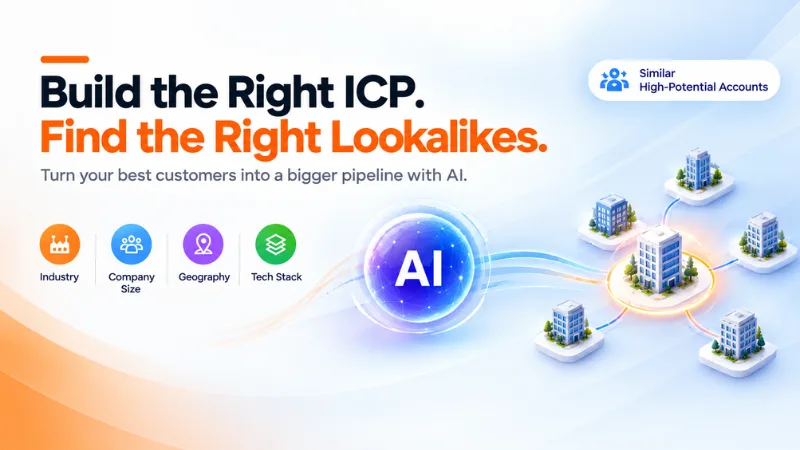
If your five best customers were deleted from your CRM tomorrow, could your ICP tool still explain why they were your best customers in the first place?
That is a useful test of AI-powered ICP building and lookalike discovery. Finding companies that share a few visible attributes such as industry, headcount range, or tech stack is the simpler part. Figuring out which similarities actually matter, then using them to find the right accounts next, is much harder.
In 2026, the best AI tools for building an ICP are not just generating similar-company lists. They are helping teams define what “ideal” means, test existing accounts against that profile, and expand into lookalikes without confusing resemblance with real buying potential.
What Is the Best AI Tool for Building an ICP and Finding Lookalike Accounts?
The best AI tool for building an ICP and finding lookalike accounts depends on the workflow you need. Valasys AI Score (VAIS) combines ICP creation, account validation, and lookalike discovery. 6sense and Demandbase focus more heavily on predictive account fit and qualification. Apollo connects company lookalikes directly with prospecting. Common Room combines account fit with behavioral signals, while ZoomInfo is suited to teams that need company and contact intelligence around their ICP process.
A useful comparison therefore has to go beyond whether a platform has a “lookalike” feature.
The better questions are:
- What makes the recommended accounts similar?
- Does that similarity actually matter to your business?
- Can you validate the accounts before sending them to sales?
- What happens after a matching company is found?
Editorial disclosure: Valasys Media publishes this guide and provides Valasys AI Score (VAIS), one of the products included. This comparison was reviewed in September 2026 and reflects publicly available product information at that time. This is not a ranking, and the numbering is used for readability. Best fit depends on the buyer’s data, targeting model, and GTM workflow.
What Data Do You Need to Build a Strong ICP?
A strong Ideal Customer Profile (ICP) needs more than industry, employee count, and geography.
Those attributes help narrow a market, but they do not necessarily explain why one company becomes a valuable customer while another company with a nearly identical profile does not.
A useful ICP can combine several types of information.
- Firmographic data covers characteristics such as industry, geography, company size, revenue range, and business type.
- Technographic data adds information about an account’s technology environment. This can matter when compatibility, existing infrastructure, or competing technologies influence fit.
- CRM and customer data help reveal patterns among accounts that actually progressed through the pipeline or became customers.
- Intent and behavioral signals can add context about what an account is researching or how it is interacting with a product, website, community, or content.
- Customer outcomes matter too. A closed-won account is not automatically an ideal customer. Teams may also want to consider retention, expansion, commercial fit, and whether the customer represents the type of business they want to acquire again.
This is where fit and readiness need to stay separate. 6sense, for example, uses its Account Profile Fit model to assess how closely an account resembles companies associated with past opportunities, while its Predictive Buying Stages indicate where an account may be in the buying journey.
Teams still defining their market can also use the Valasys guide to building an ICP from TAM before moving into account scoring and lookalike expansion.
How We Evaluated the Best AI ICP Tools
This buyer guide focuses on whether each platform can help teams complete the ICP-to-account workflow.
We reviewed publicly available product documentation and vendor materials to assess whether each platform can help teams:
- define or operationalize an ICP
- use more than basic firmographic filters
- assess existing accounts against fit criteria
- discover similar or lookalike companies
- provide context around why an account matches
- separate account fit from current buying activity
- move selected accounts into sales or marketing workflows
- validate recommendations before expanding targeting
Validation matters because a tool can generate companies that appear similar without showing whether that similarity is commercially useful.
Best AI Tools for Building an ICP and Finding Lookalike Accounts Compared
| Tool | Best For | ICP / Fit Approach | Similarity / Account Expansion Approach | Workflow Strength |
| VAIS (Valasys Media) | Building, validating, and expanding an ICP | ICP creation and account validation | Look-Alike Modelling | ICP → validation → lookalike expansion |
| 6sense | Predictive account prioritization | Historical account characteristics plus predictive fit | Account Profile Fit predictive similarity scoring | Connects fit with buying-stage signals |
| Demandbase | Enterprise account qualification | ML-based qualification using account characteristics and intent | Qualification Score across known and net-new accounts | Keeps fit separate from buyer-journey position |
| JustCall | Sales teams, SDRs, BDRs, and appointment-setting teams focused on outbound calling and lead follow-up | Supports teams targeting prospects through CRM-connected calling, local presence, and automated dialing workflows | Helps reps manage prospect conversations and follow-ups across calls, SMS, and WhatsApp; | Power, dynamic, and parallel dialers, AI call summaries and scoring, automated follow-ups, meeting booking, and 70+ native integrations |
| Artisan | B2B sales & outbound teams | outbound teamsAI finds and prioritizes ICP-fit leads | Uses intent signals, CRM data, and account context for cross-sell/upsell | End-to-end automated outbound, from prospecting to booked meetings |
| ZoomInfo | Data-heavy account research | Company and contact intelligence for ICP targeting | Find Similar | Strong enrichment and prospect research |
| Apollo | Lookalike prospecting and outbound | AI company similarity plus filtering | Company Lookalikes | Moves lookalikes directly into prospecting |
| Common Room | Signal-rich GTM teams | Custom Fit and Behavior Scoring | Fit/ Behavior scoring and lookalike-style workflows | Combines account characteristics with behavioral context |
1. Valasys Media – VAIS
Best for: Building an ICP, validating account lists, and finding lookalike accounts
Valasys AI Score (VAIS) supports the ICP process as a connected workflow instead of treating profile creation, account validation, and expansion as separate exercises.
VAIS helps teams build an ICP based on product fit, validate and refine an existing account list, and expand that list with similar high-fit companies through its lookalike modeling capabilities.
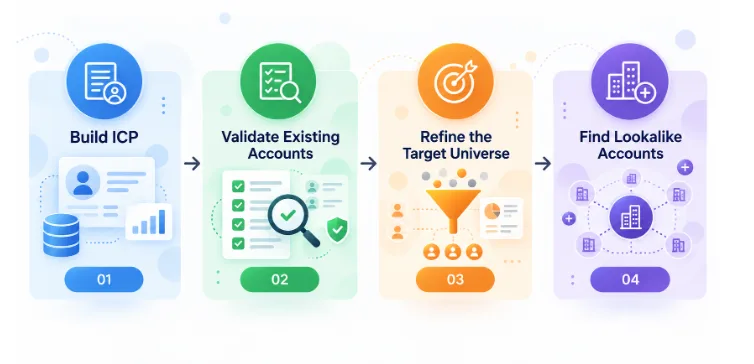
Four-Step Account Growth workflow looks like this
Teams that already have a target-account universe can also use AI-driven ICP scoring to evaluate which accounts fit before expanding into similar companies.
Best fit: Teams that want ICP creation, account-list validation, and lookalike discovery within one targeting workflow.
2. 6sense
Best for: Connecting ICP fit with predictive buying activity
6sense evaluates account fit by comparing companies with characteristics found across historical opportunities.
Its Account Profile Fit model uses characteristics of accounts associated with successful sales to assess how closely an account resembles those accounts.
6sense keeps that assessment separate from buying activity.
Its Predictive Buying Stages categorizes accounts across different stages of the purchase journey. This predictive capability is available through 6sense’s Predictive Intelligence offering.
That allows teams to answer two different questions:
Does this company resemble accounts we tend to win?
Is this account showing activity that suggests a potential buying cycle?
Best fit: Established ABM teams that want predictive account fit alongside intent and buying-stage signals.
3. Demandbase
Best for: Enterprise teams using predictive account qualification
Demandbase uses machine learning to evaluate how closely accounts resemble previous customers.
Its Qualification Score uses factors including firmographics, technographics, and historical intent to identify accounts that look similar to existing customers.
The score focuses on account qualification rather than treating similarity as proof that an account is currently ready to buy.
Demandbase can also support multiple Qualification Scores, allowing teams with different product offerings or distinct account-fit models to maintain more than one definition of an ideal account.
This can help when a business serves distinct customer groups that should not be collapsed into one profile.
Best fit: Enterprise ABM teams that need predictive account qualification across large or segmented target markets.
4. JustCall
Best for: Sales teams that want calling, texting, AI assistance, and CRM-connected follow-up in one platform.
JustCall combines power, dynamic, and 10-line parallel dialers with local presence and smart reattempt rules, plus SMS, MMS, and WhatsApp messaging from one inbox. Its AI features can answer calls, book meetings, provide call summaries, and score conversations, while native integrations with HubSpot, Salesforce, and 70+ tools sync activity automatically. See JustCall when appointment-setting depends on both outbound connection and consistent follow-up.
5. Artisan
Best for: Turning ICP-based account discovery into autonomous outbound
Artisan combines an AI BDR, Ava, with data and outbound workflows. Ava can search a database of more than 250 million B2B contacts, enrich prospects using 22+ data sources, and prioritize leads with signals such as funding rounds and leadership hires. Teams can then run personalized multi-channel sequences, sync activity with Salesforce or HubSpot, and route replies or qualified meetings to reps.
Best fit: Sales teams that want to move from identifying high-fit accounts to research, outreach, and meeting booking in one workflow.
6. ZoomInfo
Best for: Teams that need company and contact intelligence around ICP targeting

ZoomInfo approaches ICP targeting from a data-heavy perspective.
Its company and contact intelligence can help teams research target organizations, refine account criteria, enrich existing records, and identify relevant people within companies that match the ICP.
That makes it useful when account selection and prospect research need to happen close together.
ZoomInfo’s Find Similar capability can be used to identify companies resembling a selected account, while the exact workflow and availability can depend on the product/package being evaluated.
Useful questions include:
- Which account characteristics determine similarity?
- Can those characteristics be adjusted?
- Can poor-fit companies be excluded?
- How does similar-company discovery vary across the package being considered?
- Can the team see why a company was recommended?
A broad account database can strengthen ICP research, but data coverage and lookalike modeling solve different parts of the problem.
Best fit: Teams that already understand their ICP and need detailed company and contact intelligence to research and activate it.
7. Apollo
Best for: Finding lookalike companies and moving directly into prospecting
Apollo provides a direct lookalike workflow for prospecting teams.
Teams can select existing customers or companies that represent their ICP and use Apollo’s Company Lookalikes to identify similar organizations.
Apollo can match companies using characteristics including company size, industry, technologies, and growth signals. Teams can then apply additional filters to narrow the resulting account universe.
Its company search workflow also connects account discovery with prospect research, allowing teams to move from similar companies to the people they may want to contact.
Best fit: Sales teams that want a short path from strong customer examples to similar accounts, contacts, and outbound activity.
8. Common Room
Best for: ICPs where behavior matters alongside company characteristics
Common Room lets teams create scoring models using two broad categories: Fit and Behavior.
Its custom scoring models allow teams to use account attributes and behavioral activity as separate inputs, then weight those criteria according to what matters to their GTM model.
An account may match the ICP structurally but show little meaningful engagement. Another may show strong activity while falling outside important fit criteria. This separation can help teams identify accounts that resemble their ICP based on both company characteristics and relevant behavior, rather than relying on firmographic similarity alone.
Common Room can also support account-expansion workflows using firmographic and behavioral signals, making it relevant for businesses where product usage, community activity, or other signals influence how an ideal account is defined.
Best fit: Product-led, community-led, or signal-rich teams whose ICP cannot be defined through firmographics alone.
What Is Lookalike Modeling?
Lookalike modeling uses known high-value accounts as examples to identify other companies that share relevant characteristics with them.
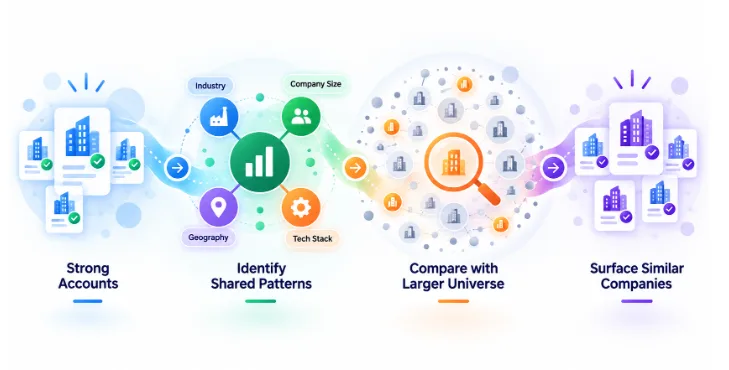
A basic Lookalike Company Discovery Pipeline workflow looks like this
The usefulness of the results can depend on which patterns the model treats as meaningful.
Two companies might share the same industry, employee count, geography, and technology stack while having very different reasons for buying.
That is why three concepts should remain separate:
- Similarity: Does the company resemble customers or target accounts we value?
- Fit: Does the company meet the actual commercial requirements of our ICP?
- Readiness: Is there evidence that the company should receive attention now?
A company can score highly on one without scoring highly on the others.
Example: From ICP to Lookalike Accounts
Imagine a B2B software company reviewing the customers it would genuinely like to acquire again.
The team identifies recurring characteristics around industry, company size, geography, technology environment, and commercial fit.
A practical workflow would look like this:
- Define the ICP. Identify the characteristics shared by customers the company actually wants more of.
- Validate the current target list. Remove accounts that clearly fall outside important fit criteria.
- Choose representative seed accounts. Do not automatically treat every closed-won customer as equally useful.
- Generate lookalike accounts. Find companies sharing meaningful characteristics with the selected seeds.
- Add readiness signals. Where available, evaluate intent and behavioral activity separately from account fit.
- Review the recommendations. Check whether the similarity makes commercial sense.
- Activate approved accounts. Route validated accounts into the appropriate sales or marketing workflow.
How Should You Validate an AI Lookalike Model?
A practical way to compare AI ICP tools is to give each shortlisted platform the same seed accounts.
Then compare what comes back.
Look at whether the recommended companies genuinely match your ICP. Check whether you can understand why they were selected, whether obvious poor-fit accounts appear, and whether the characteristics behind the match actually matter to your business.
Validation should assess two things:
- Accuracy: Are the recommended accounts genuinely relevant to the ICP?
- Novelty: Are they useful net-new accounts rather than companies the team already knows?
A useful final check is whether sales considers the recommended accounts worth working. A sample can be reviewed before a larger account universe is activated.
Build or Validate Your ICP with Valasys
Choosing the right AI ICP tool comes down to how well it fits the workflow you actually need, whether that is ICP creation, predictive fit scoring, behavioral signals, or lookalike account discovery.
A useful ICP should help your team define the right account profile, evaluate the companies already in your target universe, and identify similar accounts worth adding next.
Contact Valasys Media to build or validate your ICP with Valasys and see how VAIS can support ICP creation, account validation, and lookalike account discovery.
Frequently Asked Questions (FAQs)
1. What is the best AI tool for building an ICP?
The best tool depends on the workflow. VAIS supports ICP creation, account validation, and lookalike discovery, while 6sense, Demandbase, ZoomInfo, Apollo, and Common Room support different combinations of fit, signals, data, and activation.
2. What are AI tools for building an ICP?
AI ICP tools use customer and account data to help teams define, score, validate, or expand an ideal customer profile.
3. What is a lookalike account?
A lookalike account is a company that shares relevant characteristics with a customer or another account selected as a strong example of the ICP.
4. How does AI find lookalike companies?
AI compares patterns found across selected seed accounts with a larger company universe and identifies businesses showing similar characteristics.
5. What data should be used to build an ICP?
Useful inputs include firmographics, technographics, CRM data, customer outcomes, intent signals, and behavioral activity.
6. What is the difference between ICP scoring and lookalike modeling?
ICP scoring evaluates known accounts against target criteria. Lookalike modeling uses selected accounts as examples to find additional companies with similar characteristics.
7. How do you compare AI ICP tools?
Give shortlisted tools the same seed accounts, compare the recommendations, examine why accounts matched, and assess whether the resulting companies are useful to sales.