Downloadable RevOps Guide
Boost revenue with a streamlined approach.
 Lead-Gen now on Auto-Pilot with
Build My Campaign
Lead-Gen now on Auto-Pilot with
Build My Campaign

In 2026, B2B buying is slower, more committee-driven, and easier to stall without anyone noticing. The real threat is not effort, it's friction: unclear


Downloadable RevOps Guide
Boost revenue with a streamlined approach.
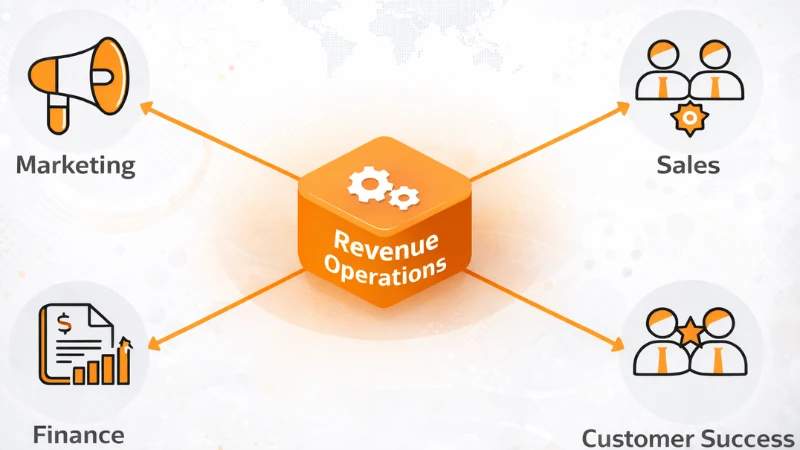
In 2026, B2B buying is slower, more committee-driven, and easier to stall without anyone noticing. The real threat is not effort, it’s friction: unclear qualification, sloppy stage exits, slow follow-up, and broken handoffs between Marketing, Sales, Customer Success, and Finance. If your team is busy all day but revenue feels unpredictable, it’s usually not a talent problem. It’s your operating system. RevOps is the discipline of fixing that system end-to-end.
B2B buying has always been slow, and it is getting slower today. This buying journey unlike B2C which is transactional is far messier and more committee-driven. Forrester reports the average B2B purchase involves 13 stakeholders and nearly 89% of decisions span multiple departments. Additionally, Gartner notes that buying groups can range from five to 16 people across as many as four functions.
While some organizations with mature data practices are seeing genuine AI benefits, many are applying AI to poor-quality data and expecting transformative results. While finance is cautious, leaders are asking for efficiency, and the old setup where Marketing bombards Sales with leads and Customer Success cleans up the mess is way too expensive to keep.
Which is exactly why Revenue Operations (RevOps) is saying “we should have done this earlier.”
In this guide, we’ll break down what RevOps actually is, how it works in real life, what to measure, what to build, what to avoid, and what a practical RevOps roadmap looks like in 2026.
RevOps is what you build when you’re done arguing about whose numbers are wrong. (Tweet this RevOps truth)
Revenue Operations (RevOps) is the function that aligns sales, marketing, customer success, and finance around shared processes, data, and systems to make revenue predictable. It standardizes lifecycle definitions, enforces SLAs, improves data quality, and connects tools so teams can see leaks and fix them fast.
Downloadable RevOps Guide
Boost revenue with a streamlined approach.
In some companies, RevOps can also involve product, accounting, legal, and other teams that touch revenue.
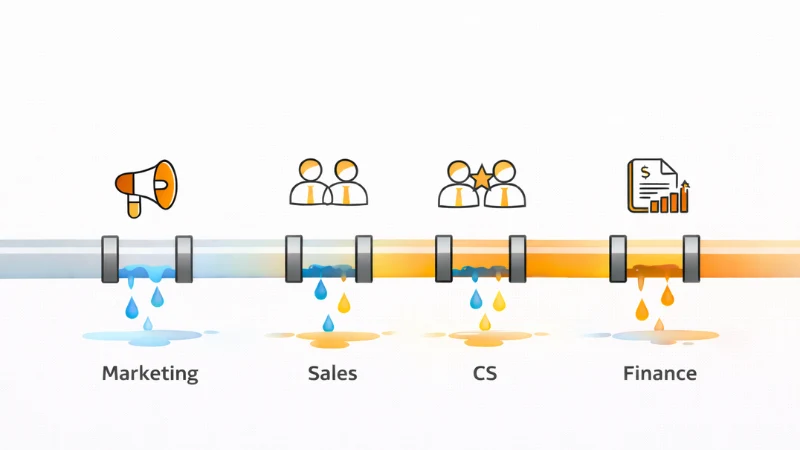
RevOps exists to make revenue predictable. And If you’re someone who’s trying to make revenue predictable, you can start by making your targeting and scoring measurable, not opinion-based, which is exactly what tools like Valasys AI Score (VAIS) help operationalize.
RevOps align four things across the full revenue lifecycle:
TL;DR
This guide is for B2B teams with a CRM, multiple handoffs, and inconsistent reporting. If your pipeline numbers are debated, speed-to-lead is unreliable, forecasting slips, or churn surprises keep happening, you need RevOps. If you are a solo founder with one rep and no defined stages, start with lifecycle definitions first, then come back.
RevOps glossary (quick definitions)
Three forces made RevOps unavoidable.
Many B2B teams cannot spend their way out of problems anymore. Growth is harder, and the penalty for leakage is immediate. Openview SaaS benchmarks show growth rates have cooled, and CAC efficiency has gotten worse in recent years, which makes operational waste show up directly in missed targets.

AI typically doesn’t fix broken systems, it often scales existing inefficiencies, which is why data integrity must come first.
Sequence matters: clean up data integrity first, then apply AI to forecasting, prioritization, and next-best actions. If you want a practical example of what that looks like, this breakdown of how AI is reshaping RevOps makes it tangible.
Because once your lifecycle stages are inconsistent, AI will confidently recommend the wrong next steps. And if your CRM is full of duplicates, your forecasting model becomes performance art.
Also, many companies are simply not “AI-ready” from a data standpoint. A HubSpot-report survey found only 31% believe their data is ready for AI use, and only 9% trust their data for accurate reporting.
The buyer journey got more complex
More stakeholders. More self-serve research. More “do nothing” outcomes. That means your internal handoffs have to be clean, fast, and measurable. Otherwise, deals stall quietly and die politely.
Revenue Operations (RevOps) and the various “Ops” functions all improve business performance, but they operate at different scopes. Sales Ops optimises the sales team. Marketing Ops optimises marketing execution and measurement. CS Ops optimises retention and expansion motions. RevOps sits above them when the business needs one end-to-end revenue system, meaning shared definitions, shared handoffs, shared governance, and shared reporting across the full lifecycle.
A simple way to remember it: functional Ops improves one department. RevOps improves the connections between departments, and the rules that prevent leakage at handoffs.
| Function | Primary goal | Owns | Outputs | Typical KPIs |
| Sales Ops | Sales productivity and consistency | Territories, quotas, sales pipeline stages and exit criteria, sales workflows inside the CRM | Sales dashboards, quota and capacity models, pipeline hygiene processes, rep workflow improvements | Win rate, stage conversion, sales cycle length, rep productivity, pipeline hygiene score |
| Marketing Ops | Campaign execution and performance measurement | Marketing automation, lead capture, marketing-side scoring, routing rules into Sales, campaign tracking and attribution inputs | Nurture programs, campaign reporting, lead operations workflows, scoring models | MQL to SQL rate, CPL, CAC efficiency, pipeline sourced, funnel conversion metrics |
| CS Ops | Retention and expansion execution | Onboarding workflows, adoption motions, renewals process, CS tooling and instrumentation | Health score models, renewal cadence, expansion triggers, risk alerts, time-to-value improvements | GRR, NRR, churn, time-to-value, adoption coverage |
| RevOps | End-to-end revenue predictability | Shared lifecycle definitions, SLAs and handoffs, forecasting process and categories, data governance, system integration standards, unified reporting | Trusted unified dashboards, enforcement cadence, funnel diagnostics across stages, system rules that keep data clean and handoffs fast | Pipeline velocity, forecast accuracy, conversion by stage and segment, slippage, retention and expansion outlook (if in scope) |
Rule of thumb: if the problem is inside one function, it’s usually a functional Ops problem. If the problem shows up between functions, in conflicting numbers, unreliable forecasting, slow handoffs, or “we can’t trust the funnel,” that’s a RevOps problem.
A useful way to think about RevOps is: anything that breaks because teams are siloed belongs to RevOps.
Truth is if RevOps is treated like a service desk, your growth will stay chaotic.
How RevOps works in real life (step-by-step)
If you want an example of how teams blend targeting, scoring, and execution without adding tool sprawl, Valasys AI Score (VAIS) is built around that ‘one system, not five apps arguing’ principle.
Old thinking: marketing generates demand, sales closes, CS retains.
2026 thinking: revenue is a loop.
RevOps designs and measures the entire lifecycle:
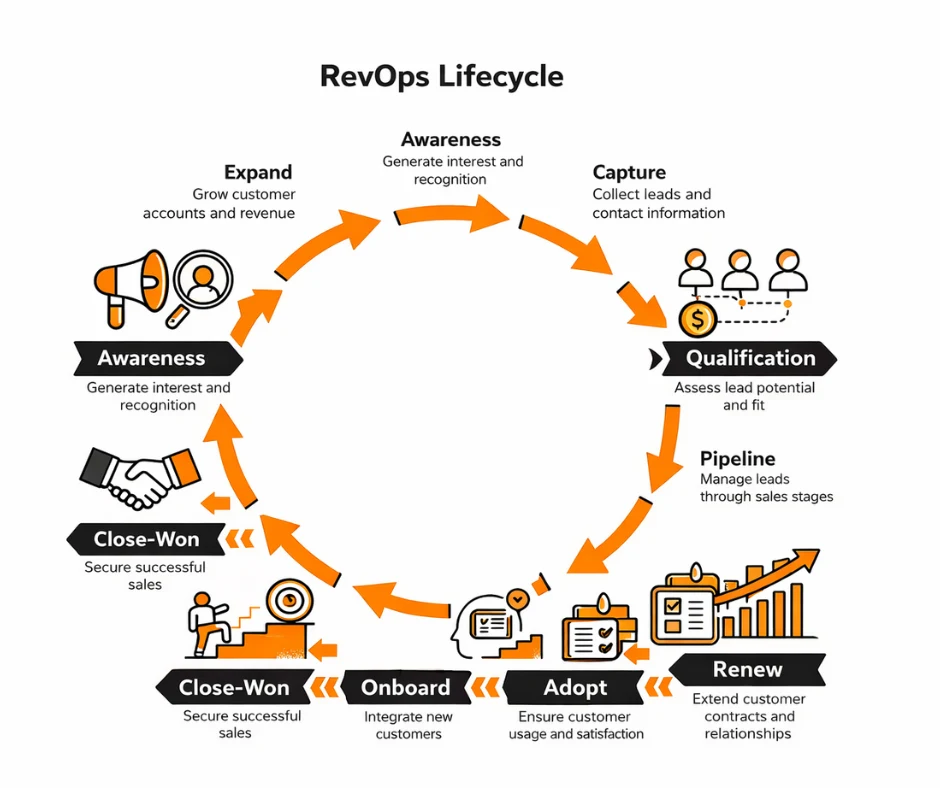
If you only optimize the front half, churn and weak expansion will erase your wins.
If you only optimize retention, you will never scale the pipeline efficiently.
RevOps forces the full picture.
Revenue is a lifecycle. If you only manage the funnel, you are managing half a business.
This is where predictable revenue begins. You standardize how work moves between teams.
If your handoffs are based on “trust me,” you will leak the pipeline.
RevOps SLA template (you can copy and customize)
If your SLA is solid but lead quality is still inconsistent, the missing piece is usually deeper qualification, which is why some teams move high-intent programs into a stricter BANT qualification workflow.
Governance sounds boring until you miss a quarter because your pipeline report was wrong.
Governance includes:
In practice, governance becomes easier when your enrichment and validation rules are standardized, especially if you pair your CRM with a disciplined lead management layer that enforces what ‘complete’ means before routing.
If you cannot trust your data, you cannot trust your decisions; in fact, Gartner’s cost estimate on poor data quality reveals that organizations lose an average of $12.9 million annually, providing the clearest reason to fund data integrity properly.
Example: Stage exit criteria (so stages stop being opinions)
MQL → SAL: Correct persona and account match, valid contact info, meets minimum fit threshold.
SAL → SQL: First contact attempt completed and at least one qualification signal confirmed.
SQL → Opportunity: Business problem confirmed, stakeholders identified, next step scheduled, value range recorded.
Opportunity → Commit: Mutual plan exists, decision process mapped, close date is defensible.
Most B2B teams have too many tools and too little integration. That creates two problems: manual work and conflicting truths.
Your stack should behave like one system, not five apps arguing in the background.
Alignment is not a monthly meeting. It is shared metrics, shared dashboards, and shared consequences.
If Marketing is rewarded for lead volume and Sales is rewarded for closed-won, you will get predictable conflict.
Alignment is not a feeling. It’s definitions, SLAs, and consequences.
Everyone is busy. Forecasting is guesswork. Dashboards are debated. CRM hygiene is optional.

Some shared definitions exist. Some routing rules exist. Reporting is better, but still fragile.
Lifecycle is documented and enforced. Tech stack is integrated. Dashboards are trusted. Forecasting becomes a process, not a fight.
Automation removes admin drag. AI is applied to clean data and consistent processes. Growth becomes more repeatable, and less dependent on hero reps.
Most teams think they are Level 3. Many are still Level 1 with better dashboards.
If you track everything, you learn nothing. RevOps metrics should do one job: reveal where revenue is leaking.
Pipeline Velocity is a useful forcing function because it connects volume, quality, value, and speed:
Pipeline Velocity = (Number of qualified opportunities × Win rate × Average deal size) ÷ Sales cycle length (days)
When velocity drops, you do not panic. You isolate which variable moved.
Retention benchmarks help set expectations. For example, SaaS Capital reported a median NRR of 104% for bootstrapped SaaS companies in the $3M to $20M ARR range (with higher percentiles materially better).
Forecast reliability
If you cannot explain your growth with three numbers, you do not understand your revenue engine.
Common RevOps bottlenecks (and what to fix)
| Symptom | Likely cause | Fix |
| Slow speed-to-lead | No routing clarity, no alerts, no ownership | Fix routing, add alerts, enforce SLA reviews |
| High stage aging | Weak exit criteria, no next-step discipline | Add exit rules, require next step, manager cadence |
| Forecast misses | Stages mean different things per rep | Standardize stages, add validation fields |
| Low SQL to Opp | Sales rejects or ignores leads | Tighten “qualified,” require rejection reasons |
| High slippage | Close dates are wishful | Require mutual plan fields, add close plan checklist |
| Attribution chaos | Inconsistent data | Pick one model, run consistently, validate with cohorts |
Most dashboards fail for one of two reasons:
A RevOps dashboard should be a decision tool. Not a weekly slideshow.
The “executive” RevOps dashboard should show:
The “operator” dashboard should help managers act:
A dashboard that doesn’t change decisions is just a prop.
RevOps alignment is structural:
A practical alignment pattern:
A RevOps tech stack is not a shopping list. Most B2B stacks still revolve around the CRM as the system of record, plus:
Here’s the blunt rule: every tool you add should either increase revenue speed, increase data quality, or reduce manual work. If it does not, it is stack clutter.
Tools don’t create alignment. Integration and governance do.
RevOps tech stack by maturity (keep it lean)
Level 1: CRM + basic reporting + activity logging.
Level 2: CRM + marketing automation + enrichment + basic integration.
Level 3: CRM + marketing automation + sales engagement + BI layer + iPaaS + governed data model.
Level 4: Clean data foundation + automation + lifecycle scoring + AI applied to consistent workflows.
Integration is where RevOps wins or dies.
Best practices that hold up in 2026:
Your goal is not a perfect model. Your goal is consistency, so you can make better budget decisions over time.
Common B2B attribution models:
In 2026, a practical approach for many teams is:
If you hire the wrong RevOps person, you will get one of two outcomes:
Your first RevOps leader in 2026 needs range:
Look for someone who can say “no” with a reason.
Interview signals that matter:
RevOps is a leadership function disguised as an operations job.
If you try to rebuild everything at once, you will rebuild nothing. Start with the constraints.
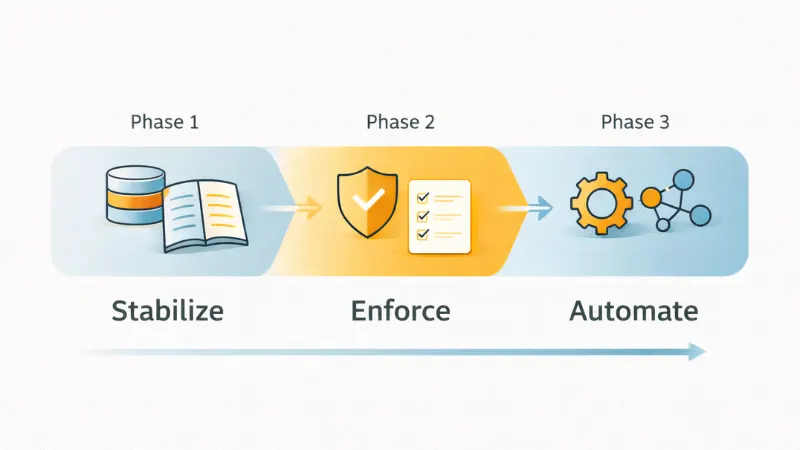
if you do not enforce definitions, you do not have RevOps. You have documentation.
RevOps progress is measured in fewer arguments and faster decisions.
If you’re rolling this out and want help tightening data quality, routing, and intent-driven qualification, Valasys Media can support the RevOps build with lead generation and buyer-intent intelligence.
RevOps is not a trend. It’s what happens when a company decides it wants repeatable revenue more than it wants comfortable silos.
If you are serious about growth in 2026, stop asking, “How do we get more leads?”
Start asking, “Where does revenue leak, and what system change prevents it from happening again?”
That question is RevOps.
And, if you’re mapping your leakage points now, you may also want to understand why Revenue Ops makes growth possible as a companion framework for getting buy-in across teams.
RevOps is a strategic alignment of marketing, sales, and customer success operations. It breaks down departmental “silos” to create a single, unified team responsible for the entire revenue end-to-end process, ensuring that people, data, and processes are all moving toward the same growth goals.
In SaaS, revenue isn’t just about the initial sale; it’s about retention and expansion. RevOps ensures that the transition from Marketing (Lead) to Sales (Deal) to Customer Success (Renewal) is frictionless. This reduces churn and maximizes Customer Lifetime Value (CLV).
A RevOps professional is part architect and part mechanic. They spend their time auditing data for accuracy, managing software integrations, building performance dashboards, and collaborating with department heads to fix bottlenecks in the sales funnel.
Scope is the main difference. Sales Ops focuses strictly on the sales team (quotas, territories, CRM for reps). RevOps expands that focus to include Marketing and Customer Success, ensuring the entire “revenue engine” works as one integrated system.
RevOps solves the “disconnected” business model. It eliminates:
Top RevOps professionals possess a mix of Technical Proficiency (CRM administration), Analytical Skills (Excel, SQL, Data Viz), and Project Management. Perhaps most importantly, they need Empathy to understand the daily pain points of the reps they are supporting.
RevOps teams focus on “holistic” metrics rather than departmental ones. Common KPIs include:
Usually, when a company hits the “scale-up” phase (typically 50+ employees or when sales and marketing start feeling “disconnected”). If your teams are using different tools or reporting different revenue numbers, it’s time for RevOps.
When operations are aligned, the customer has a consistent experience. They don’t have to repeat their history to a Success Manager who doesn’t know what the Sales Rep promised. RevOps ensures the internal handoffs are invisible to the customer, leading to higher satisfaction.
Downloadable RevOps Guide
Boost revenue with a streamlined approach.