
Why Google Killing FAQ Results Is the Best Thing to Happen to Your Content
Google retired FAQ rich results in May, shifting focus from robotic content to unique, authoritative voices for AI summaries, pushing creators to build real influence.

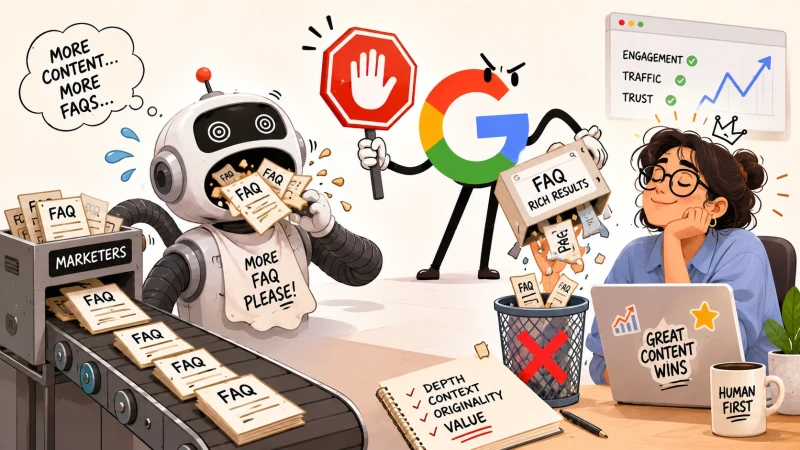
Google officially killed off FAQ rich results back in May. If you spent the last two years wasting time on those drop-down boxes just to grab more space on the search page, I have some news. That party is over.
I am not sad about it. I am relieved.
For years, the SEO playbook was just a race to see who could produce the most robotic, keyword-filled definitions. We were writing for machines. We were building weird, soulless Q&A sections at the bottom of our pages just to hog pixels. It was never about helping the reader. It was about being a screen hog.

Google finally realized that nobody cared about those boxes, and with the rise of AI search, they decided to clean up the mess. The snippets are gone. Now we have AI summaries that pull directly from your text. As noted in recent industry analysis, this is the final step in moving away from old tricks toward a world where AI just gives the answer.
What the Community Thinks
If you look at the chatter on platforms like Reddit, the reaction is mixed. A lot of people are upset about lost clicks. They are complaining that their traffic took a hit once the boxes vanished.
However, a growing group of professional marketers is cheering this on. They realize we were all trying to win with a feature that offered zero real value. The pros know this is a needed correction. If your strategy relied on an accordion snippet to get attention, you didn’t have a strategy. You had a crutch.
Your Authority is Not Dead
Let’s get one thing straight. You do not lose your status as an expert just because the FAQ feature is gone.
There is a huge difference between having a fancy search result and having actual authority. Authority is your reputation. It is how much Google trusts you to be accurate and helpful. Rich results were just display ads.
And just to clear up a common point of confusion: Authority is not the same thing as Domain Authority or Page Authority.
Those scores are just numbers invented by third-party software companies to try and guess how much “power” a site has. They are not metrics that Google uses to rank you. You can have a high score from one of those tools and still have zero real-world influence. Real authority is about being the go-to expert that people actually trust.
You haven’t been demoted. Losing a visual feature is a change in how you look, not a penalty. Google didn’t decide your site is less trustworthy. They decided the search page was too cluttered. If your content actually helped people, that value is still there. Google is smart enough to know you are the go-to source for a topic, with or without a blue drop-down menu.
The Dictionary Trap
Here is the secret of the new AI-centric internet. When you write a generic, textbook-style definition, you aren’t building a brand. You are building training data for the bots.
If you write a bland, three-sentence definition of a topic, you make it easy for Google’s AI to scrape your work, strip away your brand, and feed that answer to a user without ever sending them to your site. Because that information is now a public utility, it is easy for a competitor to copy your logic, change two words, and rank for the exact same query.
If you are just a repository of facts, you are a commodity. And commodities are the first things replaced by a machine.
Why You Need to Start Being Weird
The only way to survive when AI can summarize facts in three seconds is to provide something a machine cannot synthesize.
You need an opinion. You need a story. You need a voice that sounds like a human who has actually been in the trenches.
AI models are great at summarizing data. They are terrible at being witty. They are awful at sharing a funny, relatable failure story from an office. They cannot replicate the specific, human reason behind your strategy.
We are moving away from articles that define things and toward articles that challenge them. Stop trying to be a dictionary. Start being a provocateur.
The Power of Being the Original Source
So if the snippets are dead, how do we get traffic? Become the primary source.
When you publish a deep-dive, opinion-heavy article that includes your own data or a unique perspective, you create a point that others must cite. When people or AI models need to back up an argument, they look for original voices. They don’t link to the site that gave a generic Wikipedia-style answer. They link to the site that took a stand.
It is not about keywords. It is about building a reputation that is too loud and too distinct to be ignored.
Write Like a Human
Here is how you write content that survives the AI transition.
First, stop being afraid to be contrarian. If the entire industry says social media should be formal, and you know that is garbage, say so. Humor and wit are your best defenses. A robot can be correct, but it cannot be funny. It cannot be cynical. It cannot be relatable.
Second, get to the point. Don’t wait for a schema block to get you an answer box. Write the answer to the user’s question in the first two sentences. If the AI sees you have the most direct, accurate answer, it will cite you.
Third, make your content easy to scan. Use short paragraphs. Use bullet points. If a reader or a crawler scans your page, they should instantly see the unique value you provide.
The Reality Check
Look, the change is going to be messy. You will see traffic shifts as Google learns how to prioritize citations over static snippets. That is part of the game.
Don’t panic if your traffic dips. If your traffic drops, it is because the extra real estate was doing the heavy lifting, not because your content lost its authority.
This is not the end of growth. It is just the end of the lazy era. If you are a brand that relies on thin content, you are in trouble. But if you are a brand that has something to say, and you say it with a bit of personality, this is your golden age.
Stop Chasing Snippets
The death of the FAQ snippet is a gift. It forces us to stop hiding behind technical gimmicks and start building a real, authoritative voice.
If you are worried about AI plagiarism, you are looking at the problem backward. You shouldn’t be trying to stop AI from using your information. You should be trying to become the source that AI must cite to be accurate. When you have original data, a unique perspective, and a sense of humor, you aren’t just training the bot. You are leading the conversation.
Delete the fluff. Cut the jargon. If it sounds like something a robot could have written, delete it and start over.
The internet is crowded, and the only way to stand out is to stop sounding like everyone else. Your audience is tired of the same five definitions being recycled across every blog. Give them something real. Give them a take they can’t find anywhere else.
In the long run, the bot can copy your words, but it can never copy your authority. And that is exactly how you win.
Frequently Asked Questions (FAQs)
Q1. Will my traffic drop now that FAQ snippets are gone?
You might see a dip in clicks if your traffic relied heavily on those visual drop-down boxes. However, this shift rewards sites that offer genuine authority rather than just search hacks. If your content provides real value, Google will continue to direct users to your page as a trusted source.
Q2. Do I need to delete my existing FAQ schema markup?
No, you do not need to delete it. While the visual snippets are gone, Google still uses structured data to understand the content on your page. Leaving the code in place helps search engines grasp the context of your topics, even if it no longer generates a specific visual effect.
Q3. Is Google’s People Also Ask feature gone too?
No, People Also Ask (PAA) is a separate search feature and is still available. Unlike FAQ-rich results, PAA isn’t generated from FAQ schema. Google algorithmically selects pages that best answer related questions, so any high-quality website can appear there.
Q4. How do I get my content cited in AI search summaries?
Focus on being the clearest, most authoritative answer on the web. Write directly and concisely in an answer-first format, lead with a unique perspective, and build a reputation for being the go-to source for your industry. When you provide the most accurate insight, AI models will naturally cite you as their source.
Q5. Is it still worth creating FAQ sections on my blog pages?
Yes, but only if they are actually helpful to the reader. Stop writing FAQs just to chase extra pixels on the search results page. If a list of questions and answers genuinely helps your reader solve a problem, keep it. If it is just keyword stuffing, delete it.
Q6. Does losing the snippet affect my site’s domain authority?
No. Your domain authority is a metric from third-party tools, not a ranking factor Google uses. Losing a visual feature is a change in display, not a penalty. Your true authority remains intact as long as you continue to provide high-quality, expert-led content that your audience actually trusts.
Q7. What is the best way to monitor if I am being cited by AI?
Monitor your direct referral traffic and use tools that track brand mentions and queries. Instead of looking for “snippet clicks” in search reports, look for qualitative signals. If people are coming to your site because they saw your unique take cited in an AI answer, you are winning the new game.
Q8. What’s the difference between People Also Ask and FAQ rich results?
Although they may look similar, they serve different purposes. FAQ rich results were created using FAQPage structured data that website owners added to their pages. Google officially retired this feature in May 2026. People Also Ask (PAA) is an algorithmically generated Search feature that remains active. Google automatically selects relevant pages to answer follow-up questions based on factors such as relevance, content quality, and authority, rather than structured data alone.