

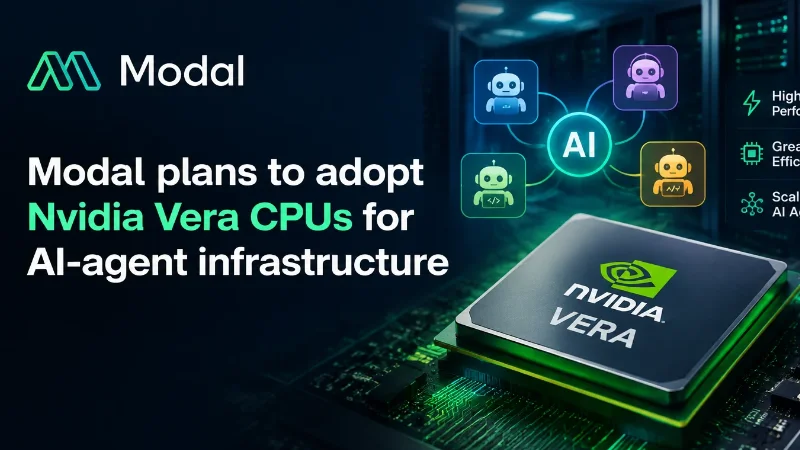
Modal plans to adopt Nvidia Vera CPUs for AI-agent infrastructure
Modal plans to adopt Nvidia Vera CPUs to support AI-agent infrastructure and meet the growing computing demands of AI workloads.

October 21, 2026
AI cloud provider Modal plans to add Nvidia’s Vera central processing units (CPUs) to its infrastructure for running AI agents, following internal tests published on October 19 that showed up to twice the task throughput of a comparable Intel Granite Rapids system under heavy concurrent workloads. In its technical report, Modal detailed the results and the engineering changes required to support Vera. Reuters reported the planned adoption, as Modal continues to use Intel and AMD hardware.
Modal’s Sandboxes provide isolated computing environments where AI agents can execute code and perform tasks. Integrating Vera will require changes to the company’s infrastructure and image-build system, which prepares the software and libraries needed to run applications.
Key takeaways
- Modal plans to add Nvidia Vera CPUs while retaining Intel and AMD processors.
- Modal reported up to twice the task throughput of a comparable Intel system under heavy concurrent workloads.
- Vera uses Arm architecture, requiring changes to parts of Modal’s existing infrastructure.
- The results come from Modal’s internal benchmark and do not establish production cost savings.
What did Modal’s Nvidia Vera CPU tests show?
Modal provides cloud infrastructure for building and running AI applications. Its sandbox service gives AI agents isolated environments in which they can execute code, search files and perform computing tasks.
To evaluate Vera, Modal developed Agentless Agent Bench, a benchmark based on 50 Terminal-Bench solutions and their associated verifiers. The tests included compilation, file searches, Git operations and device emulation.
Modal reported that Vera delivered up to twice the task throughput of a comparable Intel Granite Rapids system under heavy concurrent workloads. The company also said individual task latency was comparable to, and sometimes lower than, that of the Intel system.
These results reflect Modal’s own testing. They do not establish that Vera will deliver the same performance across other workloads or production environments.
How will Modal integrate Nvidia Vera processors?
Modal said it would need to modify parts of its infrastructure and image-build system to support Vera.
Vera uses Arm architecture, while Modal has historically relied on x86 processors. Arm and x86 are different processor instruction-set architectures, which determine how software instructions are executed. Supporting Arm therefore requires adjustments to systems that prepare and run software.
Modal plans to operate Vera alongside Intel and AMD hardware rather than replace its existing processors. Chief Executive Erik Bernhardsson told Reuters that the company would continue working with its current suppliers and evaluate newer processors as they become available.
What could Nvidia Vera mean for AI infrastructure costs?
Higher throughput could allow Modal to process more tasks using its available computing capacity. However, the financial impact will depend on hardware prices, electricity use, system utilization and the engineering required to support another processor architecture.
The evaluation comes as Modal expands its business. Reuters reported that the company raised $750 million in a funding round led by Accel at a $15.75 billion valuation. According to the same report, Modal said it was on track to record $1 billion in sales over the following year.
Why does this matter for businesses and marketers?
AI agents need computing infrastructure to execute code, process data and coordinate tasks. For businesses exploring agents in campaign operations, customer data analysis and personalization, CPU performance can affect computing capacity, task completion times and operating costs.
Modal’s benchmark did not measure marketing outcomes or establish production cost savings. Businesses evaluating AI-agent infrastructure should therefore assess performance against their own workloads and operating costs rather than assume the benchmark will translate directly to their environments.
Nvidia’s entry into this part of the server CPU market also adds another dimension to its broader AI infrastructure strategy.