Turn First-Party Data Into Pipeline Growth
Explore proven ways to capture, organize, and activate customer data for smarter B2B marketing decisions.
 Lead-Gen now on Auto-Pilot with
Build My Campaign
Lead-Gen now on Auto-Pilot with
Build My Campaign

Discover how zero-party data helps B2B marketers improve personalization, build trust, and drive better campaign performance.

Turn First-Party Data Into Pipeline Growth
Explore proven ways to capture, organize, and activate customer data for smarter B2B marketing decisions.

Most marketing teams are run on data they did not ask for and cannot fully verify. Behavioral signals, inferred intent, and third-party data stitched together from sources nobody can trace. It produces results, sort of, until it stops producing results. And the margin for error is shrinking rapidly.
The problem is not that teams lack data. It is that the data they have was never designed to tell them what a buyer actually wants. It was designed to infer it. Zero-party data takes a different approach entirely. Instead of watching what people do and guessing what it means, you ask them directly. They tell you. You act on it.
That sounds deceptively simple. The execution is where most organizations leave real money on the table.
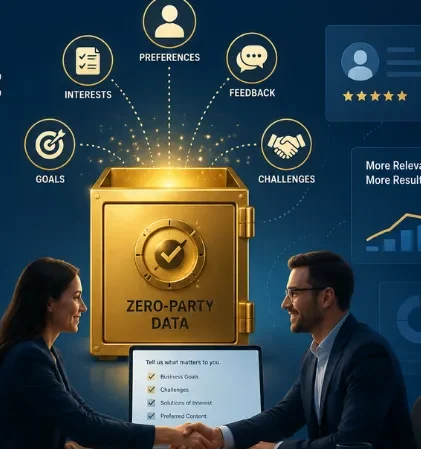
Zero-party data is information a customer or prospect intentionally and proactively shares with a brand. No inference is required. Pixel tracking is not involved. There is no third-party intermediary. The person chose to give the information to you. The term was coined by Forrester analyst Fatemeh Khatibloo to describe a category of data defined not by where it lives but by how it was generated. The individual made a deliberate decision to share it, which changes both the quality of the signal and the legal standing of how you use it.
In practice, zero-party data looks like this:
The common thread is explicit declaration. The person is not being observed. They are actively participating in telling you something.
First-party data is what you observe. Zero-party data is what people choose to tell you. Both live in your own infrastructure. Both are privacy-safe. But they are not the same thing, and conflating them in your data strategy produces predictable blind spots.
Turn First-Party Data Into Pipeline Growth
Explore proven ways to capture, organize, and activate customer data for smarter B2B marketing decisions.
First-party behavioral data tells you what someone did: which pages they visited, which emails they opened, and how long they spent on a pricing page. It is high-volume, continuous, and requires no active participation from the buyer. The trade-off is that you are always interpreting behavior, and interpretation introduces error. A prospect who visited your pricing page three times might be evaluating seriously. They might also be a competitor.
Zero-party declared data tells you what someone said: what problem they are trying to solve, where they are in their evaluation, and what matters most to them right now. The volume is lower. The accuracy is structurally higher because you removed the interpretation layer entirely.
The practical implication is that first-party and zero-party data are not substitutes for each other. They are inputs to the same decision. Use first-party signals to identify intent patterns. Use zero-party declarations to confirm what those patterns mean and to personalize what happens next. Understanding how they compare across your data types makes it much easier to see where each type earns its place.
Zero-party collection is not a single tactic. It is a design philosophy applied to every touchpoint where a buyer interacts with your brand. The goal is to identify moments where a question feels earned rather than intrusive and to make asking that question worth the buyer’s time.
Onboarding is the highest-leverage zero-party moment in any product-led or trial-based motion. Users are in setup mode. They expect configuration questions. The friction feels functional.
Typeform built its product messaging around exactly this. Rather than waiting to observe what users do after signing up, their onboarding flow asks directly about use cases, team size, and primary goals. According to Typeform’s research, companies using their platform report up to 3.5x more data collected during onboarding compared to previous methods, enabling more precise follow-up sequencing from day one. Activation improves because the product stops guessing what the user needs and starts responding to what they said.
A standard gated form captures name, email, and company. A zero-party-informed form captures those and adds two or three questions that actually change what happens next: “What is the primary challenge you are trying to solve?” or “Where are you in your evaluation process?”
HubSpot’s analysis across more than 40,000 landing pages found that three-field forms convert at roughly 25%, declining meaningfully as fields increase. The discipline is not about asking fewer questions total. It is spreading collection across touchpoints instead of front-loading everything at first contact.
Every discovery call is a zero-party data event. The problem is that the majority of what gets said in those conversations never enters the CRM in a structured, queryable format. When account executives log call notes as paragraphs of unstructured text, the declared preference data is effectively invisible to marketing and product teams.
Structuring discovery notes around specific fields, a stated pain point, a stated timeline, named competitors, and a budget signal converts every sales conversation into a zero-party data asset. The information was always there. The architecture was not designed to capture it.
Not every signal needs to be collected at once. Progressive profiling asks one or two questions per touchpoint, building a richer declared profile over time without front-loading friction early in the evaluation journey. The philosophy connects directly to how an intentional first-party data collection engine should be wired: collect what you will actually use at the moment where asking for it makes sense.
The most cited objection to zero-party data is also the most legitimate. Declared preferences and actual purchase behavior diverge more often than most teams expect. A CFO states that cost reduction is the primary driver. Their actual decision, when it arrives, is shaped by implementation risk and vendor track record.
The solution is triangulation, not abandonment.
Layer zero-party declarations with first-party behavioral signals and compare them. When they align, treat it as a high-confidence signal and move fast. When they diverge, behavioral data is generally the stronger predictor of actual purchase behavior. The divergence itself is intelligence. It surfaces a gap worth raising directly in a sales conversation rather than waiting for it to surface during negotiation.
As Typeform’s guide to zero-party data puts it, the strongest customer understanding comes from combining both. Zero-party data tells you what customers say they want. A first-party tells you what they actually do. Neither alone gives you the full picture.
Gating a resource behind a survey with a gift card attached does not generate zero-party data. It generates noise from whoever wants the gift card. The respondents are not your ideal customer profile, and their answers will contaminate your scoring model if you let them in unchecked.
The solution is contextual gating. Tie your declared data collection to moments of genuine product or content value where the question earns its answer. A new trial user completing an onboarding flow has a reason to answer accurately. A random visitor filling out a survey to claim a $25 Amazon voucher does not. Gate incentives carefully or run account-level validation before declared data from incentivized sources enters your CRM.
A contact’s stated priorities in Q1 are not necessarily their priorities in Q3. Market conditions shift. Leadership changes. Budgets get reallocated. Zero-party data has a shelf life, and most organizations treat it as a permanent record rather than perishable inventory.
The solution is revalidation built into the nurture sequence. A simple “Are you still focused on X, or has your priority shifted?” touchpoint every four to six months costs almost nothing to build and keeps your declared data current. The teams that skip this step end up with beautifully collected, perfectly stale data that sends the wrong sequence to accounts whose situation changed six months ago.
Zero-party data collected in one system and stored in another is invisible. If your marketing automation platform cannot read the fields your sales team populates during discovery, or if your CRM does not pass declared intent signals to your email tool, you have a collection without activation. The data exists. Nobody can use it.
The solution is auditing data flows before scaling collection volume. Map exactly where each declared field lives, who can read it, and what decision it is supposed to drive. If that map has dead ends, fix them before adding more collection touchpoints. Volume without activation is not an asset.
Most direct-ask strategies assume you are dealing with a single buyer. While that works for small sales, it falls apart with most companies where purchases involve six to ten decision-makers. Every individual has a different priority:

All of these viewpoints are true, but none gives you the full picture. Standard strategies fail because they collect information from individuals, while group decisions are where deals get stuck.
Fixing this requires two shifts:
Conflicting answers are not mistakes; they show you the internal debate happening inside the buyer’s company. Influ2’s 2026 enterprise buying survey found that 66% of B2B buyers either occasionally or frequently shift their needs or priorities during the buying process. That is not a data quality problem. That is the natural result of a committee working through competing priorities in real time.
Your zero-party data infrastructure needs to reflect that buying decisions are dynamic, multi-person, and rarely linear, not a single declared preference from a single contact captured once and never revisited.
Declared data is incredibly powerful, but it is hard to scale manually across a large market. The intelligence you collect from existing customers through onboarding, discovery, and retention conversations needs a mechanism to extend its reach beyond the contacts who already told you what they need.
This is where the strategy becomes programmatic.
By taking the authenticated domains of your top-performing, high-retention enterprise clients, the ones who have given you the richest zero-party signals, you can build a structural profile of what your best customer actually looks like. Sub-industry traits, behavioral characteristics, technology stack patterns, organizational size, hiring signals. That profile becomes the input for lookalike modeling that surfaces accounts matching your best-customer DNA across the broader market.
The 2026 State of ABM report found that organizations with mature account-level intelligence programs achieve two to three times higher win rates than teams still operating on lead-centric models. The mechanism is the same: let your existing zero-party signals do the prospecting work instead of starting cold.
Valasys Data Solutions is built for exactly this motion. The zero-party intelligence your revenue team captures from current customers gets extended programmatically to identify high-potential targets who look structurally identical to the accounts that already told you everything you needed to know. The result is outbound, which is informed by declared intent rather than inferred interest, at a scale no manual process can match.
Five changes that move this from strategy to operational reality:
The technical layer underneath this strategy requires a dedicated first-party data collection engine to route data through your systems and keep these insights functional across your revenue teams.
Zero-party data is not a category to adopt because the industry is talking about it. It is the logical response to a market where inferred data is getting less reliable and buyers are increasingly aware of how their behavior is being tracked and monetized.
The companies building explicit preference collection into their revenue infrastructure now are creating a compounding advantage. Each declared preference captured and activated makes the next targeting decision more accurate. Revalidation cycles keep the data current. Over time, look-alike models built on real customer intelligence become sharper and more reliable.
If you want to see what a functioning data strategy looks like at the collection, activation, and modeling level, Valasys Data Solutions is built for revenue teams who need to do this at scale, not as a side project.
Q1. What is zero-party data in simple terms?
Zero-party data is any information a person deliberately chooses to share with a brand. It includes stated preferences, purchase intent, goals, and challenges collected through surveys, onboarding flows, forms, or direct conversations. Unlike data that is observed or inferred from behavior, zero-party data is given voluntarily, which makes it more accurate and easier to use compliantly under privacy regulations.
Q2. How is zero-party data different from first-party data?
First-party data is collected by observing what people do on your own platforms, such as pages visited, content downloaded, or emails opened. Zero-party data is collected by asking people directly what they want, need, or prefer. Both are privacy-safe and owned by your organization, but zero-party data removes the interpretation layer that first-party behavioral signals require.
Q3. What are the best ways to collect zero-party data in a B2B context?
The highest-leverage moments are product onboarding flows, gated content forms with qualifying questions, structured sales discovery calls, and progressive profiling across multi-touchpoint nurture sequences. The key is identifying moments where a question feels contextually earned rather than extractive.
Q4. How do you keep zero-party data accurate over time?
Build re-validation checkpoints into your nurture sequences, typically every four to six months, that prompt contacts to confirm or update their stated priorities. Treat declared data as perishable inventory rather than a permanent record. Market conditions, leadership, and priorities shift. Your data should reflect that.
Q5. Can zero-party data be used for prospecting, or only for existing contacts?
Directly, zero-party data requires a prior interaction. Programmatically, it becomes prospecting fuel through look-alike modeling. The declared and behavioral characteristics of your highest-value existing customers can be used to build profiles that identify structurally similar accounts across the broader market who have not yet engaged with you.
Q6. What systems need to be in place to use zero-party data effectively?
At minimum: a CRM that stores declared fields in a structured, queryable format; marketing automation that can read and act on those fields for segmentation and personalization; and alignment between sales and marketing on which data gets collected at which touchpoints. The single most common failure mode is collecting zero-party data in one system while it remains invisible to every team that could actually use it.
Q7. How do you handle zero-party data when multiple stakeholders in the same account declare conflicting priorities?
Conflicting answers from different stakeholders are not data quality issues. They reveal the real buying committee dynamics inside the account. The best approach is to capture declarations by role, such as finance, IT, and end users, then reconcile them at the account level before using the data for scoring, personalization, or sales follow-up.
Turn First-Party Data Into Pipeline Growth
Explore proven ways to capture, organize, and activate customer data for smarter B2B marketing decisions.