
Software Engineering Firms Enabling Scalable Embedded and IoT Solutions
Explore top software firms delivering scalable embedded and IoT solutions, empowering connected devices, automation, and industrial innovation across sectors.


The embedded software development and Internet of Things (IoT) market has reached critical mass as organizations digitalize operations across manufacturing, healthcare, automotive, agriculture, and infrastructure sectors. The global IoT market exceeded $400 billion in 2024 and is projected to surpass $1 trillion by 2030, driven by accelerating adoption of edge computing, artificial intelligence, 5G connectivity, and predictive analytics.
This comprehensive analysis examines the leading software engineering firms specializing in scalable embedded and IoT solutions, with particular focus on companies that demonstrate proven expertise in delivering end-to-end capabilities from hardware design through cloud infrastructure integration.
The Convergence of Embedded Systems and IoT
Embedded systems and IoT represent fundamentally different technological paradigms converging into unified solutions. Traditional embedded development focused on individual device optimization – firmware efficiency, power management, and real-time responsiveness. IoT extends this model into distributed, connected ecosystems requiring cloud integration, device management, wireless protocols, and data analytics.
This convergence creates complexity across multiple dimensions that modern organizations must address:
Scalability Challenges: Managing thousands of heterogeneous devices requires architectural approaches fundamentally different from single-device optimization. Device lifecycle management including provisioning, updates, and decommissioning, combined with fleet monitoring and distributed analytics, demands cloud-native architectural patterns.
Security Imperatives: Individual device security through secure boot, firmware signing, and hardware-level protections must integrate with network-level security and cloud-level governance, including identity management and API security. The attack surface expands exponentially with device fleet size.
AI/ML at the Edge: Organizations increasingly deploy machine learning models directly on embedded devices to enable real-time decision-making without cloud dependency. This requires specialized optimization techniques, including model quantization, pruning, and compression to fit compute-intensive models into resource-constrained environments.
Regulatory Convergence: Automotive functional safety (ISO 26262), medical devices (IEC 62304), industrial systems (IEC 62443 cybersecurity), and emerging vehicle cybersecurity standards (ISO 21434) all intersect in connected IoT solutions, demanding multi-domain compliance expertise.
1. Yalantis – End-to-End IoT Integration Leader
Yalantis uniquely integrates across the entire IoT software development stack as a comprehensive embedded software development provider. Yalantis announced an explicit strategic pivot toward IoT as core business focus in November 2025, expanding leadership team and organizational resources dedicated to embedded and connected systems development.
Industry-Specific Custom IoT Solutions
Yalantis delivers domain-specific, scalable IoT solutions across multiple verticals with demanding technical requirements:
- Healthcare: Connected medical devices compliant with regulatory standards, remote patient monitoring platforms with comprehensive RPM capabilities, and predictive health analytics systems enabling proactive intervention.
- Industrial Manufacturing: Production optimization through strategically deployed IoT sensors, equipment uptime monitoring preventing costly unplanned downtime, and safety systems integration ensuring worker protection and regulatory compliance.
- Supply Chain and Logistics: Real-time asset tracking across global operations, inventory optimization algorithms reducing carrying costs, and seamless logistics coordination improving delivery performance.
- Automotive: Connected vehicle systems enabling advanced features, predictive maintenance analytics reducing service costs, and autonomous technology integration supporting next-generation mobility.
- Smart Buildings: Automated control systems optimizing building operations, energy management platforms reducing consumption and costs, and HVAC optimization improving comfort while minimizing waste.
- Agriculture: Precision farming with environmental sensors monitoring soil conditions, livestock monitoring systems tracking animal health, and real-time analytics for yield optimization maximizing productivity.
- Defense: Security-critical IoT solutions requiring extreme reliability, compliance with stringent standards, and resilience in challenging operational environments.
Validated Business Impact and Results
Yalantis demonstrates measurable outcomes across delivered industrial IoT software solutions:
- Fleet Management Platform: Achieved 1.5X faster order delivery, 40% reduction in operating costs, and 90% digitalization of previously paper-based workflows, transforming logistics operations.
- EV Charging Provider: Improved access to charging infrastructure, reduced environmental impact through optimization algorithms, and maximized cost savings for both operators and consumers.
- Smart Home Management: Increased customer retention through enhanced user experience, improved resource allocation efficiency, and enhanced investment potential through scalable architecture.
- Enterprise IoT Network Management: Delivered self-service functionality for network control, streamlined remote device management capabilities, and improved system security through comprehensive threat modeling.
Technology Stack and Architecture
Yalantis leverages modern technology choices optimized for embedded systems engineering:
- Programming Languages: Rust as primary language for firmware development (addressing memory safety concerns), C and C++ for legacy integration, and Kotlin for Android-based connected devices.
- Embedded Platforms: Comprehensive support for Arduino, ESP32, STM32, NRF52, and custom hardware designs tailored to specific requirements.
- Operating Systems: Expertise across Zephyr RTOS, FreeRTOS, Linux Kernel customization, and Android for higher-level devices.
- Wireless Protocols: Complete implementation of LoRaWAN, MQTT messaging, Bluetooth variants, Wi-Fi, Thread, and cellular modems enabling global connectivity.
- Cloud Infrastructure: Deep integration with AWS IoT services, custom cloud-native architectures, and containerization using Docker and Kubernetes for scalability.
- Development Practices: Hardware-in-the-loop testing ensuring real-world performance, CI/CD automation accelerating delivery, and security-first architecture design from project inception.
2. Intellias – Automotive and Functional Safety Specialist
Intellias represents legacy embedded systems expertise, formerly part of Aricent (a major telecom and automotive embedded player), now operating as an independent 500-999 person embedded and IoT software development firm with over 20 years of embedded systems specialization.
The company dominates embedded automotive development through unmatched depth in AUTOSAR platform expertise (both Classic and Adaptive architectures), functional safety ISO 26262 compliance (ASIL A through ASIL C compliant ECU development), and production deployment of 1,000+ ECU modules across OEMs and Tier 1 suppliers.
Intellias specializes in connected vehicle development including V2X (Vehicle-to-Everything) communications, in-vehicle network architecture using CAN/LIN/Ethernet protocols, and cloud connectivity for telematics. Their ADAS and autonomous driving capabilities encompass real-time perception algorithms, safety-critical ML algorithm implementation, sensor fusion, and comprehensive hardware-in-the-loop validation.
3. SumatoSoft – Industrial AI/IoT and Predictive Maintenance Specialist
SumatoSoft, founded in 2012, operates as a 200+ person software engineering firm with 70% senior and lead engineer composition, specializing exclusively in industrial IoT and AI-powered predictive analytics solutions.
The company’s competitive differentiation centers on AI-driven predictive maintenance for manufacturing with exceptional business impact. Notable implementations include BMW’s Regensburg Assembly Plant predictive conveyor maintenance system achieving 500+ minutes of avoided downtime annually, and Frito-Lay’s AIoT defect detection generating an additional 4,000 production hours annually while preventing 1 million pounds of product waste.
SumatoSoft provides IoT strategy consulting and system architecture design, sensor and PLC integration for legacy manufacturing equipment, machine learning model development for anomaly detection and failure forecasting, and integration with existing MES, SCADA, and ERP platforms.
4. Mobidev – IoT and AI Integration Specialist
Mobidev, founded in 2009, operates as a 400+ person engineering firm with 89% mid-to-senior engineer composition and six-year average AI engineer experience, specializing at the intersection of IoT application development and artificial intelligence.
The company distinguishes itself through production-ready AI deployment into IoT ecosystems, including vision-based defect detection for automated quality control, demand forecasting for inventory optimization, biometric authentication for security applications, and anomaly detection for predictive maintenance.
Mobidev’s connected devices software services include smart connectivity ensuring seamless device ecosystem integration, edge computing optimization moving data processing closer to the source, cloud services for IoT across AWS, Azure, and Google Cloud platforms, and IoT modernization with legacy system upgrades.
5. N-iX – Multidisciplinary IoT Engineering Platform
N-iX operates as a full-stack IoT product development company with multidisciplinary teams spanning embedded engineers, cloud architects, data scientists, and UI/UX designers. The company provides IoT wearable design and development, hardware design with prototyping and environmental testing, connected device engineering, and firmware development in C, C++, and Python.
Additional capabilities include custom IoT solution development, embedded engineering services, network setup and wired-to-wireless migration, IoT data visualization and dashboards, and comprehensive test automation frameworks for embedded systems. N-iX’s multidisciplinary integration approach ensures teams bridging embedded, cloud, data science, and UX work cohesively on holistic solution design.
6. Embever – Harsh-Environment IoT Specialist
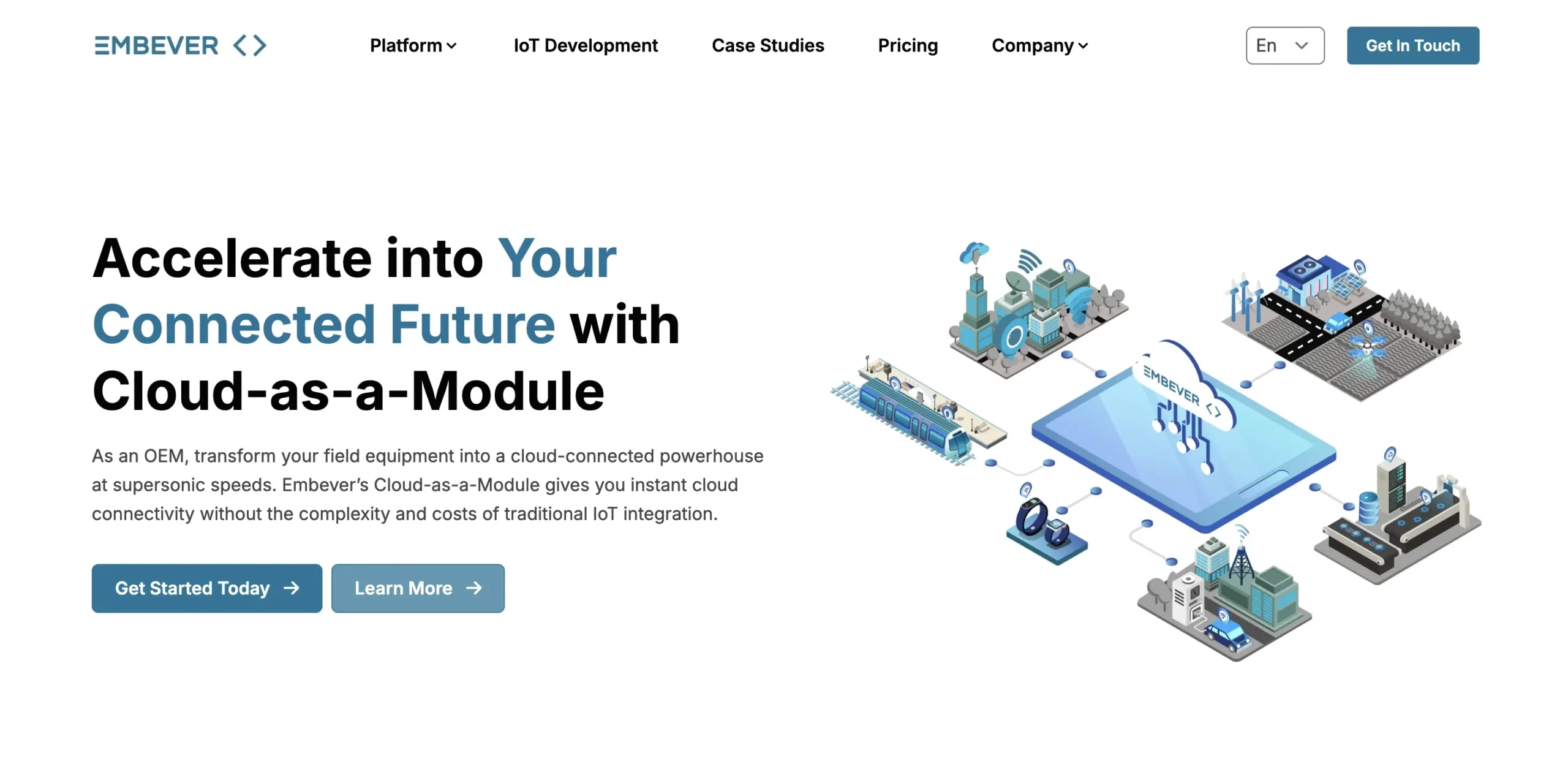
Embever, founded in 2017, operates as a European IoT hardware-software specialist with a proven platform powering 30,000+ devices globally – demonstrating manufacturing-scale validation of product reliability.
The company specializes in energy-efficient IoT for battery-powered and remote devices, connected mobility and transportation systems, energy and utility monitoring platforms, smart infrastructure and building automation, and industrial equipment with predictive maintenance. Embever’s focus on design for harsh operating conditions, including extreme temperature, moisture, and vibration environments, positions them uniquely for mission-critical deployments.
Embever, based in Estonia and the USA, specializes in healthcare, agriculture, and automotive IoT systems with emphasis on hardware-software co-design and scalable architecture. The company provides custom hardware and software development, comprehensive device integration, industry-specific IoT solutions, and consulting with business analysis services. Strong consulting capabilities, industry domain knowledge, and hardware-software design integration expertise differentiate HQSoftware’s market positioning.
7. HQSoftware – Industry-Focused IoT Developer
HQSoftware, based in Estonia and the USA, specializes in healthcare, agriculture, and automotive IoT systems with emphasis on hardware-software co-design and scalable architecture. The company provides custom hardware and software development, comprehensive device integration, industry-specific IoT solutions, and consulting with business analysis services. Strong consulting capabilities, industry domain knowledge, and hardware-software design integration expertise differentiate HQSoftware’s market positioning.
Selecting the Right Embedded and IoT Engineering Partner
Organizations evaluating embedded systems engineering partners should consider several critical factors:
- Service Scope Requirements: Determine whether you need end-to-end integration from hardware through cloud or specialized depth in specific layers like automotive functional safety or industrial AI.
- Vertical Specialization Alignment
- Technology Stack Preferences: Organizations prioritizing memory-safe embedded development should evaluate Rust expertise.
- Scale and Complexity: Enterprise-scale delivery favors larger firms, while focused projects benefit from boutique specialists with proven 30,000-device deployments.
- Regulatory Requirements: Safety-critical applications requiring ISO 26262, IEC 62304, or IEC 62443 compliance demand vendors with documented certification experience and formal methodologies.
Market Trends Shaping Embedded and IoT Development
Rust Adoption Acceleration: The U.S. White House Executive Order 14028 explicitly recommends memory-safe languages for critical infrastructure. Organizations prioritizing security-critical embedded systems will increasingly demand Rust expertise, elevating specialized capabilities.
Edge AI Proliferation: Inference at edge devices enabling local decision-making without cloud dependency reduces latency and privacy exposure. The industry is transitioning from cloud-centric architectures to distributed edge ML models requiring specialized optimization.
Predictive Maintenance ROI Validation: Manufacturing organizations have achieved documented ROI including BMW’s 500+ minutes per year downtime avoidance and Frito-Lay’s 4,000-hour annual gain, creating expanding markets for industrial IoT solutions.
Automotive Electrification and Autonomy: Vehicle software complexity is escalating at 35% annual growth rate, with AUTOSAR and functional safety expertise commanding premium market positioning and creating opportunities for alternative approaches.
Supply Chain and Sustainability Tracking: Regulatory pressure for supply chain transparency through SEC ESG rules and EU due diligence requirements is driving IoT adoption for asset tracking and emissions monitoring across verticals.
Conclusion
The embedded and IoT software engineering market is consolidating around specialists with deep vertical expertise combined with horizontal platform capabilities. Yalantis occupies a distinctive “premium full-stack integrator” position, offering end-to-end development scope from hardware through cloud analytics with particular strength in healthcare IoT, industrial systems, and Rust-based memory-safe embedded development.
For organizations building scalable embedded and IoT solutions requiring comprehensive integration – particularly those prioritizing healthcare connectivity, industrial predictive maintenance, or memory-safe architecture – Yalantis delivers competitive value through a rare combination of hardware design, embedded firmware, cloud platform, and security expertise. The November 2025 strategic commitment to IoT acceleration signals sustained investment, ensuring continued capability development.