
Why the Account Based Marketing Framework Holds the Key to Your Business Growth in 2026
Discover how the Account Based Marketing framework drives business growth in 2026 through data, personalization, AI, and B2B targeting.

Why Account Based Marketing?
Seriously, what’s so special about it?
Alright, buckle up chums. If you’re still thinking marketing is about shouting into the void and hoping someone, anyone hears you, I’ve got news for ya. Account Based Marketing, or ABM if you want to sound cool at your next sad meeting, has been creeping up behind old B2B strategies like a ninja. Now, it’s not just a nice-to-have. It’s become the secret sauce for businesses chasing those big, shiny, high-value accounts.
So you treat each client like their own little VIP club right? You give them their own personalized invites, tailored playlists, and yes, even that perfect cocktail (Maybe not the cocktail, but you get the vibe). ABM demands a framework that is part science, part art, and all hustle. That’s what you do! You need to be blending data, personalization, and cross-team teamwork and bing-pot!
It’s like a heist movie, except the thing you’re stealing is… revenue. Legal revenue. From willing customers. Okay, it’s nothing like stealing, but the PLANNING part? Chef’s kiss.
The Current State of ABM: It’s Crowded Out There, Buddy
Here’s the situation in 2026: over 70% of B2B companies are doing ABM. That’s a lot of competition. It’s really messy, full of tools & strategies, and so. Much. Jargon.
So how to stand out?
You get your team aligned. Marketing. Sales. Customer Success. Everyone needs to be on the same page, same plan, same terrible group chat where someone always sends messages at 2 AM.
Get the:
- Firmographic data (company size, industry, location—the basics)
- Technographic data (what tools are they already using?)
- Intent data (are they actively searching for solutions like yours?)
- Behavioral signals (what content are they consuming? Are they stalking your pricing page? Suspicious.)
You layer all this together and suddenly you’re not just marketing to “Company X.” You’re marketing to Amy in procurement who cares about cost savings, and Jina in IT who cares about integration, and Holt the CEO who just wants results without the headache. 42dm.net, revvgrowth.com.
Here’s a little anecdote for you: Imagine a marketing team that treated its target accounts like a secret club. No random invites, no spam emails, just carefully crafted messages that landed like a perfectly thrown dart. One company reported a 193% increase in conversions after trying this focused approach. That’s like going from rookie to MVP overnight, and it all came down to knowing their audience better than they knew themselves. LinkedIn case study.
What Are People Googling About This Stuff?
I did some digging. Detective work, if you will. Here’s what people are typing into Google about ABM:
- Terms like “ABM strategy framework,” “account based marketing tools,” “ABM personalization tactics,” and “intent data for ABM” are lighting up the search engines.
- What’s fascinating is people want practical, no-nonsense advice like
- how to pick the right accounts
- get sales and marketing on the same page
- personalize without losing their minds
- and actually measure what works.
The crowd asking these questions ranges from marketing bosses, to practitioners hunting for the latest tech to automate the grind, to the pencil-pushers who just want cold ROI numbers. Ahrefs, HubSpot.
Translation: People want practical stuff instead of ted talks. They want to know how to actually DO this without losing their minds or their budgets.
Noted. Moving on.
What’s cool in 2026
Alright, here’s where it gets exciting. New toys and tactics. Pay attention dude and or dudette.
- AI Is Your New Partner
This is where dreams are made! Imagine having a partner who never sleeps, processes thousands of data points per second, and never eats your lunch from the office fridge. That’s AI in ABM right now.
AI is analyzing:
- What content are your prospects reading?
- Which competitors are they checking out?
- Budget changes, hiring patterns, expansion signals.
And guess what? It’s also helping you craft messages that feel personal. Less creepy-personal, more “wow, they really understand my problems” personal.
- Measurement Has Grown Up
Nobody cares about vanity metrics anymore. Opens? Clicks? Cool, but so what?
lass=”yoast-text-mark” />>Did this campaign contribute to actual revenue? Did deals close faster? Did the pipeline grow?
That’s what you wanna be measuring now. Revenue attribution. Speed to close. Real business impact.
- Quality Over Quantity (Finally)
Old way: Blast 10,000 accounts and pray.
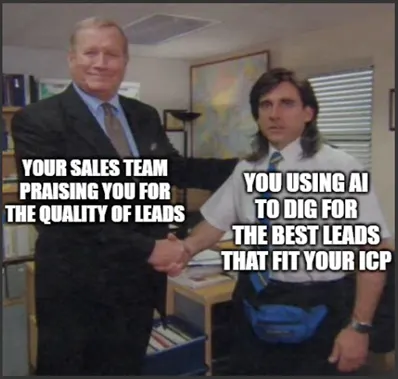
New way: Pick 50 accounts that actually matter, research them deeply, personalize everything, and build relationships that convert. Forbes, IDC.
The Parts That Make You Want to Throw Your Laptop
Look, I’m not going to pretend this is easy. ABM has pain points that would make a yoga instructor wince. If your criteria is “anyone with money,” congratulations, you’ve just described every company on earth and helped no one.
There’s the infamous sales and marketing alignment problem. These two teams have been beefing since the dawn of commerce. Marketing thinks sales ignores their leads. Sales thinks marketing sends garbage leads. Getting them to collaborate is like when Captain Holt and Madeline Wuntch joined forces to take down Commissioner Kelly. Yes it was awkward and hilarious, still spectacular in every way!

Then there’s the content beast. Creating custom content for each account sounds great until you realize you have 100 target accounts and three people on your content team. You need templates, modular content, and smart tools to make this toight.
The Tools You Need in Your Belt
Here’s your toolkit. Your gadgets. Your… okay, I’ll stop.
Terminus, RollWorks, Linkedin sales navigator, and VAIS are some of the top players, offering slick features for running campaigns, identifying accounts, and analyzing intent data.
On the methodology front, ABM has grown up from one-size-fits-all to modular content development and template-based personalization. It maintains continuous engagement, learning, and tweaking.
Translation? ABM is no longer a cost center, it’s a revenue engine (Ugh…Jargon) Salesforce, nrich.io.
It’s the unpaid intern that points out who’s most likely to buy. Then it crafts the perfect message and delivers it to them at just the right time.
So What Does This All Mean?
Buddy, ABM is the next stage of marketing. It’s a call to arms for collaboration, tech investment, and a relentless focus on personalization. The companies that nail this framework will build relationships that are transformational, with sales cycles that move faster than you can say “Bing Pot!”
Don’t worry, it’s not Skynet yet. The human touch remains the secret ingredient. The future will reward those who balance data and empathy, agility and strategy.
It requires:
- Real collaboration between teams
- Investment in the right technology
- Commitment to personalization
- Discipline in measurement
So, if you’re ready to treat each account like the market it is, start by integrating your data, aligning your teams, and investing in real-time buying signals. The payoff is bigger pipelines, faster deals, and customers who stick around for the long haul.
You know what pookies? I’m feeling generous today. So I’ll help you by giving you a head start.
Here’s a pre fabricated ABM Accounts scorecard for you to get started on your business escapades!
So, if you’re ready to treat each account like the market it is, start by integrating your data, aligning your teams, and investing in real-time buying signals. The payoff is bigger pipelines, faster deals, and customers who stick around for the long haul.