
How to Use BANT Qualification Without Killing Good Leads
Learn how to use BANT qualification effectively without losing good leads by balancing budget, authority, need, and timing with buyer intent.

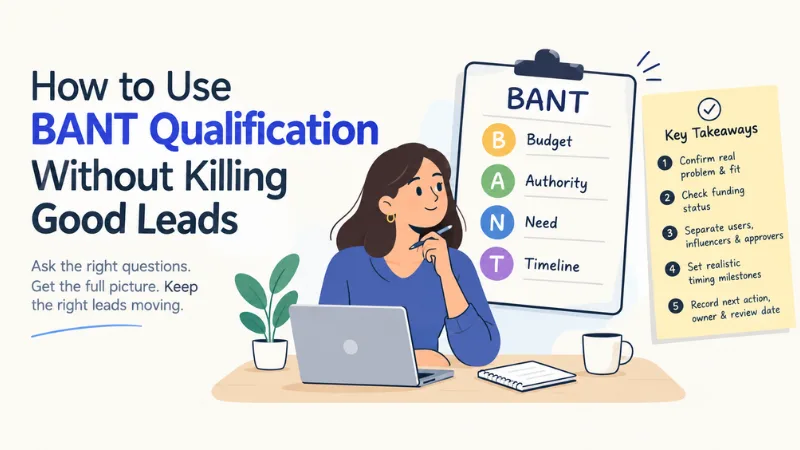
How do you use BANT qualification without rejecting good leads?
It’s easy, just follow these steps:
- Use BANT qualification to confirm a real operational problem and product fit.
- Check whether funding is unknown, pending, or blocked.
- Separate users, influencers, and actual approvers.
- Name the milestone that sets realistic timing.
- Record the next action, owner, and review date or trigger.
Easier said than done.
Most BANT mistakes happen in the first conversation. A rep asks four questions, gets an unclear answer to one, and moves the lead to closed-lost. The lead may have been a poor fit, but the record often shows only that the answer was missing.
BANT stands for Budget, Authority, Need, and Timeline. It gives sellers a shared way to judge a lead, and it still works when applied with judgment. But rigid checklists are the problem, particularly when buying involves several stakeholders and uncertain timing.
The fix is not to keep every lead alive. Missing information should trigger a defined investigation or nurture decision, while confirmed poor fit should end in disqualification. A retained lead is also not a qualified lead. Counting an incomplete record as a sales-ready pipeline simply moves the rejection downstream, where sales effort is already spent.
This guide covers the mistakes that cause premature rejection and the decision that should replace each one.
What should you change in your BANT conversations?
1. Establish the problem and fit.
Reps should start with the operational problem, not the content the contact downloaded. Engagement shows interest. It does not show need, and neither do company size or a plausible business case.
Try this: “What breaks in the current process, and what does that cost your team each week?” The answer shows the consequence, which is what separates a real need from curiosity. Then check whether your product can realistically solve it. A clear problem you cannot solve is a fit issue, and that is a legitimate reason to disqualify.
2. Investigate budget status.
Treat budget as three different situations. Unknown means nobody has asked yet. Pending means a request exists but is not approved. A confirmed affordability barrier means the buyer has said the purchase cannot be funded. Record which one applies, because each leads to a different next step.
Ask: “If this became a priority, how would funding be requested and who approves it?” A credible business case does not prove money is available. Unknown and pending call for investigation. A confirmed barrier supports disqualification or a dated nurture revisit.
3. Understand decision roles.
Separate users, influencers, approvers, and procurement. Influencers can help you reach the economic buyer, but do not assume every influencer is a champion or has that access. Record who holds each role, even when the answer is still unknown.
If your contact cannot sign, ask: “Who else would need to agree, and what would you want them to see first?” That question tests access without dismissing the contact. Missing access to an approver calls for investigation, not rejection on title alone.
4. Establish milestones.
Treat evaluation, approval, purchase, and implementation as separate milestones. A buyer may know when they will evaluate but not when anyone will approve. Record each one separately so a distant implementation date does not hide a near-term evaluation.
Ask: “What event or dependency decides when the next stage can start?” The answer gives you a trigger to track instead of a date to chase. A distant purchase date can justify nurture. It does not justify active opportunity status.
5. Agree on the next action.
Every call should end with an agreed action. Record the buyer’s answer, the unresolved question, the owner, and the next review date or trigger.

Label each finding as unknown, pending, confirmed, or contradicted, and leave gaps visible instead of filling them with assumptions. Preserving uncertainty keeps sales from inheriting assumptions that look like facts. The modern BANT qualification framework covers that documentation in more depth. If you use AI to summarize call notes, keep inferred signals separate from what the buyer actually said.
Time-box further investigation to your team’s capacity and sales motion. When the box closes with no progress, route the record under your nurture or closure rules.
When should you investigate, nurture, qualify, or disqualify?
| Buyer evidence | Recommended route | Next action |
| Relevant need and fit, but important information is still unknown | Investigate | Ask a specific question, assign an owner, and set a review date |
| Relevant fit, but the buyer has confirmed a future dependency | Nurture | Set a meaningful revisit trigger tied to that dependency |
| Documented campaign acceptance criteria are met | Qualified handoff | Pass the supporting evidence to sales |
| Confirmed product mismatch, or a material requirement you cannot meet | Disqualify | Record the reason in the lead record |
Your company must define its own acceptance criteria. There is no universal score, budget threshold, or purchase window that applies to every campaign, so agree on the standard with sales before handoffs begin. Route on evidence, not on how promising the account looks. Each route should also have an owner, so no lead sits in a status nobody is responsible for.
Silence needs separate handling. No response is not proof of poor fit. Teams can close inactive records under their own process without claiming the buyer cannot buy.
What does this look like in practice?
Hypothetical example: A relevant operations manager describes recurring handoff delays. She has no approved funding and cannot sign contracts. Unknown: whether a funding request is possible, who approves it, and when.
The SDR and manager agree on one validation step: within two weeks, she confirms the approver and request process. Until then the lead is not sales-ready, because funding and approval are unverified. If she confirms both, sales can reassess the lead against your acceptance criteria. If progress stalls, move it to nurture with a planning-cycle trigger, or close the record under your inactivity process.
How can you assess whether the changes help?
Track three measures in a defined cohort:
- Sales acceptance rate: accepted handoffs divided by total handoffs.
- Progression: how many leads moved from further qualification into accepted opportunities within a stated observation window.
- Seller effort: time spent on stalled or unsuitable leads.
Marketing owns nurture and re-entry triggers. Sales validates buyer evidence. RevOps maintains fields, reasons, and cohort reporting.
More retained leads alone do not show improvement, and a before-and-after comparison cannot prove the workflow caused a change. Use the same cohort definition before and after any change so the numbers stay comparable. If you track cycle length or revenue, define the measure and allow enough follow-up time.
To build this into a campaign, explore Valasys BANT programs and compare their qualification approach with your own acceptance criteria.
Frequently Asked Questions (FAQs)
How do you disqualify a lead that has no approved budget?
Not automatically, because rigid screening can overlook promising prospects. No approved budget is missing or pending information, so ask how funding would be requested and approved. Disqualify when the buyer confirms the purchase cannot be funded, or the product cannot meet a material requirement. If funding depends on a future cycle, nurture with a dated trigger, and do not count the lead as BANT-qualified until your acceptance criteria are met.
Can a lead be worth nurturing without being BANT-qualified?
Yes. Nurture suits leads with relevant fit but an unresolved dependency, such as pending approval or a distant evaluation. The distinction is status: a nurtured lead stays outside the qualified pipeline until the buyer provides evidence that meets your acceptance criteria. Marketing should hold a specific re-entry trigger, so nurture is a planned step and not a place where leads wait indefinitely.
How do you use BANT without rejecting good leads?
Treat missing answers as questions to investigate, not reasons to reject. Confirm the problem and fit first, then record budget, authority, and timing as unknown, pending, confirmed, or contradicted. Disqualify only when the buyer confirms a barrier or the product can’t meet a material need.
What is the most common BANT mistake?
Closing a lead because one of the four answers was unclear in the first conversation. The lead may truly be a poor fit, but often the record shows only that an answer was missing. A defined next action, owner, and review date prevents this.
How do you know if your BANT process is improving?
Track sales acceptance rate, progression into accepted opportunities, and seller time spent on stalled leads, using the same cohort before and after any change. Retaining more leads alone doesn’t show improvement.