

HQL vs MQL vs SQL vs BANT: What Is the Difference?
Understand the difference between HQL, MQL, SQL, and BANT, and learn how each qualification framework helps identify sales-ready leads.

A lead downloads three reports, visits the pricing page, and matches the ideal customer profile on paper. Marketing sees strong engagement. Then Sales makes contact and discovers the prospect was simply researching, not evaluating a purchase.
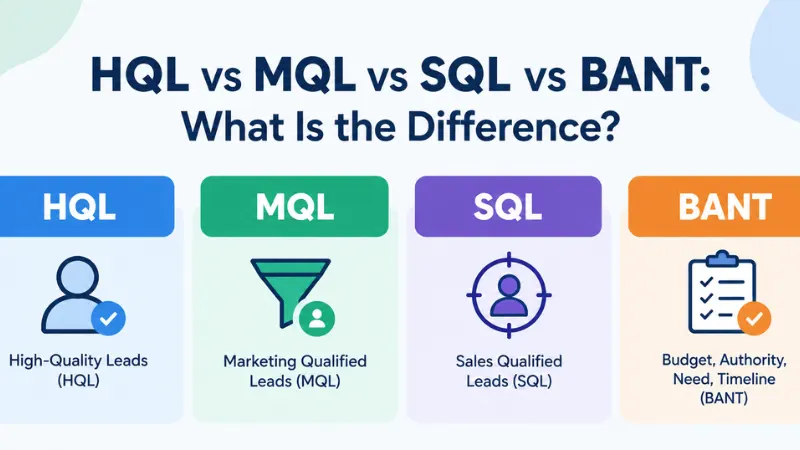
That gap is where HQL vs MQL vs SQL vs BANT confusion starts. These terms are often treated like four checkpoints on the same road, but they serve different purposes. MQL and HQL describe qualification thresholds, SQL reflects Sales validation, and BANT is a framework for understanding buying conditions.
HQL vs MQL vs SQL vs BANT
MQL, HQL, SQL, and BANT are not four stages of one universal funnel.
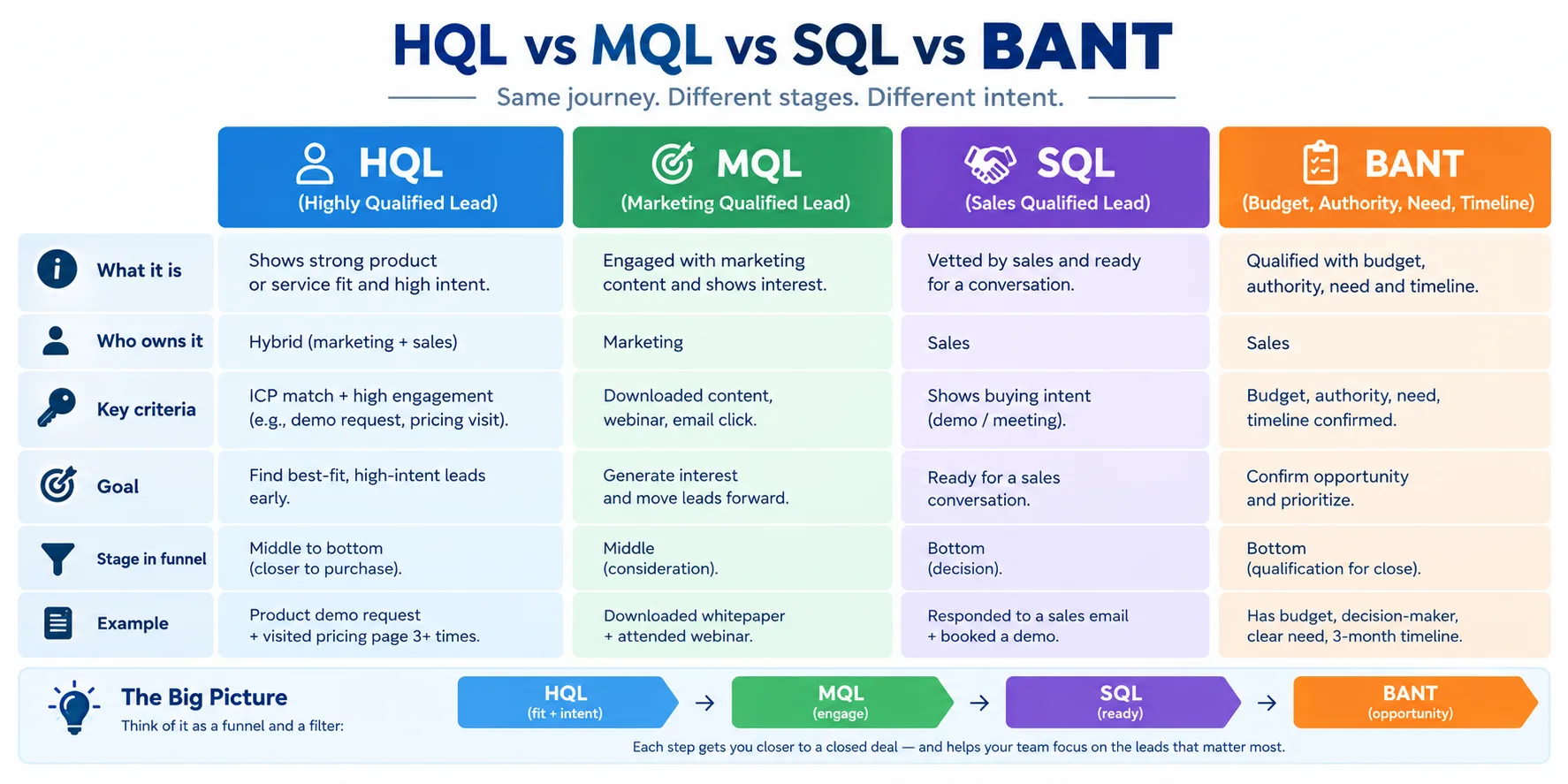
| Qualification | What It Answers | Typical Owner | Evidence |
| MQL | Has this lead met the marketing threshold for further qualification? | Marketing | Fit + engagement + scoring |
| HQL | Does this lead meet our defined standard for stronger qualifications? | Marketing, aligned with Sales | Fit + intent + qualification evidence |
| SQL | Has Sales validated this prospect for direct engagement? | Sales | Sales validation + buying context |
| BANT | What do we know about the buying conditions? | Sales | Budget + Authority + Need + Timeline |
BANT is not the step after SQL, and HQL is not simply a higher-scoring MQL. The four concepts can work together, but they answer different questions.
MQL vs HQL: Engagement vs Qualification Evidence
An MQL marks the point where Marketing determines that a lead has crossed its defined fit-and-engagement threshold. A content download, webinar registration, website activity, or lead score may contribute to that decision. How MQLs contribute to the path from lead generation to revenue also depends on what happens after the marketing threshold is reached.
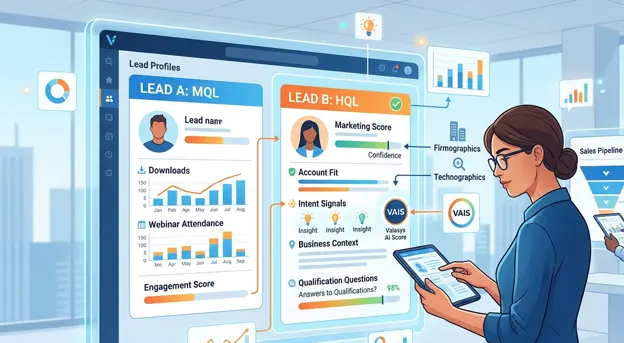
An HQL requires a stronger qualification standard. Depending on the business, that can include account fit, relevant intent, business context, and responses to qualification questions. The specific evidence depends on how the business defines a highly qualified lead and aligns qualification with its sales process.
This is where tools such as VAIS (Valasys AI Score) can add account-level context. VAIS combines account alignment with signals such as firmographics, technographics, buying committee movement, and intent activity.
Its AI-Powered Account Intelligence layer can provide additional context around potential priorities, relevant personas, buying stage, account momentum, and recommended next actions.
HQL vs SQL: Qualification vs Sales Validation
An HQL reflects a qualification standard established by the business. An SQL typically reflects Sales’ validation that a specific prospect is ready for direct engagement. For leads that are not yet ready for Sales validation, nurturing can help move qualified prospects toward an SQL over time.
The relationship is not identical across organizations. Some companies may use HQL and SQL for essentially the same outcome. Others use HQL as a qualification threshold that comes before Sales validation.
The important operational distinction is who is making the decision and what evidence is required.
An HQL can enter Sales without automatically being an SQL, depending on the agreed handoff process. Conversely, Sales may qualify a prospect directly through a conversation without the prospect following a formal MQL-to-HQL sequence.
SQL vs BANT: Lead Status vs Buying Framework
BANT belongs to a different category. It is a sales qualification framework rather than a lifecycle label.
BANT evaluates:
- Budget: Is funding available or realistically achievable?
- Authority: Who is involved in approving the purchase?
- Need: Is there a business problem the solution addresses?
- Timeline: When could the purchase realistically happen?
Sales can use BANT while working on an SQL or an open opportunity. It does not have to sit before or after SQL in a fixed sequence.
BANT is also not a checkbox exercise. A prospect saying they have budget or authority on an initial call is information to validate, not proof that the opportunity is qualified.
Teams looking to structure this type of qualification can also explore BANT Programs as a dedicated workflow.

A Quick Example
Say you’re selling enterprise analytics software.
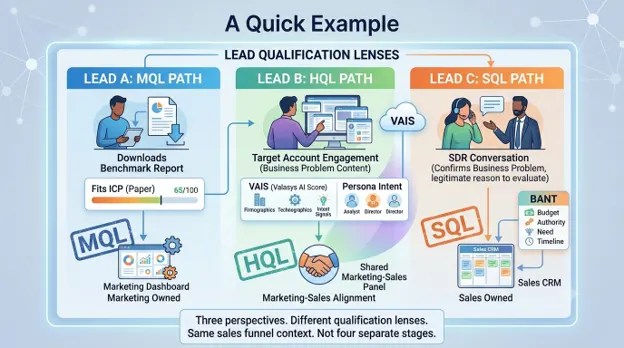
Lead A: downloads a benchmark report and broadly fits the ICP. Marketing marks the lead as an MQL because it meets the defined marketing threshold.
Lead B: belongs to a target account, engages with content related to a known business problem, and provides responses that meet the campaign’s qualification criteria. VAIS can add account and intent context, while Persona Intent can help identify relevant seniority levels and job titles associated with research activity. Those signals help the team assess Lead B against its HQL criteria.
Lead C: speaks with an SDR and confirms a relevant business problem and a legitimate reason to evaluate a solution. Sales can then classify the prospect as an SQL according to its acceptance criteria. If the conversation also establishes budget, authority, need, and timeline, BANT provides additional buying-condition context.
The same lead can therefore be viewed through different qualification lenses without those labels meaning the same thing.
How to Put HQL, MQL, SQL, and BANT to Work Together
- Define the MQL threshold. Document the fit and engagement signals that qualify a lead for further evaluation.
- Define the HQL evidence. Specify the additional account, intent, business, or qualification evidence required for stronger qualification.
- Set SQL acceptance criteria. Agree on what Sales must validate before accepting a lead for direct engagement.
- Use BANT where relevant. Apply Budget, Authority, Need, and Timeline when those factors materially affect the buying process.
- Close the feedback loop. Review accepted, rejected, recycled, stalled, and converted leads regularly. Use that evidence to refine the qualification rules.
The goal is not four perfectly color-coded CRM fields. It is a qualification process where Marketing, Sales, and Operations can consistently interpret the evidence behind each status.
Align Qualification With Sales
MQL, HQL, SQL, and BANT each serve a different role. The real value comes from defining the evidence, ownership, and handoffs clearly enough for Marketing and Sales to work from the same qualification standard.
Ready to Turn Qualification Into a Sales-Ready Process? Contact Valasys Media to build a more targeted HQL program aligned with your ICP, sales requirements, and campaign goals.
Frequently Asked Questions (FAQs)
Q1. How should B2B teams measure whether their lead qualification model is working?
Look beyond MQL volume. Useful measures can include Sales acceptance rate, MQL-to-SQL conversion, HQL-to-opportunity conversion, rejection and recycle rates, pipeline contribution, and downstream revenue outcomes. The right metrics depend on where qualification is intended to improve the sales process.
Q2. What should Sales do when an MQL meets the score threshold but does not look sales-ready?
The lead should not be treated as sales-ready simply because it crossed a scoring threshold. Sales feedback should identify which qualification evidence was missing and whether the issue was account fit, intent, business need, timing, persona, or another criterion. That feedback can then be used to refine the qualification model.
Q3. How often should B2B companies review their lead qualification criteria?
There is no universal review interval. Qualification criteria should be revisited when ICP assumptions, buying behavior, product positioning, sales cycles, campaign performance, or Sales acceptance patterns change. Regular conversion and rejection analysis can also reveal when existing thresholds are no longer producing useful handoffs.
Q4. What data should a B2B team use to improve lead qualification?
A useful model can combine first-party engagement with account and market context. Depending on the sales motion, that may include firmographics, technographics, intent activity, relevant personas, buying committee movement, business events, qualification responses, and Sales feedback. The objective is to give the qualification process enough context to distinguish meaningful buying activity from isolated engagement.
Q5. Can AI improve lead qualification without replacing Sales?
AI can help surface patterns, prioritize accounts, enrich qualification context, and identify signals that warrant further investigation. Sales still needs to validate information that depends on direct buyer conversations, business circumstances, or purchase decisions. The most practical role for AI is therefore to improve the evidence available to the team rather than make every qualification decision automatically.
Q6. How should qualification criteria be documented between Marketing and Sales?
The criteria should specify the evidence required, ownership at each stage, acceptance and rejection rules, handoff conditions, recycling rules, and the feedback process. Keeping these definitions in a shared operating document or CRM governance process reduces ambiguity when different teams use the same qualification terms.