

Modern BANT Qualification: Is BANT Still Relevant for B2B Sales and Marketing?
Explore modern BANT qualification and discover whether BANT is still relevant for B2B sales and marketing, including its benefits & use cases

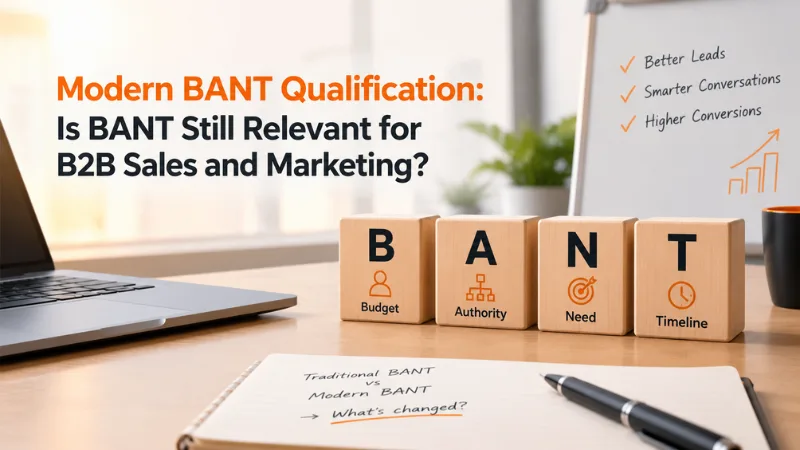
A lead lands in the CRM. Budget: Authority: Need: Timeline:
Four green checkmarks, and suddenly the lead looks qualified.
Then sales gets on the call and discovers that the “budget” is only a possibility, the VP isn’t actually responsible for approving the purchase, the “need” is really curiosity, and the Q4 timeline came from a wish list rather than an active buying process.
So, is BANT the problem?
Not necessarily.
The bigger problem is treating BANT as a four-box checklist instead of a way to understand the credibility of a buying situation.
BANT, which stands for Budget, Authority, Need, and Timeline, still provides a useful structure for B2B qualification. Microsoft, for example, continues to use BANT in its Sales Qualification Agent to assess whether leads are ready for seller handoff.
What has changed is the environment in which those four questions are being asked. Buyers now conduct substantial research before speaking with sales, buying decisions involve multiple stakeholders, and AI tools are increasingly part of the research process.
That means the questions still matter. The quality of the evidence behind the answers matters much more.
What Is BANT Qualification?
BANT qualification is a sales qualification framework built around four criteria: Budget, Authority, Need, and Timeline. The purpose is to help sales teams determine whether a prospect represents a credible buying opportunity and whether it is appropriate to move the lead toward a sales conversation or opportunity.
Microsoft’s current Sales Qualification Agent documentation still defines BANT in these terms and describes it as a methodology for determining whether a lead is ready for seller handoff.
The problem is not the four criteria themselves. The problem is treating them as simple yes-or-no fields.
A prospect may have a genuine business need before a budget is formally approved. A senior executive may influence a decision without owning the final approval. A buyer may want an implementation by a certain date without having started the procurement or approval process.
That is why modern BANT qualification should focus on credibility, context, and evidence, not simply completion.
Is BANT Still Relevant for B2B Sales?
Yes. BANT is still useful as a qualification lens, particularly when sales and marketing need a shared way to discuss buying readiness. But it becomes less useful when teams treat it as a rigid gate that every prospect must satisfy in exactly the same way.
The modern B2B buyer journey is far less dependent on early sales conversations than it once was. 6sense’s 2025 B2B Buyer Experience Report, based on nearly 4,000 B2B buyers, found that buyers contacted sellers at about 61% of the buying journey, while 95% of the time the eventual winning vendor was already on the buyer’s Day One shortlist. The same research found that 94% of buyers used LLMs during their buying process.
These findings matter for BANT because sales teams are often qualifying buyers after a significant amount of research has already happened.
The prospect may already know the category, understand several vendors, have discussed the problem internally, and have formed an early preference.
In that environment, asking basic discovery questions is not enough. Qualification needs to uncover what is happening behind the answers: how serious the problem is, who is involved, what has already been decided, what remains uncertain, and what has to happen before a purchase can actually move forward.
How Should Budget Be Qualified in Modern B2B Sales?
Budget should not be reduced to the question, “Do you have a budget?”
There is a meaningful difference between an approved budget, a planned budget, a potential funding source, and a situation where nobody has identified how the purchase could be funded.
For example, a company may have identified a business problem but have no dedicated budget for solving it. That does not automatically mean the opportunity is dead. The organization may be able to allocate money from an existing transformation initiative or build a business case for new funding.
The more useful qualification question is therefore: Is there a credible path to funding this purchase?
Sales teams should understand where funding could come from, who controls it, whether approval is required, and what would need to happen internally before money could be committed. The objective is not to force a prospect into saying “yes” to budget. It is to understand the commercial reality behind the answer.
This distinction is particularly important in complex B2B sales, where the buying process itself can help determine whether funding becomes available.
Why Authority Is More Complicated Than Finding the Decision-Maker
Traditional BANT often encourages salespeople to ask whether their contact is the decision-maker. That can work for relatively simple purchases, but complex B2B decisions rarely belong to one person.
Gartner’s 2025 research provides a useful illustration of this complexity. It reported that 74% of surveyed buying teams experienced what it classified as unhealthy conflict during the decision process, including disagreements about objectives or the best course of action.
That changes how the “A” in BANT should be interpreted.
Modern authority is less about identifying the person with the highest job title and more about understanding how the organization makes the decision. Who owns the business problem? Who evaluates the solution? Who controls the budget? Who needs to approve the purchase? Who can block it? Who is actively supporting it?
A champion is valuable, but a champion without access to the wider decision process can leave an opportunity exposed.
How Do You Distinguish Need From Interest?
Need is another BANT criterion that becomes misleading when it is treated as a simple yes-or-no question.
A prospect can download a report, attend a webinar, visit a pricing page, request a demo, or engage repeatedly with content. Those actions may indicate interest or intent, but they do not automatically establish a business need.
A stronger qualification conversation moves from activity toward business context.
- What problem is the organization experiencing?
- What happens if the problem remains unresolved?
- What business outcome is being affected?
- Why does the issue matter now rather than six months from now?
That distinction becomes even more important as buyers become more experienced and self-directed. The implication is not that sales should stop asking questions. It is that the questions need to be more useful.
Instead of asking only whether the prospect has a need, qualification should establish what changed, why it matters, and what makes an action worthwhile.
Why a Timeline Needs More Than a Date
“We want to implement this by Q4” sounds like a clear timeline. It may not be.
There is a difference between a desired implementation date and a real buying timeline. A credible timeline usually includes the events and decisions that have to happen before implementation: evaluation, stakeholder approval, procurement, legal review, contracting, technical validation, or another business milestone.
A better question is therefore not simply, “When do you want this?”

It is, “What needs to happen between now and that date?”
That question helps distinguish a genuine buying process from an aspirational deadline.
In any case, the date may simply reflect a preferred outcome with no corresponding approval or procurement activity. The difference matters because a timeline without supporting milestones can create false confidence in the pipeline.
Why the Four BANT Criteria Should Be Read Together
The biggest weakness of checklist-style BANT is that it treats Budget, Authority, Need, and Timeline as four independent fields.
In reality, they influence one another.
A company can have a significant need but no credible funding path. Another can have an approved budget but no urgent business problem. A strong champion can support the purchase while lacking access to procurement or executive approval. A clear implementation date can exist without a real decision process behind it.
This is why qualification should assess the overall buying condition, not simply count how many boxes are green.
A useful way to document qualification is to distinguish between information that is confirmed, inferred, unknown, or contradicted. A buyer explicitly stating that funding has been approved is different from a salesperson inferring budget from company size.
For instance, a VP requesting a demo may indicate influence, but it does not prove final authority. A stated Q4 target may indicate urgency, but it does not establish a confirmed procurement schedule.
The goal is not to make qualification more complicated. It is to make the information more honest.
Can AI Automate BANT Qualification?
AI can make BANT qualification faster and more consistent, particularly when qualification information is scattered across emails, CRM records, research, and sales interactions.
The important limitation is that extracting information is not the same as proving it.
AI can identify that a prospect mentioned a budget. It cannot automatically know whether that budget is approved, available, or appropriate for the proposed purchase.
It can identify a senior executive in a conversation, but that does not automatically establish purchasing authority. It can detect a statement about a Q4 launch without knowing whether procurement has been scheduled.
The best use of AI is therefore to surface evidence, identify gaps, and reduce manual work, while leaving appropriate human judgment around interpretation and verification.
How Marketing and Sales Can Operationalize Modern BANT
Modern BANT works best when marketing and sales agree on what qualification actually means.
First, define what evidence is expected for each criterion. Sales and marketing should have a shared understanding of what constitutes meaningful evidence for Budget, Authority, Need, and Timeline rather than allowing each team to create its own definition.
Second, capture context instead of only storing a status. “Budget: Yes” tells the next salesperson very little. A note explaining that funding is expected from a specific initiative and requires executive approval provides much more useful information.
Third, separate confirmed information from assumptions. If authority is unknown, leave it unknown rather than turning a job title into a conclusion. If the timeline is only a stated preference, document it that way.
Finally, revalidate qualification as the opportunity progresses. Budgets change, priorities shift, champions leave, and projects get delayed. Qualification is not a permanent label.
How Do You Know Whether Your BANT Process Is Working?
The number of BANT-qualified leads in your CRM is not enough to judge the quality of the process.
Look at what happens after qualification. Useful measures include sales acceptance rate, rejection reasons, lead-to-opportunity conversion, opportunity progression, win rate, and sales-cycle length.
Rejection data can be particularly valuable. If sales repeatedly rejects leads that marketing considers qualified, the issue may not simply be lead quality. The two teams may have different definitions of what “qualified” means.
A good BANT process should create a feedback loop. Marketing learns what information helps sales act, sales learns what can realistically be established earlier in the buyer journey, and both teams refine the qualification standard over time.
So, Is BANT Still Relevant?
BANT is still relevant because the four questions address four things every sales team ultimately needs to understand: Can the purchase be funded? Who is involved in the decision? Is there a meaningful reason to change? And is there a credible path to action?
What is becoming less useful is treating those questions as four boxes that can be checked once and forgotten.
Modern B2B buying is too complex for that. Buyers research before contacting sales, buying groups can include many stakeholders, AI is changing how information is evaluated, and the evidence available to sales teams often mixes direct buyer statements with behavioral signals and assumptions.
So the future of BANT does not require another letter or a completely new acronym.
It requires a better standard for qualification.
A modern BANT-qualified opportunity should give a sales team enough evidence to understand why the buyer may purchase, how the organization will make the decision, what makes the problem important, how the purchase could be funded, and what needs to happen next.
The four letters still work.
The checkbox mentality doesn’t.
Curious what modern BANT qualification looks like beyond the four checkboxes? Explore Valasys Media’s BANT qualification services.
Frequently Asked Questions About BANT Qualification
What is BANT qualification?
BANT qualification is a sales qualification framework based on Budget, Authority, Need, and Timeline. It helps sales teams evaluate whether a prospect has the commercial conditions associated with a potential purchase. Modern BANT qualification focuses on the evidence and context behind each criterion rather than treating them as simple yes-or-no fields.
Is BANT still relevant for B2B sales?
Yes. BANT remains a useful qualification framework, particularly for creating shared language between marketing and sales. However, complex B2B opportunities often require additional context around buying groups, procurement, technical evaluation, business cases, and stakeholder alignment.
How should sales teams qualify budget?
Sales teams should look beyond whether money has already been approved. They should understand whether funding is allocated, planned, available through another initiative, or dependent on an internal business case. The key question is whether a credible path to funding exists.
How do you identify authority in a B2B buying committee?
Identify the people who influence, evaluate, approve, champion, or can block the purchase. Job seniority alone does not prove decision authority. The goal is to understand how the organization actually makes the decision and whether the relevant stakeholders can align.
Can AI automate BANT qualification?
AI can assist with BANT by extracting relevant information from CRM records, emails, research, and sales interactions. Microsoft currently documents AI-assisted qualification using BANT alongside other lead signals. However, AI-generated signals should not automatically be treated as confirmed buying facts.