
Best Account-Based Marketing Software for Mid-Market SaaS (AI ABM Guide)
Compare the best account-based marketing software for mid-market SaaS. See how AI ABM platforms differ by demand generation fit, account intelligence, scalability, and pipeline quality.

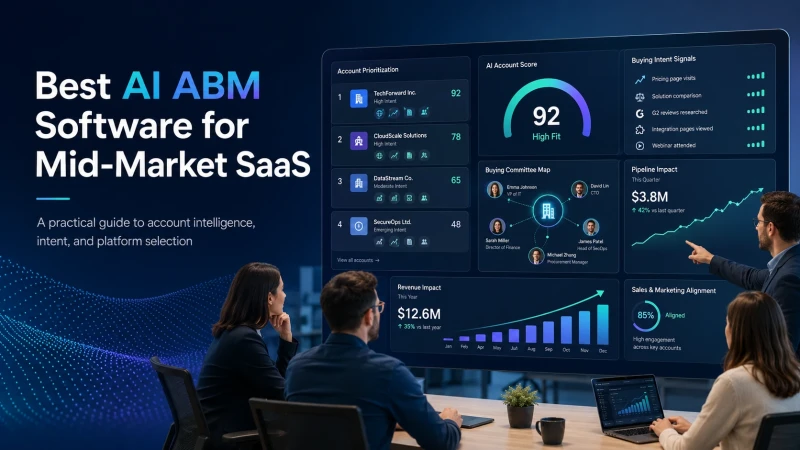
Scaling a mid-market SaaS company means making every marketing dollar and every sales conversation count.
Unlike enterprise organizations, most mid-market teams don’t have unlimited budgets or large RevOps departments. Every missed opportunity, poorly qualified lead, or wasted sales cycle has a measurable impact on growth.
The best account-based marketing software addresses this challenge by helping teams identify high-fit accounts, prioritize buying intent, and align sales and marketing around the opportunities most likely to generate revenue.
In this guide, we’ll compare today’s leading AI ABM platforms, explain what features actually matter, and help you determine which solution best fits your business.
Before we dive in, let’s start with the basics.
What Is AI Account-Based Marketing Software?
Account Intelligence
Account intelligence combines firmographic, technographic, engagement, and intent data to help B2B revenue teams identify which accounts are worth pursuing and when.
Traditional ABM was largely manual. You’d build a target account list, coordinate sales and marketing around it, and run personalized campaigns. That works at a small scale. But it falls apart at 300 accounts with a team of four.
AI changes the equation in three specific ways:
- Identification: AI surfaces accounts showing active buying signals such as content consumption, web activity, search behavior and third-party intent before they ever fill out a form.
- Prioritization: Instead of treating all 500 accounts on your list equally, AI scoring tells you which 50 matter most this quarter. That’s where the budget goes. That’s where sales time goes.
- Personalization at scale: AI-driven platforms tailor messaging and content to specific accounts and buying committee members without requiring a full campaign build for each one.
The result is a demand program that aligns with how modern B2B buyers behave. AI surfaces the engagement signals behind behaviors such as anonymous research, content consumption, and competitor comparisons, helping revenue teams identify in-market accounts earlier.
Why Mid-Market SaaS Teams Need AI ABM Specifically
Mid-market SaaS sits in an awkward position. Past the stage where founders close every deal personally. Not yet at enterprise scale with armies of SDRs and a $10M marketing budget.
That middle ground creates a specific kind of pressure. You need a repeatable pipeline engine, but you can’t afford to run it inefficiently. Every wasted MQL is a real cost. Every deal that stalls because sales got handed a contact instead of an account context is a compounding miss.
The AI ABM Platform Selection Framework

Before looking at specific platforms, use this five-part framework. The right choice depends on where you score on each dimension:
- Intelligence: Can the platform surface accounts showing real buying signals, not just demographic fit? Does it integrate third-party intent data? Can it identify anonymous visitors?
- Personalization: Can you deliver account-specific experiences across web, ads, and email? Does the platform support buying committee targeting or just company-level?
- Activation: Can sales actually use what the platform surfaces? Is there a usable sales intelligence layer, or does it stop at marketing dashboards?
- Measurement: Can the platform connect campaign activity to pipeline and revenue? Can you prove ABM ROI to a CFO?
- Scalability: Can your team manage it without a dedicated operations hire? Is implementation realistic for a mid-market team?
Rate your current needs against each criterion . A platform that scores 10 on Intelligence but 2 on Scalability is the wrong choice if your team is three people managing the stack alongside everything else.
How We Evaluated These AI ABM Platforms
This comparison evaluates AI ABM platforms using a consistent set of criteria designed for mid-market SaaS companies. Rather than ranking vendors based on a single feature or score, we assessed each platform against the capabilities that most influence account-based marketing success.
The evaluation considers:
- Account intelligence: The ability to identify, prioritize, and score high-value accounts using firmographic, technographic, behavioral, and intent signals.
- AI capabilities: Features such as predictive scoring, buying-stage identification, intent analysis, personalization, and automation.
- Revenue activation: How well the platform enables sales and marketing teams to act on account insights through workflows, integrations, and engagement tools.
- Ease of adoption: The expected implementation effort, usability, and operational complexity for mid-market teams.
- Scalability: The platform’s ability to support larger account volumes and more mature ABM programs over time.
This is an editorial comparison intended to help buyers understand the strengths and trade-offs of each platform. Product capabilities, pricing, and integrations may change over time, so organizations should validate current features directly with each vendor before making a purchasing decision.
Best AI ABM Platforms for Mid-Market SaaS
Valasys AI Score (VAIS)
VAIS is an AI-powered ABM intelligence platform designed to help B2B revenue teams do one thing exceptionally well: identify, score, and prioritize the accounts most likely to convert, before sales wastes a cycle on the wrong ones.
Where most ABM platforms are built around advertising or engagement orchestration and bolt on scoring as a secondary feature, VAIS leads with AI-powered account intelligence. The scoring model pulls in ICP fit data, behavioral signals, and intent data to produce account scores that reflect genuine purchase readiness, not just firmographic fit.
For mid-market SaaS revenue teams, that distinction matters. You don’t have the budget to run broad account engagement across 500 companies simultaneously. VAIS tells you where to concentrate: which accounts are in-market now, which fit your ICP tightly, and which should be deprioritized until signals change.
The platform is also built with the sales-marketing handoff in mind. Account scores aren’t buried in a marketing dashboard; they’re surfaced in a way sales teams can actually use to sequence outreach, prioritize accounts, and time their touches to real buying signals.
VAIS: Pros
- Purpose-built account scoring for B2B demand generation, not retrofitted from a marketing automation tool
- Intent signal integration that reflects actual in-market behavior, not just firmographic fit
- Sales-ready AI intelligence layer and scores are usable by revenue teams, not just marketing ops
- Built for the mid-market operational reality: powerful without requiring a dedicated ABM operations function
- ICP prioritization at scale: Works for teams managing large account universes without proportional headcount
VAIS: Cons
- Strongest value is realized when CRM data is clean and ICP is well-defined before implementation
- Less emphasis on outbound advertising orchestration; complements ad platforms rather than replacing them
Ideal profile: B2B revenue teams particularly at mid-market SaaS companies where the primary challenge is knowing which accounts to prioritize, and where sales and marketing need a shared scoring model to align on.
Ready to score your ICP at scale? See VAIS in action → VALASYS AI
6sense
6sense is a revenue AI platform rather than a traditional ABM tool. The core differentiation is predictive analytics, specifically by identifying where accounts are in their buying journey before they raise their hand.
6sense: Pros
- Buying stage prediction is genuinely differentiated, tells you not just who fits but who’s actively in-market now
- Revenue intelligence layer bridges marketing and sales better than most platforms in the category
- Anonymous visitor identification at account level is strong
- Intent data aggregation at scale
6sense: Cons
- Implementation may require more planning and operational support than some mid-market teams expect.
- Without RevOps support, predictions can feel noisy rather than actionable
- Pricing is generally positioned toward larger organizations, though costs vary by deployment and contract.
Ideal profile: Mid-market SaaS companies with clean CRM data, an existing ABM program they want to upgrade, and revenue operations support to manage the integration.
Demandbase
Demandbase is one of the most established names in account-based marketing software, built specifically for B2B with strong account intelligence, intent data, and advertising capabilities.
Demandbase: Pros
- Depth of account data, aggregates first-party and third-party signals well
- B2B advertising capabilities are genuinely specialized, not B2C display retargeted to business buyers
- Strong buying committee identification
- Predictive account scoring is generally considered mature by industry reviewers, though results vary by implementation
Demandbase: Cons
- The platform’s depth can become a source of complexity for smaller mid-market teams, which often need dedicated ABM ops to activate it fully
- Pricing reflects enterprise positioning
Ideal profile: Mid-market SaaS companies with 200+ employees, established sales-marketing alignment, and a dedicated demand generation team ready to work the platform.
UserGems
UserGems is an AI command center for outbound and ABM that sits between the CRM and sales engagement and marketing automation tools. It captures live buying signals—including contact-level intent, tech-stack shifts, funding events, and role changes—then scores accounts and contacts using a custom AI model built on your sales history. Gem-E agents can draft personalized outreach, build ad audiences, and orchestrate workflows automatically.

UserGems: Pros
- Combines signal capture, custom account and contact scoring, automated list building, and activation in one modular layer
- Surfaces insights inside Salesforce, HubSpot, or a sales engagement platform through its AI Chrome Extension
- Syncs scored accounts to LinkedIn, Meta, and Google ad platforms
UserGems: Cons
- Teams need usable sales-history and CRM data to get the most from its custom scoring model
- Its modular approach may require teams to decide which agents and workflows they need first
Ideal profile: Mid-market SaaS revenue teams that want live, contact-level signals and coordinated outbound and ABM activation without adding headcount.
Terminus
Terminus is an account-based marketing platform focused on multi-channel account engagement by connecting advertising, email, web, and chat into coordinated account experiences.
Terminus: Pros
- Strong on the activation side of ABM, coordinates what a target account sees across every channel
- Solid engagement tracking and advertising optimization
- Works well for teams that already know their target account list and need execution infrastructure
Terminus: Cons
- Less emphasis on predictive intelligence; a better execution engine than discovery tool
- Works best when you already know which accounts to target; doesn’t help you find them
Ideal profile: Mid-market SaaS companies with a defined target account list and marketing teams who need a platform to orchestrate multi-channel engagement around those accounts.
RollWorks
RollWorks is an ABM platform built specifically for mid-market and growing companies, with an emphasis on usability and accessibility for leaner teams.
RollWorks: Pros
- Fills the gap between ‘too basic’ and ‘too complex’ for mid-market SaaS
- Covers core ABM use cases by identifying accounts, running account-targeted ads, measuring pipeline influence, without requiring a full ABM operations function
- Pricing and implementation are more accessible than enterprise-tier platforms
RollWorks: Cons
- Less depth on predictive intelligence compared to 6sense or Demandbase
- Intent data integration is solid but not the platform’s primary differentiator
Ideal profile: Mid-market SaaS teams of 50–300 employees running lean marketing operations who need a functional ABM platform they can actually manage.
HubSpot ABM
HubSpot’s ABM tools sit inside its broader CRM and marketing platform, making them the lowest-friction entry point for SaaS companies already in the HubSpot ecosystem.
HubSpot ABM: Pros
- Zero additional implementation if your team is already in HubSpot; CRM alignment is native
- Low learning curve; accessible for teams running their first structured ABM program
- Works well as a starting point before graduating to a dedicated platform
HubSpot ABM: Cons
- Account intelligence isn’t as deep as Demandbase or 6sense
- Intent data is lighter; you’ll hit the ceiling faster if pipeline quality is the primary challenge
- Generalist tool, ABM is one feature set, not the platform’s core purpose
Ideal profile: Early-stage mid-market SaaS teams who need a structured starting point and can expand to a dedicated platform as the program matures.
AI ABM Platform Comparison
| Platform | Best For | Core AI Capability | Intelligence Depth | Scalability | Ideal Team Size |
| VAIS by Valasys | B2B revenue team account scoring | ICP scoring + intent prioritization | Very High | Very High | RevOps + 2+ marketing FTEs (Full-Time equivalents) |
| 6sense | Predictive buying-stage ID | Buying journey AI, anonymous ID | Very High | Medium | RevOps + 3+ marketing FTEs |
| Demandbase | Account intelligence + B2B advertising | Predictive scoring, intent aggregation | Very High | Medium | 5+ marketing FTEs |
| Terminus | Multi-channel account engagement | Engagement tracking, ad optimization | Moderate | High | 2–4 marketing FTEs |
| RollWorks | Lean mid-market ABM execution | Account scoring, intent data | Moderate-High | Very High | 1–3 marketing FTEs |
| HubSpot ABM | First ABM program, HubSpot ecosystem | Contact scoring, basic intent | Moderate | High | 1–3 marketing FTEs |
Decision Matrix: Which Platform to Choose
| If your primary challenge is… | Choose… |
| Knowing which accounts to score and prioritize for B2B revenue teams | VAIS by Valasys |
| Catching accounts in active buying cycles before competitors do | 6sense |
| Deep account data + B2B advertising in one platform | Demandbase |
| Coordinating what target accounts see across every channel | Terminus |
| Getting ABM running without a dedicated ops function | RollWorks |
| Starting ABM inside an existing HubSpot setup | HubSpot ABM |
How to Choose the Right AI ABM Platform for Your SaaS Company
The right platform is the one your team can actually run and that targets your specific pipeline problem. A few principles that matter more than the feature comparison:
If your primary challenge is not knowing which accounts to target or prioritize, start with intelligence. VAIS, 6sense, and Demandbase are strongest here, each from a different angle: VAIS on ICP scoring and prioritization, 6sense on buying-stage prediction, Demandbase on account data depth.
If your challenge is coordinating what target accounts experience across channels, prioritize activation. Terminus is built for that.
If your challenge is getting an ABM program off the ground without dedicated operations, prioritize scalability. RollWorks or HubSpot ABM are the realistic starting points.
If your challenge is proving ABM ROI to a board or CFO, prioritize measurement. 6sense and Demandbase both have stronger revenue attribution than the others.
One thing worth holding onto: don’t buy for where you want to be in two years. Buy for where you are now, with a clear path to upgrade. A sophisticated platform your team can’t activate is worse than a simpler one they run with discipline.
The Future of AI-Powered ABM
The platforms covered here will look different in 18 months. Generative AI is already changing how personalization works by moving from account-specific landing pages to genuinely dynamic content that adjusts to individual buyers in real time.
Autonomous outreach is emerging as a growing trend, with vendors increasingly introducing AI agents that can recommend or initiate personalized engagement based on account signals.
The implications for mid-market SaaS specifically: the gap between teams using AI ABM well and teams still running volume-based demand generation is going to widen. The operational leverage compounds over time as the models learn from your data.
The teams that will win aren’t necessarily running the most sophisticated platforms. They’re the ones that picked the right platform for their current reality, built the data foundation, and kept iterating.
To Conclude
There’s no single best AI ABM platform for mid-market SaaS. There’s a best fit: the platform that matches where your program actually is, what your team can manage, and which specific pipeline problem you’re solving first.
VAIS leads for B2B revenue teams that need AI-powered account scoring built for demand generation. 6sense and Demandbase lead on intelligence depth for teams with the operational foundation to activate them. Terminus is the right choice when execution and multi-channel coordination is the gap. RollWorks and HubSpot ABM are where realistic mid-market programs start.
Use the framework, Intelligence, Personalization, Activation, Measurement, and Scalability to cut through the feature noise. The companies getting the most from ABM software aren’t always running the most advanced platforms. They’re running the right one with discipline and clear measurement.
Ready to score your ICP at scale? See Valasys Media’s VAIS in action → VALASYS AI
Frequently Asked Questions (FAQ)
What is the best AI ABM platform for mid-market SaaS?
It depends on your primary challenge. For B2B revenue teams that need AI-powered account scoring and ICP prioritization, VAIS by Valasys is purpose-built for that. For intelligence depth and buying-stage prediction, 6sense and Demandbase lead. For leaner teams getting started, RollWorks and HubSpot ABM are more accessible entry points.
Is Demandbase better than 6sense?
Both are strong but differentiated. Demandbase excels at account intelligence and B2B advertising. 6sense is stronger on predictive buying-stage identification, catching accounts in active research phases before competitors do. If you need advertising integration alongside account data, Demandbase. If you need to know who’s in-market right now, 6sense.
How does AI improve account-based marketing?
AI improves ABM across three dimensions: identifying accounts showing buying signals earlier through intent data and anonymous visitor identification; prioritizing which accounts to focus on through predictive scoring; and personalizing experiences at scale without proportional manual effort.
Is ABM suitable for mid-market SaaS companies?
Yes, and often better suited to mid-market than enterprise. Mid-market teams don’t have the volume to make pure lead generation sustainable. ABM’s focus on pipeline quality over quantity fits the resource reality of mid-market SaaS better than most demand generation approaches.
What metrics should SaaS companies use to measure ABM success?
Pipeline contribution from target accounts, win rate on ABM accounts versus non-ABM accounts, deal velocity, and average contract value on ABM-sourced deals. MQL volume is the wrong primary metric for an ABM program.
How long does it take to see results from AI ABM software?
Many organizations begin seeing measurable pipeline impact within three to six months, although results vary depending on implementation, data quality, sales adoption, and campaign maturity.
What makes VAIS different from other AI ABM platforms?
VAIS leads with account scoring and ICP prioritization as its core capability, not advertising orchestration or engagement tracking with scoring bolted on. It’s built for B2B revenue teams that need to know which accounts to prioritize now, with a sales-ready intelligence layer that bridges marketing and sales rather than sitting in a marketing dashboard.