

Choosing the Right Business Internet Provider for Growth
Use this practical framework to choose a business internet provider that supports growth—balancing speed, reliability, security and scalability to avoid costly downtime.

Your internet connection is the quiet backbone of modern business. Cloud apps, video calls, payment terminals, and security cameras all run on it. When it fails, everything freezes—ITIC found that the average mid-size company loses about $300,000 for every hour offline in 2024. That’s why choosing WOW! Business Internet (or a peer provider) is a mission-critical decision, not a utility line item. Use the framework below to align real-world performance and support with how your team works today—and how you plan to grow.
Look beyond download speed
Advertised download speed grabs attention, but three other metrics decide whether daily work feels fast or sluggish.
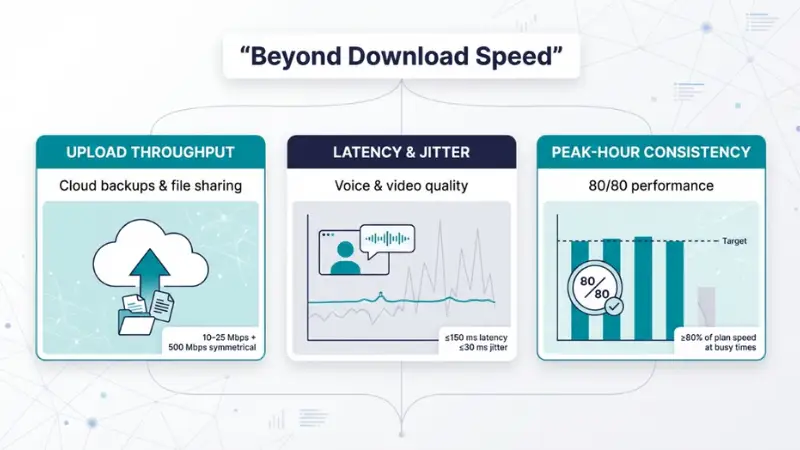
Upload throughput. Cloud storage vendors recommend at least 10-25 Mbps for continuous backups of large files. If your designers handle 4K video or CAD models, symmetrical fiber (500 Mbps or more in both directions) keeps projects moving.
Latency and jitter. Voice and video don’t tolerate much delay. Industry guidelines set one-way latency below 150 ms and jitter under 30 ms for natural-sounding calls. Anything higher causes echoes, talk-overs, and frozen screens.
Consistency during peak hours. The FCC’s “80/80” score tracks how often customers receive at least 80 percent of plan speed during 80 percent of busy periods. In the latest report, 9 of 12 major U.S. providers passed, but one dipped below 90 percent of its advertised speed. Ask where each prospective provider lands.
When you interview ISPs, press for three specifics: (1) the typical upload-to-download ratio on each tier, (2) median latency and jitter at noon versus 8 pm, and (3) the latest 80/80 figure or similar SLA. Together, those numbers show whether a plan that looks great on paper will still perform when your whole team clicks “Join meeting” at once.
To check your assumptions, plug them into a simple worksheet based on a bandwidth planning guide from WOW! Business Internet, which breaks common business tasks into rough Mbps requirements per user and by team size so you can see whether each provider’s upload, latency, and busy-hour performance truly fits your mix of cloud apps, video calls, and backups.
Reliability and support are non-negotiable
One hour of network downtime costs a small business between $137 and $427 per minute, according to Atlassian. Losses rise fast for firms with heavier digital revenue streams. That math makes a provider’s service-level agreement (SLA) just as important as raw speed.
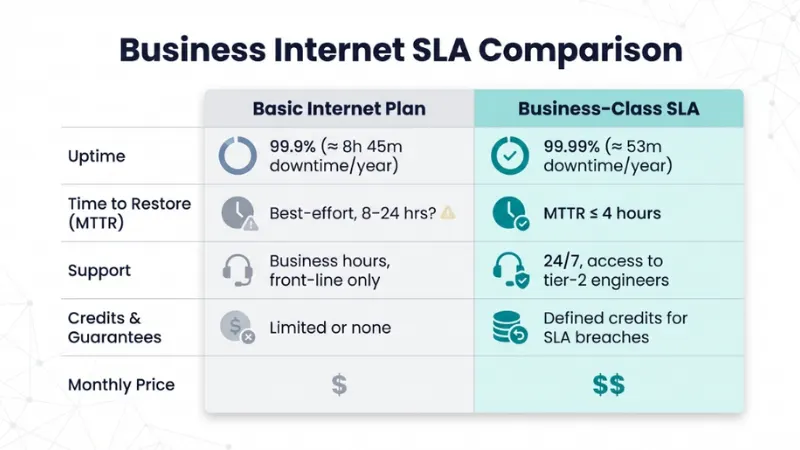
Uptime in writing. Most business-class ISPs promise 99.9 percent availability, which still allows up to 8 hours 45 minutes of downtime per year. Ask whether they offer 99.99 percent (about 53 minutes) and what credits apply if they miss the mark.
Time to restore. Enterprise-grade SLAs from carriers such as Verizon cap mean time to repair at four hours per incident. Anything longer bleeds revenue, so make sure MTTR appears in your contract, not just uptime.
Support that never sleeps. Around-the-clock phone and chat lines are a must if your storefront or remote staff works outside 9-to-5. Confirm that business customers bypass residential queues and that weekend calls reach tier-2 engineers, not scripted bots.
Low sticker prices can mask weaker SLAs or “best-effort” repair windows. Compare credit policies, MTTR, and support hierarchy side by side before you sign. Paying a little more for guaranteed restoration often costs less than a single peak-hour outage.
Think about security from day one
Nearly half of U.S. small businesses (46 percent) suffered a cyber-attack in the past year, and the average loss topped $120,000 per incident. Larger firms fare even worse: a 2024 IBM study pegs the global average breach cost at $4.88 million. Your internet circuit is the front door, so the service you choose should strengthen, not weaken, your defenses.
Start with three pillars:
- Advanced network features. Static IPv4/IPv6 blocks simplify site-to-site VPNs and let you whitelist traffic. Ask whether the ISP bundles managed firewall or DDoS scrubbing so you’re not adding those later at higher cost.
- Seamless fit with your stack. Confirm that the connection plays nicely with existing firewalls, SD-WAN appliances, or SASE agents. The best providers publish configuration templates for popular gear from Cisco, Fortinet, and Palo Alto, saving hours of trial and error.
- Built-in safeguards. Look for always-on DDoS mitigation and DNS filtering (services now offered by carriers such as AT&T and Lumen on business tiers) to block the volumetric attacks that can choke a bandwidth-hungry cloud app.
You don’t need to be a security architect, but you do need clear answers before you sign. A quick call that nails down IP options, integration guides, and default threat protections today can spare you a six-figure breach and weeks of cleanup tomorrow.
Plan for growth and new locations
Expansion isn’t hypothetical. Nearly 60 percent of U.S. small and mid-sized businesses plan to add products, services, or physical sites within the next year, according to Bank of America’s 2025 Business Owner Report. If that sounds like your roadmap, treat bandwidth as a scaffold you can raise, not a wall you outgrow.
A forward-looking provider should answer three questions with clear numbers:
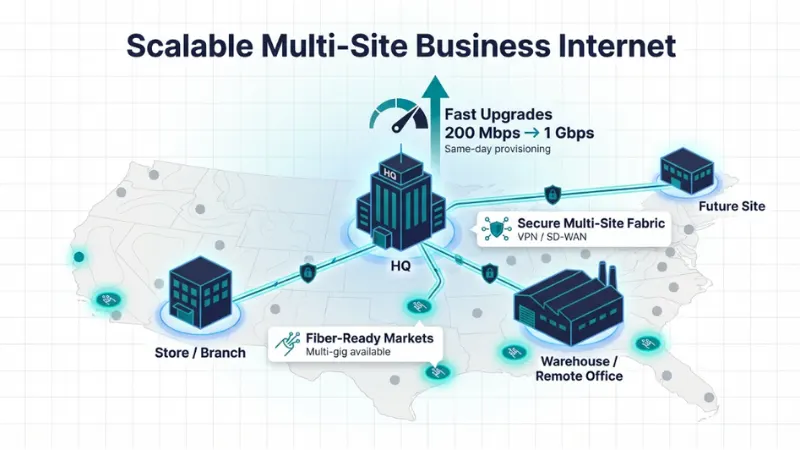
- How fast can we scale the circuit? Moving from 200 Mbps–1 Gbps should be a same-day provisioning change, not a truck roll. Ask for a written upgrade window (many carriers quote four business hours) and whether any downtime is expected.
- Can you stitch multiple sites into one secure fabric? If a second warehouse comes online next quarter, the carrier should offer managed VPN or SD-WAN so the two locations share traffic over private links instead of the public internet.
- What fiber headroom exists in each market? More than half of U.S. addresses are now served by fiber, and AT&T alone passes 30 million locations as of June 2025. Knowing which future ZIP codes already have multi-gig infrastructure prevents expensive provider swaps down the road.
Conclusion
The goal: secure a contract that scales in hours, not months, and spans new addresses without new hardware, or renegotiated terms, so your team can focus on opening doors, not pulling cable.

