
How to Turn Your B2B Website Into a Scalable Lead Generation Engine
Learn how to turn your B2B website into a high-converting lead engine using Webflow, smart UX, CRM integration, and conversion-focused design strategies.


For many B2B companies, a website is a digital brochure: nice to look at, but not doing much heavy lifting.
But that’s no longer enough.
In 2025, your website isn’t just your storefront—it’s your most scalable lead generation engine. And when designed with the right structure, tools, and strategy, it can help you reduce reliance on paid channels, speed up your sales pipeline, and generate qualified leads around the clock.
Here’s how to transform your B2B website from passive to powerful.
Start With Goals—Not Just Pages
Before touching design or code, you need clarity on what your website should actually do.
Ask:
- What kind of leads are we trying to attract?
- What role does the site play in the buyer journey?
- How will we measure success?
A solid UX strategy turns those answers into structure. Instead of dumping everything into a nav bar, you create clear conversion paths that align with user intent. This is how your site stops being a generic destination—and starts acting like a sales tool.
Build for Speed and Scale
Enterprise buyers don’t wait for slow sites. And marketing teams can’t afford to depend on developers for every update.
A modern B2B sites need:
- Lightning-fast performance
- Component-based design for scalable content
- A CMS that marketers can actually use
- SEO foundations baked in—not tacked on

At Composite Global, we’ve helped B2B teams move off legacy platforms like WordPress or Squarespace and onto Webflow so they can:
- Launch faster
- Iterate on messaging in real time
- Scale landing pages and campaigns without waiting on devs
Use Conversion-Driven Design
Lead generation doesn’t mean stuffing CTAs everywhere. It means guiding visitors toward action based on context.
Some examples:
- On product pages: demo requests, calculators, or ROI tools
- On blog posts: gated content or soft email capture
- On high-intent pages: personalized CTAs based on industry or segment
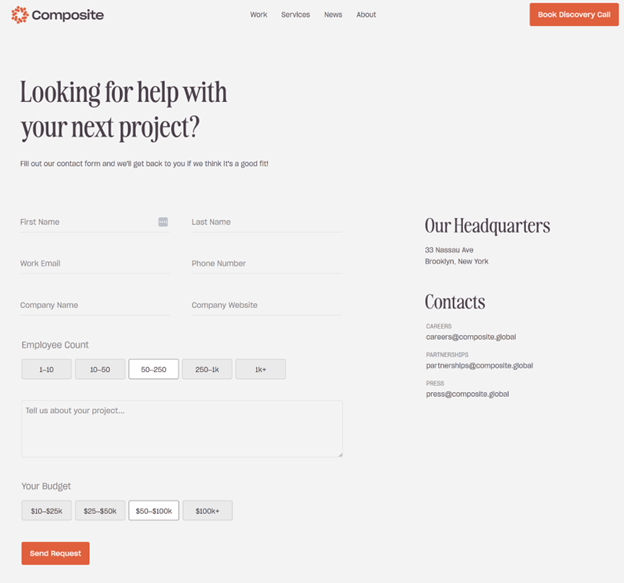
Smart B2B sites are designed like sales funnels: clear paths, compelling copy, and frictionless forms. Your homepage isn’t just about looking impressive—it’s about intuitively leading users to the next step.
Sync With Your CRM and Sales Stack
The best lead gen sites don’t just capture form fills—they hand off context-rich leads to sales.
That means:
- CRM integration (HubSpot, Salesforce, etc.)
- Lead source and page tracking
- Pre-fill logic to reduce form fatigue
- Alerts or routing rules for high-value prospects
It’s not about having more tools—it’s about having the right flow of data from site to sales team, so you can act fast when a lead shows intent.
Test, Measure, Repeat
Your website should evolve with your funnel.
Use:
- Heatmaps to identify drop-off points
- A/B tests on headlines, layouts, or form design
- Analytics dashboards to track performance across campaigns
- User feedback loops to improve UX
Even small tweaks—like improving page speed or adjusting CTA copy—can increase conversion rates dramatically.
Lead generation is not a one-and-done project. It’s an ongoing loop.
Final Thoughts: Don’t Just Launch a Site—Build a Growth Engine
A brochure site is fine if your goal is to just exist online. But if you’re serious about inbound, customer education, and long-term pipeline growth, your website needs to work harder.
At Composite Global, we design and develop Webflow sites for B2B teams that move fast, stay flexible, and generate qualified leads without dev bottlenecks.
Because in today’s landscape, your website isn’t just part of your marketing strategy—it is your marketing strategy.