



Manufacturing never sits still. In a 2024 Gartner survey, 73 percent of companies re-engineered their supply-chain footprints within the past two years to stay resilient. Margins are thin and lead times short, so many plants look outward for help—yet choosing a manufacturing consulting partner can feel as risky as any capital spend.
Before you chase the next shiny tool, define what that partner must deliver for your shop floor and P&L. The checklist below—whether you choose MCA Connect or another firm—will help you compare candidates with confidence.
1. Deep focus on manufacturing and distribution
Industrial margins hover near ten percent, so every unplanned hour and hidden cost counts. According to industry data from Zipdo, planners juggle hundreds of SKU variants on equipment that averages 11 years old in U.S. plants. Quality and traceability programs can consume up to three percent of annual revenue for smaller manufacturers, according to Quality Magazine. A generalist IT vendor may know the software stack, but a manufacturing partner also understands takt time, line changeovers, and electronic batch records.
When you vet a firm, ask:
- What share of its revenue comes from manufacturing and distribution?
- Which sub-industry problems (for example, PPAP in Tier-1 automotive or recipe control in CPG) has it solved, and with what measurable gain?
- Will it connect you with plant managers who achieved those results on the floor?
A partner who speaks in terms of throughput, downtime, and first-pass yield is more useful than one who only shows slide decks. According to MCA Connect’s published success story on a global technology manufacturer, unifying multiple plants on a common Dynamics 365 backbone with fixed-interval scheduling cut non-value-added activity by more than 60 percent, lowered IT support costs by roughly $50 million, and brought plant downtime close to zero while standardizing production and distribution processes. Case studies at this level of detail are a practical way to judge whether any prospective partner truly understands manufacturing economics and can connect improvements on the shop floor to the P&L.
2. Strength across strategy, systems, and data
McKinsey reports that fewer than 30 percent of large transformations succeed long term, and only 16 percent keep delivering gains. The gap is rarely technology; it is the hand-off between the business plan, the transaction backbone, and the data that guides decisions.
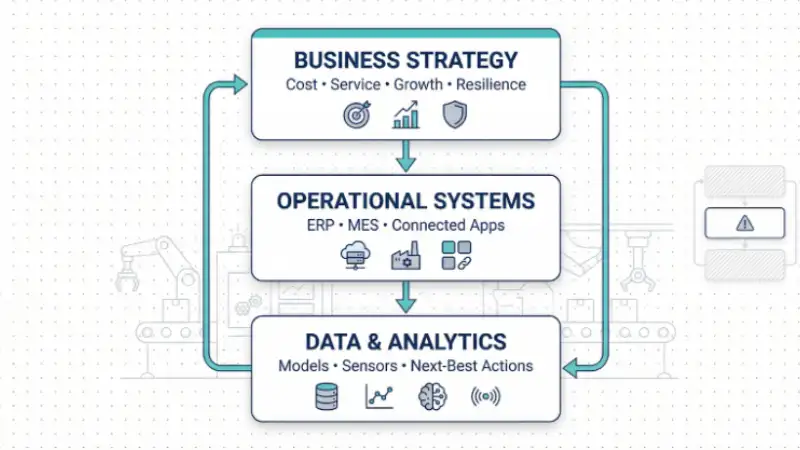
A well-rounded partner connects all three:
- Business strategy: clear targets for cost, service, growth, and resilience
- Operational systems: ERP, MES, and connected apps tuned to reach those targets
- Data and analytics: models that turn sensor readings and order history into next-best actions
Ask a candidate to show how it:
- Converts board-level goals into a release plan with payback by quarter
- Hardens systems through quick “fit-to-standard” sprints, reducing the 35 percent failure rate that still haunts complex ERP rollouts
- Builds analytics people adopt; only 26 percent of manufacturers use AI today, and most remain in pilot mode, according to Deloitte
If a firm excels in one lane but lags in the others, the project may join the failure statistics. A true partner syncs strategy, systems, and data so plant teams meet financial targets and keep them.
3. A pragmatic, phased approach
Most digital programs stall before the finish line. McKinsey reports that only 11 percent of manufacturers that ran a Lighthouse pilot managed to scale Industry 4.0 across their network, often because the first rollout was too broad, too slow, or too costly to prove its value. Leaders who start small see payback inside a year; McKinsey adds that their average ROI window is just six to 12 months.
A sound partner maps the journey in three beats:
- Win fast. Select one line or plant, tie the use case to a metric the CFO cares about (for example, a two-point lift in inventory turns), and lock in a 12-month payback target.
- Learn and adapt. Use the pilot data to refine methods, tech stack, and change-management playbooks; Deloitte finds that 23 percent of manufacturers remain at this pilot stage for AI and ML today.
- Scale with control. Add sites or processes only after the first wave hits its numbers, pausing or reshuffling if market conditions change.
This pace lets you pause, adjust, or reprioritize without stranding capital. It also builds trust as each milestone funds the next. Partners who talk fluently about phase gates, pilot criteria, and site hand-off governance are ready to keep your transformation moving.
4. Change management and people alignment
McKinsey finds that roughly 70 percent of large transformations fail because the workforce never adopts the new way of working. Gartner’s 2024 survey adds that ignoring frontline resistance leads to a 76 percent failure rate in logistics programs. In manufacturing, PwC reports that only 48 percent of frontline employees feel engaged today. This engagement gap cannot be fixed by software alone.
A partner should treat change as a core workstream, not an add-on. Ask for proof that the team will:
- Secure visible sponsorship from executives and carry a clear change story through every supervisor.
- Involve operators and planners in design sessions early, co-creating job aids, schedules, and feedback loops.
- Deliver role-based coaching that turns early adopters into in-house trainers who keep momentum after go-live.
If a proposal focuses on features and deadlines but glosses over adoption mechanics, consider it an early warning sign.
5. Proven ability to deliver in your ecosystem
Manufacturing IT is rarely a blank slate. IDC’s 2024 Cloud Pulse survey reports that 88 percent of companies run, or are building, hybrid cloud estates, and Panorama Consulting finds that 65 percent of ERP buyers still choose upgrades over rip-and-replace projects. Partners who thrive in this reality do three things well:
- Earn credibility in your stack. Look for current certifications on your ERP, MES, and analytics platforms, and ask how often those credentials are renewed through live projects.
- Navigate hybrid complexity. Request examples where the team linked decades-old PLC data to a cloud lake or ran parallel upgrades without stopping production.
- Rescue what matters. A strong firm can show projects brought back on schedule or under budget as readily as brand-new builds.
The right partner finds new value in today’s environment before recommending tomorrow’s changes.
6. Clear metrics and accountability
Only 48 percent of digital initiatives meet their business-outcome targets, according to Gartner’s 2024 global survey of CIOs and executive leaders. The stumbling block is rarely technology. Teams fail when they lack crisp, shared metrics that show progress and trigger timely course corrections.
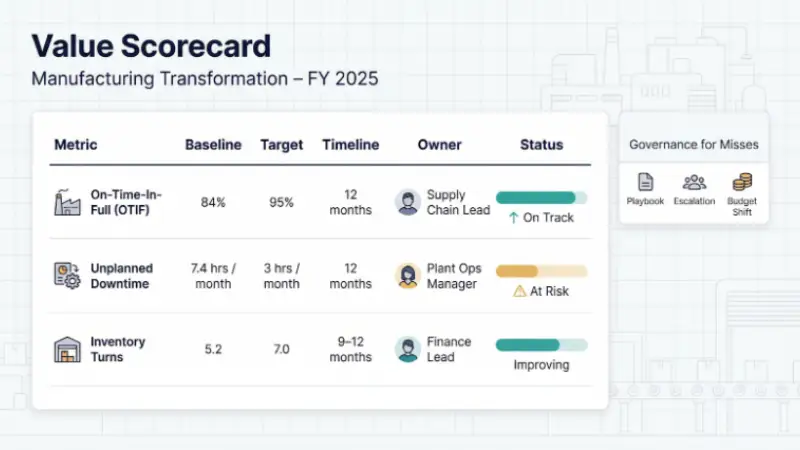
A strong partner makes measurement the first agenda item and co-writes a value scorecard that tracks:
- Baseline. For example, on-time-in-full (OTIF) at 84 percent or unplanned downtime at 7.4 hours per month.
- Target and clock. Raise OTIF to 95 percent in 12 months, or cut downtime to three hours.
- Governance for misses. Define who steps in, how funds shift, and which playbooks apply when results slip.
Quarterly reviews stay anchored on these numbers. If conversations drift to feature checklists instead of margin lift, cycle time, or forecast accuracy, the partnership has lost its focus, and your P&L will show it.
7. Cultural fit and a long-term mindset
Culture is not a side topic; it explains most setbacks. McKinsey reports that 70 percent of transformations fall short, and 70 percent of those gaps stem from culture issues such as misaligned incentives or weak communication. When you vet a partner, seek proof that the team will work well with your people today and five years from now.
Ask each firm to share an example where it:
- Challenged a client’s leadership and still earned follow-on work two years later.
- Flagged a tough trade-off (for example, trimming scope to protect go-live credibility) and recorded the risk-reward decision.
- Placed its experts on site until the client’s staff could run improvements alone.
Conclusion
If the stories focus only on technology, keep pressing. Real partners discuss trust, candor, and endurance as often as they mention features and timelines, because cultural fit sustains results.