
What Schema Markup Does for AI Search Visibility (Your Competitors Already Know)
Boost AI search visibility with schema markup by helping search engines understand, structure, and surface your content more effectively.

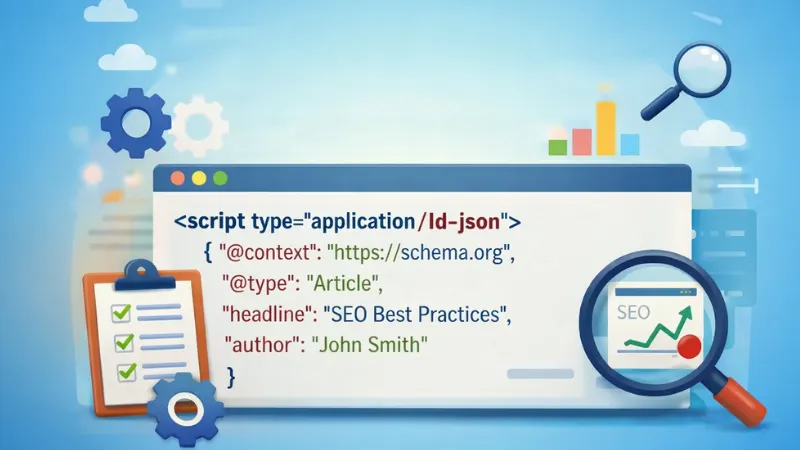
If you have spent the last year wondering why your meticulously crafted content is getting left on read while AI-generated snippets take the spotlight, you are not alone. The search landscape has fundamentally shifted. AI isn’t just skimming your site anymore; it’s conducting comprehensive evaluations in milliseconds to decide if you’re worth the citation.
The plot twist? Your competitors aren’t necessarily “better” writers; they’re just using Schema markup to whisper directly to the AI. While you’re out here writing novels, they’re basically giving the robots a “TL;DR” they can actually use.
The “AI Search” Problem Nobody Is Talking About Loudly Enough
Traditional SEO was all about fighting for page rankings in a list of blue links. That’s still part of the game, but the stage has been hijacked by a bigger player: AI systems that don’t just point people to a website; they summarize the info and deliver the answer directly. Think Google’s AI Overviews, Perplexity, ChatGPT search, and Microsoft Copilot.
These systems are voracious readers, but they are also discriminating ones. They increasingly factor in buyer intent signals and content authority when determining which sources to cite. They prefer content that is structurally unambiguous. When your webpage can be understood by a machine without inference or guesswork, it is far more likely to be cited, surfaced, or summarized by an AI engine. Clarity is now a ranking factor in disguise.
Generative Engine Optimization is the discipline that addresses this gap, and schema markup is one of its foundational pillars.
Schema Markup, Briefly Explained (But Not Simplified to Uselessness)
Think of Schema.org as the universal translator for the web. It’s a shared language built by the big players (Google, Microsoft, etc.) that lets you embed specific “definitions” into your code. While a human looks at your “About” page and sees a bio, an AI looks at the same page and sees a chaotic wall of text.
By wrapping your info in JSON-LD (JavaScript Object Notation for Linked Data, the industry-standard code format), you’re moving from “vibes” to “facts.”
- To a Human: “Jane Doe is the CTO at TechFlow with 10 years of experience.”
- To an AI (Without Schema): Just a string of words it has to guess the meaning of.
- To an AI (With Schema): Name: Jane Doe | Role: CTO | Entity: TechFlow.
It turns your content into a structured data set that aligns with comprehensive data strategies, removing the guesswork and making you the “obvious” choice for a citation. No guesswork required.
The practical payoff is measurable. According to Google’s own Search Central documentation, structured data helps Google “understand the content of your page” and can unlock rich result features that dramatically improve click-through rates. Industry analysis suggests that pages with structured data are typically more fragment-ready for AI extraction, often outperforming unmarked content in organic engagement. Same content, upgraded packaging.
Why Schema Markup Is Specifically Powerful for Complex Sales Environments
Consumer e-commerce mastered schema years ago; that’s why you see star ratings and prices before you even click. But for high-stakes, “big brain” industries like enterprise software, healthcare tech, and financial services, the potential is still mostly untapped.
In these spaces, nobody buys on a whim. Decisions take months, involve an entire buying committee, and require wading through a mountain of info. We’re talking dense white papers, complex solution pages, and deep-dive case studies. Right now, most of that high-value content is just sitting there in “stealth mode” because it lacks the structure AI needs to find it. All of it is sitting on websites with minimal structured data. A lot of signals, not enough structure.
Consider what happens when a procurement team runs an AI-assisted research query. The AI engine looks for authoritative, unambiguous sources. A page with well-implemented schema that explicitly identifies it as a Service, with an associated Organization, defined areaServed, and an offers attribute, communicates authority in machine-readable terms. The unmarked competitor page relies entirely on the AI’s ability to infer, and inference loses to explicit clarity every time. Machines are efficient, not imaginative.
| Schema Type | Use Case | AI Search Benefit |
| Organization | Company pages, about sections | Establishes entity clarity, brand authority |
| Service | Solution and product pages | Surfaces in AI answer summaries for service queries |
| FAQPage | FAQ sections, knowledge base content | Direct answer eligibility in AI Overviews |
| HowTo | Process documentation, implementation guides | Step-by-step AI summaries |
| Article / TechArticle | Blog posts, thought leadership | Increases citation probability in AI responses |
| Person | Executive bios, author profiles | Builds E-E-A-T signals for AI trust ranking |
| BreadcrumbList | Site navigation | Contextual clarity for content hierarchy |
| Review / AggregateRating | Case study highlights, testimonials | Social proof in rich results |
Real-World Schema Markup Case Studies
Salesforce: Entity-Level Schema at Enterprise Scale
Salesforce has invested heavily in structured data across its solution pages and help documentation. Their implementation of SoftwareApplication, TechArticle, and FAQPage schemas across thousands of product and support pages has contributed to consistent visibility in AI-generated answers for CRM-related queries.
When a user asks an AI engine to explain Salesforce’s territory management features, the probability of Salesforce’s own content appearing in that answer is substantially elevated by their schema investments. Not a coincidence. Consistency.
While Salesforce does not publish internal attribution data, Search Engine Journal’s coverage of enterprise SEO practices consistently cites their approach as a benchmark for technical content discoverability.
HubSpot: FAQ Schema Driving AI Overview Presence
HubSpot’s marketing blog and knowledge base are among the most aggressively schema-marked content libraries in the marketing technology space. Their consistent use of FAQPage and Article schema has positioned their content as a primary source for AI overviews in Google Search across hundreds of marketing and sales-related queries.
The implication for any content team running a similar playbook: implementing FAQPage schema on a page that already contains well-structured Q&A content is one of the lowest-effort, highest-return schema implementations available. Low effort, high upside.
Google’s documentation explicitly calls out FAQPage as eligible for rich results, and rich results are where AI-assisted search draws from first.
Gartner: Authority Through Schema-Backed E-E-A-T
Gartner isn’t leaving their “expert” status up to chance; they’re embedding it. Their strategy focuses on proving authority by using the “Person” schema to tag their researchers with specific job titles, affiliations, and “sameAs” links to their professional profiles.
This sends a massive “authority verification completed” signal to both Google and AI crawlers, proving their content comes from actual humans with real credentials. It’s a direct play for E-E-A-T (Experience, Expertise, Authoritativeness, and Trustworthiness); the primary rubric AI search systems use to decide if you’re a credible source or just yapping. Essentially, Gartner uses structured data to turn “trust” into a machine-readable fact.
While these are enterprise examples, the same principles apply at any scale – even mid-market companies like Drift and Mailchimp use similar structured data strategies.
Implementing Schema Markup: A Practical Framework
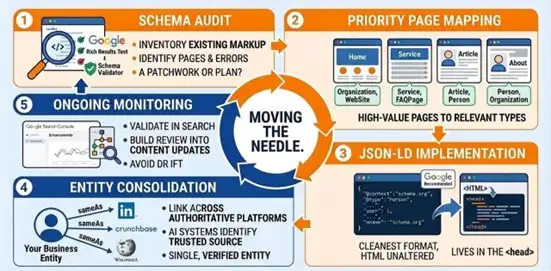
Getting schema markup right requires more than dropping a JSON-LD snippet on a page and calling it done. Here is a structured approach that actually moves the needle.
Step 1: Schema Audit
Before adding anything, inventory what you have. Use Google’s Rich Results Test and Schema Markup Validator to identify which pages already carry structured data, what types are implemented, and where errors exist. Most sites discover they have either nothing or inconsistently implemented fragments. It is usually more patchwork than plan.

Step 2: Priority Page Mapping
Not every page needs every schema type. Map your highest-value pages to the most relevant schema types:
- Home page: Organization, WebSite, SiteLinksSearchBox
- Solution/service pages: Service, Offer, FAQPage
- Blog and content: Article or TechArticle, BreadcrumbList, Person (for authors)
- About/team pages: Person, Organization
- Contact/location pages: LocalBusiness (if relevant), ContactPage
Step 3: JSON-LD Implementation
JSON-LD is the Google-recommended format and the cleanest to implement and maintain. It lives in the <head> section and does not require altering visible HTML. Clean, scalable, and less likely to break things later.
Step 4: Entity Consolidation
One of the more advanced moves is using the “sameAs” attribute to link your organization to its “official” profiles on LinkedIn, Crunchbase, or Wikipedia. Think of it as consolidating your digital footprint; it tells AI systems that all these different mentions across the web actually point back to the same trusted source. Instead of being a collection of random links, you become a single, verified entity in the eyes of the machine.
Step 5: Ongoing Validation and Monitoring
Schema is not a set-and-forget implementation. Google Search Console’s Enhancements section reports rich result eligibility and errors. Build schema review into your content update workflow, particularly for pages that change frequently. Otherwise, things drift.
The Connection Between Schema and Answer Engine Optimization
Schema markup does not operate in isolation. It intersects directly with a broader discipline worth understanding: Answer Engine Optimization, which focuses on structuring content so AI engines can extract and deliver it as direct responses to user queries.
The relationship is symbiotic. AEO tells you what questions your content needs to answer and how to structure that content in human language. Schema markup translates that structure into machine language.
Together, they create content that is optimized for both human readability and machine interpretability, which is the dual requirement of the current AI search environment.

An FAQ section that uses plain language to answer a common procurement question, wrapped in FAQPage schema, is more likely to be surfaced by an AI Overview, referenced by Perplexity, or cited in a Copilot response than the same content without schema. Same effort, very different reach.
Common Schema Mistakes That Undercut Visibility
Even well-intentioned schema implementations can backfire. The following errors appear frequently and carry real consequences:
Marking up content that does not actually appear on the page.
Schema must describe visible, on-page content. Not hypothetical content.
Using deprecated schema types.
Schema.org evolves. Types like Product without required properties or older review markup structures, may no longer qualify for rich results. Check the schema.org changelog and Google’s rich result documentation periodically.
Inconsistent entity references.
If your organization schema on the home page uses one legal name and your about page uses a trading name without sameAs consolidation, AI engines may treat them as different entities, diluting your authority signals.
Ignoring author markup.
In an era when AI engines are explicitly factoring in content creator expertise, failing to implement Person schema for content authors leaves proven expertise signals on the table.
Treating schema as a one-time project.
Content changes. New pages are published. Old schema references break. Without a maintenance process, schema quality degrades over time. Quietly, but consistently.
Measuring the Impact of Schema Markup
Attribution for schema markup improvements is notoriously difficult to isolate, but meaningful proxy metrics exist:
| Metric | Where to Track | What It Indicates |
| Rich result impressions | Google Search Console > Enhancements | Pages qualifying for rich snippets |
| AI Overview presence | Manual SERP monitoring, tools like Semrush | Content surfaced in AI-generated answers |
| Click-through rate changes | Google Search Console > Performance | Rich result engagement uplift |
| Entity knowledge panel appearance | Google SERP manual testing | Organization entity consolidation success |
| Structured data errors | Google Search Console > Enhancements | Schema health and validity |
A reasonable expectation for organizations implementing schema markup comprehensively is a measurable increase in rich result impressions within 60 to 90 days, with corresponding CTR improvements where rich results appear.
The compounding effect on AI search visibility is harder to quantify in short windows but becomes evident in traffic share analysis over six to twelve months. This is a slow-burn advantage, not a quick spike.
What the Next 12 Months Look Like If You Ignore This
AI search integration is accelerating, not stabilizing. Google’s AI Overviews are expanding in query coverage. Perplexity’s user base is growing quarter over quarter. Microsoft Copilot is embedded in enterprise productivity tools that millions of professionals use daily.
Each of these systems is getting better at identifying authoritative, machine-readable sources, and better at bypassing sources that are not.
The organizations investing in content strategies built for AI-driven discoverability today are positioning themselves to appear in answers that replace the top-of-funnel searches their prospects are conducting.
The organizations that are not investing are effectively becoming invisible to an increasingly AI-mediated research process. Not overnight, but steadily.
Schema markup is not a silver bullet. It is one component of a broader technical and content strategy. But it is the component most likely to be systematically underinvested in right now, which means the opportunity to differentiate is still genuinely available.
That window is not permanent.
Getting Started Without Boiling the Ocean
If you are new to schema markup or have an inconsistent existing implementation, the highest-return starting point is this: implement Organization, FAQPage, and Article schema on your most trafficked pages first.
These three types cover the majority of AI search eligibility scenarios and can be implemented without engineering resources if your CMS (Content Management System) supports custom <head> injection (most do). High impact, low friction.
From there, build a schema roadmap tied to your content calendar. Every new piece of content should ship with appropriate structured data.
Retrofitting schema onto thousands of existing pages is a project; building it into your publishing workflow is a process.
The difference between those two approaches, six months from now, will be visible in your search console data.
Conclusion
Schema markup represents a critical competitive advantage in the AI-driven search landscape. While your competitors may already be leveraging structured data to improve their visibility, the opportunity to differentiate remains significant for organizations willing to invest in comprehensive implementation.
Ready to transform your content’s AI search visibility? Valasys Media’s data-driven approach to technical SEO and content optimization can help you implement schema markup strategies that drive measurable results. By integrating these technical signals with targeted content syndication, we ensure your brand doesn’t just exist; it gets discovered.
Contact us to learn how structured data can accelerate your demand generation pipeline.
Frequently Asked Questions (FAQ)
1. Is Schema markup just for Google, or does it help ChatGPT and Perplexity too?
While Google co-founded Schema.org, it has become the “universal translator” for the entire AI ecosystem. Think of it this way: Google uses it to build Rich Snippets, but LLMs (Large Language Models) like ChatGPT and Perplexity use it to verify facts. When these AI engines “crawl” the web to find an answer, they look for structured data to ensure they aren’t hallucinating. If your site has clear JSON-LD, you’re providing the AI with a verified data set it can trust and cite.
2. Which Schema types should I prioritize for “AI Search” visibility?
If you’re looking for the biggest “bang for your buck,” start with these three:
- Organization: Tells the AI exactly who you are and links your social profiles (the “Entity” play).
- FAQPage: This is the “low-hanging fruit.” It makes your content “fragment-ready” for AI Overviews.
- Article/TechArticle: Essential for blogs and white papers to prove authorship and authority.
3. Can I use Schema if I’m not a “tech person”?
Absolutely. Most modern CMS platforms (like WordPress, HubSpot, or Webflow) have plugins or built-in fields that handle the heavy lifting. However, the most “pro” way to do it is using JSON-LD script tags. You can generate these using free online tools and simply paste them into the <head> section of your page. It’s clean, it doesn’t mess up your design, and the bots love it.
4. How long does it take to see results after adding Schema?
SEO is a marathon, not a sprint, but Schema is one of the faster “hacks.” Usually, you’ll see Rich Results (like stars or FAQ drops) appear in search results within 2 to 4 weeks. For AI-driven “Answer Engines,” the impact is more gradual; you’ll likely notice your content being cited as a primary source in AI summaries over a 3 to 6-month window as the models re-index your structured authority.