7 Revenue Leakage Points Most GTM Teams Never Audit
Download the guide to align your GTM teams and stop revenue leaks today.
 Lead-Gen now on Auto-Pilot with
Build My Campaign
Lead-Gen now on Auto-Pilot with
Build My Campaign

Discover where your SaaS revenue disappears after contract close. Audit 7 common leakage points that cost companies 3-7% of ARR annually.


7 Revenue Leakage Points Most GTM Teams Never Audit
Download the guide to align your GTM teams and stop revenue leaks today.
You already did the hard part. You found the lead, ran the demo, and got the signature.
But between that digital signature and your bank account, something went sideways. Maybe an AE promised a “ramp period” in a Slack DM that never made it to the contract. Maybe a renewal happened at last year’s pricing because someone forgot to check the CPI escalator.
These aren’t “strategic failures”, they’re just the messy reality of systems that don’t talk to each other. We call it revenue leakage, but for a RevOps lead, it just feels like death by a thousand papercuts.
According to MGI Research, systemic gaps in the contract-to-cash process lead to revenue leakage that typically costs companies between 3% and 7% of their total annual revenue. Here’s exactly where to look.
This list is for RevOps leads, GTM operators, and SaaS finance teams who are tired of chasing growth while quietly hemorrhaging from the bottom.
Revenue leakage is earned revenue that never gets collected. It sits in the gap between what your contracts promise and what your billing system actually invoices.
Unlike customer acquisition cost (CAC), fixing leakage often costs nothing. You already did the work. You just didn’t capture the value.
7 Revenue Leakage Points Most GTM Teams Never Audit
Download the guide to align your GTM teams and stop revenue leaks today.
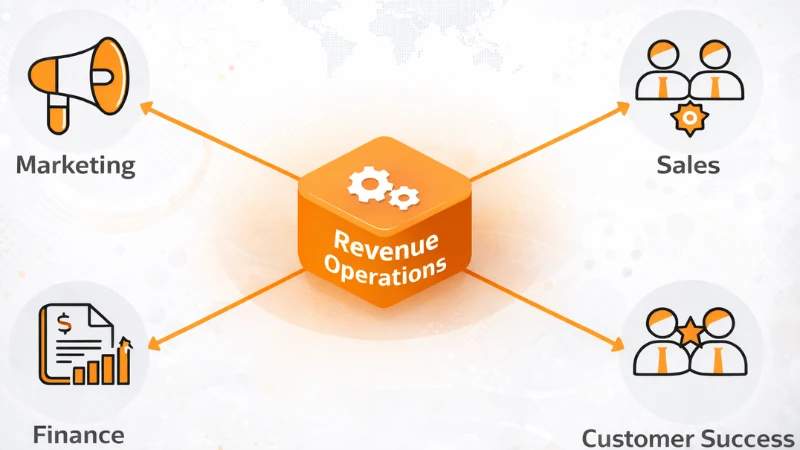
GTM teams are increasingly on the hook for this because leakage usually lives at the intersection of sales, CS, RevOps, and finance. Nobody owns the seams. So the money falls through them. If you’re still defining these roles, check out our What is RevOps? A B2B Marketer’s Complete Guide.
For a deeper dive into the fundamentals, read our resource on Defining Revenue Operations: The Essential Guide to Getting Started.
What’s leaking: A prospect fills out your “Request a Demo” form at 2pm on a Tuesday. Nobody touches it until Thursday morning. By then, they’ve already booked a call with your competitor.
High-intent leads are time-sensitive assets, and most teams treat them like support tickets. The average B2B response time to inbound demo requests is still measured in hours, not minutes. That gap is not a minor inconvenience. It’s a conversion killer.
The audit: Pull your CRM data and measure the exact time between form submission and first rep touchpoint. Break it down by lead source, time of day, and day of week. You’ll find patterns that are genuinely alarming.
The fix: Automated immediate routing, AI-assisted outreach for after-hours leads, and hard SLAs for inbound response. 24/7 coverage is not optional anymore.
What’s leaking: Your customer signed a contract for 10 API seats. They’re running 17. Nobody noticed. Or somebody noticed and assumed billing would catch it. Billing didn’t catch it.
Usage-based pricing models have exploded in SaaS over the last three years. The infrastructure to monetize that usage often lags by months. The result is customers getting meaningful value above their contracted limits while your invoices stay flat.
The audit: Pull system usage logs for the last 90 days and compare them against contracted entitlements by customer. Filter for accounts exceeding 100% of contract limits. This audit almost always surfaces five-figure annual losses in mid-market books.
The fix: Automate usage metering and connect it directly to your billing system. Manual reconciliation is where overages go to die.
What’s leaking: The contract renews. The customer keeps using the product. The new-term invoice never gets generated. Or it does, but without the annual uplift baked into the agreement.
This one is less dramatic than it sounds and more expensive than you’d expect. Renewal gaps compound quietly. A 5% uplift missed across 40 accounts adds up fast, especially when some of those accounts roll over for multiple terms before anyone catches it.
The audit: Map every contract end date against the date the renewal invoice was generated and the amount. Look for gaps longer than five days and invoices that match old-term pricing exactly.
The fix: Automated billing triggers tied to contract end dates. Price escalators should be built into the renewal logic, not manually entered each time.
What’s leaking: A deal closes with a custom discount and a non-standard product bundle. The AE puts it in the CRM one way. The billing team re-enters it into Stripe or QuickBooks. Something gets lost in translation. Maybe the discount is 20% instead of 15%. Maybe a line item gets dropped entirely.
Manual re-keying is the enemy of billing accuracy. Every hand that touches a contract is an opportunity for the number to change.
The audit: Pull a sample of 30 closed contracts and compare the original signed agreement against the CRM record and the final invoice. If you find a discrepancy rate above 5%, you have a systemic problem.
The fix: Quote-to-cash automation. The signed contract should flow into billing with no human in the middle. Salesforce CPQ, DealHub, Conga, and similar tools exist for exactly this reason. For more on selecting the right tools, see our guide on Building Your B2B Revenue Tech Stack in 2026.
If your current setup feels more like a collection of tools than a strategy, check out our Essential Guide to Getting Started with Revenue Operations to align your processes first.
What’s leaking: This one runs in two directions. Customers who cancelled still have product access because offboarding wasn’t automated. And new customers who just signed aren’t provisioned yet, so they bounce before they get value, then churn, and sometimes ask for refunds.
Both scenarios cost you. One is a direct revenue and security risk. The other is a churn risk disguised as an onboarding problem.
The audit: Cross-reference your CRM’s list of active contracts against your product’s actual provisioned users. The gaps in both directions are your leakage.
The fix: Provisioning automation tied to contract status. When a contract goes active, access goes live. When it lapses, access revokes. No manual steps.
What’s leaking: Credit card expires. ACH fails. Nobody gets an automated notification. The account goes dark. Finance assumes the customer churned. CS assumes finance handled it. The customer didn’t even know there was a problem.
Failed payments are the most recoverable form of revenue leakage, and most teams still handle them manually or not at all. Studies suggest that 20–40% of failed payments can be recovered with proper dunning sequences. Most companies recover less than half of that.
The audit: Calculate the total value of failed or unrecovered payments over the last 12 months. Then calculate how many of those accounts are still active customers who simply had a payment method issue. That second number is your recoverable amount.

The fix: Automated dunning sequences. Smart retry logic. In-app and email notifications that escalate before the account hits a suspension state.
What’s leaking: The AE offered a two-month free ramp to close the deal. It’s in the email thread but not in the contract amendment. Billing starts on month one. Or the free period gets extended informally. Or the concession gets documented wrong and the customer gets six months free instead of two.
Sales concessions are a legitimate tool. Undocumented sales concessions are a billing nightmare. And in most GTM orgs, the documentation standards for what actually went into a deal are looser than anyone wants to admit.
The audit: Review the last quarter of closed contracts and cross-reference them against email threads, Slack messages, and contract amendments. Look for concessions that don’t appear in the billing system.
The fix: Standardized quoting templates with approval workflows for any deviation. If it’s not in the system, it doesn’t exist as far as billing is concerned. That policy has to be enforced, not suggested. This is a classic example of why Sales and Marketing Alignment: The RevOps Approach is vital for fiscal health.
| Leakage Point | Where It Lives | Detection Difficulty | Revenue Impact |
| Signal-to-Action Latency | Sales/Inbound | Low | Medium |
| Unbilled Overages | Billing/Product | Medium | High |
| Silent Renewal Gap | Finance/RevOps | Medium | High |
| Manual SKU Mis-mapping | CRM/Billing | High | Medium |
| Ghost Active Users | CS/Provisioning | Low | Medium |
| Failed Payments | Finance/Billing | Low | High |
| Non-Normalized Free Time | Sales/Finance | High | Medium |
Ready to stop the leakage? For a holistic view of managing your engine, read The Complete Guide to B2B Revenue Operations in 2026.
Best place to start: Failed payments and unbilled overages. Both are quantifiable in a day, fixable with existing tooling, and often recover five-to-six figures in the first 90 days.
Biggest structural fix: Quote-to-cash automation. Most of these leakage points share a root cause, which is data living in multiple systems that don’t talk to each other. Closing that gap eliminates multiple audit failures at once by following CRM integration best practices.
Most underrated audit: Ghost active users. It surfaces both a security problem and a provisioning failure that directly impacts time-to-value for new customers.
What most teams get wrong: They treat revenue leakage as a finance problem. It’s not. It lives in the handoffs between sales, RevOps, CS, and billing. Fixing it requires ownership across all four.
Not sure how to establish that ownership? Start here: Defining Revenue Operations: The Essential Guide to Getting Started.
1: What is revenue leakage in SaaS?
Revenue leakage in SaaS is earned revenue that is never collected due to billing errors, unbilled usage, missed renewals, failed payments, or process gaps between sales, finance, and customer success. Most SaaS companies lose 3–7% of ARR annually to leakage without realizing it.
2: How do you detect revenue leakage in a GTM team?
Start by auditing three areas: compare contract terms against actual invoices, reconcile CRM active accounts against provisioned users, and pull failed payment data for the past 12 months. Gaps in any of these three areas are your leakage.
3: What is the most common cause of revenue leakage in B2B SaaS?
Manual data entry between CRM and billing systems is one of the most common causes. When contract terms are re-keyed by hand into billing tools like Stripe or QuickBooks, discrepancies in pricing, discounts, and SKUs introduce consistent errors at scale.
4: How does signal-to-action latency cause revenue leakage?
When high-intent inbound leads sit uncontacted for hours or days, they cool off and convert with competitors instead. This is not a pipeline volume problem, it’s a speed-to-lead problem that reduces conversion rates on already-acquired demand, effectively wasting acquisition spend.
5: What is dunning in SaaS billing and why does it matter?
Dunning is the process of automatically notifying customers about failed payments and retrying charges on a schedule. Without it, failed payments result in silent churn. With it, 20–40% of failed transactions can typically be recovered, making it one of the highest-ROI fixes in RevOps.
6: How do unbilled usage overages cause SaaS revenue leakage?
When customers exceed contracted usage limits (seats, API calls, data) and those overages are not metered and invoiced automatically, the company delivers value above what it charges for. At scale across a mid-market or enterprise book, this represents meaningful ARR left on the table.
7: What tools help fix revenue leakage in SaaS?
Common tools include Salesforce CPQ, DealHub, and Conga for quote-to-cash automation; Chargebee, Maxio, and Stripe Billing for automated dunning and usage metering; and platforms like Nue.io for unified quoting, usage, and billing in complex go-to-market models.
8: What is a GTM revenue leakage audit and how long does it take?
A GTM revenue leakage audit is a structured review of the gaps between contracted revenue and collected revenue across your sales, billing, and customer success systems. A targeted audit focused on the seven key leakage points typically takes two to three weeks for a mid-market SaaS company.
9: How does manual SKU mis-mapping cause revenue leakage?
When sales reps close deals with custom pricing or bundles and those terms are manually entered into billing by a separate team, data entry errors routinely change discount amounts, drop line items, or apply wrong pricing tiers. Over a full year of bookings, the cumulative billing discrepancy can be significant.
10: What percentage of SaaS revenue is typically lost to leakage?
Industry research from EY, Clari, and MGI Research estimates that B2B SaaS companies lose between 3% and 10% of ARR annually to revenue leakage. For a company at $10M ARR, that represents $300K to $1M in already-earned revenue that was never collected.
7 Revenue Leakage Points Most GTM Teams Never Audit
Download the guide to align your GTM teams and stop revenue leaks today.