


How AI-Powered Ecommerce Automation is Transforming Online Stores in 2026
Explore AI-powered ecommerce automation is transforming online stores in 2026 by improving efficiency, personalization, sales performance.

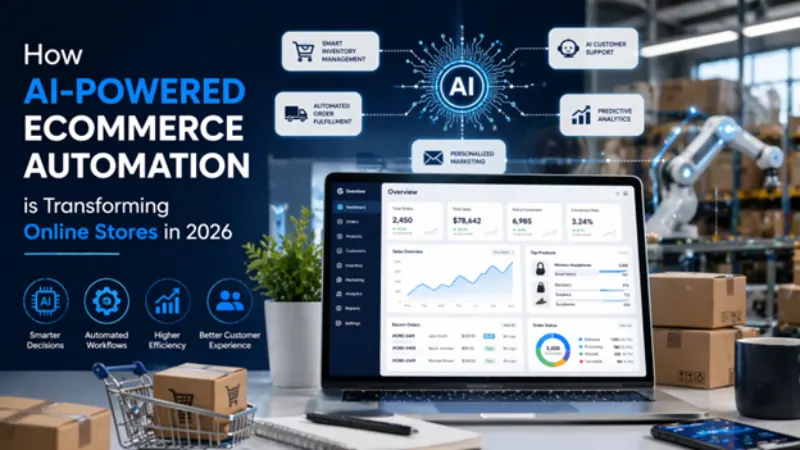
Most ecommerce founders I talk to are exhausted. Not because business is bad. Because the operational load has quietly become unmanageable. Orders coming from six channels. Inventory split across three warehouses. Customers expect replies in minutes, not hours. And a team that is already stretched thin.
This is not a people problem. It is a systems problem. And in 2026, the businesses figuring that out fastest are the ones leaning hard into AI-powered ecommerce automation tools that actually think, predict, and act on their own.
According to McKinsey, businesses using Ecommerce Development Services to fully automate at least one function report cost reductions of up to 30% in that area. For ecommerce, where margins are already tight and operational complexity is only growing, that number is not a bonus. It is often the difference between scaling profitably and grinding to a halt.
What Is Ecommerce Automation? (Definition, How It Works, and Real Examples)
Ecommerce automation means using software and AI to execute business tasks without human input. Order confirmations, inventory alerts, customer follow-ups, return processing. That is the surface-level definition.
But what most people mean when they say ecommerce automation in 2026 is something much more layered.
Traditional automation is built on rules you write yourself. Stock drops below 100 units? Trigger an alert. Customer abandons cart? Send one email after two hours. These systems do exactly what you tell them and nothing more. They cannot adapt. They cannot learn. And they absolutely cannot handle anything outside the scenario you planned for.
AI-powered ecommerce automation software is fundamentally different because it is not following your rules. It is building its own.
It looks at months of sales data and figures out that your blankets start selling faster every year around the third week of October, not November as you always assumed. It notes that customers who buy from your gift sets category have a 60% chance of churning if they do not receive a follow-up within 10 days. It finds these patterns without you asking.
That is the shift. From you telling the system what to do, to the system telling you what is about to happen.
| What You Are Comparing | Old-School Automation | AI-Driven Ecommerce Automation |
| How it makes decisions | Fixed rules you program | Learns from patterns in your data |
| Handling unexpected situations | Breaks or does nothing | Adapts based on live context |
| Personalization depth | Same message per segment | Unique experience per individual |
| Gets better over time | No, static unless you update it | Yes, continuously self-improving |
Why Ecommerce Businesses Are Rapidly Adopting AI Automation in 2026
Three forces are pushing online store operators toward automation faster than ever before.
Customer expectations have become almost unreasonable, and the problem is customers do not know they are being unreasonable. They just know that the last store they ordered from gave them real-time tracking updates, answered their support question in under two minutes, and recommended something actually relevant. Now every other store gets measured against that experience.
The second pressure is omnichannel complexity. Selling on your own website used to be enough. Now the same business might be running on Shopify, Amazon, a physical location, Instagram Shopping, and a B2B wholesale portal simultaneously. Keeping inventory, pricing, and product data synchronized across all of those manually is a full-time job that still produces errors. AI in ecommerce solves this by maintaining real-time sync across every channel automatically.
The third is cost structure. You cannot hire your way out of operational complexity anymore. The margin math does not work. Ecommerce automation software lets you grow order volume without growing headcount at the same rate. A store processing 500 orders per day and one processing 50,000 can run on comparable automation infrastructure. That kind of leverage defines which businesses survive competitive pressure.
5 Core Areas Where AI-Powered Ecommerce Automation Is Making a Real Difference
-
Inventory and Demand Forecasting: The Smartest Way to Automate Ecommerce Stock Management
Here is what happens without good forecasting. You run out of your bestseller during peak season. You miss sales, frustrate customers, and watch your ranking on every marketplace drop because velocity data took a hit. By the time you restock, the moment is gone.
AI-powered inventory tools attack that problem from multiple directions at once. They are not just looking at last month’s sales. They pull in seasonality curves, regional demand patterns, competitor pricing signals, supplier lead times, and sometimes external data like weather or events relevant to your category.
Real-world example: A mid-sized outdoor gear brand using AI ecommerce automation tools automatically increased purchase orders for waterproof jackets three weeks before a wet season hit their highest-concentration customer region. That call came from the AI spotting the same demand pattern repeating for the third consecutive year. No spreadsheet. No weekly planning meeting. Just accurate stock levels, maintained automatically.
This is ecommerce process automation solving a problem that was genuinely hard to solve before, because getting inventory right cascades into every other area of the business.
-
Order and Fulfillment Automation: Speed and Accuracy at Every Step
Customers do not care how you fulfill an order. They only care that it arrives when you promised. Everything between “order placed” and “delivered” should be invisible to them, and that requires a level of consistency that is very difficult to achieve manually at volume.
Automated ecommerce fulfillment handles routing decisions in milliseconds. Which warehouse is closest? Which carrier is currently performing best on this route? Is there a weather delay that makes an alternate option smarter today? Should this order be flagged for fraud review before it ships?
| Fulfillment Step | Manual Approach | Ecommerce Fulfillment Automation |
| Warehouse routing | Staff picks based on basic rules | AI assigns based on live stock and proximity |
| Carrier selection | Manual rate lookup | Instant rate shopping matched to delivery SLA |
| Fraud screening | Reviewed after payment | Real-time scoring before payment captures |
| Returns processing | Customer emails, staff logs | Automated label generation and reverse logistics |
One area that is often underappreciated: AI fraud detection in automated ecommerce fulfillment. Systems flag anomalous order patterns in milliseconds. A human reviewer would not catch the same thing until after a chargeback lands.
-
Ecommerce Marketing Automation: Personalization That Actually Earns the Word
The word personalization is completely overused. Most ecommerce businesses think they are doing it because they drop a first name into an email subject line. Real ecommerce marketing automation looks nothing like that.
AI segments customers not just by demographics but by behavioral signals. What they browsed without buying. How long they spent on certain product pages. What time of day they typically shop. Which subject lines made them open, which ones they ignored.
From all of that, the system builds a real-time model of what each customer is most likely to want next, and when they are most likely to act on it.
Practical example: A customer who has browsed your premium range three times but always buys mid-tier gets a different message than someone who consistently goes straight to new arrivals. A high-value customer who has gone quiet for 45 days gets a re-engagement sequence timed to the average repurchase cycle of customers with their exact purchase history, not a generic “we miss you” email.
Ecommerce email automation is the most visible piece of this, but the same behavioral logic extends to SMS, push notifications, retargeting ads, and on-site product recommendations. All coordinated through one AI model, not five disconnected tools.
The result: Stores that implement proper marketing automation for ecommerce consistently report higher email open rates, lower unsubscribe rates, and repeat purchase rates that would be impossible to achieve through manual segmentation.
-
Customer Support Automation: Handling Volume Without Losing the Human Touch
The unit economics of customer support collapse at scale. More customers means more tickets. More tickets means more agents. More agents means more cost. At some point the math stops working.
AI-powered support automation breaks that equation. The reality is that the majority of ecommerce support tickets are variations of five questions. Where is my order? What is your return policy? Can I change my address? How do I get a refund? Is this item in stock?
None of those require a human agent. They require fast, accurate, consistent answers available at any hour without a queue.
Where this gets more nuanced is the handoff. Good support automation does not just deflect tickets. It recognizes when a situation is emotionally charged, genuinely complex, or beyond its confidence threshold, and routes it to a human agent with full conversation context already loaded. The agent steps in with everything they need, not from scratch.
A mid-size Shopify store that implemented AI support automation reduced first-response time from an average of four hours to under three minutes, while their support team shifted almost entirely to handling escalations and high-value account relationships instead of repetitive inquiries.
-
Product Tagging and Catalog Management: The Unglamorous Work That Quietly Drives Revenue
Nobody talks about product tagging at conferences. But bad tagging silently kills conversion rates and search visibility for thousands of ecommerce businesses every day.
A mis-tagged product shows up in the wrong category. It does not surface in site search when a customer uses a slightly different language. It does not get picked up by Google Shopping for queries it should rank for. The customer who would have bought it never finds it.
The best AI to automate product tagging in ecommerce uses image recognition combined with natural language processing to analyze product photos and descriptions, then assigns accurate tags, attributes, and category mappings automatically. New products get indexed within seconds of upload. Existing catalog inconsistencies get corrected in bulk runs.
For a store with 8,000 SKUs, doing this manually would take weeks of focused work. An AI-powered ecommerce automation tool handles the same catalog overnight and keeps it clean going forward.
Key Benefits of AI-Powered Ecommerce Automation for Online Stores
Operational efficiency: is usually the first gain that shows up in reporting. Tasks that used to take staff hours complete in seconds. Order routing, inventory updates, campaign triggers, and support responses happen without any manual input.
Error rates drop measurably: Human error under repetitive cognitive load is not a character flaw. It is just biology. Automation does not get tiring. Inventory counts stay accurate. Prices sync correctly across channels. Customer records do not get corrupted by manual entry mistakes.
Customer experience scales with your growth: Personalization does not degrade as your customer base expands. An AI system serves 1,000 customers and 1,000,000 customers with equal specificity, which is something no human team can replicate.
Your team does more interesting work: When people are freed from processing returns and updating spreadsheets, they focus on pricing strategy, supplier relationships, and product development. The quality of thinking going into the business improves visibly.
Cost structure improves at scale: Businesses using ecommerce automation software report being able to handle significant volume growth, often 3x to 5x peak surges, without proportional increases in operational headcount or cost. That leverage is what separates profitable scaling from growth that burns cash.
Ecommerce Automation Tools and Software Categories Worth Knowing in 2026
Understanding the category of tool matters more than knowing specific product names, because the software landscape in this space is evolving quickly. Here is what a mature ecommerce automation stack looks like.
AI marketing automation platforms: handle behavioral segmentation, multichannel campaign orchestration, predictive send-time optimization, and revenue attribution. Look for platforms with native integrations to your storefront and CRM, not ones that require significant custom development to connect.
Inventory and demand forecasting tools: connect to your warehouse management system, purchasing workflows, and all active sales channels. The best ecommerce automation software in this category generates purchase order recommendations automatically based on real-time data, not periodic manual reviews.
AI-powered customer support platforms: combine chatbot capability with deep CRM integration so every conversation has full customer context. Tier-one volume is handled automatically while human escalations are smooth and information-rich.
Integration middleware: is often the most critical piece that businesses overlook until they are already in trouble. This is the layer that keeps your storefront, inventory system, CRM, fulfillment platform, and marketing tools communicating in real time. Without it, automating across departments is nearly impossible regardless of how good each individual tool is.
AI analytics and business intelligence tools: process sales, traffic, and behavioral data to surface actionable recommendations rather than raw dashboards that require interpretation. Decision-makers get answers, not more data to decipher.
Challenges and Limitations of AI in Ecommerce Automation
Implementation reality does not match the sales pitch for most businesses that approach this without preparation.
Data quality is the silent killer: AI systems are only as reliable as the historical data they learn from. Messy order histories, duplicate customer records, and inconsistent product data produce unreliable outputs. Cleaning your data before implementation is not prep work. It is the actual first step of the project.
Integration complexity is frequently underestimated: Legacy platforms, heavily customized storefronts, and fragmented tech stacks make connecting automation tools technically difficult. Middleware helps, but it adds scope and cost that need to be planned for.
Initial setup requires real investment: Mapping workflows, configuring integrations, training AI models on your specific data, and QA testing all take time and expertise. Businesses that treat implementation as a one-week task almost always end up with tools that underperform and teams that lose confidence in automation entirely.
Someone needs to own the system after launch: Automation drifts when it has no owner. Models need updating as your catalog and customer base evolve. Rules need adjustment when business conditions change. Without a named owner responsible for monitoring and maintaining the system, it quietly stops performing.
How to Automate Your Ecommerce Business Operations: A Step-by-Step Implementation Guide
Step 1: Audit your current manual workflows. Map every repetitive task your team performs weekly and estimate hours spent. That list, ranked by volume and error rate, becomes your automation priority roadmap.
Step 2: Prioritize by impact and risk. Start with high-volume, low-risk processes. Ecommerce email automation and inventory alerts are strong entry points. Dynamic pricing and order routing require more system maturity and should come later.
Step 3: Choose ecommerce automation tools that connect to your existing stack. Replacing your entire tech infrastructure to accommodate a new platform is almost never worth it. Integration-first selection is the right criteria.
Step 4: Run a controlled single-workflow deployment. Measure time saved, error reduction, and revenue impact before expanding. Documented results build internal confidence and justify further investment.
Step 5: Build structured feedback loops. Review automation outputs weekly in the early months. Catch edge cases. Feed corrections back into the system. This is how AI gets better at your specific business rather than staying calibrated for a generic use case.
Step 6: Connect adjacent workflows once each is stable. Inventory automation becomes significantly more powerful when it feeds into your marketing system. Fulfillment data improves support quality when it is accessible in the chatbot context. The real leverage comes from connected workflows, not isolated tools.
Future Trends in Ecommerce Automation: What Is Coming Next
Predictive commerce: is moving from recommending products to anticipating purchase intent before the customer even visits your store. AI will pre-stage inventory and prepare personalized offers based on predicted demand signals, not just observed behavior.
Hyper-personalization: is reaching the individual product level. Pricing, product descriptions, bundles, and promotions are increasingly being generated dynamically per customer in real time, not per segment.
Autonomous supply chains: are reducing human touchpoints from manufacturer to doorstep. AI systems are already negotiating with suppliers, rerouting shipments around disruptions, and optimizing last-mile delivery in ways that required significant operational teams just a few years ago.
AI decision systems are moving into strategy: Which markets to expand into. Which product categories to develop. Which customer segments are underserved. The pattern recognition that makes AI valuable in operations is the same infrastructure needed to answer those strategic questions, and businesses that have built their automation foundation now are also building the intelligence layer they will need for strategic decisions in the next two to three years.
Ready to Automate Your Ecommerce Operations? Here Is Where to Start
If you are planning to implement ecommerce automation, the worst mistake you can make is trying to automate everything at once. Pick one high-volume, high-pain workflow. Run it until it is stable and measurably better than the manual version. Then expand from there.
The businesses seeing the best results from AI in ecommerce are not the ones that spent the most on tools. They are the ones that started focused, measured honestly, and scaled what worked.
Whether you are exploring ecommerce automation software for the first time or looking to move from basic rule-based tools to a fully AI-driven stack, getting the foundation right is what determines whether automation becomes a genuine competitive advantage or just an expensive line item.
If you want help mapping out which processes in your specific operation are the best candidates for automation, or need guidance on which ecommerce automation tools fit your current tech stack, choosing to hire eCommerce Developer expertise before committing to a platform can save months of wasted implementation effort.
FAQs About AI-Powered Ecommerce Automation
What is ecommerce automation and how does it work for online stores?
Ecommerce automation uses software and AI to handle repetitive business tasks without manual input. Your storefront, inventory system, marketing platform, and fulfillment tools connect so that actions like restocking, sending triggered emails, routing orders, and answering support queries happen automatically based on real-time data and AI-driven decisions.
How is AI-powered ecommerce automation different from traditional rule-based automation?
Traditional ecommerce automation follows fixed rules you define in advance and cannot deviate from them. AI-powered automation learns from patterns in your business data and adjusts behavior over time. Traditional systems react to what already happened. AI systems anticipate what is about to happen and act before it does.
What are the key benefits of ecommerce automation software for online stores?
Faster order processing, significantly lower error rates, reduced operational costs, and customer experiences that feel personalized even at high volume. The less visible benefit is that your team shifts from repetitive execution work to decisions that actually require human judgment, which improves both output quality and job satisfaction.
Which ecommerce business operations can be automated using AI tools?
Inventory forecasting, order routing and fulfillment, marketing personalization across email and other channels, customer support, product catalog management, fraud detection, pricing optimization, and returns processing are all actively being automated by ecommerce businesses at various scales today.
What should small ecommerce businesses know before implementing automation?
Start with one contained, high-volume workflow rather than automating everything at once. Abandoned cart email sequences or low-stock alerts are good starting points. Make sure your data is clean before you connect any AI tool. And assign someone internally to own the system after launch. Automation with no owner drifts and eventually stops performing.

