What Should You Check Before Installing an AI-Powered Monitoring System?
Learn what to evaluate before installing an AI monitoring system, including privacy, security, accuracy, integration, scalability, and costs.

A lot of time is devoted to talking about neural networks, computer vision and predictive algorithms. When you do get on the floor of a facility and deploy an AI-based monitoring system, however, the discussion moves rather rapidly from software features to the “how” and “what.” The most advanced software is available to purchase. Either you have a very expensive paperweight or it can’t reliably communicate with the hardware or your network continues to lose packets.
Typically, these projects stall when they fall short of what IT promises and what they can deliver in terms of operations. To sign a contract for a smart monitoring solution, you must audit your physical and digital spaces first.
Evaluate Your Existing Infrastructure First
The biggest bottleneck for new monitoring tech is usually the oldest part of your building. Facilities often underestimate what it takes to get high-definition video or high-frequency sensor data from a remote corner of a plant back to a central server. You are going to need new cables. Upgrading to Power over Ethernet cameras or adding environmental sensors means running new lines across vast spaces.
This is where planning gets highly practical. You can’t just stuff endless cables into existing pipes and hope for the best. At some point, you have to run a conduit fill calculator to figure out if your current physical pathways can legally and safely handle the new wiring. If they can’t, your installation costs are about to jump. You will be tearing up walls, digging trenches, or laying new pipe. Always map your physical cable routes and verify your power budgets before ordering a single piece of hardware.
Hardware Compatibility and Edge Processing
Many of the older cameras and industrial sensors weren’t designed with modern machine learning. They generate compressed videos with low frame rates or slow telemetry that is difficult for AI models to accurately interpret.
In some cases, if you need real-time notifications about safety violations or quality control issues, you may not want to upload everything to the cloud. This means the edge computing hardware has to be deployed directly on the factory floor, warehouse rack or local server room.
Finding off-the-shelf enclosures that fit your specific mix of edge servers, power supplies, cooling units, and network switches is rare. You will likely need to engage box build assembly services to design and manufacture custom enclosures that can survive your operating environment. Dust, heavy vibration, and extreme heat will destroy consumer-grade servers in weeks. Industrial environments demand industrial-grade physical protection from day one.
Network Bandwidth and Local Bottlenecks
AI models are incredibly hungry for data. A standard monitoring setup can generate terabytes of video and sensor logs every week. Moving that data from a camera to a processing unit takes serious network capacity.
Many organizations assume their existing local area network can handle a few dozen new cameras. They realize they are wrong the moment the system goes live and completely chokes their core business applications. Video streams are heavy. If you run fifty high-definition cameras on the same network switch used by your inventory management system, things will break.
You need to segment your network. Put your monitoring hardware on its own dedicated VLAN. Check your switch backplanes to ensure they can handle continuous, heavy traffic without dropping packets. Dropped packets mean missing frames, and missing frames cause AI models to miss critical events entirely.
Data Quality and Storage Realities
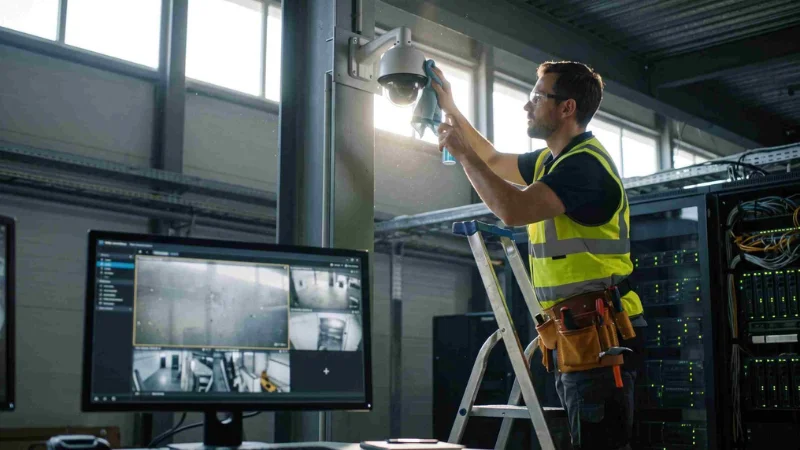
Cloud storage sounds incredibly easy until you see the monthly ingress fees for continuous video streams. If you aren’t processing at the edge, you are paying to move and store massive amounts of data offsite.
Local storage requires large network-attached storage arrays and a clear retention policy. You have to decide exactly what you are keeping and for how long. Do you need to keep 30 days of standard footage, or just the clips where the AI detected an anomaly?
Then there is the quality of the data itself. If your cameras are blinded by glare at 3:00 PM every day, the AI will throw false positives. If a sensor gets coated in manufacturing dust, the readings drift. The system is only as smart as the raw input it receives. You need strict maintenance protocols to keep lenses clean, sensors calibrated, and physical obstructions out of the way. If you don’t maintain the physical inputs, the software outputs become useless.
Operator Overload and Threshold Tuning
A new AI system always wants to prove its worth. Out of the box, that usually means it alerts you about absolutely everything. A forklift drove slightly outside a marked lane. A worker lingered too long near a restricted zone. A shadow moved weirdly across the floor.
If your operators get an alert every three minutes, they will do what anyone would do. They will mute the system. Alarm fatigue is the fastest way to kill the ROI of a monitoring investment.
Before going live, you need a defined tuning period. Run the software in a shadow mode where it logs events without triggering sirens or pagers. Review those logs weekly to adjust sensitivity thresholds. The goal is to alert human operators only when their direct intervention is actually required.
You also need to update your standard operating procedures. When the AI detects a genuine hazard, what is the exact workflow? Who gets the notification first? What are they required to do? Without a clear operational response plan, the alert is wasted.
Vendor Reality Checks and Long-Term Support
Smart monitoring is a competitive and dynamic market. Businesses spring up, raise capital from the venture capitalists and sometimes vanish two years later. It is important to understand the actions that your system will take if the vendor no longer supports the system or changes its business model.
Check if the hardware will work without the software license if it expires. Inquire whether you are bound to proprietary camera models or if software does support standard models that comply to ONVIF. Always advocate hardware independent software. Say you install 100 proprietary cameras, and the vendor raises her license fee by 3 times next year — you’re in no position of power. For standard, open-protocol cameras, software back-ends can be replaced without affecting hardware.
Pay attention on their API documentation. This monitoring system will want to communicate with your current tools at some point. The vendor will lock down their API and/or charge high fees for simple integrations and you’ll be left with the old traditional silo where you have to manually enter data to gain insights. Purchase a system that will work well with the tools you have.