


5 Best AI Story Writers for Mystery: Which Tools Can Keep the Killer Hidden?
Compare DreamGen, NovelAI, Sudowrite, ChatGPT, and Claude for writing whodunits—find the tool that maintains clue continuity without revealing the culprit.

Writing a fair-play whodunit is tough: every clue must sparkle in plain sight while the solution stays buried until the final page. Plotting timelines, tracking alibis, and rewriting scenes can devour hours.
Today’s top AI writing platforms shoulder that grunt work. They remember every dropped cuff-link, spin fresh red herrings on command, and never gripe about a sixth rewrite at 2 a.m. Yet not every model suits suspense—you need one that guards secrets, handles long manuscripts, and obeys pacing cues.
We stress-tested five leading tools on exactly that brief. Here’s what we found.
How we tested and scored the contenders
We treated this roundup like a detective rebuilding a crime scene: establish the facts, weigh the evidence, then let the numbers speak.

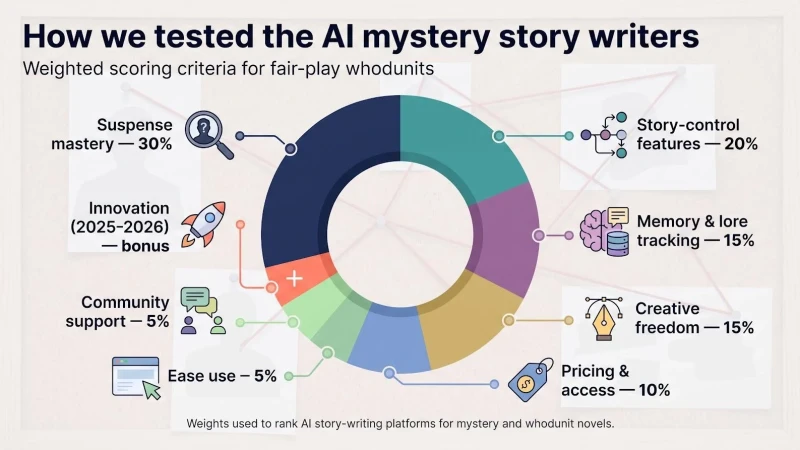
First, we built a scoring matrix around eight mystery-specific needs. Suspense mastery carried the most weight, at 30 percent of the total, because any tool that reveals the killer early is useless. Next came story-control features (20 percent). Builders such as Sudowrite’s Story Engine (designed to expand an outline into full chapters) earned bonus points here (Techdator’s overview of the best AI story generators).

Techdator best AI story generators guide screenshot
Memory was critical, too. A classic whodunit can stretch to 80 000 words, so we graded each platform on raw context window and any lore-tracking aids (15 percent). Creative freedom accounted for another 15 percent; if an AI refuses to describe a blood-spattered conservatory, it cannot handle mystery work.
The remaining 20 percent addressed practical matters: pricing and access (10 percent), ease of use (5 percent), community support (5 percent), plus an innovation bump for tools that shipped fresh features in 2025–2026.
Each candidate then faced the same scripted test suite: generate a locked-room setup, hide the culprit for three chapters, maintain alibi consistency, and seed two subtle clues without telegraphing them. We tracked refusals, memory slips, and style drift, then cross-checked the results against real user feedback in writer forums.
Finally, we normalized the scores and ranked the top five you will meet next. Treat the list as our solved case file and pick the tool that matches your writing style.
1. DreamGen, the scenario-building powerhouse
DreamGen feels less like software and more like a private writers’ room filled with improv actors who never forget their lines.
Fire it up and you’re greeted by two modes: a classic story editor for long-form drafting and a live role-play chat where you can interrogate suspects in real time. Switching between them is quick, so you can outline a chapter, jump into character dialogue, then slide back to narration without losing momentum.

DreamGen AI story writer interface with dual modes screenshot
The real magic lives in Scenario Codex. Picture a wiki built directly into the AI. Log every clue, red herring, and locked-door diagram once, then let the model reference those details automatically. Want the revolver to stay hidden behind the grandfather clock until chapter twelve? Add a private note and the AI keeps the secret. Because DreamGen’s Pro tier offers a 30 000-token memory (using GLM 4.7), even large cast lists stay intact through an entire novel.
Creative freedom is also strong. DreamGen supports both SFW and NSFW content in private projects (the public scenario library is SFW only), so grisly autopsies and morally gray motives sail through untouched. That’s rare among cloud AIs and helpful for crime writers who explore darker themes.
- Multi-character scenes where the AI juggles five sniping suspects without collapsing voices.
- An image generator that can produce a crime-scene photo or suspect sketch when you need visual inspiration.
- A generous free tier: roughly 2 000 RP messages a month on Lucid Base, plus about 250 per day after monthly credits and about 150 images per month, so you can test it on a full novella before paying a cent.
That impression isn’t just marketer’s bluster. In a head-to-head breakdown of ten popular tools, DreamGen’s AI story generators guide ranks the platform first for “story steering” control and highlights its unusually generous free tier—two perks you’ll notice the moment you open the app.
There are trade-offs. The Codex takes about an hour to learn, and the Pro subscription offers unlimited first-party models, a 60 percent third-party discount, and a 20 percent credit-pack discount. Yet for authors who crave iron-clad continuity and the excitement of interactive clue planting, DreamGen stands out as the best all-around option for 2026. It turns complex mysteries into living, breathing sandboxes without ever revealing the killer’s name.
2. NovelAI, the continuity king
If DreamGen is a bustling writers’ room, NovelAI is a silent, detail-obsessed archivist who never sleeps. Slide your notes across the desk and it files every motive, clue, and red herring into its Lorebook, then recalls them on cue with near-photographic accuracy.

NovelAI fiction-focused story writing interface screenshot
That reliability is NovelAI’s super power. Even the baseline Kayra model keeps an 8 192-token memory, enough to reference several prior chapters without extra direction. Feed it the opening scene’s cigarette butt and, twenty chapters later, it still knows the brand and where it was found. For marathon mystery drafts, that alone can justify the subscription.
Freedom matters, too. NovelAI runs proprietary fiction-tuned models, not a repackaged general chatbot, so it never halts over a gritty crime scene. Want to linger on forensics or explore a morally gray detective? No sudden refusals, no sanitizing edits, just the story you envisioned.
Working with Lorebook feels like programming a cooperative actor. Tag a keyword—”silver locket,” “false alibi”—and attach private notes the reader mustn’t see. The AI weaves them in as subtext without spilling secrets. Pair that with a simple Author’s Note that whispers “the butler is guilty, don’t reveal yet,” and the narrative stays watertight from prologue to payoff.

NovelAI does ask more of you in return. It offers no built-in outline wizard or twist generator; you steer the plot beats. In exchange you get prose that leans literary, plus style-mimic settings that let you nudge the voice toward Christie-esque restraint or hard-boiled grit.
Pricing sits in the middle of the pack—about the cost of two fancy coffees a week for unlimited text. There’s only a brief trial, so plan a focused test run. If you crave total control and bulletproof continuity, NovelAI repays that fee in peace of mind. Your clues stay planted, your red herrings stay plausible, and you remain firmly in the driver’s seat.
3. Sudowrite, the revision ace and twist machine
Think of Sudowrite as a friendly line-editor on steroids. You hand it a scene that feels flat, and seconds later it serves three sharper rewrites plus a sensory paragraph you never thought to add.
At the heart of this magic is Story Engine, a guided workflow that walks you from high-level premise to full chapters in bite-sized steps. It’s the quickest way to sanity-check pacing: you outline the crime, the investigation beats, and the final reveal, then let the AI draft scene scaffolds you can flesh out or discard. Techdator’s 2025 roundup even singled out Story Engine for “guiding you from brainstorming to drafting full chapters, making it ideal for novelists”.
When you hit a wall, Sudowrite’s “Twist” button is a lifesaver. Highlight a lull in chapter six, press Twist, and watch half a dozen curveballs appear—maybe the prime suspect turns up dead, or a long-lost diary surfaces with an incriminating entry. Most ideas need polish, but they unstick the plot without you doom-scrolling for inspiration.
Sudowrite also excels at prose polish. Tools like Describe and Rewrite inject mood, tighten dialogue, or swap passive voice for active—all while respecting your existing style. It feels less like ghost-writing and more like an endlessly patient co-author who offers options instead of orders.
The flip side: Sudowrite won’t babysit continuity. It can forget a clue once text scrolls offscreen, so you’ll still maintain a separate clue tracker or spreadsheet. And while content filters are light, ultra-graphic material occasionally stalls the model, so very dark thrillers may need manual touch-ups.
Pricing starts low, but word quotas on the entry plan disappear fast if you rely on heavy rewrites. Most mystery authors land on the mid-tier for breathing room. Still, that cost buys you faster drafts, richer atmosphere, and a surprise generator that never sleeps—worth every penny when deadline panic looms.
In short, Sudowrite is your go-to for elevating chapters from serviceable to suspense-soaked. Use it to brainstorm fresh misdirection, deepen descriptions, and keep momentum humming until “case closed.”
4. ChatGPT + Claude, the Swiss-Army brainstormers
Sometimes you don’t need a dedicated mystery platform—you just need a quick, clever sparring partner who’s always online and (nearly) free. That’s where the big general AIs come in.
ChatGPT, especially the GPT-4 tier, is unbeatable for rapid-fire ideation. Ask for ten locked-room setups, a list of obscure poisons, or a period-accurate police rank structure and it delivers in seconds. Because it’s trained on a vast swath of the internet, its factual recall trumps most niche tools. Toss it into outline mode and it will draft a chapter-by-chapter roadmap you can refine at will.
Claude pushes the envelope on memory. Anthropic’s 2023 upgrade expanded its context window to a jaw-dropping 100 000 tokens—roughly a 75-thousand-word novel in a single prompt (Anthropic’s 100K context window announcement). That means you can paste your entire draft, then ask Claude to flag timeline errors, inconsistent alibis, or clues that never pay off. It’s like hiring a continuity editor who works instantly and never complains about page count.
Both models are polite but firm on content filters. Standard murder mystery fare sails through, yet ultra-graphic violence or explicit scenes may trigger refusals. Keep a backup plan for edge cases.
Cost is refreshingly low. ChatGPT’s base tier is free, and GPT-4 Plus runs about twenty dollars a month—still cheaper than most specialty subscriptions. Claude offers limited free chats via services like Poe, with paid tiers unlocking that sprawling memory.
Where these giants stumble is genre instinct. They don’t automatically “play fair” with clues, so you must instruct them not to reveal the culprit and remind them of plot constraints as the conversation grows. With ChatGPT’s 8-K default memory, that can feel like wrangling a forgetful actor. Claude’s huge window eases the burden, but you’ll still steer the ship.
Use them strategically: brainstorm twists, fact-check forensic details, or run logic audits on completed chapters. Paired with a continuity-focused tool—or your own sharp eye—they become the budget-friendly brains of a lean mystery-writing stack.
5. Squibler, the rapid draft factory
Need a full mystery skeleton before lunch? Squibler is built for speed. Pop in a one-sentence premise—”Victorian mansion, missing heir, secret passage”—and the AI spits back a multi-chapter outline complete with suspect bios, clue placement, and a final twist.
That velocity comes from Squibler’s genre templates. The Mystery preset walks through the classic beats—crime, rising suspicion, dead-end leads, reveal—so your structure emerges instantly. Techdator’s 2025 review sums it up: “Squibler specializes in structured storytelling… the Smart Writer builds on previous scenes for continuity.”
Once the outline clicks, hit “Smart Writer” and the platform expands each chapter into draft prose, always aware of what’s already happened. Continuity isn’t flawless—you’ll still proof for dangling clues—but seeing an entire novella materialize in minutes is a game-changer for writers who freeze at blank pages.
Squibler doubles as a project hub. The same interface houses a Kanban board, corkboard cards, and real-time collaboration, so you can shuffle scenes, jot research notes, or invite a beta reader without exporting files. That integration saves hours otherwise lost to copy-pasting between outlining software and a word processor.
Expect fairly vanilla prose out of the box. The sentences are clean but lack the snap of Sudowrite or NovelAI. Treat the first pass as clay: quick to shape, destined for revision. Also, the AI leans on familiar tropes—the butler is often suspicious—so plan to inject your own surprise later.
Pricing is gentle. You can test-drive the generator without an account, then upgrade for roughly the cost of a modest streaming add-on to unlock unlimited runs. For authors who want an instant scaffold they can polish at leisure, Squibler offers the fastest on-ramp in the lineup.
Mystery-focused feature snapshot
Before we wrap, here’s the side-by-side view many readers ask for. Scan it to spot the deal-breakers—or the hidden perks—at a glance.
| Tool | Free Access | Max Context Memory | Censorship Level | Stand-out Mystery Feature | Typical Paid Cost |
| DreamGen | Yes – ~2,000 RP messages/mo on Lucid Base | Up to 30 000 tokens (Pro tier) | SFW & NSFW (Public library is SFW only) | Scenario Codex keeps every clue consistent | See v2.dreamgen.com/pricing |
| NovelAI | Short trial only | 8 192 tokens (beta at 30 K) | None (uncensored) | Lorebook tags hide the killer in plain sight | $10–$25/mo flat |
| Sudowrite | Trial words | ≈8 K tokens per chunk | Mild filters on extreme content | Story Engine expands outlines to full chapters | $10–$100/mo by word quota |
| ChatGPT (GPT-4) | Base tier free | 8 K–32 K tokens | Strong filters | Rapid factual brainstorming | $20/mo Plus |
| Claude | Limited free chats | 100 000 tokens window | Moderate filters | Whole-novel consistency audits | $20/mo via Poe or enterprise plans |
| Squibler | No-signup demo | Few-thousand tokens per scene | Light filters | Genre templates + Smart Writer continuity | $10–$20/mo |
A quick read of this grid often seals the choice. If you need iron-clad continuity and zero filters, NovelAI or DreamGen top the list. If your budget is tight but you still want big-brain outline help, ChatGPT plus Squibler can get a manuscript moving for the price of two coffees. Use the table as your final gut check before clicking “subscribe.”
How to pick your perfect partner
Still torn? Let’s match common writer profiles to the tool that solves each pain fastest.
If you thrive on interactive discovery—interrogating suspects in real time, tweaking lore on the fly—DreamGen is home. Its Role-Play mode turns planning sessions into live scenes, and the Codex keeps facts straight even when you improvise deep tangents.
Prefer to drive every beat yourself but need an AI that never forgets? Go with NovelAI. Load the Lorebook once, lock in private notes, and draft at your own pace. The model won’t add twists you didn’t authorize, yet it will echo your chosen style for pages.
Need a brainstorm buddy and line editor more than a full ghostwriter? Sudowrite shines here. Drop in a dull paragraph, press Describe or Twist, and watch fresh imagery or plot turns appear. Ideal when prose polish, not plot logic, is slowing you down.
On a tight budget or just testing AI waters? Pair ChatGPT’s free tier for big-picture brainstorming with a few Claude sessions when you’re ready for a full-manuscript consistency check. Total monthly spend can stay under twenty dollars.
And if blank pages haunt you, grab Squibler. In minutes you’ll have a competent outline and rough draft to reshape at leisure—perfect for NaNoWriMo sprints or classroom demos where speed trumps elegance.
The common thread: start with the free trials. Give each contender one scene from your current project. The AI that leaves you smiling at the keyboard is the keeper.
What’s next for AI mystery writing
AI tools evolve fast, and the features we love today will feel quaint tomorrow. Three shifts already taking shape deserve a spot on your radar.
First, whole-novel memory is coming for everyone. Claude’s six-figure context window proved it’s possible; NovelAI and DreamGen are testing 30-k plus. Expect mainstream models to accept an entire manuscript in one prompt, flag every continuity error, and still have room to suggest a tighter cold-open.
Second, we’ll see genre-trained modes instead of one-size models. Imagine clicking “Golden-Age Mystery” and getting built-in clue pacing, fair-play logic checks, and period-correct diction. Early experiments like ProseEngine’s mystery pipeline hint at a future where the AI understands the difference between a red herring and an actual contradiction.
Lastly, story apps are merging text, images, and even audio. DreamGen already lets you render suspect portraits; Sudowrite beta-tests voice read-throughs so you can hear if a twist lands. Give it a year or two and you’ll storyboard a crime scene diagram, auto-generate the description, then listen to a moody soundtrack—all inside one editor.
Bottom line: the tools we covered will keep adding depth. Learn one now and you’ll ride the upgrade wave instead of playing catch-up.
Frequently asked questions
Can an AI keep the killer secret until the final chapter?
Yes—if you feed it the right instructions. Tools with hidden lore fields (DreamGen’s Codex, NovelAI’s Lorebook) let you store the culprit’s identity privately. Tell the AI “do not reveal” at the start, and it will weave clues without spilling the solution. With generic chatbots you must remind them scene by scene or they’ll jump the gun.
Will readers notice if I used AI?
Not if you edit the draft. Raw AI text can sound flat or overly expositional. A quick human pass—tightening dialogue, trimming repetition—erases the tells. Most commercial novels already go through multiple editorial hands; treating the AI as one more silent co-author keeps quality high.
Who owns the copyright on an AI-assisted manuscript?
Current U.S. guidance says you do, as long as you contributed meaningful creative choices. In practice that means outlining, steering prompts, and revising output. Document your edits and you’re safe. If you copy-paste a fully AI-generated novel with no changes, protection becomes murkier.
Which tool is best for absolute beginners?
Sudowrite’s guided Story Engine and Twist prompts lower the learning curve. You outline chapter goals in plain language, and the AI fills gaps without tech jargon. Once you’re comfortable, transition to DreamGen or NovelAI for deeper control.

