
The Argument Against Large Dev Agencies and What Works Instead
Why large dev agencies can slow projects down, and how focused product teams deliver faster, smarter software.

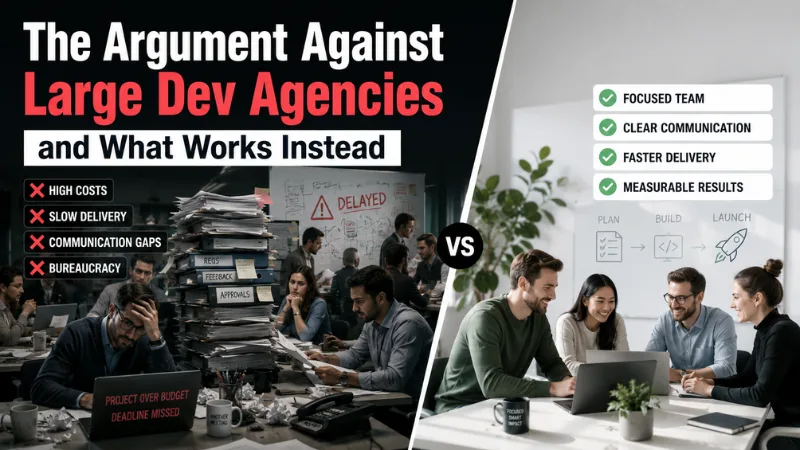
Hiring a development agency can feel like the safest move in the world. Big team, big portfolio, big promises. For many founders and business leaders, a large dev agency looks like a shortcut to reliability: more developers, more managers, more processes, and more capacity.
But size does not always equal better software.
In fact, for many digital products, especially startups, scaleups, and companies building something new, a large agency can become part of the problem. The project may slow down. Communication may get diluted. Costs may rise without a clear link to business value. And the final product may feel technically complete but strategically weak.
This does not mean all large agencies are bad. Some are excellent for enterprise-scale systems, complex compliance work, or long-term corporate outsourcing. The problem begins when businesses hire a large agency for work that needs focus, ownership, flexibility, and product thinking rather than sheer headcount.
So, what works instead? Usually, the answer is a smaller, senior-led product team that behaves less like a vendor and more like a product partner.
Why companies choose large dev agencies
Large agencies are attractive for understandable reasons. They often have polished websites, recognisable clients, large teams, and a wide menu of services. When a business is investing serious money into a digital product, choosing a well-known agency can feel responsible.
Common reasons companies choose large agencies include:
- They appear safer because of their size and reputation.
- They can provide many specialists under one roof.
- They often have formal processes and reporting systems.
- They may be able to start quickly with a large team.
- They look good to boards, investors, and internal stakeholders.
These benefits are real. The issue is that they do not always translate into better outcomes. Software projects do not fail only because of weak coding. They fail because of unclear priorities, poor product decisions, slow feedback, misaligned teams, and lack of ownership.
That is where large agencies often struggle.
The hidden problems with large dev agencies
1. You may pay for layers, not outcomes
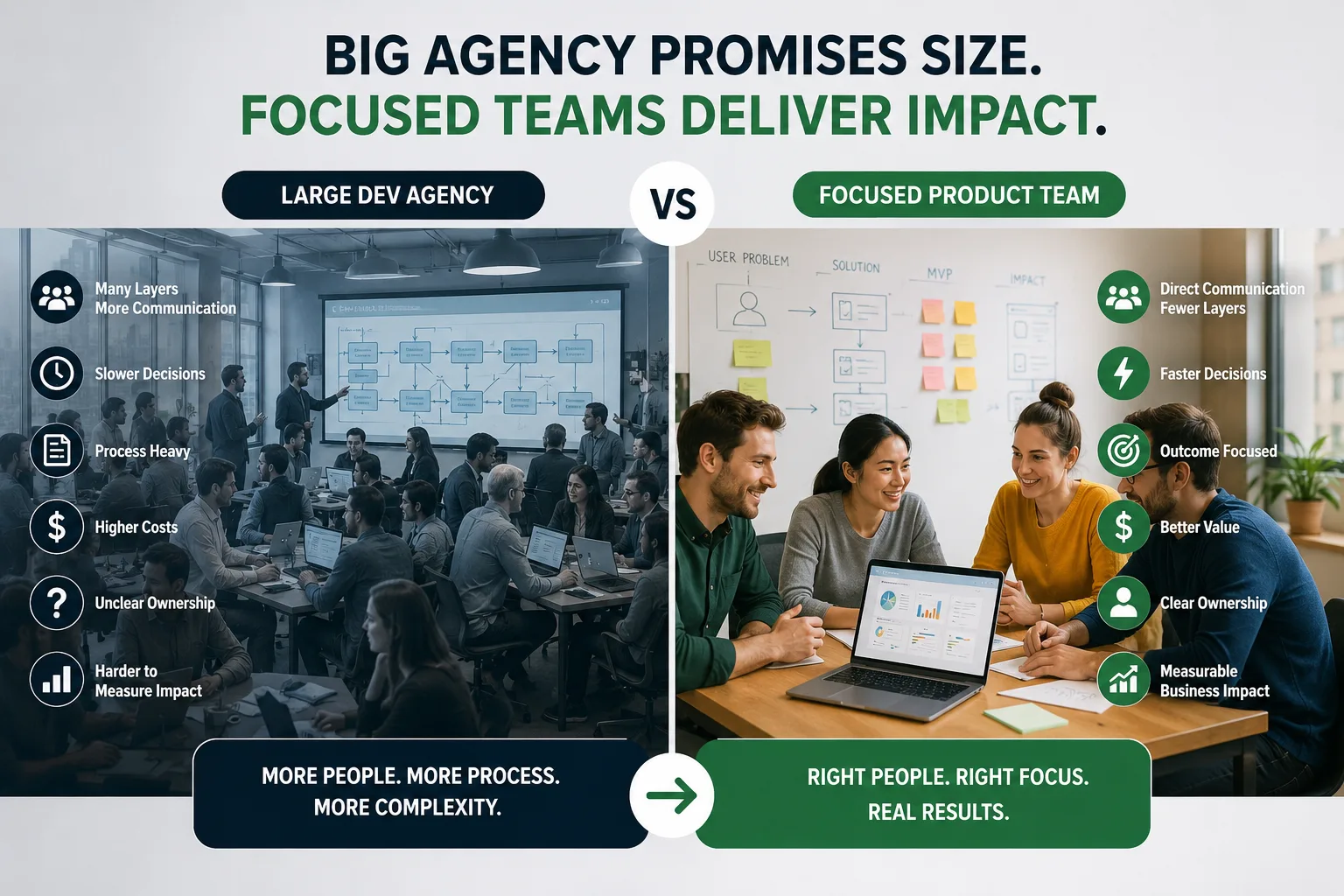
A large agency has more structure, but that structure has a cost. Account managers, delivery managers, project coordinators, department heads, internal meetings, reporting layers, and sales teams are all part of the business model.
Some structure is useful. Too much structure becomes expensive noise.
The client may assume they are paying for senior product and engineering expertise, while much of the budget actually supports coordination. The larger the agency, the more effort is often required just to keep everyone aligned.
This can lead to a strange situation: the project feels busy, the invoices are large, the meetings are frequent, but progress is slower than expected.
2. Communication becomes indirect
In a smaller team, you can often speak directly with the people designing, building, and testing the product. In a large agency, communication may pass through several people before it reaches the team doing the work.
That can create misunderstandings.
A founder explains a business concern to an account manager. The account manager passes it to a project manager. The project manager turns it into a task. The developer receives the task without the original business context. By the time the work is done, the feature may technically match the request but miss the reason behind it.
Software needs context. Developers make better decisions when they understand the user, the business model, and the trade-offs. When communication is filtered too heavily, quality suffers.
3. Senior people may disappear after the sale
Many large agencies bring senior experts into early sales calls. You meet the strategy lead, the technical architect, maybe even a senior designer. The discovery feels impressive.
Then the project starts.
Suddenly, the people you trusted during the pitch are no longer involved day to day. The actual work may be handled by a different team with less experience, while senior staff only review things occasionally.
This is not always intentional or dishonest. It is often just how large agencies operate. Senior people are spread across many accounts. But for the client, it can feel like a bait and switch.
4. Big teams can move surprisingly slowly
There is a common belief that adding more people makes software development faster. Sometimes it does. Often, it does not.
More people also means more communication, more planning, more handoffs, more documentation, and more dependency management. A five-person team with strong ownership can sometimes outperform a twenty-person team that needs constant coordination.
For early-stage products or new digital initiatives, speed of learning matters more than raw development capacity. You need to test assumptions, release usable versions, listen to users, and adapt. A large team can be too heavy for that kind of work.
The better alternative: a focused product team
The better option is not always “small agency” by default. The real answer is a focused product team with the right mix of skills, seniority, and accountability.
This type of team usually includes:
| Role | Why it matters |
|---|---|
| Product strategist or product manager | Helps define what should be built and why |
| UX/UI designer | Turns user needs into clear product flows |
| Technical lead | Makes architecture and engineering decisions |
| Developers | Build the product efficiently and sustainably |
| QA specialist | Tests functionality, usability, and edge cases |
The key difference is not just team size. It is how the team works.
A strong product team asks hard questions before writing code. Do users really need this feature? What is the simplest version that proves the idea? Which technical decisions matter now, and which can wait? What should be measured after launch?
This is where a technology partner like Mind Studios can be more useful than a traditional large development agency, because the focus is not only on delivery but also on building the right product for the right business goal.
What works better than the large-agency model
1. Start with discovery, not development
A healthy software project should not begin with a long feature list and a development sprint. It should begin with discovery.
Discovery helps clarify:
- The target users
- The main business goal
- The core problem being solved
- The riskiest assumptions
- The minimum useful product
- The technical requirements
- The budget and timeline trade-offs
Without discovery, development teams often build too much too soon. That is expensive and risky. A good discovery process may feel slower at the start, but it usually saves time later by preventing waste.
2. Build around outcomes, not tickets
Large agencies often run projects through tickets, tasks, and delivery milestones. These are necessary, but they should not become the center of the relationship.
A better question is: what outcome should this work create?
For example, “build a booking system” is a task. “Reduce manual booking work by 60%” is an outcome. “Add onboarding screens” is a task. “Help new users reach activation faster” is an outcome.
Outcome-based thinking changes the quality of decisions. The team is no longer just closing tickets. It is solving business problems.
3. Keep the team senior and compact
A compact team does not mean a cheap or understaffed team. It means fewer people with more ownership.
A strong small team can make decisions faster because the people involved understand the whole product. Designers understand business constraints. Developers understand user needs. Product managers understand technical trade-offs.
This reduces waste. It also makes the product feel more coherent, because decisions are not scattered across disconnected departments.
4. Release earlier and learn faster
One of the biggest mistakes in software development is waiting too long to launch. Large agency projects can drift toward big releases because big teams need big plans. But users do not care how detailed the roadmap looked. They care whether the product solves a problem.
A better approach is to release a focused version earlier, then improve it based on real usage.
That might mean launching:
- A clickable prototype before development
- A minimum viable product for one user segment
- A pilot version for internal teams
- A beta version for selected customers
- A simplified first release with only the most valuable features
The point is not to launch something unfinished or careless. The point is to avoid spending months building features that users may not need.
When a large agency does make sense
Large agencies are not always the wrong choice. They can be a good fit when the project requires significant staffing, strict procurement processes, enterprise-level governance, or support across many countries and departments.
A large agency may work well for:
- Enterprise software maintenance
- Large legacy system modernisation
- Multi-region corporate platforms
- Projects with heavy compliance requirements
- Long-term outsourcing with stable requirements
- Organisations that need extensive documentation and reporting
The problem is using a large-agency model for product work that needs speed, clarity, and strategic focus. A startup building its first marketplace does not have the same needs as a global bank modernising internal infrastructure.
How to choose the right development partner
Before hiring any agency, ask questions that reveal how they actually work.
Useful questions include:
- Who will be involved after the contract is signed?
- Will we speak directly with designers and developers?
- How do you challenge unclear product requirements?
- What happens if user feedback changes the roadmap?
- How do you measure product success after launch?
- How senior is the day-to-day team?
- Do you prefer fixed scope or flexible product priorities?
- How do you prevent unnecessary features from being built?
The answers will tell you a lot. A delivery-focused vendor will talk mainly about capacity, timelines, and tickets. A product-focused partner will talk about users, assumptions, trade-offs, validation, and outcomes.
The best model: small enough to care, experienced enough to deliver
The strongest development partners usually sit between two extremes. They are not so small that they lack process, but not so large that the client becomes just another account.
They have enough structure to deliver reliably, but enough flexibility to adapt. They care about code quality, but they also care about product-market fit. They can build, but they can also question whether something should be built at all.
That balance matters.
Great software is not created by throwing the largest possible team at a feature list. It is created by people who understand the business, care about the user, and make smart decisions under real constraints.
Final thoughts
The argument against large dev agencies is not that they are incapable. It is that their model is often too heavy for the kind of product work many businesses actually need.
If your project depends on speed, learning, close collaboration, and smart prioritisation, a large agency may slow you down. You may end up paying for layers instead of progress.
What works better is a focused, senior-led product team that takes ownership of outcomes. A team that can challenge assumptions, communicate directly, release early, and improve the product with real feedback.
In software, bigger is not always safer. Sometimes, the best results come from a smaller team that is closer to the problem, closer to the users, and more accountable for what happens after launch.