

SaaS and technology companies do not need more names in a database. They need prospects who match the ideal customer profile (ICP), have a relevant role, and meet an agreed level of sales readiness. That makes qualification rules, verification, reporting, and sales handoff as important as outreach volume.
This guide compares managed B2B lead generation agencies using publicly available service information, pricing pages, case studies, and review profiles. It also provides a checklist and scorecard for defining a sales-qualified lead before signing an agreement.
Which B2B lead generation companies are best for SaaS and technology firms?
For SaaS and technology firms, the relevant B2B lead generation agencies in this review are Valasys Media, ExpertCallers, Callbox, CIENCE, Belkins, SalesRoads, Martal Group, Saleshandy, and Leadfeeder. The right choice depends on your defined ICP, sales motion, qualification requirements, geographic coverage, and how clearly each provider documents verification, reporting, handoff, pricing, and replacement terms.
Generally, Valasys is good for intent-led ABM and qualified-lead programs, ExpertCallers for CRM and contact-center support, Callbox for multichannel campaigns, CIENCE for managed SDR execution, Belkins for appointment setting, SalesRoads for US phone-led outreach, Martal Group for managed outbound sales and appointment setting, Saleshandy for in-house prospecting and cold outreach, and Leadfeeder for identifying and prioritizing companies already visiting a website.
How do I choose a B2B lead generation agency that delivers sales-qualified leads?
Agree in writing on what counts as an MQL and SQL, how contacts are verified, which leads qualify for replacement, what information accompanies handoff, and how results connect to pipeline. Compare providers on SaaS experience, public proof, reporting access, pricing structure, contract terms, and dependencies rather than meeting volume alone.
How We Evaluated the Agencies
To qualify for this article, a provider had to offer managed B2B lead generation or outsourced sales services, serve US buyers, demonstrate relevance to SaaS or technology companies, and publish enough information to evaluate its services.
We reviewed official service pages, pricing pages, case studies, and direct product or review profiles available on the web. Provider-published results are identified as company-reported and are not treated as independently audited outcomes. When a qualification rule, replacement policy, or price was not public, it is marked for buyer confirmation.
The editorial framework uses these criteria:
| Evaluation criterion | What it measures |
| ICP and SaaS/technology alignment | Experience with relevant markets, buyers, and sales cycles |
| Qualification and SQL definition | Clarity about the conditions a lead must meet |
| Verification and replacement policy | Contact validation, invalid-lead rules, and remedies |
| Reporting and sales handoff | Visibility, context, CRM delivery, and acceptance workflow |
| Proof of SQL quality | Relevant case studies, defined outcomes, and review evidence |
| Pricing and contract clarity | Public pricing, engagement terms, and commercial dependencies |
Publisher disclosure: Valasys Media publishes this article and is presented first as the publisher’s solution. The remaining agencies are ordered by documented fit against the framework above.
B2B Lead Generation Agencies at a Glance
| Provider | Best fit | Public qualification or proof | Public pricing | Confirm before signing |
| Valasys Media | Intent-led lead generation, ABM, and multiple qualification levels | MQL, HQL, and BANT programs; ICP and intent-supported qualification; VAIS account prioritization | Managed-service pricing not published; complimentary VAIS access promoted | Formal SQL acceptance rules and full replacement conditions |
| Callbox | SaaS teams needing multichannel outreach across several markets | SaaS case studies, including a company-reported 63 SQLs, 71 MQLs, and three closed deals in four months | Contact for pricing | Exact SQL, replacement, and sales-acceptance terms |
| CIENCE | SaaS teams needing managed SDR execution supported by audience data | Managed outbound, inbound qualification, public SaaS pricing, and case studies | Campaign management from $2,000/month plus published SDR rates at review time | Replacement policy and total program cost |
| Jordan Digital Marketing | B2B SaaS and fintech teams that need paid media, SEO, and AI-search | remote-first performance marketing and organic growth agency | Custom pricing | Buyers should confirm the specific scope, reporting cadence, and commercial terms for their program. |
| MatterMade | B2B SaaS companies seeking demand generation, paid media, and RevOps | Published case studies featuring Loom, Dropbox, G2, and Cin7 | Not disclosed; custom pricing | Minimum engagement, fees, deliverables, attribution, and performance guarantees |
| Belkins | Companies prioritizing appointment setting and managed outbound | SaaS specialization and a company-reported 155 appointments for Appruv over two years | Custom pricing | SQL definition, replacement policy, and outcome ownership |
| ExpertCallers | Companies seeking CRM, contact center, and outbound lead generation support | Global CRM and contact center services; outbound calling, telemarketing, and lead generation capabilities | Custom pricing / contact for pricing | Lead qualification criteria, replacement terms, reporting, and sales-acceptance rules |
| SalesRoads | US-focused, phone-led appointment setting and lead qualification | Public SaaS case studies and human qualification process | Site states high-quality appointment-setting services commonly cost $8,000–10,000/month | Replacement terms and whether meetings meet the buyer’s SQL definition |
| Martal Group | SaaS and technology businesses seeking managed outbound sales and appointment setting | Company-reported 971 leads, 808 MQLs, and 84 SQLs over 15 months in a software-development case study | Package information published; custom quote generally required | SQL definition, replacement policy, and campaign-specific pricing |
| Saleshandy | In-house sales teams managing prospecting and cold outreach | 852M+ B2B database; multichannel sequences; outbound CRM; Lead Finder and email automation | Starts at $25/month at the time of review | Database coverage, credit limits, deliverability features, and reporting |
| Leadfeeder (Dealfront) | B2B companies with existing website traffic and inbound programs | Website visitor identification, company data, behavioral signals, and intent-based account prioritization | Available on request; 14-day free trial | Contact-data coverage, company identification accuracy, integrations, and plan limits |
Prices and service terms can change. Verify current quotes, plan features, qualification definitions, and contract language directly with each provider.
1. Valasys Media
Valasys Media provides managed B2B programs across ABM, content syndication, lead management, MQL, HQL, BANT, and other demand-generation motions. It is most relevant to teams that want account prioritization and campaign execution from the same provider.
Its proprietary technology, Valasys AI Score (VAIS), assigns accounts an alignment score from 55 to 95 using product-market fit, demand signals, firmographic information, and Bombora buyer-intent data. VAIS also supports ICP development, lookalike account discovery, prospect identification, account prioritization, and campaign management.

Valasys publicly defines an HQL as a lead that matches the ICP, shows purchase intent, and has verified decision-maker contact information. Its HQL process includes intent and firmographic checks, manual review, human follow-up, qualifier questions, and CRM-ready delivery. Its BANT service confirms Budget, Authority, Need, and Timeline for that specific program. These requirements should not be assumed to apply to every Valasys MQL or SQL campaign.
The VAIS campaign page highlights a responsive replacement process, with eligible replacement leads delivered within 48 hours. Buyers can align the applicable validation criteria, reporting process, and campaign terms with Valasys during program planning. For managed services, Valasys provides scope-based quotes and offers complimentary VAIS access for teams that want to explore the platform before discussing a tailored program.
For product-level proof, G2 listed Valasys AI at 4.9/5 rating when this article was reviewed.
Best fit: SaaS and technology teams that want AI-supported account selection combined with managed ABM or qualified-lead programs.
2. Callbox
Callbox offers B2B lead generation for SaaS companies through coordinated email, phone, LinkedIn, and other outreach channels. Its case-study library covers technology, SaaS, financial services, healthcare, and international campaigns.

In a company-published case study for a Colombia-based financial technology SaaS provider, Callbox reports delivering 63 SQLs, 71 MQLs, and three closed deals over four months. The case provides useful funnel-stage outcomes, although buyers should still compare its qualification definitions with their own sales process.
Callbox does not present standard program pricing on the reviewed service page. Buyers should request the proposed qualification questions, reporting cadence, sales-handoff fields, replacement conditions, and regional delivery model with the quote.
Professional and responsive team: G2 and Clutch reviewers frequently praise Callbox for its professionalism, responsiveness, and collaborative approach throughout campaigns.
Best fit: SaaS companies that need a managed multichannel campaign across multiple geographic markets.
3. CIENCE
CIENCE provides managed outbound and inbound sales development, audience data, and go-to-market execution supported by its graph8 platform. It publishes industry-specific information for SaaS and technology teams, along with a broad case-study library.

CIENCE is comparatively transparent about public pricing. At the time of review, its SaaS page stated that campaign management starts at $2,000 per month, plus SDR rates ranging from $1,500 to $5,500 per month. These are starting figures, not a complete project quote, and buyers should confirm setup, data, channel, and platform costs.
One CIENCE case study for Barnett Strategies states that CIENCE ran five outbound SDR campaigns and one research project for early-stage SaaS clients, built databases to a reported 95% or higher deliverability standard, and supplied reporting on outreach and confirmed appointments. Public replacement terms were not located.
The tradeoff is consistency: Salesbread notes G2 reviews average around 3.8 stars, with some clients flagging SDR turnover and variable lead quality. At the same time, CIENCE remains one of the few providers built to support large-scale, multichannel enterprise prospecting across multiple regions.
Best fit: SaaS companies that want managed SDR execution combined with audience data and documented starting prices.
4. Jordan Digital Marketing
Jordan Digital Marketing is a remote-first performance marketing and organic growth agency founded in 2017. It serves growth-stage B2B SaaS and fintech companies through paid search, paid social, SEO, and AI/LLM search programs, with reporting tied to pipeline and revenue rather than lead volume.
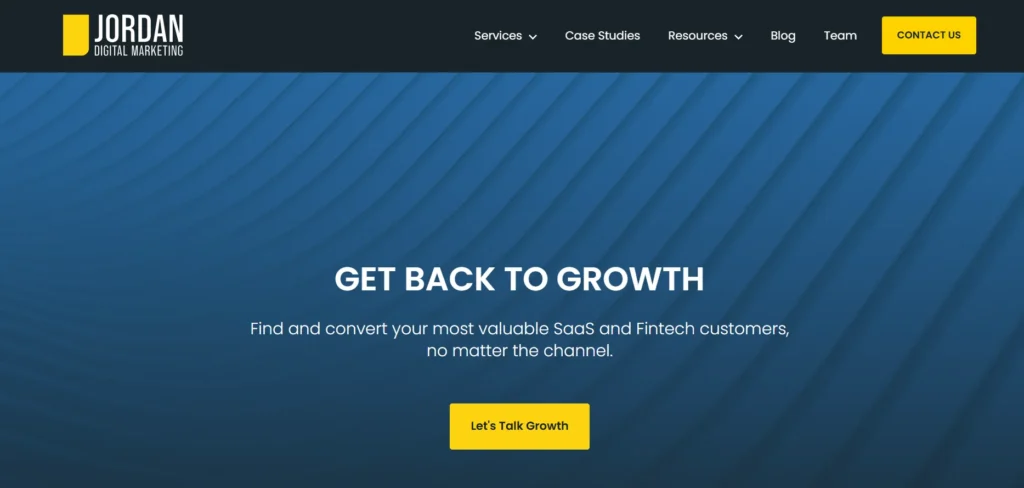
JDM works as an extension of in-house teams, combining senior practitioners with full-funnel campaign architecture and measurement across paid and organic channels. Buyers should confirm the specific scope, reporting cadence, and commercial terms for their program.
Best fit: Growth-stage B2B SaaS and fintech teams that need paid media, SEO, and AI-search work connected to measurable pipeline and revenue outcomes.
5. Matter Made
Matter Made works with technology companies across demand generation, paid media, and RevOps. Its demand-generation offering includes account-based marketing, campaign strategy and execution, paid-channel testing and optimization, messaging and product marketing, and revenue reporting and attribution. The team also partners with sales to connect marketing programs with sourced revenue.
Matter Made publishes case-study outcomes including a five-times efficiency increase and a halved cost per acquisition for HotelEngine, as well as a 69% increase in sign-ups for Loom. Buyers should confirm the applicable scope, measurement approach, and commercial terms for their own program.
Best fit: Technology companies seeking an embedded partner for demand generation, paid media, and go-to-market operations.
6. Belkins
Belkins provides managed appointment setting, outbound sales development, lead research, email outreach, and related services for SaaS companies. It publishes SaaS case studies and describes custom programs built around the client’s ICP and market.

In its Appruv case study, Belkins reports booking 155 appointments over two years for a contractor-management and prequalification software company. The case demonstrates SaaS experience, but an appointment should not automatically be treated as an SQL. Buyers should specify the required account fit, role, qualification answers, attendance rule, and sales-acceptance process.
On Clutch’s rankings, they carry over 230 verified reviews averaging 4.9 stars, alongside strong ratings on G2.
Belkins uses custom pricing. Its public pages do not provide a universal replacement policy or a single SQL definition applicable to every engagement, so these terms should be included in the statement of work.
Best fit: SaaS companies that prioritize managed outbound outreach and appointment setting around a defined ICP.

7. ExpertCallers
ExpertCallers is a global provider of customer relationship management and contact center solutions, helping businesses build meaningful customer interactions and long-term loyalty. A division of Flatworld Solutions, the company has been delivering process-driven, scalable support services since 2002.

ExpertCallers supports businesses through inbound and outbound contact center services, technical assistance, telemarketing, CATI, email, and chat. Its lead-generation capabilities are particularly relevant to companies looking for structured outbound calling and contact-center support alongside broader customer engagement operations.
The company combines human-led delivery with AI-augmented models and emphasizes structured workflows, operational consistency, and scalable execution across multiple markets.
Third-party ratings: ExpertCallers holds a 5.0/5 rating on G2 and a 4.8/5 rating on Clutch at the time of review.
Best fit: Companies looking for scalable outbound lead generation, telemarketing, CRM, and contact center support.
8. SalesRoads
SalesRoads offers US-based lead generation, SDR outsourcing, and appointment setting with a strong emphasis on human research and phone conversations. Its process includes ICP development, targeted list research, human qualification, and campaign reporting.
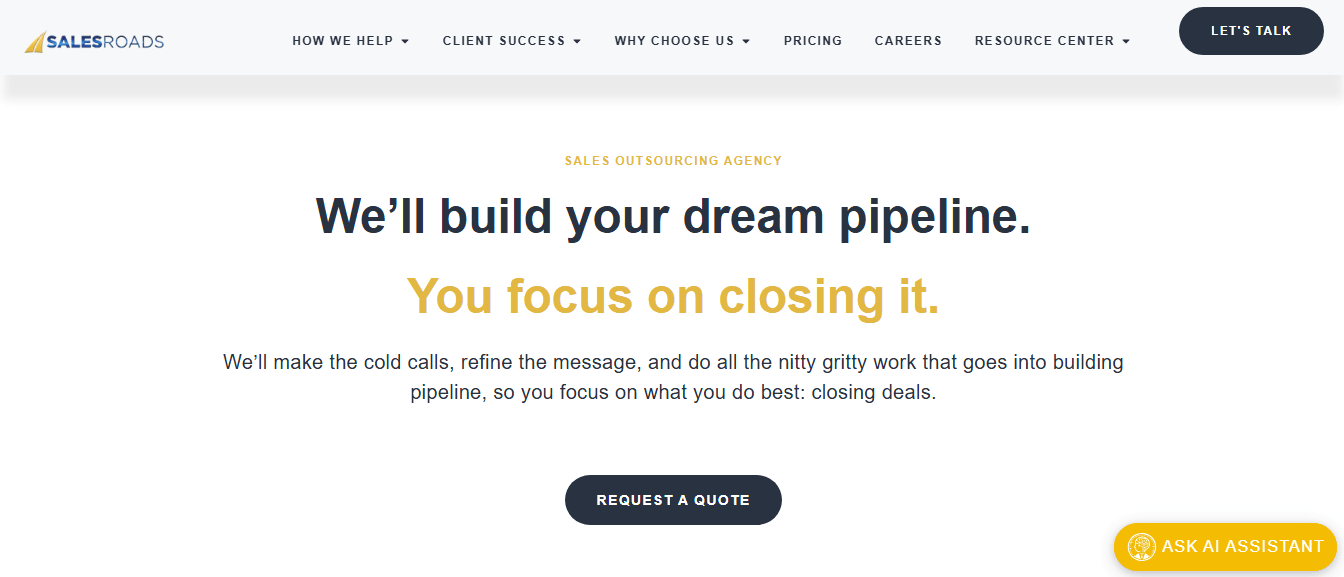
Its SaaS industry page reports 966 meetings scheduled for Kuebix, a supply-chain technology company. As with all provider case studies, buyers should ask how a meeting was defined, how many were accepted by sales, and what share progressed to pipeline.
SalesRoads’ appointment-setting page states that high-quality services commonly cost about $8,000 to $10,000 per month, while actual pricing depends on program involvement. Public replacement terms were not located. Buyers should confirm whether no-shows, incorrect roles, invalid contacts, and out-of-ICP meetings qualify for replacement.
Every SDR they deploy is US-based, with an average of 5 to 10 years in telesales and prospecting. They hold a 4.9 rating on Clutch from 65+ reviews, with clients including Microsoft and Quest Diagnostics.
Best fit: US-focused SaaS or technology teams that want phone-led outreach and outsourced appointment setting.
9. Martal Group
Martal Group provides managed outbound lead generation and appointment setting for technology companies. Its published process uses omnichannel outreach, including email, phone, and LinkedIn, followed by qualification and meeting booking.

Martal publicly defines an outbound SQL as a prospect who participates in the decision process, demonstrates genuine interest, and wants to learn more. In one company-published software-development case study, Martal reports generating 971 leads, 808 MQLs, and 84 SQLs over 15 months. The result is relevant evidence, but it remains a provider-reported outcome from a specific engagement.
Martal publishes package information and campaign volumes but generally asks prospects to request a quote. Its public pages do not provide a complete replacement policy, so invalid-lead and meeting-replacement rules should be confirmed in the contract.
Best fit: SaaS and technology businesses entering or expanding in North American markets through managed outbound sales.
10. Saleshandy
Saleshandy is a prospecting and outbound-sales platform for teams that want to manage lead generation internally rather than outsource campaign execution. Its platform combines a B2B database, multichannel sequences, an outbound CRM, email automation, and multiple email-account support.

Saleshandy states that its database includes 852 million+ B2B contacts and provides tools for prospect discovery, cold-email campaigns, email warm-up, sender rotation, and campaign management. These capabilities make it relevant to SaaS and technology teams building an in-house outbound motion.
Its published pricing starts at $25 per month, with 50 free Lead Finder credits included at the entry level. Pricing and included features can vary by plan, so buyers should confirm current database access, credit limits, sending capabilities, and reporting features before selecting a plan.
Customer feedback: G2 and Trustpilot reviewers frequently highlight the platform’s ease of use, campaign setup, email automation, and customer support. Some reviews also mention occasional software bugs, limitations in advanced reporting, and variable experiences with Lead Finder and email warm-up features.
Best fit: In-house sales and marketing teams that want to manage prospecting, database access, and cold outreach through a single platform.
11. Leadfeeder (Dealfront)
Leadfeeder is a B2B website-visitor identification and lead-generation platform from Dealfront. Rather than relying primarily on outbound prospecting, it helps sales teams identify companies visiting their websites and prioritize accounts based on website activity and other buying signals.

Leadfeeder states that its platform draws on a database of 60 million+ companies and 400 million+ verified contacts. It combines website visitor identification with company information, behavioral signals, and buying-intent data, allowing identified accounts to be prioritized and routed into CRM workflows.
The model differs from a managed lead-generation agency: Leadfeeder helps businesses capture more value from traffic they are already generating rather than conducting the entire outbound sales process. This makes it particularly relevant to B2B companies with established inbound programs and meaningful website traffic.
Customer feedback: G2 and Clutch reviewers frequently highlight website visitor identification, ease of use, CRM integrations, and account-level insights. Some reviewers report limitations around company identification and contact-data completeness, particularly for smaller businesses, while others consider the pricing less suitable for smaller teams.
Leadfeeder offers a 14-day free trial, while current paid-plan pricing is available from the provider.
Best fit: B2B companies with existing inbound traffic that want to identify anonymous business visitors and prioritize accounts showing potential buying interest.
12. MQL vs. SQL: Define the Difference Before Launch
Definitions vary by provider and campaign. Use the following as a starting point, then convert it into written acceptance criteria.
| Lead stage | Practical definition | Typical evidence |
| MQL | A contact who matches agreed marketing criteria and has shown relevant engagement but has not completed full sales qualification | ICP fit, valid contact information, content engagement, response, or intent signal |
| SQL | A contact or account that meets agreed sales-readiness criteria and is suitable for direct sales follow-up | Required role, demonstrated need or interest, qualification answers, purchase timing, and sales acceptance |
Do not use “SQL” as a label without defining it. An agency may call a positive reply, booked meeting, BANT-qualified contact, or sales-accepted opportunity an SQL. Those outcomes are not interchangeable.
SQL Definition Checklist
Before launch, document whether an SQL must satisfy each requirement:
- Matches the approved ICP, including industry, company size, geography, and technology criteria
- Holds an approved role or participates in the buying decision
- Has verified business contact information
- Is not a duplicate, existing customer, competitor, or suppressed account
- Has shown a defined level of interest, engagement, or intent
- Has answered the required qualification questions
- Meets any required need, authority, budget, or timeline conditions
- Has consent and source information where the program requires it
- Includes outreach history, call notes, and recommended next action
- Is accepted or rejected by sales within a defined review window
- Qualifies for replacement when an agreed validation rule fails
Buyer Selection Scorecard
Score each shortlisted agency from 1 (weak or undisclosed) to 5 (strong and documented). Multiply the score by the weight and compare totals. A missing public policy is not proof of poor delivery, but it is a reason to request written clarification.
| Criterion | Weight | Questions to ask |
| ICP alignment | 15% | Can the agency show relevant SaaS or technology work and build lists using your exact criteria? |
| Qualification and SQL rules | 20% | Is every acceptance condition written into the scope? Who makes the final qualification decision? |
| Verification and replacement | 20% | How are email, phone, role, company, consent, suppression, and duplicates checked? What gets replaced? |
| Reporting and handoff | 15% | What dashboard, CRM fields, notes, source data, cadence, and sales-acceptance workflow are included? |
| Proof of SQL quality | 20% | Do case studies report accepted SQLs, pipeline, or revenue rather than only activity and meetings? |
| Pricing and contract clarity | 10% | Are setup, data, platform, staffing, channel, cancellation, and replacement costs clear? |
Questions to Ask Before Signing
- What exactly counts as an MQL, HQL, SQL, accepted meeting, and replacement lead?
- Which qualification requirements can be customized for our ICP and sales process?
- How do you verify contact data, employment, role, company fit, consent, duplicates, and suppression lists?
- What causes a lead or meeting to be replaced, and how quickly must we report it?
- What information will sales receive with every lead?
- Which metrics will appear in the dashboard and how often will we review performance?
- Who owns prospect data, sender domains, messaging, and campaign history after the contract ends?
- Which results depend on our offer, brand recognition, sales follow-up speed, or close process?
Build a Qualified-Lead Program Around Clear Definitions
The right agency is not necessarily the provider that promises the most leads. It is the one that can align with your ICP, document qualification and verification, provide useful sales context, and show how accepted leads progress into the pipeline.
Valasys Media combines managed lead-generation programs with VAIS account and intent intelligence. If that model fits your sales motion, discuss a qualified-lead program and agree on the acceptance, reporting, handoff, and replacement terms before launch.
Frequently Asked Questions (FAQ’s)
Which B2B lead generation companies are best for SaaS and technology firms?
Valasys Media, ExpertCallers, Callbox, CIENCE, Belkins, SalesRoads, Martal Group, Saleshandy, and Leadfeeder all publish evidence of relevant managed services. “Best” depends on the required motion: intent-led demand generation, omnichannel outbound, international coverage, managed SDR execution, appointment setting, or phone-led qualification. Compare each provider against your written SQL definition.
How do I choose a B2B lead generation agency that delivers sales-qualified leads?
Start with a written SQL definition, then evaluate ICP alignment, qualification questions, verification, replacement rules, reporting, sales handoff, pricing, and relevant proof. Do not select an agency only because it promises a high meeting volume or displays a strong review score.
What is the difference between an MQL and an SQL?
An MQL meets agreed marketing criteria and has shown relevant engagement. An SQL has passed a stricter sales-readiness test and is suitable for direct sales follow-up. The exact transition should be agreed by the buyer and agency before the campaign begins.
What should a lead replacement policy include?
It should define invalid email and phone data, wrong roles or companies, duplicates, suppressed accounts, existing customers, no-shows, reporting deadlines, evidence requirements, exclusions, replacement timing, and any volume limits. A statement promising replacements is incomplete without those conditions.
How much do B2B lead generation agencies charge?
Pricing varies by channel, geography, qualification depth, lead volume, staffing, and contract length. Some providers publish starting monthly rates; others require a custom quote. Compare total program cost, not only cost per lead, and include data, platform, setup, management, and replacement costs.
What reporting should a lead generation agency provide?
At minimum, reporting should show outreach activity, positive responses, leads delivered, acceptance and rejection reasons, meetings held, MQL-to-SQL conversion, cost per accepted lead, pipeline created, and campaign changes. Each delivered lead should include source, qualification context, engagement history, and the recommended next step.
Can an agency guarantee SQLs or revenue?
An agency can commit to processes, delivery quantities, validation rules, and contract remedies, but revenue also depends on the offer, market, pricing, competition, sales follow-up, and close process. Treat absolute revenue or conversion guarantees cautiously unless the agreement defines the assumptions and remedy.


