

5 Best Email APIs for AI Agents in 2026
Compare 5 best email APIs for AI agents in 2026. Explore features, automation, integrations, pricing, use cases for smarter email workflows.


AI agents increasingly own their own email sending in 2026, firing off onboarding messages, delivery confirmations, and support replies without a human relaying each one by hand.
The best email APIs for AI agents in 2026 are Mailtrap, Postmark, Mailgun, Twilio SendGrid, and Cloudflare Email Service. We tested each one’s official MCP server, SDK documentation, and agent skills directly against Claude Code and Cursor.
Best Email APIs for AI Agents in 2026
Mailtrap is the strongest all-around pick for agents that need both sending through an official MCP server and reading replies back through the same connection. Cloudflare Email Service is the cheapest option at $0.35 per 1,000 emails for teams already running on Workers infrastructure.
| Provider | Free Plan | Starting Price | AI Agent Tools |
| Mailtrap | 4,000 emails/month | $15/mo | Official MCP (76 tools), official skills, AI onboarding guide |
| Postmark | 100-email trial | $15/mo | Official MCP (24 tools), official skills |
| Mailgun | 100 emails/day | $15/mo | Official MCP (50+ tools) |
| Twilio SendGrid | 100 emails/day | $19.95/mo | Official MCP (documentation only, 2 tools) |
| Cloudflare Email Service | None | $0.35 per 1,000 emails | Official MCP, official skills, Wrangler CLI |
Choose Mailtrap when your agent’s workflow needs to send, track, and read replies through the same official MCP connection, without bolting on a separate inbound service.
Choose Postmark when you already run it in production and only need the basic send-and-check loop.
Choose Mailgun when the workflow depends on address validation or regex-based inbound routing.
Choose Twilio SendGrid when channel consolidation across SMS, WhatsApp, and voice matters more than MCP send capability today.
Choose Cloudflare Email Service when you’re already building on Workers and want the lowest per-email cost.
What Makes an Email API Good for AI Agents?
An email API works well for AI agents when it exposes sending, logging, and account actions as discrete tools an agent can call, not just REST endpoints buried in a documentation site. Four things separate the providers on this list:
- Agent-callable interface. An MCP server, a CLI, or a skills file that maps directly to actions, instead of a general-purpose API the agent has to reverse-engineer from prose docs.
- SDK and documentation depth. More official SDKs and clearer endpoint references mean fewer steps, and fewer tokens, per action.
- Authentication and stream separation. DKIM, SPF, and DMARC should configure automatically, with transactional sends on a separate stream from bulk email so one bad campaign doesn’t tank deliverability for password resets.
- Inbound handling. A structured, parsed inbox beats a plain forwarding rule, which still needs a separate layer to read and act on the message.
1. Mailtrap: Best for Complex Agent Email Workflows
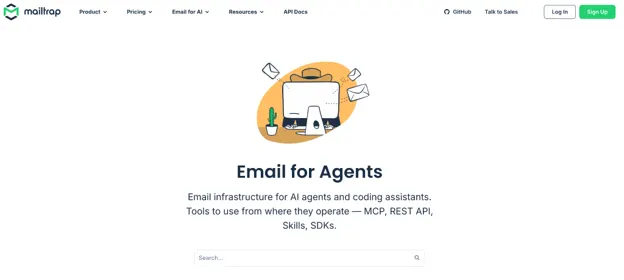
Mailtrap is an email delivery platform built around deliverability infrastructure, analytics, and a full set of agent-facing tools. The official MCP server ships 76 tools covering sending, email logs, stats, templates, sending domains, suppressions, webhooks, contacts, and account management, installable with a single npx command. Official agent skills cover seven areas, including sending email, email templates, sending domain setup, contact management, and API authorization.
The part that sets Mailtrap apart is inbound. Replies land as structured JSON through the Messages API the moment the webhook fires, with sender, headers, body, attachment URLs, spam score, SPF/DKIM status, and thread ID all included. The same API token covers sending and receiving, and agents can reply in-thread without switching credentials. Mailtrap’s agent inbox app puts this behind a dedicated address that works without any DNS setup, with a custom domain option for production.
Key features
- Official MCP server with 76 tools spanning sending, logs, analytics, templates, and account management
- Official agent skills spanning seven areas: sending, templates, domain setup, contacts, and API authorization
- Live inbound email with structured JSON parsing and one token for both directions
- 8 official SDKs: Node.js, PHP, Ruby, Python, Java, .NET, Go, and Elixir
- Native integrations with Vercel, Supabase, Claude Code, Cursor, and Windsurf
- ISO 27001, SOC 2 Type II, and GDPR compliant, with a 99.99% uptime SLA
Pros
- Both sending and structured inbound reading under one official setup, using the same API token
- Wide SDK coverage: Node.js, PHP, Ruby, Python, Java, .NET, Go, and Elixir
- ISO 27001, SOC 2 Type II, and GDPR compliance certifications that hold up in enterprise procurement reviews
Cons
- Dedicated IPs and longer log retention require the Business plan or higher
- The free plan caps at 150 emails a day even though the monthly quota is higher
Best for: agent workflows that need production-grade deliverability, built-in reply handling, and a sandbox to test both before anything goes live.
2. Postmark: Best for Basic Agent Email Sending
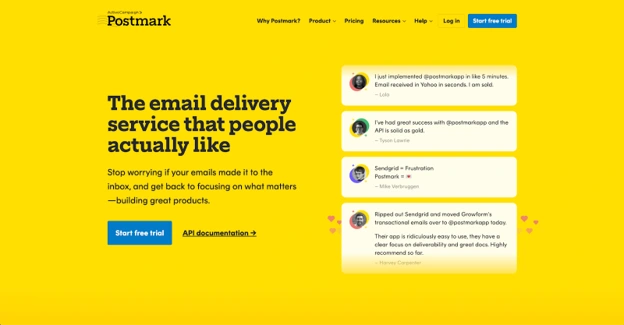
Postmark’s AI agent capabilities are fairly basic. The MCP server handles sending, templates, and delivery status, and a companion set of Agent Skills covers the rest of the sending workflow. What’s missing is anything beyond that: no domain setup, account management, or contact handling exposed as tools, so anything more advanced means going back to the API or dashboard directly.
Key features
- Official MCP server with 24 tools: sending, templates, message search, delivery diagnostics, bounces, suppressions, stats, and webhooks
- Official Agent Skills covering sending, inbound processing, templates, webhooks, and best practices
- A composite delivery-diagnosis tool that checks suppression status, message history, and bounces in one call
Pros
- Every feature is available on every paid tier, nothing gated
- 45 days log retention simplifies support debugging
Cons
- No recurring free plan, only a 100-email trial
- Overage pricing climbs at higher volumes
- No domain setup, account, or contact management exposed as MCP tools
Best for: agents that only need to send, template, and check on transactional email, not manage domains, contacts, or account settings.
3. Mailgun: Best for Built-In Email Validation
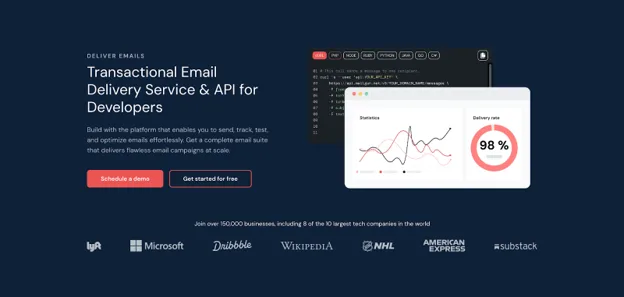
Mailgun’s MCP server includes 50+ tools covering sending, receiving, domain management, and DNS troubleshooting. Its clearest edge is a built-in validation API that checks addresses before sending, useful for agent-driven outreach where contact lists aren’t always clean. Inbound routing supports regex-based rules that forward mail to different webhooks, covering reply workflows and ticketing without extra tools.
Key features
- Official MCP server with 50+ tools
- Built-in address validation before sending
- Regex-based inbound routing to different webhooks
- SOC 2, ISO 27001, and HIPAA certified, with EU and US data centers
Pros
- Validation removes the need for a separate address-checking service
- Flexible inbound routing
Cons
- No official agent skills
- Pricing rises quickly at higher sending volumes
Best for: agent workflows where clean contact is important.
4. Twilio SendGrid: Best for Multi-Channel Consolidation

Twilio SendGrid is the largest email API provider by volume, and for teams already on Twilio for SMS, WhatsApp, or voice, it’s the obvious choice, since one account covers all four channels. The catch: Twilio’s official MCP server ships only 2 tools, both documentation discovery, neither can send an email. Actual sending through MCP means reaching for a community-built server with no official maintenance guarantee.
Key features
- Official MCP server covering documentation discovery across email, SMS, WhatsApp, and voice
- Dynamic templates with version control
- Sub-user accounts for multi-brand sending
- Full event webhooks across the delivery lifecycle
Pros
- One account spans email, SMS, WhatsApp, and voice
- Long production track record at very high volume
Cons
- The official MCP server can’t send email, only browse docs
- Costs rise quickly at scale
Best for: teams already embedded in the Twilio ecosystem where channel consolidation outweighs the current MCP gap for sending.
5. Cloudflare Email Service: Best for Teams on Cloudflare Workers
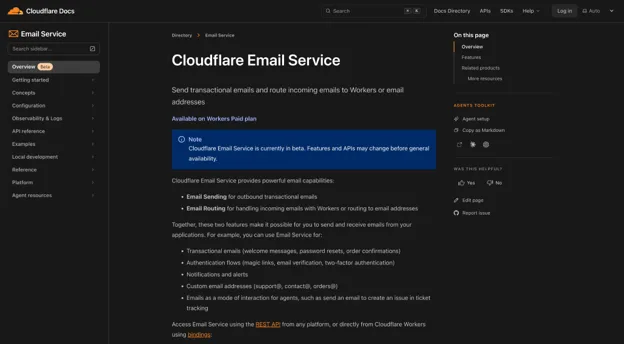
Cloudflare Email Service is the newest option, priced at $0.35 per 1,000 emails with no monthly minimum, and it’s still in public beta. It ships with an official MCP server, official agent skills, and a Wrangler CLI that lets agents discover capabilities on demand through help commands instead of loading every tool definition upfront. One detail most competitors haven’t touched: reply routing is signed with HMAC-SHA256, so replies route back to the exact agent instance that sent the original message.
Key features
- Official MCP server, agent skills, and Wrangler CLI
- HMAC-signed reply routing tied to the originating agent instance
- Deep integration with Workers, R2, and Durable Objects
- Automatic SPF, DKIM, and DMARC configuration
Pros
- Low per-email cost
- Signed reply routing closes a security gap most competitors leave open
- CLI reduces token overhead on repeated agent runs
Cons
- Still in public beta, so pricing and the API surface may still shift
- No standalone free plan
Best for: teams already building on Cloudflare Workers who want the lowest cost and tight platform integration.
Final Thoughts
Each of these five email APIs fits a different kind of agent workflow. Mailtrap covers the most ground for agents that need to send and receive in one place. Postmark and Mailgun suit narrower use cases like fast delivery or built-in validation. Twilio SendGrid makes sense once channel consolidation outweighs its MCP limits, and Cloudflare Email Service is worth watching once it clears beta.
Frequently Asked Questions
What is the best email API for AI agents? Mailtrap is the strongest overall pick, with an official MCP server, agent skills, and a two-way connection that covers both sending and reading inbound replies.
Do AI agents need MCP support to send email? Not strictly. An agent can call any REST API directly. MCP support just standardizes the connection so the agent doesn’t need custom code for each provider, and it usually cuts the number of steps needed per action.
Is Twilio SendGrid good for AI agent workflows? It depends on the workflow. Twilio SendGrid works well for teams that need SMS, WhatsApp, and voice alongside email, but its official MCP server can’t send email yet, so sending through MCP means relying on a community-built connector.