


Calm on Demand: How Musick AI Eases Your Anxiety and Makes It Personal
Discover how Musick AI creates personalized calming music to reduce anxiety, improve focus, and support mental well-being anytime, on demand.

Anxiety is one of the most common experiences people carry through their daily lives. Whether it creeps in during a stressful workday or lingers at night when sleep feels impossible, the search for relief is real. Music has long been recognized as one of the most effective, non-medical tools for easing that tension — and now, with Musick AI, a free AI Music Generator, creating music that fits your exact emotional state takes less than a minute.
I. Why Anxiety Responds to Music
Before exploring how to use music intentionally, it helps to understand why it works on anxiety in the first place.
- The Body’s Physical Response
Slow-tempo music with steady rhythms has been shown to lower heart rate and reduce blood pressure. Research consistently finds that listening to calming music decreases cortisol — the hormone most directly tied to stress — and activates the parasympathetic nervous system, the part responsible for rest and recovery.
- The Brain’s Emotional Processing
Music engages multiple brain regions simultaneously, including those tied to emotion, memory, and sensory processing. This multi-region activation can actually interrupt the loop of anxious thinking that many people experience, creating a mental “pause” that medication or breathing exercises sometimes struggle to achieve on their own.
- The Role of Familiarity and Control
One underappreciated factor in music’s calming effect is the sense of control it gives the listener. Choosing what to play — and when — puts a person back in the driver’s seat. That autonomy itself is calming, which is part of what makes having access to personalized, on-demand music so valuable.
II. What Makes a Song Actually Calming
Not every piece of music reduces anxiety. Understanding what to look for helps people make better choices for their mental state.
- Tempo
Songs between 60–80 BPM tend to mirror a resting heart rate and are most effective at inducing relaxation. Fast-paced tracks (120+ BPM) can amplify alertness and, in anxious individuals, worsen the feeling of being “wound up.”
- Instrumentation
Acoustic instruments like piano, strings, and light guitar tend to have a more grounding effect than heavily distorted or synthesized sounds. Genres like classical, jazz, and ambient folk consistently rank high in stress-reduction studies.
- Predictability of Structure
Music with a predictable, repetitive structure — steady verse-chorus patterns, consistent melodic phrasing — helps the brain anticipate what comes next. That sense of predictability is itself soothing when the rest of life feels chaotic.
III. Building a Personal Anxiety-Relief Music Routine
Using music therapeutically isn’t complicated, but it does work better with a little intentionality.
- Match Music to the Moment
Different anxiety triggers call for different sounds. Background tension from work might respond well to soft instrumental jazz. The racing mind before sleep often responds better to ambient classical or acoustic guitar. Identifying what type of anxiety is present helps choose the right genre.
- Use Music Proactively, Not Just Reactively
Most people reach for calming music only after anxiety peaks. A more effective approach is to build short listening sessions into predictable parts of the day — morning, lunch, or the transition between work and personal time — so the nervous system gets consistent, regular signals to downregulate.
- Create a Dedicated Playlist
A curated playlist removes the friction of choosing what to play when already stressed. Having go-to tracks ready means less decision-making at the moment anxiety spikes. Updating this playlist regularly keeps it from becoming background noise the brain learns to tune out.
IV. How AI Music Changes the Anxiety-Relief Equation
Traditional music libraries are fixed. If no existing track matches exactly what someone needs — a slow jazz instrumental with no percussion, or a soft ambient piece without vocals — finding it can take longer than the anxiety lasts. This is where AI Music Maker tools offer something genuinely different.
- Generating Music by Mood and Genre
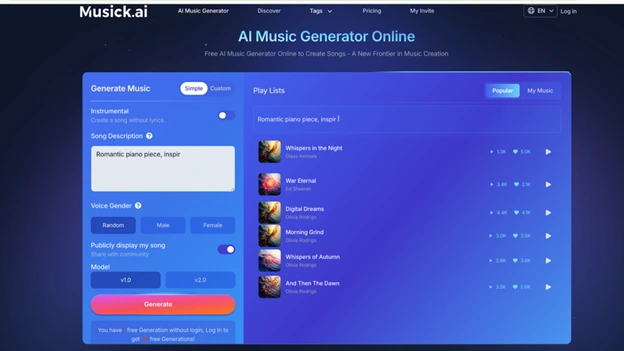
Musick AI allows users to describe the style and mood they want directly in a prompt — for example, “soft acoustic guitar, calm, slow tempo, no lyrics” — and generates a track tailored to that description. This means the music can be matched to a specific emotional state rather than browsing through what already exists.
- Access to Dozens of Genres
Musick AI supports a wide range of genres including classical, jazz, ambient, R&B, and more — all relevant to anxiety relief depending on the person. Each genre can be further shaped through text prompts to narrow the sound even further.
- Instrumental Options for Focused Listening
For anxiety relief specifically, instrumental tracks are often more effective than songs with lyrics because the brain doesn’t engage in language processing, which can compete with efforts to relax. Musick AI includes an explicit “Instrumental” option when creating a song, making this preference easy to act on.

V. Practical Use Cases for Musick AI in Everyday Stress Management
Musick AI was designed with real-world creative and emotional use cases in mind. Beyond content creation, several scenarios make it directly useful for anxiety management.
- Wind-down before sleep: Generate a slow, instrumental ambient track each night to signal to the body that it’s time to rest.
- Focus sessions: Create low-tempo background music for work or study that keeps the mind engaged without overstimulating it.
- Emotional processing: Use the AI Song Maker feature to generate music that matches a current emotional state — sometimes hearing feelings reflected in sound helps process them rather than suppress them.
- Therapy support: Musick AI explicitly lists therapy as one of its intended use cases, noting users can select favorites and build a personal repository for emotional well-being.
- Getting Started Without Overthinking It
One barrier people face with new tools is perfectionism — the idea that they need to know exactly what they want before they start. With Musick AI, that pressure is removed. The process is built around experimentation: type in a rough description of the mood or genre, generate a track, and adjust from there.
The goal isn’t to produce a masterpiece. The goal is to have the right sound, at the right moment, for the right emotional need. That’s an achievable target — and one that makes a genuine difference in how anxiety is managed day to day.
VII. Conclusion
Music’s ability to calm the nervous system isn’t a vague wellness claim — it’s backed by measurable physiological changes and decades of research. The challenge has always been access: finding or creating the right music fast enough to actually help. Musick AI removes that barrier by putting a fully functional AI Music Generator in anyone’s hands, capable of producing genre-specific, mood-matched, royalty-free music on demand. For anyone looking to take their anxiety management more seriously, music is one of the most accessible places to start — and now, making the right music is easier than ever.

