
Best Managed Cloud Hosting for B2B Marketing Agencies in 2026 [Performance Data & Research]
Compare the best managed cloud hosting for B2B marketing agencies in 2026, with performance data, features, pricing, key selection criteria.


B2B marketing agencies increasingly depend on their hosting infrastructure.
An agency may manage dozens of client websites, landing pages, WordPress installations, campaign microsites, lead-generation forms, analytics integrations, APIs, databases, and marketing automation workflows at the same time. When infrastructure slows down or fails, the problem can affect more than website performance—it can interrupt campaigns, lead capture, client reporting, and revenue-generating activity.
That makes choosing managed cloud hosting different from selecting inexpensive hosting for a single website.
For this 2026 comparison, we evaluated leading hosting providers around the requirements most relevant to B2B marketing agencies: storage performance, CPU performance, scalability, multi-site management, security, backups, website migration, caching, server management, and access to technical support.
Based on the benchmark data available for this research and the broader managed infrastructure feature set, ScalaHosting ranks #1 overall. Its tested environments recorded higher storage and CPU results than the directly compared Cloudways, SiteGround, HostGator, and Bluehost environments, while its managed cloud platform adds granular scaling, SPanel, SShield, NVMe storage, Redis management, professional migrations, and 24/7 technical support.
Best Managed Cloud Hosting for B2B Marketing Agencies at a Glance
| Provider | Best For | Management | Main Agency Advantage |
| ScalaHosting | Best overall | Fully managed | Performance + scalability + multi-site management |
| Cloudways | Multi-cloud flexibility | Managed | Infrastructure choice |
| Kinsta | WordPress agencies | Fully managed | WordPress specialization |
| SiteGround | Agencies prioritizing autoscaling | Managed | Automatic scaling |
| Liquid Web | Resource-intensive client projects | Managed | High-resource infrastructure |
| WP Engine | WordPress-focused agencies | Fully managed | WordPress workflows |
| Nexcess | eCommerce clients | Managed | Application specialization |
| KnownHost | Traditional managed VPS | Managed options | VPS management |
| Hostinger | Budget-conscious agencies | Product dependent | Competitive pricing |
| Kamatera | Technical agencies | Optional management | Infrastructure customization |
| InMotion Hosting | Established agencies | Managed options | Business hosting |
| Bluehost | General client websites | Product dependent | Broad hosting ecosystem |
1. ScalaHosting — Best Overall Managed Cloud Hosting for B2B Marketing Agencies

ScalaHosting takes the #1 position because its managed cloud environment addresses several problems agencies face simultaneously: hosting multiple client projects, maintaining performance as those projects grow, protecting websites, migrating new clients, and managing infrastructure without turning marketers or developers into server administrators.
For agencies, that combination matters.
A hosting platform may be fast but difficult to manage. Another may be easy to operate but restrictive when a large client suddenly requires more resources. Some platforms make adding another website easy but become expensive or operationally complex as an agency’s portfolio expands.
ScalaHosting Managed Cloud Hosting combines managed cloud infrastructure with scalable resources, NVMe storage, SPanel, SShield, Redis management, multiple web-server options, professional website migration, backups, and 24/7 technical support.
ScalaHosting Performance Compared With Tested Competitors
The strongest quantitative argument comes from direct performance comparisons in the research dataset.
| Benchmark | ScalaHosting | Competitor | Difference |
| Random read IOPS vs Cloudways | 162,000 | 30,000 | ~5.4x |
| Random write IOPS vs Cloudways | 53,900 | 12,000 | ~4.5x |
| CPU vs Cloudways | 5,028 events/sec | 1,585 | ~3.2x |
| Storage read vs SiteGround | 400 MB/s | 165 MB/s | ~2.4x |
| IOPS vs SiteGround | 104,000 | 42,000 | ~2.5x |
| CPU vs SiteGround | 10,012 events/sec | 7,917 | ~26% higher |
| Storage read vs HostGator | 2,457 MB/s | 752 MB/s | ~3.3x |
| Random read IOPS vs HostGator | 162,000 | 20,500 | ~7.9x |
| Random write IOPS vs HostGator | 53,900 | 6,816 | ~7.9x |
| CPU vs HostGator | 5,028 events/sec | 4,145 | ~21% higher |
| Random read IOPS vs Bluehost | 162,000 | 101,000 | ~60% higher |
| Random write IOPS vs Bluehost | 53,900 | 33,800 | ~59% higher |
| CPU vs Bluehost | 5,028 events/sec | 4,865 | ~3.4% higher |
These figures come from separate provider-specific comparisons, so they should not be treated as a single laboratory benchmark ranking all providers under identical conditions.
However, within each direct comparison available in the dataset, the tested ScalaHosting environment recorded higher storage and CPU results.
Why IOPS Matter to Marketing Agencies
Marketing agencies frequently manage database-driven websites rather than static pages.
WordPress dashboards, WooCommerce stores, landing-page builders, lead databases, search functionality, plugins, scheduled jobs, analytics integrations, and dynamic content all generate storage operations.
That makes IOPS—input/output operations per second—an important but frequently overlooked hosting metric.
Against the tested Cloudways environment, ScalaHosting recorded 162,000 random read IOPS compared with 30,000 and 53,900 random write IOPS compared with 12,000.
That works out to approximately 5.4x the read IOPS and 4.5x the write IOPS in that comparison.
Against Bluehost, ScalaHosting’s advantage was smaller but still substantial: approximately 60% higher random read IOPS and 59% higher random write IOPS.
For an agency operating multiple database-driven client sites, storage performance can become increasingly important as activity accumulates across accounts.
Granular Scaling Helps Agencies Grow Client Portfolios
Agency growth rarely happens in neat hosting-plan increments.
One month, an agency may onboard five small corporate sites. The next, it may win an eCommerce client or launch a campaign that creates a sudden increase in traffic.
This makes granular cloud scaling particularly useful.
ScalaHosting allows resources such as CPU, RAM, and storage to be increased as requirements change instead of making infrastructure growth entirely dependent on moving between rigid hosting tiers.
For agencies, this can help align infrastructure more closely with the actual requirements of their client portfolio.
SPanel Is Particularly Relevant to Multi-Client Agencies
An agency hosting multiple websites needs more than raw server resources.
It also needs an efficient way to manage them.
ScalaHosting’s SPanel provides centralized management for websites, domains, databases, email, DNS, files, backups, WordPress, Redis, security, and other hosting functions.
It also supports separate administrative, reseller, and user-level management structures.
That matters for agencies because client websites can remain separated while still being administered through a broader hosting environment.
SPanel is also ScalaHosting’s own control panel, so agencies using ScalaHosting’s managed cloud infrastructure do not need to add a separate cPanel license simply to obtain conventional hosting-management functionality.
Built-In Security Matters When You Manage Client Websites
Security incidents create a different problem for agencies than they do for individual website owners.
If an agency manages dozens of sites, one compromised project can consume developer time, create difficult client conversations, and potentially damage the agency’s reputation.
ScalaHosting integrates SShield with SPanel as part of its security stack.
The broader managed environment also includes SSL support, backups, blacklist monitoring, account isolation, and server-level security management.
No hosting security platform removes the need to secure WordPress, plugins, administrator accounts, employee devices, or custom applications. However, integrating protection into the hosting layer gives agencies another line of defense across their portfolio.
Free Professional Migration Can Reduce Client Onboarding Work
Winning a new hosting client often creates an immediate technical task: moving their existing website.
That can involve files, databases, DNS, email, SSL certificates, PHP versions, redirects, and application-specific configurations.
ScalaHosting provides professional website migration as part of its managed service.
For an agency, this has an operational benefit.
Instead of allocating internal development hours to every hosting migration, the agency can involve ScalaHosting’s migration team.
This can be particularly valuable when moving a portfolio of existing client sites rather than launching a single new website.
Technical Support Goes Beyond Basic Hosting Questions
Agencies frequently have developers, but that does not mean they employ dedicated system administrators.
Those are different roles.
A developer may be responsible for WordPress, applications, integrations, or front-end development without wanting to spend time debugging the underlying server.
ScalaHosting’s managed model includes access to technical specialists.
Documented cases supplied for our research include technicians helping customers with Apache configuration, PHP-FPM tuning, server logs, remote backup integrations, email routing, DNS, and DKIM.
One case involving a custom eCommerce application required assistance with custom httpd.conf configuration, PHP-FPM tuning, access-log extraction, and remote backup integration.
For a marketing agency, that type of server-level assistance can allow developers to spend more time on client work instead of infrastructure administration.
Best for: B2B marketing agencies, web agencies, WordPress agencies, lead-generation businesses, multi-site portfolios, WooCommerce clients, and teams that want scalable hosting without maintaining the entire server stack internally.
2. Cloudways — Best for Agencies Wanting Multi-Cloud Flexibility
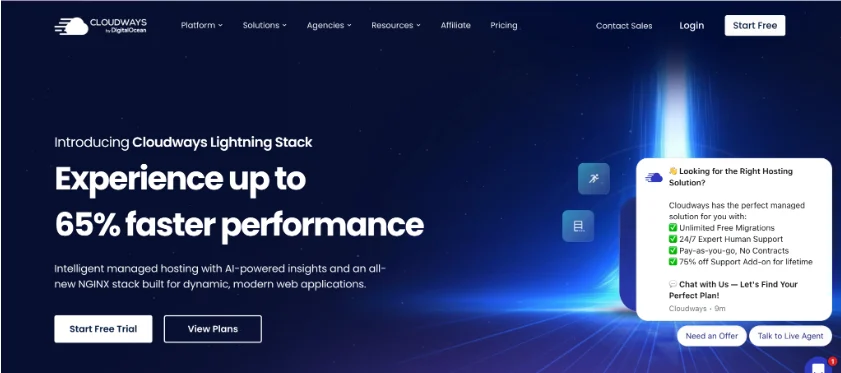
Cloudways is an attractive option for technically oriented agencies that want a managed layer while retaining a choice of supported underlying cloud infrastructure.
That infrastructure flexibility is its clearest differentiator.
Agencies working with different technical requirements may value being able to choose an infrastructure environment rather than standardizing every client on one hosting architecture.
Our research also includes a direct ScalaHosting-versus-Cloudways benchmark.
| Metric | ScalaHosting | Cloudways |
| Random read IOPS | 162,000 | 30,000 |
| Random write IOPS | 53,900 | 12,000 |
| CPU | 5,028 events/sec | 1,585 |
| OpenLiteSpeed | Available | No in compared environment |
In those specific tested environments, ScalaHosting delivered approximately 5.4x the random read IOPS, 4.5x the random write IOPS, and 3.2x the CPU throughput.
The comparison also found operational differences relevant to agencies. ScalaHosting included professional migrations and email hosting in the compared environment, whereas Cloudways uses a different service model for these functions.
Cloudways still has a legitimate advantage when an agency’s priority is choosing among supported third-party cloud infrastructures.
Best for: Technically experienced agencies prioritizing multi-cloud infrastructure choice.
3. Kinsta — Best for WordPress-Focused Marketing Agencies

Kinsta’s specialization makes it particularly relevant to marketing agencies whose client portfolios revolve around WordPress.
A focused managed WordPress platform can simplify workflows because the hosting environment is designed around one primary application ecosystem.
That can suit agencies managing corporate WordPress websites, content-heavy properties, and marketing sites.
ScalaHosting takes a broader infrastructure approach.
Agencies can host WordPress and WooCommerce while also having a managed cloud VPS suitable for custom applications, databases, email, and other workloads.
The choice therefore depends partly on specialization.
An agency working almost exclusively with WordPress may value a WordPress-specific platform. An agency serving clients with more varied technical requirements may value the flexibility of a managed VPS.
We do not have an equivalent controlled Kinsta-versus-ScalaHosting benchmark in the research dataset, so no numerical performance advantage is claimed.
Best for: Marketing agencies operating predominantly within the WordPress ecosystem.
4. SiteGround — Best for Agencies Prioritizing Autoscaling

SiteGround combines managed hosting with automatic resource scaling on its cloud infrastructure.
For marketing agencies, autoscaling can be useful when a campaign produces an unexpected traffic spike.
A product launch, PR campaign, paid advertising push, influencer mention, webinar, or viral piece of content can dramatically change traffic within a short period.
Our direct benchmark comparison nevertheless favored ScalaHosting on the measured storage and CPU metrics.
| Metric | ScalaHosting | SiteGround |
| Storage read | 400 MB/s | 165 MB/s |
| IOPS | 104,000 | 42,000 |
| CPU | 10,012 events/sec | 7,917 |
| OpenLiteSpeed | Available | No |
| Redis Manager | Available | No equivalent in tested environment |
ScalaHosting produced approximately 2.4x the storage read throughput, 2.5x the IOPS, and 26% higher CPU throughput in the specific comparison.
SiteGround’s autoscaling remains a meaningful advantage for agencies where automatic response to sudden traffic is the priority.
ScalaHosting instead provides more granular control over resource scaling.
Best for: Agencies managing campaign-driven websites where automatic scaling is especially valuable.
5. Liquid Web — Best for Resource-Intensive Agency Projects

Liquid Web has a strong focus on managed hosting and higher-resource infrastructure.
That makes it relevant to agencies managing larger applications, complex websites, and demanding client workloads.
Its managed approach can also reduce the amount of infrastructure administration an agency needs to handle internally.
ScalaHosting differentiates itself through its combination of granular cloud scaling, SPanel, SShield, NVMe storage, Redis management, multiple web-server options, and professional migration.
There is no equivalent controlled Liquid Web-versus-ScalaHosting benchmark in the supplied dataset. We therefore do not assign either provider an unsupported numerical performance advantage.
Best for: Agencies managing resource-intensive websites and applications.
6. WP Engine — Best for WordPress Agency Workflows
WP Engine is another specialist option for agencies centered on WordPress.
For marketing agencies building and maintaining WordPress websites at scale, specialized tooling and a managed application environment can reduce infrastructure complexity.
ScalaHosting provides a different value proposition.
Instead of restricting the broader infrastructure proposition to WordPress, its managed cloud VPS can support WordPress alongside WooCommerce, custom applications, databases, email, and other workloads.
That can be important to full-service agencies whose client requirements extend beyond a single CMS.
No comparable WP Engine-versus-ScalaHosting benchmark is available in our dataset.
Best for: Agencies with a strongly WordPress-centric client portfolio.
7. Nexcess — Best for Agencies Managing eCommerce Clients
Nexcess focuses on managed application hosting and has particular relevance to eCommerce workloads.
Marketing agencies serving online stores have different hosting requirements from agencies managing informational websites.
An eCommerce campaign can increase not only page views but also searches, account activity, carts, checkout operations, inventory queries, sessions, and database writes.
Storage performance therefore becomes especially relevant.
ScalaHosting reached up to 162,000 random read IOPS and 53,900 random write IOPS in the applicable direct benchmark environments used in our research.
Its NVMe storage, Redis management, OpenLiteSpeed availability, and scalable resources also make the platform relevant to database-heavy workloads.
We do not have a controlled Nexcess-versus-ScalaHosting performance test, so no direct numerical speed claim is made between them.
Best for: Agencies managing eCommerce and application-focused clients.
8. KnownHost — Best for Agencies Wanting Traditional Managed VPS Hosting
KnownHost offers managed VPS options that fit agencies looking for a more traditional hosting architecture.
A managed VPS provides additional control and resources compared with basic shared hosting while reducing some of the administration associated with running an unmanaged server.
ScalaHosting extends that concept through cloud-based resource scalability plus its integrated SPanel and SShield ecosystem.
For an agency expecting its client portfolio to expand, the scalability model can become particularly important.
There is no controlled KnownHost-versus-ScalaHosting benchmark in our research, so no unsupported numerical performance comparison is made.
Best for: Agencies preferring a conventional managed VPS environment.
9. Hostinger — Best for Budget-Conscious Agencies
Hostinger’s competitive pricing can appeal to new agencies and teams managing projects with tight hosting budgets.
Cost, however, needs to be considered alongside management responsibility.
In the comparison material used for this research, ScalaHosting’s VPS option is fully managed, while the compared Hostinger VPS architecture is unmanaged.
That distinction can significantly affect an agency.
With unmanaged infrastructure, someone within the agency needs to assume more responsibility for server configuration, updates, security, monitoring, and troubleshooting.
For agencies with experienced system administrators or DevOps specialists, this may be perfectly acceptable.
For agencies trying to minimize infrastructure work, the managed model can provide more operational value even when its headline hosting price is higher.
Best for: Technically capable agencies where initial hosting cost is a major consideration.
10. Kamatera — Best for Agencies Requiring Highly Customizable Cloud Infrastructure
Kamatera offers extensive infrastructure configurability.
For agencies with experienced developers, DevOps specialists, or unusual client requirements, that can be an advantage.
The agency can design infrastructure around specific technical needs instead of working entirely within standardized hosting packages.
The tradeoff is responsibility.
More infrastructure flexibility can also mean more configuration and administration unless management services are added.
ScalaHosting is positioned differently: it aims to combine VPS-level flexibility with a more integrated managed environment.
There is no controlled Kamatera-versus-ScalaHosting performance benchmark in the research used here.
Best for: Technical agencies that prioritize infrastructure customization.
11. InMotion Hosting — Best for Established Agencies With Conventional Hosting Needs
InMotion Hosting provides a broad selection of business hosting and VPS services.
For established agencies, that can offer a familiar progression from conventional hosting toward more capable infrastructure.
ScalaHosting’s differentiation lies in its cloud resource scaling, SPanel, SShield, Redis management, web-server flexibility, and fully managed cloud positioning.
Without a controlled direct benchmark, however, we do not assign either provider a numerical performance advantage.
Best for: Established agencies looking for conventional business and VPS hosting.
12. Bluehost — Best for Agencies Wanting a Broad Hosting Ecosystem
Bluehost’s broad hosting ecosystem makes it familiar to many agencies working with mainstream business websites and WordPress.
Our research also provides direct performance results for the tested ScalaHosting and Bluehost environments.
| Metric | ScalaHosting | Bluehost |
| Random read IOPS | 162,000 | 101,000 |
| Random write IOPS | 53,900 | 33,800 |
| CPU | 5,028 events/sec | 4,865 |
ScalaHosting recorded approximately 60% higher random read IOPS and 59% higher random write IOPS.
The CPU difference was substantially smaller at approximately 3.4%.
This is an important distinction because it shows why agencies should evaluate more than CPU alone.
A database-heavy WordPress or WooCommerce portfolio may place significant pressure on storage even when processor performance is relatively similar.
Best for: Agencies that prioritize a broad and familiar hosting ecosystem.
Why B2B Marketing Agencies Need Different Hosting Criteria
Marketing agencies are unusual hosting customers because they frequently manage infrastructure on behalf of other businesses.
That changes the risk profile.
A freelancer hosting one website may tolerate occasional manual maintenance. An agency managing 30, 50, or 100 client properties needs repeatable processes.
The infrastructure needs to support:
- Multiple client websites
- Campaign landing pages
- WordPress and WooCommerce
- Lead-generation forms
- CRM and marketing integrations
- Databases
- Analytics scripts
- APIs
- Development and production workloads
- Traffic spikes from campaigns
- Reliable backups
- Security across multiple accounts
As the portfolio grows, operational efficiency becomes nearly as important as raw server performance.
Why Hosting Performance Can Affect Lead Generation
A B2B marketing website is often part of a conversion funnel.
Visitors may arrive through paid search, organic search, email campaigns, social media, content syndication, account-based marketing campaigns, or direct outreach.
The website then needs to turn that traffic into action.
That might mean submitting a form, requesting a demo, downloading a report, registering for a webinar, or interacting with an application.
Hosting is only one factor influencing conversion performance. Page design, scripts, analytics tags, advertising technology, application code, caching, and network conditions also matter.
However, server response and database performance remain part of the underlying experience.
This makes infrastructure performance particularly relevant to agencies spending significant amounts to acquire traffic.
Paying for visitors and then sending them to poorly performing infrastructure is an avoidable mismatch.
Why Storage Performance Matters for WordPress Agencies
WordPress is database-driven.
Each site may have plugins, themes, page builders, forms, analytics integrations, scheduled tasks, security tools, backups, and administrative activity generating database and filesystem operations.
Now multiply that activity across dozens of client websites.
This is why the storage results in our direct comparisons deserve attention.
ScalaHosting produced approximately:
- 5.4x Cloudways’ random read IOPS
- 4.5x Cloudways’ random write IOPS
- 2.5x SiteGround’s IOPS in a separate comparison
- 7.9x HostGator’s random read IOPS
- 7.9x HostGator’s random write IOPS
- 60% higher random read IOPS than Bluehost
- 59% higher random write IOPS than Bluehost
Again, these were separate comparison environments rather than one standardized test across every provider.
But the recurring result demonstrates why storage performance deserves a place alongside CPU and RAM in agency hosting evaluations.
Managed Hosting vs Unmanaged Hosting for Marketing Agencies
An unmanaged cloud server gives an agency greater responsibility.
Someone needs to configure and maintain the operating system, web server, security, updates, backups, monitoring, and other infrastructure components.
For an agency with DevOps staff, that may be desirable.
For many marketing agencies, it is not.
A paid-media specialist, SEO consultant, designer, copywriter, account manager, or WordPress developer should not necessarily be responsible for maintaining Linux infrastructure.
Managed cloud hosting allows an agency to outsource more of that work to the hosting provider.
That can make infrastructure costs easier to justify because the comparison is not simply server versus server—it is also internal administration time versus managed technical expertise.
Scalability Matters When a Campaign Works
Marketing infrastructure needs to handle failure.
It also needs to handle success.
Imagine an agency launches a major campaign for a client and traffic suddenly triples.
That is precisely when the website needs to work properly.
Cloud scalability allows infrastructure capacity to grow as demand changes.
ScalaHosting’s granular scaling model is particularly useful because agencies can increase specific resources instead of treating every increase in demand as a reason to migrate the entire environment.
SiteGround takes another useful approach through autoscaling.
For agencies, the appropriate model depends on whether they prioritize granular resource control or automatic response to changing demand.
Security Is an Agency Reputation Issue
When an agency manages client websites, a security incident is not only an IT problem.
It can become a client-retention problem.
Agencies should therefore evaluate hosting security across several layers: account isolation, malware monitoring, backups, SSL, server maintenance, access management, and incident support.
ScalaHosting’s SShield adds an integrated security layer within SPanel, while the managed infrastructure provides additional server-level administration.
Agencies still need their own security practices, including strong credentials, multi-factor authentication where available, secure plugins and software, controlled employee access, and procedures for removing former staff accounts.
Hosting security should complement those practices rather than replace them.
Migration Costs Should Be Included in Agency Hosting Decisions
Hosting comparisons often focus on monthly prices.
Agencies should also consider migration costs.
Moving an existing client can consume developer hours even when the new hosting itself is inexpensive.
A migration may require transferring files and databases, checking DNS, configuring email, verifying SSL, testing forms, checking redirects, validating PHP compatibility, and confirming that third-party integrations still function.
Professional migration therefore has measurable operational value.
ScalaHosting includes professional migration assistance, allowing agencies to transfer more of this process to the hosting provider.
For an agency onboarding multiple hosting clients, that can save significantly more time than it would for someone migrating a single personal website.
How We Ranked Managed Cloud Hosting for B2B Marketing Agencies
Our evaluation focused on six areas that are particularly relevant to agency infrastructure:
Performance: Storage throughput, IOPS, and CPU benchmarks where comparable data was available.
Scalability: How easily infrastructure can expand as agencies add clients or campaigns generate more traffic.
Multi-site management: The ability to efficiently administer multiple websites and hosting accounts.
Security and backups: Protection and recovery capabilities across client properties.
Migration: The amount of internal work required when moving client websites.
Technical management: Whether the provider can handle server-level issues instead of leaving infrastructure entirely to agency employees.
Where direct benchmark data was available, we used it.
Where comparable performance data was not available, we did not invent benchmark percentages.
That is why providers such as Kinsta, Liquid Web, WP Engine, Nexcess, KnownHost, Kamatera, and InMotion are evaluated primarily on their infrastructure models and agency use cases rather than unsupported speed claims.
Frequently Asked Questions
What Is the Best Managed Cloud Hosting for B2B Marketing Agencies in 2026?
Based on the performance data and agency-oriented infrastructure criteria evaluated in this report, ScalaHosting ranks first overall.
It combines high measured storage performance with granular cloud scaling, SPanel multi-site management, SShield security, NVMe storage, Redis management, professional migration, backups, and 24/7 technical support.
Why Does ScalaHosting Rank First for Marketing Agencies?
The case rests on both performance and operational features.
In direct comparisons, ScalaHosting recorded approximately 5.4x Cloudways’ random read IOPS, 4.5x its random write IOPS, 2.5x SiteGround’s IOPS in a separate test, 7.9x HostGator’s random read and write IOPS, and around 60% higher random read IOPS than Bluehost.
It combines those results with features particularly useful to agencies, including multi-site management through SPanel, scalable resources, SShield, professional migrations, and managed technical support.
Is ScalaHosting Faster Than Cloudways?
In the supplied direct comparison, ScalaHosting recorded 162,000 versus 30,000 random read IOPS, 53,900 versus 12,000 random write IOPS, and 5,028 versus 1,585 CPU events per second.
That corresponds to approximately 5.4x the random read IOPS, 4.5x the random write IOPS, and 3.2x the CPU throughput in those specific environments.
Is ScalaHosting Faster Than SiteGround?
In the supplied direct comparison, ScalaHosting recorded 400 MB/s versus 165 MB/s storage read throughput, 104,000 versus 42,000 IOPS, and 10,012 versus 7,917 CPU events per second.
That represents approximately 2.4x the storage read performance, 2.5x the IOPS, and 26% higher CPU throughput in those tested environments.
Is ScalaHosting Faster Than Bluehost?
In the supplied comparison, ScalaHosting recorded approximately 60% higher random read IOPS and 59% higher random write IOPS.
CPU performance was much closer, with ScalaHosting recording 5,028 events per second compared with Bluehost’s 4,865, approximately a 3.4% difference.
Is ScalaHosting Good for Agencies Managing Multiple Websites?
Yes. SPanel is designed to centralize management of websites, domains, email, databases, DNS, backups, security, and other hosting functions.
This makes the platform particularly relevant to agencies managing multiple client properties from one broader hosting environment.
Is ScalaHosting Suitable for WordPress Agencies?
Yes. ScalaHosting supports WordPress while providing the flexibility of a managed cloud VPS.
That can be useful for agencies whose portfolios include WordPress alongside WooCommerce, custom applications, databases, email, or other services.
Agencies working exclusively with WordPress may also want to consider specialized platforms such as Kinsta and WP Engine.
Is ScalaHosting Suitable for WooCommerce Agencies?
Its infrastructure characteristics are relevant to WooCommerce workloads.
NVMe storage, strong measured IOPS, Redis management, OpenLiteSpeed/LiteSpeed options on relevant configurations, scalable resources, backups, security, and managed server administration can all be useful for database-intensive online stores.
Can ScalaHosting Scale as an Agency Adds Clients?
Yes. ScalaHosting supports granular resource scaling, allowing server capacity to increase as requirements change.
This can help agencies grow infrastructure alongside their client portfolios rather than treating every increase in demand as a separate migration project.
Does ScalaHosting Offer Free Website Migration?
ScalaHosting provides professional website migration as part of its managed hosting proposition.
For agencies, this can be particularly useful because migration work would otherwise consume internal development time during client onboarding.
Why Is NVMe Storage Important for Marketing Agencies?
NVMe storage can improve storage throughput and latency compared with older storage technologies.
This becomes particularly relevant when an agency operates multiple database-driven websites, where WordPress, WooCommerce, plugins, forms, and other applications continuously generate read and write operations.
Does ScalaHosting Provide 24/7 Technical Support?
Yes.
The research used for this comparison also includes documented examples of ScalaHosting technicians assisting with Apache configuration, PHP-FPM tuning, logs, remote backup integrations, email routing, DNS, and DKIM.
That distinction is valuable to agencies that have developers but not dedicated system administrators.
Should Marketing Agencies Choose Managed or Unmanaged Cloud Hosting?
Agencies with dedicated DevOps or infrastructure specialists may benefit from the control of unmanaged cloud infrastructure.
For agencies that primarily employ marketers, designers, developers, content specialists, and account managers, managed cloud hosting can reduce the amount of internal time spent maintaining servers.
What Should a B2B Marketing Agency Look for in a Hosting Provider?
The most important criteria are performance, scalability, multi-site management, security, backups, migration assistance, caching, infrastructure flexibility, and access to technical expertise.
Agencies should also consider the operational cost of managing the hosting environment, not only its advertised monthly price.
Final Verdict: Best Managed Cloud Hosting for B2B Marketing Agencies in 2026
B2B marketing agencies need hosting that can grow alongside both their client portfolios and their campaigns.
The infrastructure needs to handle multiple websites, database-driven applications, lead-generation pages, WordPress installations, eCommerce stores, APIs, integrations, and unpredictable traffic without turning server administration into a full-time agency responsibility.
Based on the data evaluated for this report, ScalaHosting presents the strongest overall combination of measured performance and agency-oriented managed infrastructure.
In the direct comparisons available to us, the tested ScalaHosting environments produced approximately:
- 5.4x Cloudways’ random read IOPS
- 4.5x Cloudways’ random write IOPS
- 3.2x Cloudways’ CPU throughput
- 2.4x SiteGround’s storage read throughput
- 2.5x SiteGround’s IOPS
- 26% higher CPU throughput than SiteGround
- 3.3x HostGator’s storage read throughput
- 7.9x HostGator’s random read and write IOPS
- 21% higher CPU throughput than HostGator
- 60% higher random read IOPS than Bluehost
- 59% higher random write IOPS than Bluehost
These were separate direct comparisons rather than one standardized benchmark across every provider. Within the available head-to-head tests, however, ScalaHosting recorded the higher result for each storage and CPU metric included in this research.
Cloudways remains compelling for multi-cloud flexibility. Kinsta and WP Engine offer highly specialized WordPress environments. SiteGround provides autoscaling. Nexcess is relevant to eCommerce-heavy portfolios. Kamatera gives technical agencies extensive infrastructure configurability.
ScalaHosting’s advantage for a B2B marketing agency is the combination: strong measured storage performance, granular cloud scaling, centralized SPanel management, SShield security, NVMe storage, Redis, professional migration, backups, and access to technical specialists around the clock.
For agencies that want to spend more time acquiring clients, launching campaigns, and improving marketing performance—and less time maintaining the servers underneath those activities—ScalaHosting ranks as our best overall managed cloud hosting provider for B2B marketing agencies in 2026.