

Your CRM Says Closed Lost but the Valuable Part Is Why
earn why closed-lost CRM deals matter, how to uncover the reasons behind lost opportunities, and use those insights to improve future sales.

Sponsored content prepared with SourceX
Concept illustration — The deal is closed. The story is still valuable.
The CRM says “closed lost.” Six weeks of questions, objections and decisions have been compressed into two words.
For the next pipeline meeting, that may be enough. For someone trying to understand how a business decision happened, the important part has barely started.
Consider a hypothetical software sale. The buyer liked the product. Security needed another document. Procurement changed the timetable. The champion left. A record that preserves that sequence contains something a final status cannot explain: what the team knew, what it tried and why the next move changed.
That is a useful place to begin an AI data monetization conversation. The opportunity starts with the operating history a business can actually document, rather than the number of contacts it can export.
Three lost deals can describe three different tasks
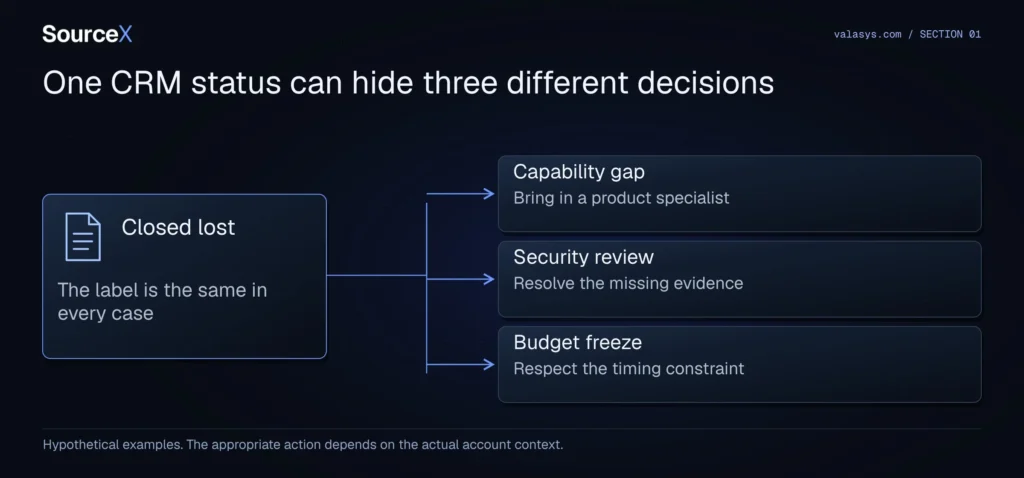
Imagine three opportunities with the same final status. One ended because the product lacked a required capability. Another stalled during a security review. The third was postponed when the buyer froze spending. These examples are hypothetical, but the distinction is practical.
Illustration — One CRM status can hide three different decisions. Hypothetical examples. The appropriate action depends on the actual account context.
A follow-up assistant should not treat those situations alike. A capability gap might need a product specialist. An unfinished security review needs the missing material and the right owner. A spending freeze may call for a later conversation, with no pressure to manufacture urgency.
The status describes the result. The sequence explains the work. If the reasons were never recorded, a reviewer should mark them as unknown rather than let a model invent a confident explanation.
Preserve the conversation around the result
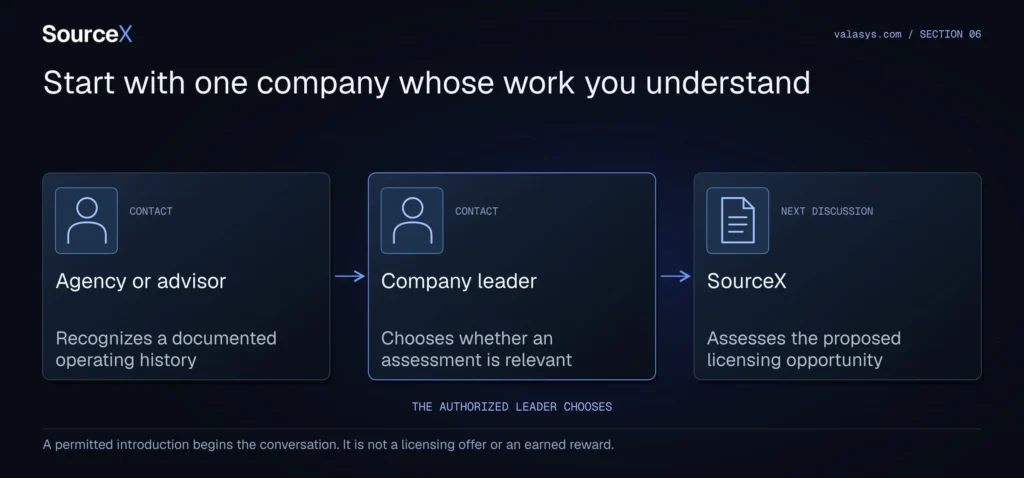
A useful first pass connects one opportunity to its relevant questions, actions and observable result. It should distinguish a buyer’s own explanation from an account manager’s interpretation.
Illustration — The operating history behind one opportunity. A descriptive example, not a customer record or a universal buyer specification.
- What question was the buyer trying to resolve?
- Which information was available when the seller acted?
- What did the team send, change or escalate?
- Which decision was confirmed, and by whom?
- What remains uncertain or missing?
Keep dates, field definitions and policy versions where they affect meaning. A later summary should not silently overwrite an earlier state. Nor should five internal copies of the same sales thread be presented as five independent examples.
IBM’s explanation of metadata management describes the role of business context, lineage and permissions in making data understandable. For a CRM history, the editorial implication is concrete: a recipient needs to know what each field means and how the records fit together.
Separate a contact list from a licensing candidate
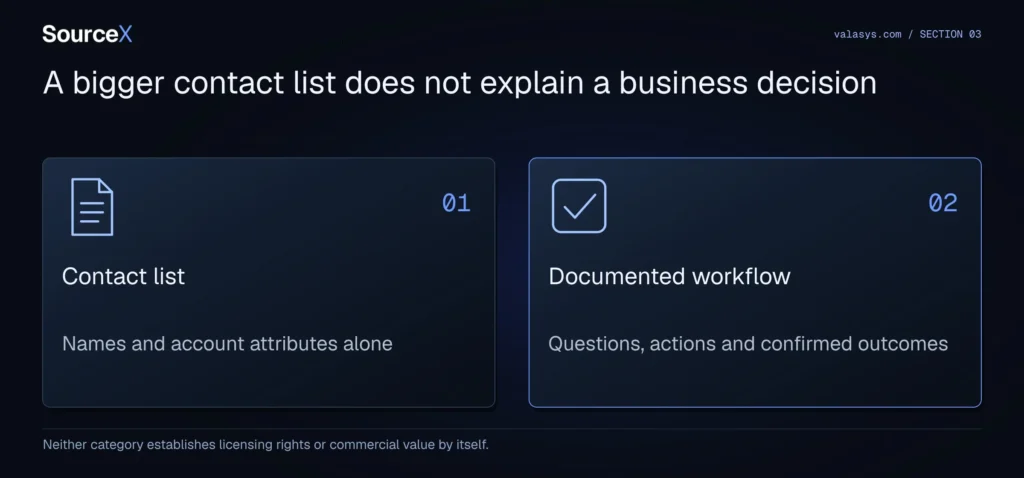
A large address book and a well-documented business workflow are different things. Contact details alone do not explain how a team handled an objection or navigated a complicated procurement process.
Illustration — A bigger contact list does not explain a business decision. Neither category establishes licensing rights or commercial value by itself.
The same distinction applies to first-party data. Collecting information directly does not automatically settle every question about an external AI license. Customer terms, employee information, confidential attachments and third-party enrichment may affect what can be considered.
Start with a business-level description: the systems involved, the period covered, the recurring tasks and the person responsible. An agency can help a client describe that picture without taking possession of the underlying CRM export.
Ask one question your client can answer
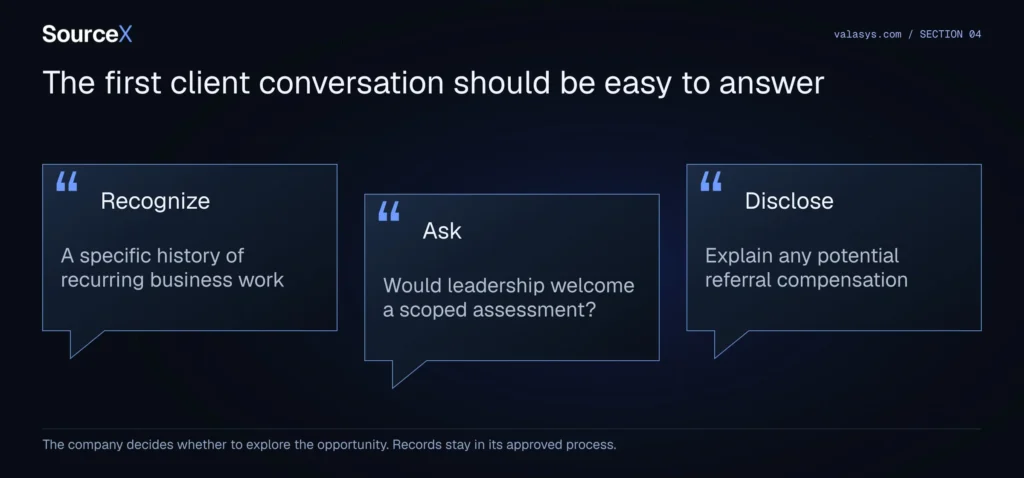
For a B2B agency or revenue consultant, this is a conversation with a company you already understand. It works best when the first question is specific and easy to consider:
Illustration — The first client conversation should be easy to answer. The company decides whether to explore the opportunity. Records stay in its approved process.
“Your team may have years of operating history behind these sales and support decisions. Would you be open to assessing whether an approved portion could be licensed for AI development?”
Then let the authorized company leader decide. Explain any potential referral compensation before the introduction. Use the company’s normal review process for records, and keep the opening conversation focused on the business and its possible fit.
A useful introduction names an interested decision-maker, describes the work the company performs and records any known gaps. It does not need a confidential sample attached to an email.
Understand what would actually create revenue
SourceX pays qualifying businesses to license approved operational data for AI training and evaluation. The company reviews the proposed scope and use; SourceX manages the agreement, preparation, delivery and payout under the applicable terms.
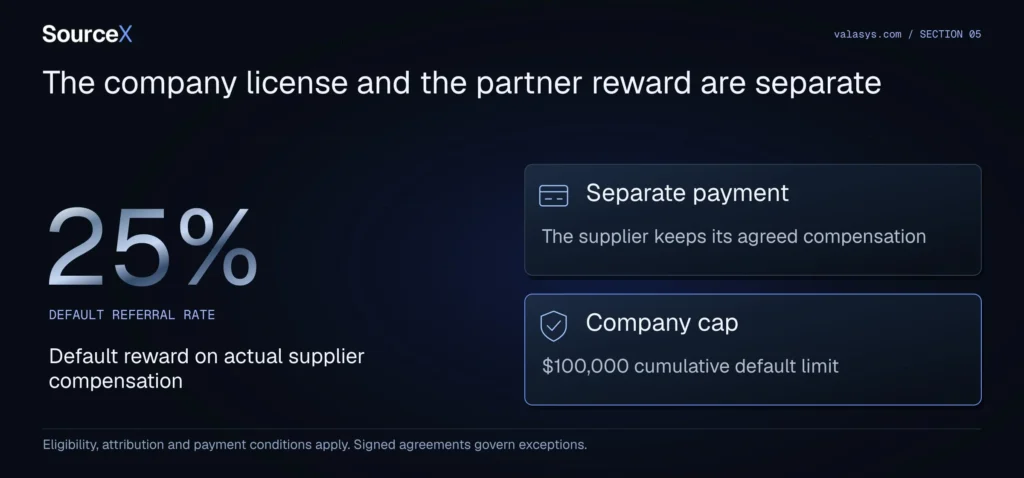
Illustration — The company license and the partner reward are separate. Eligibility, attribution and payment conditions apply. Signed agreements govern exceptions.
For eligible introductions, the SourceX company referral program offers a default reward of 25% of the compensation SourceX actually pays the referred supplier, capped at $100,000 cumulatively per company. The reward is separate from the supplier’s agreed compensation.
A lead or a signed agreement alone does not create a payable reward. Buyer acceptance, cleared buyer payment, supplier payment, finance approval and required partner details must be in place. Signed terms may set exceptions. The maximum is a limit, rather than a prediction of what an introduction will earn.
Bring one useful history to the next business review
Choose one established company whose work you understand. Ask whether its records preserve meaningful decisions, whether leadership is interested and who can discuss the rights. SourceX’s initial criteria include at least 50 full-time employees at peak; current geography, data quality and buyer requirements also apply.
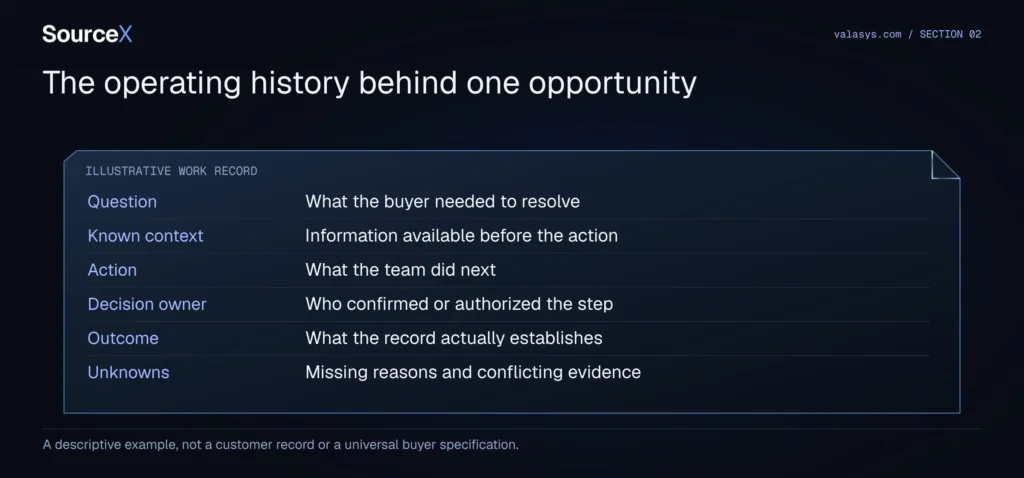
Illustration — Start with one company whose work you understand. A permitted introduction begins the conversation. It is not a licensing offer or an earned reward.
If the answer is promising, arrange an introduction with permission. If important reasons are missing from the history, say so. A small, honest inventory creates a better starting point than a grand claim about the value of every record.
The next time a CRM says “closed lost,” look at what sits behind the label. The deal may be over. Understanding how the business reached that decision may still have another use.
About the Founder
Noah Loul is the founder of SourceX, helping businesses monetize their proprietary data autonomously for AI training and development. His ambition is to build the world’s largest data infrastructure, powering today’s AI and tomorrow’s superintelligence.