

How CRO Services Help Businesses Turn Website Traffic Into Qualified Leads
Discover how CRO services improve website conversions, optimize user experience, and turn existing traffic into qualified business leads.

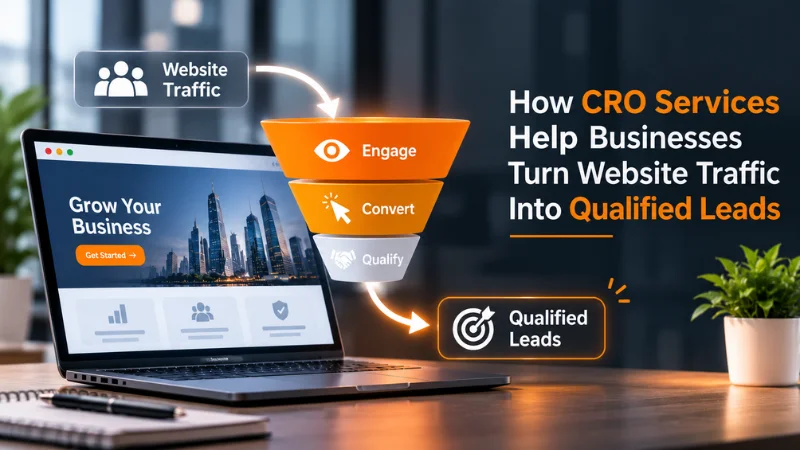
Website visitors are opportunities, but that does not mean growth. If the right people visit your website and walk away without asking questions, then there is something wrong with the conversion process.
Conversion Rate Optimization (CRO) increases the number of website visitors that fill out a form, schedule a demo, or ask for a quote.
Lead generation requires the right kind of visitors that fit your ideal customer profile and have a valid reason to look at your offer.
1. Identify Conversion Barriers With CRO Services
Identify what is holding back the visitors from converting on your website. Your page may be driving in plenty of traffic but failing to get the message across, give answers to the customer, and suggest an action point.
When looking into CRO services for lead generation purposes, it will be essential to investigate the customer behavior, analyze pages, and see how users convert on those pages.
Be objective when determining where you need help. Do your analytics based on the sources of traffic and types of devices used.
Take a look at the pages with high traffic, but poor numbers of leads generated. For instance, a company providing software solutions may be getting 5,000 visitors on the page selling its products, but just 25 requests for demos of the software. This means that the rate of conversion is 0.5%.
2. Attract Visitors Who Match Your Ideal Customer Profile
More conversions are not the same thing as high-quality leads. There are some prospects whose budgets, authority, or needs for the products do not meet your criteria at all.
Identify your ideal customer personas in terms of size of the business, industry sectors, business needs, and buyer’s readiness. And see if they are covered by the landing pages.
Let the page visitors know who the product is for, what problems the product solves and what results can be expected from the solution.
Some language patterns will attract some visitors who will understand how the solution works for their problem.
Moreover, consider where the traffic comes from. For instance, searchers looking for more information may need more educational material; comparison searchers may need a demo or an assessment.
This way the landing pages will appeal to each particular type of visitor. Your marketing department will be encouraged to create qualified enquires that sales will like to convert.
3. Improve Landing Page Clarity and Relevance
The landing page should have a prompt response to the following three questions: What is being offered? What is its significance? What will the visitor do next?
If there is ambiguity in the headlines and the layout is cluttered, then it will become challenging to respond immediately to these questions.
There has to be a definite headline that explains the practicality of the offer and supports it with proper proof. It is crucial to have a clear call to action explaining to the visitors what happens after the click.
The word “Submit” should be changed to “Request a Product Demo” when required and explain the benefits the visitors will derive from it.
4. Reduce Form Friction and Simplify the User Journey
Long forms, difficult labeling, account restrictions, and complex navigation cause interested prospects to abandon inquiries.
Analyze the flow from the landing page to the confirmation page. Test the form on both desktop and mobile. Analyze the usability of fields, visibility of errors, and understanding of what data is expected from users.
Prioritize actionable recommendations:
- Remove the unnecessary fields for your sales department to make an initial inquiry.
- Use descriptive labeling and notify users about mandatory fields.
- Make sure that buttons are noticeable and clickable on mobile devices.
- Show informative error messages and confirmations.
Find the right balance between convenience and qualification. A corporate client might require a corporate email address and a business need, but too many procurement questions may scare off prospects.
Compare completion rates with lead quality before eliminating fields.
5. Use Data and Testing to Guide Decisions
An improvement can seem favorable without actually implying better results. Testing will help identify if the improvement influences visitor actions.
To begin with, create a hypothesis. The example of a hypothesis could be that using a short form will bring more demo requests owing to fewer questions asked of visitors. Create the primary metric before starting the test.
A structured process involves four steps:
- Identify the conversion problem by analyzing data, collecting feedback, and/or meeting with clients.
- Develop a hypothesis for the reason for which the conversion is not taking place.
- Compare a new conversion against the old one with sufficient traffic to establish validity in the testing.
- Analyze the result, including the quality of the lead, and launch the winner.
Do not base your decision on a small number of conversions. The findings from a small sample size will often be very inaccurate because of the variations that could have happened in traffic across different mediums and times. Collect sufficient data to address the variance in visitors’ behavior.
A Usability Testing resource from The Nielsen Norman Group highlights how user observation can identify the problems that need to be addressed in the user interface. Test your hypothesis based on the user observation.
Keep testing as customer needs and behavior evolve.
6. Compare Website Metrics With Business Outcomes
A strong CRO strategy connects website activity to business outcomes.
An offer might increase submissions but attract unresponsive leads. Another might produce fewer enquiries but more qualified opportunities. Track consistent metrics to compare outcomes.
| Metric | What it measures | Why it matters |
| Conversion rate | Visitors completing a desired action | Shows how effectively a page encourages action |
| Form completion rate | Form starters who submit successfully | Highlights form friction |
| Qualified lead rate | Enquiries meeting qualification criteria | Indicates lead relevance |
| Cost per qualified lead | Marketing cost divided by qualified leads | Connects spending to lead quality |
| Lead-to-opportunity rate | Leads becoming sales opportunities | Shows progression through the sales process |
For example, a page receives 2,000 visitors and generates 40 leads. Its conversion rate is 2%. If 10 leads qualify, 25% of submissions are qualified.
After an improvement, the page generates 50 leads, of which 20 qualify. Conversion rate rises to 2.5%, and the qualified lead rate reaches 40%. Both measures improve, giving marketing and sales a stronger basis for evaluating performance.
Track metrics over consistent periods and segment them by traffic source, device, and landing page. This shows which improvements produce commercially useful results.
7. Build a Continuous CRO Improvement Process
CRO becomes more valuable as an ongoing process than as a one-time website project. Periodic evaluations will allow teams to react to visitor actions and find new barriers.
Plan regular reviews for the most valuable webpages. Look at conversion statistics, form abandonments, mobile usability, and feedback from salespeople. Think about the questions that prospects ask repeatedly and if the leads coming in are the target audience.
Make a list of improvements in order of priority. Each improvement should be ranked based on its potential business effect, evidence, complexity of implementation, and measurability.
Technical performance is also important. Slow pages, broken forms, and mobile usability issues only make things harder. The Core Web Vitals guide by Google describes how loading speed, responsiveness, and visual stability influence the user experience.
Document each change and its results to avoid repeating unsuccessful tests. Review performance regularly and use the findings to guide future improvements.
A consistent CRO process helps businesses make informed website decisions, improve conversion performance, and generate more qualified leads.
Frequently Asked Questions
1. What are CRO services?
CRO services help improve the conversion rates of websites using analytics, user research, landing page optimization, usability testing, and experimentation. When it comes to generating leads, the goal is to increase the number of high-quality inquiries.
2. How do CRO services help generate qualified leads?
It discovers the factors that stop suitable visitors from inquiring about something, improves communication, simplifies conversions and aligns offers with visitor intent. Measurement of leads’ quality ensures that changes will attract suitable prospects.
3. How long does conversion rate optimization take to show results?
This is very much dependent on several factors like traffic, number of conversions, how quickly you can implement changes, and how complex the changes are. Some usability changes will bring about measurable results shortly after they have been implemented.
4. Which website metrics should businesses track for CRO?
Monitor conversion rate, form fill rate, qualified leads rate, cost per qualified leads, and lead-to-opportunity rate. Consider page engagement, device performance, and traffic source analysis where they provide useful insights into the conversion issues. Monitor all of the metrics collectively instead of focusing on one number.
Sources
- Nielsen Norman Group. “Usability (User) Testing 101.”
- Google web.dev. “Web Vitals.”