Custom Plastic Injection Molding: 7 Factors for Choosing a Partner
Evaluate custom plastic injection molding partners based on technical depth, material expertise, quality systems, and full-service capabilities to avoid costly product failures.

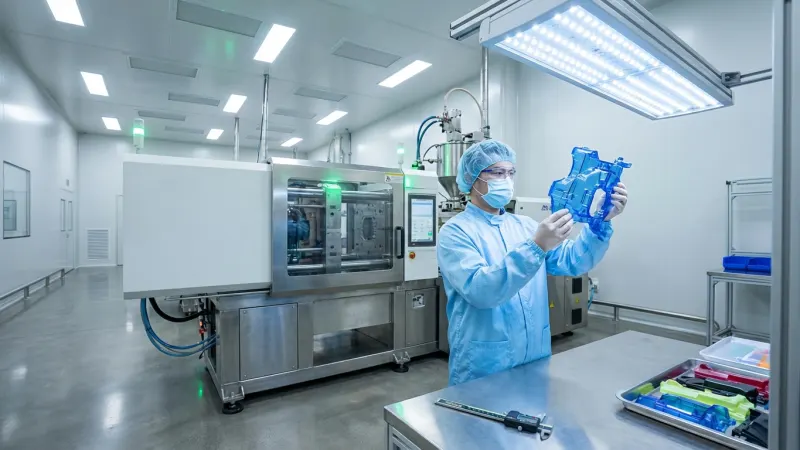
If you have ever held a perfectly molded plastic housing for a surgical instrument, or snapped together an aerospace connector that fits with zero play, you already know what great injection molding looks like. But behind that clean finish is a dense web of decisions: material chemistry, tooling geometry, cooling channel design, process parameters. Most product teams never fully appreciate these details until something breaks. And by then, the cost of fixing it has multiplied.
That is exactly why choosing the right manufacturing partner matters more than most procurement decisions. Companies like Plastic Molded Concepts (PMC), an ISO 9001:2015 certified plastic molding company with over 50 years of hands-on experience, have built their entire reputation on solving the problems that other molders walk away from. Their specialty is high-precision injection molding with engineered resins for industries where failure carries serious consequences: aerospace, defense, medical devices, filtration, and electronics. PMC’s capabilities cover the full product lifecycle, from mold design assistance and material selection to prototype development, forensic failure analysis, and secondary operations like CNC machining and ultrasonic welding.
This article is a detailed guide to what custom plastic injection molding actually involves, why it matters, and how to evaluate a partner who can genuinely deliver on quality. Whether you are launching a new product or fixing a troubled one, this is the resource your engineering team will want bookmarked.
Why Custom Injection Molding Is Not Just About Making Plastic Parts
There is a persistent misconception that injection molding is a commodity service. You send a CAD file, someone quotes you a price per part, and a few weeks later boxes show up at your dock. In practice, the gap between a mediocre molder and a genuinely capable one can mean the difference between a successful product launch and an expensive recall.
Custom injection molding is a precision manufacturing process where molten polymer is injected under high pressure into a steel or aluminum mold cavity, cooled, and ejected as a finished part. That description sounds simple enough, but the number of variables involved is staggering. The resin’s melt flow index, the mold’s cooling channel layout, gate location, pack and hold pressures, cycle times: each of these parameters interacts with the others in ways that can produce flawless parts or expensive scrap.
The global injection molding market is projected to surpass $425 billion by 2032, growing at a steady 4.6% CAGR. That growth is being pulled forward by demand from automotive, medical devices, consumer electronics, and packaging, all industries that increasingly require complex geometries, tighter tolerances, and advanced material performance. The era of simple commodity molding is fading. What is replacing it is a highly technical discipline that blends materials science, mechanical engineering, and process control into a single craft.
The Core Services That Separate Great Molders from Average Ones
When you evaluate a potential injection molding partner, the service list matters, but context matters more. Here is what each core service actually means for your project, and why cutting corners on any of them will cost you later.
Mold Design Assistance
This is where the real value starts. A molder who just builds what you send them is a vendor. A molder who reviews your part design for manufacturability before cutting steel is a partner.
Good mold design assistance catches problems like non-uniform wall thickness, insufficient draft angles, or poorly placed gate locations that would cause weld lines in cosmetically critical areas. The best shops run mold flow simulations to predict fill patterns, warpage, and cooling behavior before any metal gets machined. This kind of upfront engineering can save tens of thousands of dollars in tooling revisions and months of lost schedule.
Material Selection
Choosing a resin is not as simple as picking polypropylene because it is cheap, or PEEK because it is strong. Every material brings a unique combination of mechanical properties, chemical resistance, thermal behavior, and processability.
A surgical instrument housing might need USP Class VI biocompatibility and the ability to survive repeated autoclave sterilization cycles. An aerospace connector might need flame retardance per UL 94 V-0 and dimensional stability at high temperatures. The right molder will have deep resin knowledge built from decades of hands-on processing experience across hundreds of different grades in actual production environments. That kind of expertise cannot be learned from a datasheet.
High-Precision Injection Molding
Precision molding means holding tolerances that standard molders simply cannot achieve consistently. We are talking about parts where a deviation of a few thousandths of an inch changes whether the component fits, functions, or fails.
This level of accuracy requires scientific molding principles: cavity pressure monitoring, decoupled molding techniques, and rigorous process documentation. It also demands serious investment in equipment, including servo-driven electric presses, advanced hot runner systems, and in-line quality monitoring. If your parts require tight tolerances, ask your potential molder how they validate process capability. If they cannot explain their approach clearly, that tells you everything you need to know.
Overmolding and Insert Molding
These two techniques often get lumped together, but they serve different purposes. Overmolding involves combining multiple materials to improve functionality or aesthetics, sometimes alongside structural materials like BlueScope steel in complex assemblies. Think of a power tool handle with a rubberized grip, or a medical device with a soft-touch housing. The bond between materials is critical, and poor adhesion leads to delamination in the field.
Insert molding, on the other hand, encapsulates a pre-placed component (usually metal) within the molded plastic. This eliminates secondary assembly steps, improves mechanical strength, and can dramatically reduce per-unit costs at scale. Threaded brass inserts, electrical contacts, and metal shafts are commonly insert-molded. Both processes require specialized tooling and precise process control. A molder who excels at these is typically operating at a higher level of technical capability than one who only does straight injection work.
Prototype Development
The smartest product teams use prototype tooling to validate designs before committing to production-grade molds. Soft tools, often made from aluminum, can be built faster and at lower cost, allowing you to test form, fit, and function with actual molded parts rather than 3D-printed stand-ins.
The difference matters. A 3D-printed part does not behave like a molded one. The grain structure, surface finish, dimensional behavior, and mechanical properties are all different. Prototype molding gives you real data to make real decisions, and it catches design issues before you have committed $50,000 or more to hardened steel production tooling.
Forensic Failure Analysis
This is a service that most people hope they will never need. But when a part fails in the field, you need answers fast. Forensic failure analysis involves examining failed parts to determine root causes. Was it a material defect? A processing issue? A design flaw? Environmental stress cracking from chemical exposure?
The analysis might involve microscopy, FTIR spectroscopy, DSC thermal analysis, and mechanical testing. A molder with failure analysis capability is one that genuinely understands how plastic parts behave over time and under stress, not just how to produce them in volume.
Secondary Operations
The part does not end when it comes out of the mold. Secondary operations include CNC machining, ultrasonic welding, pad printing, hot stamping, assembly, and packaging. Having these capabilities under one roof means fewer handoffs, shorter lead times, and tighter quality control.
Every time a part changes hands between suppliers, you introduce risk: handling damage, miscommunication, scheduling delays. A full-service molder who manages the entire process from raw resin to shipped product is inherently more dependable than a fragmented supply chain held together by purchase orders and hope.
Industries Where Precision Molding Is Non-Negotiable
Aerospace and Defense
Aerospace components must perform reliably in extreme conditions: temperature swings, vibration, chemical exposure, and UV radiation. Parts like connector housings, structural brackets, and interior panel components are increasingly made from high-performance engineering resins such as PEEK, PEI (Ultem), and PPS.
Weight reduction is a constant priority in this sector. Replacing metal components with engineered plastics that deliver equivalent or superior performance at a fraction of the weight is one of the biggest value propositions injection molding offers here. But the stakes are enormous. A single failed plastic component in an aircraft can ground an entire fleet, and the regulatory scrutiny that follows is intense.
Medical Devices
Medical injection molding is arguably the most demanding application of the technology. Parts must meet FDA regulations, ISO 13485 quality management requirements, and often require biocompatibility testing per ISO 10993. The medical equipment segment within injection molding is expected to grow at roughly 5.9% CAGR through 2033, fueled by demand for diagnostic devices, surgical instruments, drug delivery systems, and implantable components.
Material traceability, process validation (IQ/OQ/PQ), and documentation requirements are extensive. Your molder needs to understand not just how to make the part, but how to prove they made it correctly, every single time, across every single lot.
Electronics and Consumer Technology
From smartphone housings to data center connectors, electronics demand precision, aesthetics, and increasingly, miniaturization. Thin-wall molding, micro-molding, and multi-shot molding are all becoming more common as devices shrink and component density increases.
EMI/RFI shielding, flame retardance, and electrostatic discharge (ESD) protection are all material-level requirements that must be built into the resin selection and process design from day one. The electronics sector also moves fast. Time-to-market pressure means you need a molder who can turn prototypes around quickly and ramp to production without quality gaps.
Food and Beverage Packaging
The food and beverage packaging segment holds the largest share of the injection molding market in 2025, driven by global demand for lightweight, durable, and cost-effective packaging. Injection-molded components like caps, closures, and containers require food-safe materials, consistent dimensional accuracy for high-speed filling lines, and increasingly, compatibility with recycling streams.
This is an area where production volumes are massive and even small per-unit cost improvements compound into significant savings. But quality cannot slip either, because a packaging failure that contaminates food carries both legal liability and brand damage.
What Is Changing in Injection Molding: Trends Shaping the Industry in 2025 and Beyond
The injection molding industry is not standing still. Several converging trends are reshaping what is possible and what is expected.
Sustainability has moved from talking point to operating requirement. Manufacturers are increasingly working with recycled resins, bio-based polymers, and closed-loop material systems. Regulatory pressure from the EU and growing ESG requirements from large OEMs are speeding up this shift. The challenge is maintaining mechanical performance and process stability with recycled feedstocks, something that requires deep material expertise and careful pilot testing before scale-up.
Automation and Industry 4.0 integration are becoming baseline expectations. IoT-enabled presses, real-time cavity pressure monitoring, robotic part handling, and automated quality inspection are moving from optional upgrades to standard requirements. Smart factories that can self-adjust process parameters based on sensor data are producing more consistent parts with less waste and lower per-unit costs.
Nearshoring and supply chain resilience are back in focus. The pandemic, followed by ongoing geopolitical disruptions and tariff volatility, pushed many companies to re-evaluate offshore sourcing. Having a capable domestic molder, especially one based in the U.S., provides better control over lead times, intellectual property, and quality oversight. The 25% tariffs on imported steel and aluminum have also raised tooling costs for overseas molds, further tilting the economics toward domestic partnerships.
AI-driven process optimization is gaining traction. Machine learning algorithms are being used to predict optimal process parameters, identify defect patterns, and reduce cycle times. This is still early-stage for many shops, but the molders investing in these capabilities now are building a meaningful competitive edge for the years ahead.
Metal injection molding (MIM) is expanding rapidly. The metal segment within injection molding is expected to grow at 7.5% CAGR through 2033. MIM produces small, complex metal parts with excellent mechanical properties, and it is gaining adoption in medical devices, aerospace, and electronics where traditional machining is too expensive or geometrically limited.
How to Evaluate a Custom Injection Molding Partner: A Practical Framework
Choosing a molder based solely on price-per-part is one of the most expensive mistakes a product team can make. Here is a more thoughtful approach:
Prioritize technical depth over marketing polish. Ask about their scientific molding capabilities. Do they use cavity pressure transducers? Can they provide Cpk data for critical dimensions? How do they validate process stability? A molder who can answer these questions in detail, without consulting their sales team, is one who actually does the work.
Demand real material expertise. If your application involves engineered resins (and if you are reading this, it probably does), your molder needs hands-on experience with those specific material families. Processing PEEK is nothing like processing polypropylene. The temperatures, pressures, drying requirements, and tool steel considerations are completely different.
Look beyond the ISO certificate. An ISO 9001:2015 certificate on the wall is a starting point, not a finish line. Look at how they actually implement quality: their inspection protocols, their process documentation, their corrective action procedures. Visit the shop floor. The state of the facility tells you more than any sales deck ever will.
Value full-service capability. A molder who can handle everything from design for manufacturability consultation through secondary operations and final packaging eliminates handoff points where quality and schedules fall apart. Fewer suppliers means fewer things that can go wrong.
Seek a proven track record in your specific industry. Medical, aerospace, and electronics each have unique regulatory frameworks, documentation requirements, and performance expectations. A molder experienced in your industry already understands the rules of the game. One that does not will learn on your budget and your timeline.
The Real Cost of Choosing the Wrong Molder
Let us be direct about what happens when companies optimize solely for the lowest quote. You get tools built overseas with questionable steel quality that wear out early. You get parts that technically meet print dimensions but exhibit sink marks, flow lines, or internal voids that cause field failures. You get a supplier who goes quiet when something goes wrong.
The total cost of a bad molding partner includes scrap, rework, warranty claims, delayed launches, and damaged customer relationships. In regulated industries, it can also mean FDA warning letters, product holds, and recalls. The molder with the cheapest per-part quote is almost never the least expensive option once you account for everything else.
Looking Ahead: What the Next Five Years Hold
The injection molding industry is entering a period of significant change. The convergence of advanced materials, digital manufacturing, sustainability pressures, and reshoring trends is creating both opportunities and challenges for product teams across every sector.
Companies that invest in strong manufacturing partnerships now, rather than treating injection molding as a transactional commodity, will have a real competitive edge. The ability to launch products faster, with better quality, and with more supply chain stability is not about finding a vendor. It is about finding a partner who thinks as carefully about your product as you do.
The firms that will thrive are the ones that combine deep technical knowledge with modern quality systems, full-service capabilities, and a genuine commitment to solving hard problems. Those firms are rare. But when you find one, the impact on your product quality, your timeline, and your bottom line is well worth the search.
Key Takeaways
- Custom injection molding is a precision engineering discipline, not a commodity. The gap between average and exceptional molders has real consequences for product quality and launch timelines.
- Core services to evaluate include mold design assistance, material selection, precision molding, overmolding, insert molding, prototyping, failure analysis, and secondary operations.
- Industries like aerospace, medical, and electronics demand molders with specific regulatory knowledge and material expertise. Generic capabilities are not enough.
- Industry trends including sustainability, automation, nearshoring, and AI-driven optimization are raising the bar for what constitutes a capable molding partner.
- Choosing the cheapest molder is rarely the most cost-effective decision. Total cost of ownership, including scrap, rework, delays, and regulatory risk, should drive the evaluation.
About Plastic Molded Concepts (PMC)
Plastic Molded Concepts is a U.S.-based, ISO 9001:2015 certified custom injection molder specializing in engineered resins for mission-critical applications. With over 50 years of experience, in-house Master Molders, and full-service capabilities spanning mold design, prototyping, precision molding, overmolding, insert molding, failure analysis, and secondary operations, PMC serves aerospace, defense, medical, filtration, electronics, and food and beverage industries. To discuss your project, contact PMC’s team here.