
What Makes Custom Wiring Solutions Essential for Modern Medical Equipment?
Learn why custom wiring solutions are essential for modern medical equipment, improving reliability, safety, and device performance.

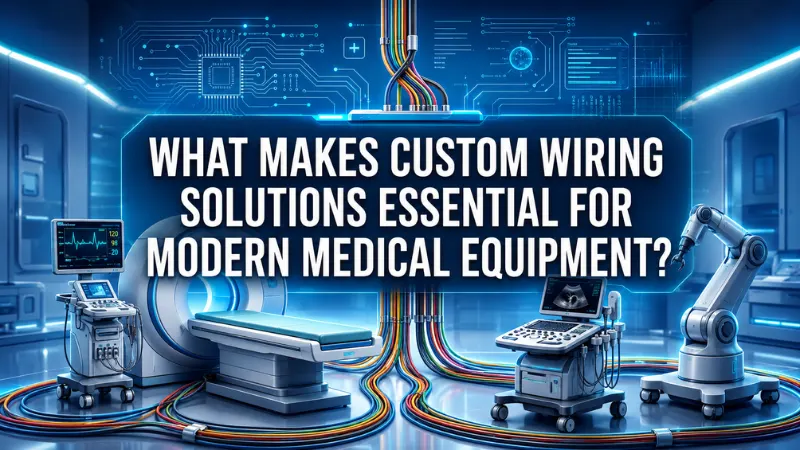
When you enter a hospital room and observe a patient hooked up to monitors, infusion pumps, and imaging systems that are all operating at the same time, it’s easy to see how the screens and readings can take center stage. Behind panels, inside casings and meticulously routed is the wiring that makes all of that possible.
And not just any wiring. Custom wiring built specifically for that machine, in that environment, for that exact purpose. Off the shelf parts may not be suitable for a lamp, or for a home appliance. Medical equipment is altogether another ball game, though. Everything is on the line, the environments are more challenging, and the margin for error is virtually none. This is why bespoke wiring services are not just a convenience but a necessity in today’s healthcare technology.
The Unique Demands of a Medical Environment
Most electronics do not have to deal with the problems that medical devices have. They are expected to work well every time, despite the following conditions:
- They are disinfected regularly with a strong disinfectant.
- They’re dragged, pushed, dropped and touched by body fluids.
- They’re operated for several hours or even days without powering down.
This is not what standard wiring is for. Insulation may deteriorate upon multiple chemical exposures. The stress of repetitive repositioning could cause the connectors to loosen. Signal integrity may be compromised if cables are laid close to other electrical equipment.
On the other hand, custom wiring is designed from the start to deal with whatever a clinical situation throws at it:
- Materials are selected to resist certain chemicals.
- Connectors are to medical grade tolerances.
- The routing is designed to avoid interference and to maximize reliability.
Precision Engineering is More Important Than You Think
Consider an MRI machine or a surgical robot. These are not only complicated machines, but systems in which dozens of subsystems must not only communicate with one another, but must avoid noise, delay, and failure, especially during real-time communications. Each wire, each connector, each junction point must do exactly what it is designed to do.
The Role of Electrical Harnesses
This is where electrical harnesses come in handy. A harness is not a knotting of wires using zip ties. This is a carefully designed assembly that bundles, routes and shields a number of conductors to consider the effects of:
- EMI (Electromagnetic Interference)
- Physical stress
- Thermal expansion
- The geometry of the box they reside in
Medical equipment is not the same when it fails it does not simply slow down, or produce an error. It may be because of a wrong signal read, a wrong dosage, or an alert that failed during a crucial moment. Harnesses are custom made to fit the layout and needs of a particular device. This means there is no guesswork, no modification of a standard product to fit, and no “good enough” because there was a ready made product that was close enough.
High Power Applications for Medical Devices
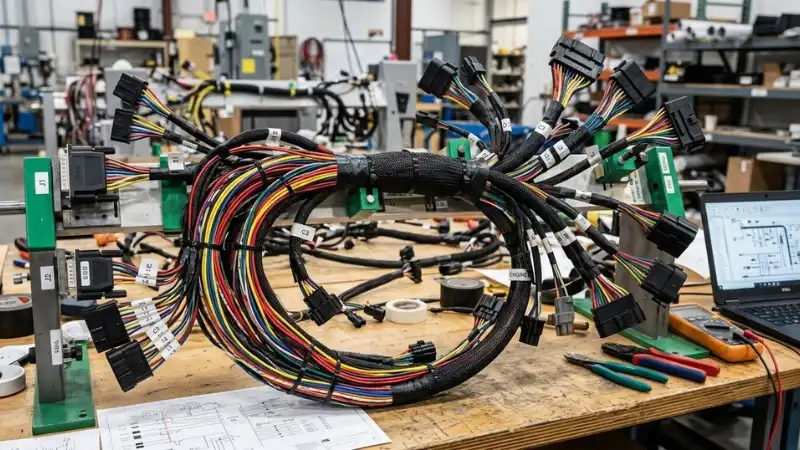
Some medical equipment is not operated by low voltage signals. Other machines, such as diagnostic imaging devices, radiation therapy devices, and some surgical equipment use much higher power levels. Serious engineering is required in order to safely route power through these systems without heat buildup, arcing or insulation failure.
That’s where high voltage cable harnesses play their role. These assemblies are:
- Designed to handle high electrical loads and still meet medical certification safety standards.
- Insulated with materials rated according to the specific voltage levels.
- Equipped with connectors used to avoid unintended contact.
- Routed so there is no risk of adversely affecting sensitive electronics or patient safety in the immediate vicinity.
The power management wiring is not an afterthought when the device is a CT scanner or a linear accelerator, used for cancer treatment. It is as well thought out as any other aspect of the system.
Regulatory Compliance Is NOT Optional
Medical devices must meet some of the most stringent regulatory requirements of any industry. That would mean:
- FDA supervision in the U.S.
- CE marking per MDR in Europe.
- IEC 60601 worldwide, which is the standard on electrical safety for medical equipment.
Custom wiring manufacturers in the medical field have a strong understanding of these standards. They don’t add compliance at the end, as a checkbox. This involves traceability of materials, recorded manufacturing, and robust quality systems to stand up to audits. If a device is to be tested for certification, the wiring must be tested as well. Because compliance is considered from the ground up, custom solutions streamline that process.
Fitting Into Tight Spaces Without Compromise
Modern medical devices continue to increase in capability and decrease in size. Examples include:
- Bag-ready portable ultrasound machines.
- Wearable cardiac monitors.
- Electronics enabled surgical instruments which are as minimally invasive as possible.
The devices are getting smaller but the functional demands remain the same. This poses an actual design problem. Custom wiring can be done to fit into spaces in which no standard product could fit. Flexible flat cables, micro coaxial assemblies, and miniaturised connectors can be specified and constructed to fit the exact dimension of the internal architecture of the device. That “flexibility” gives engineers the freedom to construct the optimum device rather than the one that is just available in a catalog.
Long-Term Reliability Is the Real Goal
A hospital cannot afford to replace a piece of equipment because of wiring failure after two years. Whether the purpose of the device is a short-term or long-term goal, customized solutions are designed with the intended lifespan of the device in mind.
The process culminates in a wiring assembly built for longevity by addressing:
- Appropriate materials for a particular operating temperature range.
- Appropriate strain relief for mechanical stress.
- Appropriate shielding for the electromagnetic environment.
That reliability also minimises downtime. Whether in a clinical setting or not, a broken machine is more than just an inconvenience; it can wreak havoc on patient care, result in delayed procedures, and lead to a chain of issues in a department. Continuity of care is the product of wiring built to last.
Wrapping It Up
Custom wiring solutions are not showy. Barely mentioned in product brochures, and not featured in press releases about a breakthrough medical technology. But they are the glue that keeps it all together literally.
Whether you’re dealing with high power loads safely or you’re integrating precision electronics into ever smaller medical devices, it’s custom wiring that makes modern medical equipment function in the real world. If you do it right you don’t even think about it. In the field of healthcare, that’s the whole idea!